


Generative artificial intelligence outputs continue to face routine rejection across global copyright offices. Rooted in continental Europe’s human-centered, personality-based legal traditions, copyright requires an author’s personal creative choices to establish original authorship. In contrast, industrial design law carries far less philosophical baggage, focusing almost exclusively on objective, commercial outcomes.
Because industrial design protection hinges on objective novelty and individual character rather than deep artistic intent, it offers a far more pragmatic and flexible legal pathway for accommodating AI-assisted product development.
At Exy Intellectual Property, we guide consumer brands, industrial manufacturers, and digital media teams in structuring hybrid AI-human design workflows, securing enforceable design registrations, and mitigating infringement risks across Malaysia, ASEAN, and global markets.
Key Legal Distinctions & Strategic Implications
Examining the structural divergence between copyright and industrial design law clarifies how enterprises can protect AI-assisted creations:
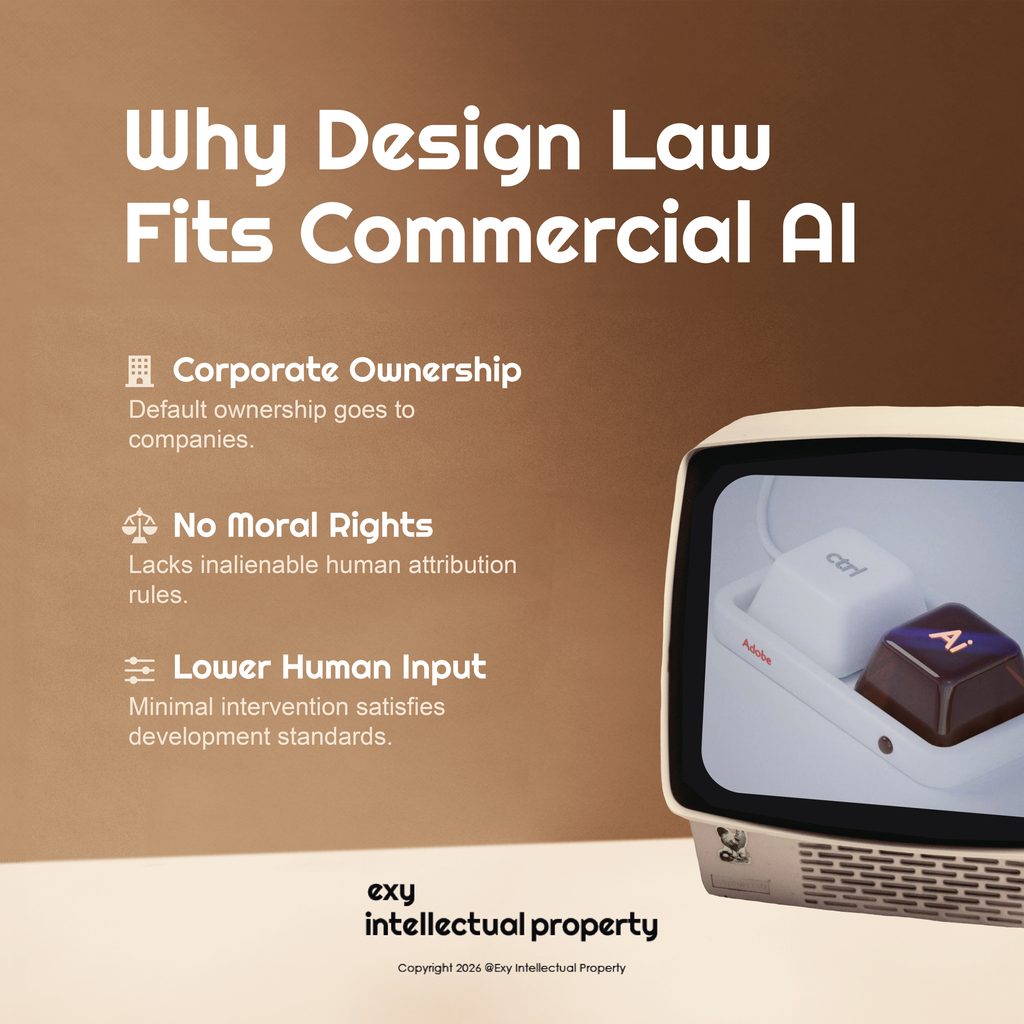
- 1. Author-Based vs. Design-Based Standards: Copyright demands strict human originality reflecting an author’s own intellectual creation. Conversely, design law prioritizes commercial utility and the external appearance of a product, frequently vesting default ownership directly in commissioning employers or corporate entities rather than individual authors.
- 2. Absence of Moral Rights: Unlike copyright—which attaches inalienable moral rights such as the right of attribution—industrial design protection focuses on the commercial development and market exclusivity of the visual appearance.
- 3. Lower Threshold for Human Input: While purely autonomous AI outputs remain excluded from protection under historical frameworks tracing back to the European Commission’s 1991 Green Paper on Industrial Design, the act of “design development” demands a substantially lower threshold of human intervention than copyright’s originality test.
- 4. Curator vs. Hybrid Approaches: Relying solely on a “curator approach”—entering text prompts and selecting an unmodified AI output—remains a legal gray area. However, adopting a hybrid approach—combining AI concept generation with hands-on manual refinement, proportional adjustments, and technical editing—firmly satisfies intellectual contribution standards for full protection.
- 5. Preventing “Design Trolling” & Automated Bulk Registrations: Because generative AI can instantly output thousands of geometric shapes and product configurations, allowing automated bulk filings across unexamined design registries risks flooding the public domain—creating corporate monopolies that expose human designers to accidental infringement lawsuits.
Recommended Action Items for Design-Led Enterprises
To secure enforceable rights over AI-assisted designs while protecting against invalidity and infringement exposure:
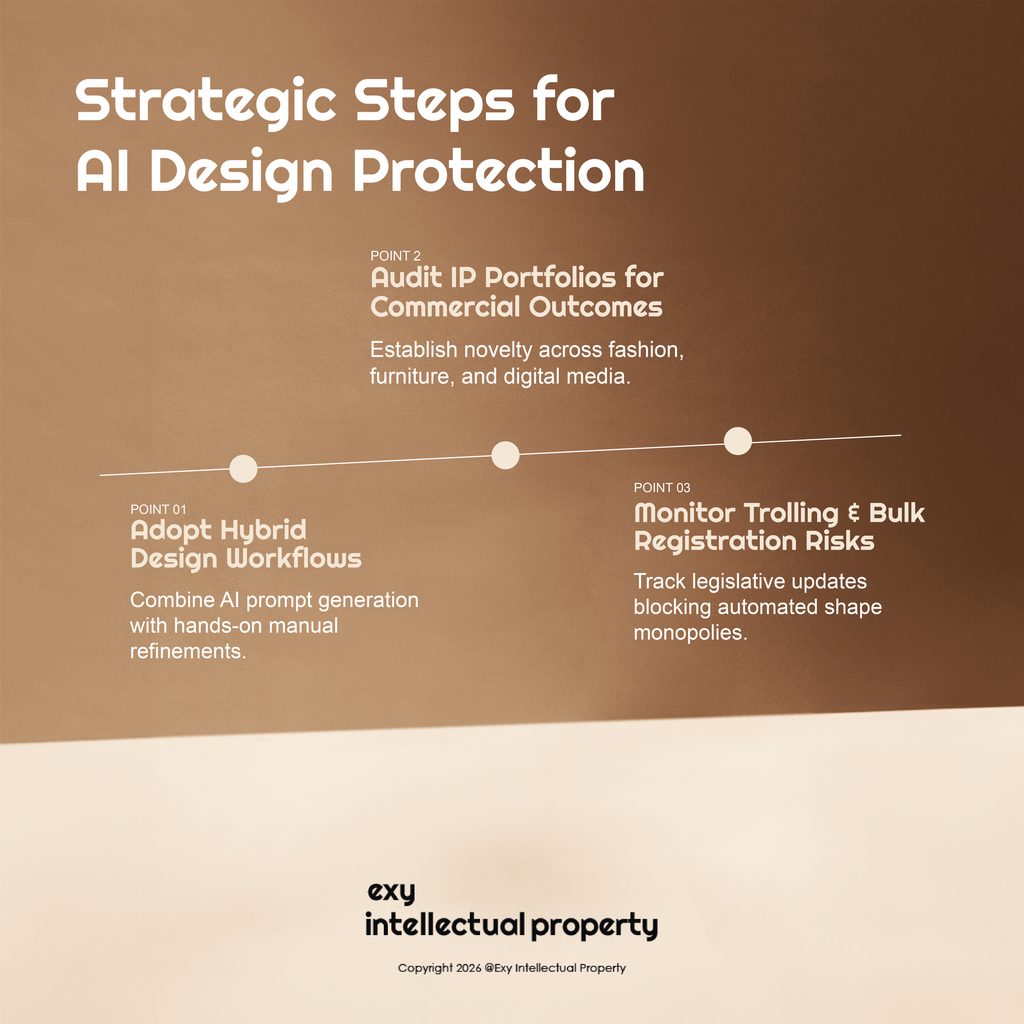
Monitor Registry Reforms on Automated Bulk Filings: Track legislative and examination updates regarding high-volume AI-generated design filings to safeguard freedom to operate against design trolling.
Adopt Documented Hybrid Design Workflows: Require product and digital designers to combine AI prompt generation with manual refinements and engineering edits, preserving dated design files that document human creative intervention.
Audit Portfolios for Objective Novelty & Individual Character: When filing across fast-moving sectors such as fashion, furniture, packaging, and digital interfaces, ensure every design produces a distinct overall impression on an informed user prior to public launch.
Conduct Pre-Filing Clearance Searches: Because many registries grant design registrations without substantive novelty examination, run prior-art checks before commercialization to avoid invalidation challenges or accidental replication of third-party designs.
#ExyIntellectualProperty #DesignLaw #IndustrialDesign #AIDesign #IPLaw #Innovation