

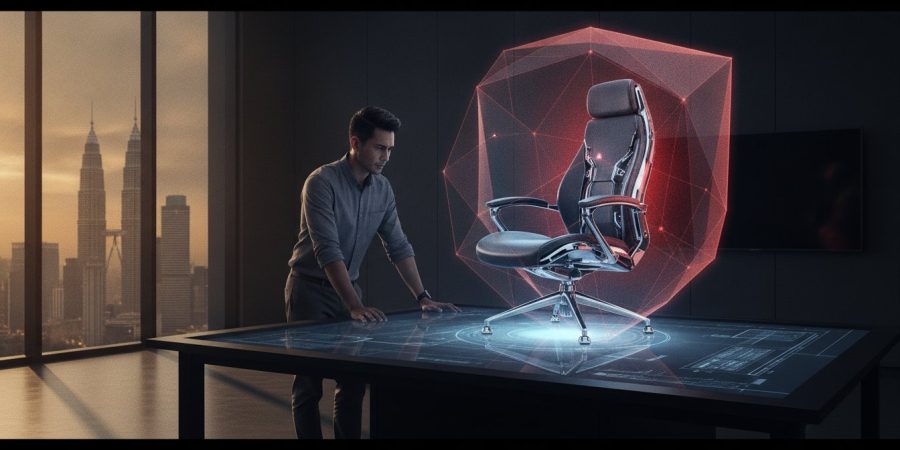
Your most successful design is more than a creative milestone. It’s a target. In a competitive market like Malaysia, the line between inspiration and blatant plagiarism is often crossed, leaving many creators feeling powerless. You’ve likely spent countless hours perfecting a silhouette or a functional aesthetic, only to worry that a competitor might replicate it before you’ve even recovered your production costs. Securing robust intellectual property protection for designers isn’t merely a legal formality. It’s a strategic move that transforms your portfolio from a collection of sketches into a suite of enforceable commercial assets.
We understand that the legal landscape can feel overwhelming. You shouldn’t have to be a legal expert to protect your livelihood. This guide simplifies the complex, clarifying exactly when to rely on Copyright and when to pursue Industrial Design registration. We’ll provide a clear roadmap for the registration process and share proven strategies to monetize your work through licensing agreements. By the end of this article, you’ll have the clarity needed to stop reacting to copycats and start proactively building a protected, profitable brand.
Key Takeaways
- Shift your focus from defensive legalities to a growth-oriented approach by implementing proactive intellectual property protection for designers.
- Protect your product’s aesthetic value by understanding the critical novelty requirements of Industrial Design registration before your official market launch.
- Recognize the specific limitations of automatic copyright for mass-produced goods to ensure your commercial assets are fully enforceable.
- Create an “IP Multiplier” effect by combining design registrations with trademarks to safeguard your studio’s long-term brand equity.
- Explore how to transform your creative work into recurring revenue through the strategic use of licensing agreements and franchising.
The Landscape of Intellectual Property Protection for Designers
Ownership. It is the defining factor that separates a successful design studio from a vulnerable one. Intellectual property (IP) is the legal framework that grants you exclusive rights over your creations. For the design industry, this isn’t just about patents for complex machinery. It covers the aesthetic appeal of a chair, the unique pattern on a textile, or the intuitive layout of a digital interface. Establishing a robust strategy for intellectual property protection for designers creates a competitive moat. This barrier prevents competitors from profiting from your original concepts without permission. Whether you are crafting bespoke furniture or developing a new wearable tech aesthetic, these rights ensure your studio remains the sole beneficiary of your innovation.
We view our role as a Business-Savvy Guardian. This means moving beyond the traditional role of a legal clerk to become a proactive partner in your commercial journey. Reactive litigation is expensive and emotionally draining. Proactive protection, however, is a controlled investment in your future. By securing your rights early, you dictate the terms of how your work is used in the marketplace. You aren’t just defending a drawing; you’re securing your studio’s commercial territory.
Why Designers Often Neglect IP Rights
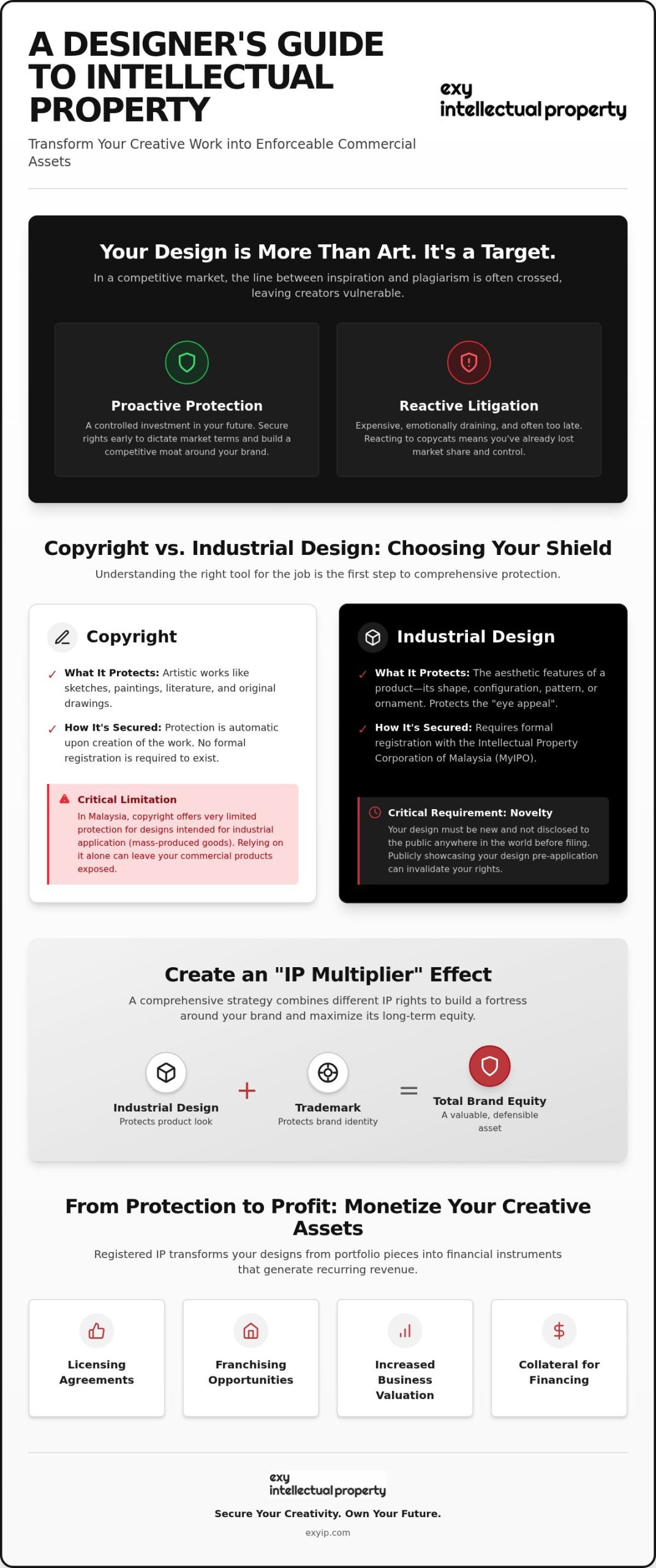
Many creators fall into the trap of believing that copyright is a universal shield. While copyright is a vital tool, it has significant limitations for physical, mass-produced goods in Malaysia. If your design is intended for industrial application, relying solely on copyright can leave you exposed once production scales. The cost of this inaction is often the total loss of your market share to copycats who can produce your designs cheaper and faster. Transitioning your mindset is essential. You aren’t just a creative worker; you are an owner of valuable intangible assets that require formal registration to remain yours.
The Economic Value of Creative Assets
Your designs are more than portfolio pieces. They are financial instruments. A well-managed IP portfolio directly increases your company’s overall business valuation, making your studio more attractive to partners or buyers. In the Malaysian financial ecosystem, registered IP can even serve as collateral for business financing and scaling efforts. Intellectual property protection for designers serves as the legal foundation for a design-led business. By treating your creativity as a commercial asset, you unlock new avenues for growth, licensing, and long-term security.
Industrial Design Registration: Securing Your Product Aesthetic
Industrial design registration focuses on the visual character of your product. Under the Malaysian Industrial Designs Act 1996, a design is defined by its features of shape, configuration, pattern, or ornament. It’s the "eye appeal" that counts. Whether you’ve developed a unique 3D contour for a consumer electronic device or a delicate 2D pattern for a textile line, this registration provides you with a legal monopoly over that specific look. This is a cornerstone of intellectual property protection for designers, ensuring that the aesthetic effort you invest isn’t simply harvested by others for free.
Timing is everything. One of the most critical aspects of intellectual property protection for designers is the novelty requirement. In Malaysia, your design must be "new" at the time of filing. This means it shouldn’t have been disclosed to the public anywhere in the world. Malaysia enforces a strict worldwide novelty rule, publicly disclosing your design before filing can invalidate your application. Under Section 12(3) of the Industrial Designs Act 1996, the 6-month grace period only covers disclosures at officially recognized international exhibitions or unlawful disclosures resulting from a breach of confidence. Public social media posts or commercial sales by the owner prior to filing generally destroy novelty. This mistake can lead to a rejected application or an invalid registration that fails to hold up in court. The registration process is methodical. It begins with a formal application, followed by an examination to ensure compliance with administrative requirements. Once passed, your design is registered and a certificate of grant is issued.
Criteria for a Registrable Design
Aesthetic appeal must be the primary focus. If a feature is dictated solely by how the product works, it cannot be protected as an industrial design; that’s the territory of patents. You must provide clear, technical visual representations in your application. These drawings or photographs define the exact scope of your protection. We also utilize the Locarno Classification, an international system, to categorize your goods accurately. To ensure your filing is accurate from the start, many creators find that conducting an Industrial Design registration novelty search with a specialist is the safest way to avoid costly filing errors.
Optimizing Protection via Black-and-White Line Drawings
While MyIPO accepts high-resolution photographs, submitting clean black-and-white line drawings is generally preferred by IP specialists. Color photographs limit your legal monopoly strictly to the specific color scheme and surface finish shown. In contrast, line drawings secure protection over the underlying shape and configuration regardless of future color variations, providing a broader shield against copycats.
Categorization via Locarno Classification
When filing Form ID1 with MyIPO, your application must specify the appropriate class and sub-class under the Locarno Classification, an international taxonomy system for industrial designs. Selecting the precise Locarno classification ensures your design is correctly indexed in the registry, preventing formality objections during examination.
The Duration and Scope of Design Rights
Exclusivity requires maintenance. A registered design in Malaysia lasts for an initial five years. You can renew this protection for four additional five-year terms, providing a total of 25 years of exclusivity. It’s vital to remember that IP rights are territorial. A Malaysian registration protects you within our borders, but you’ll need separate filings if you plan to sell in international markets. For a deeper dive into the technicalities of this process, see our Design Patent Registration in Malaysia: A Business Leader’s Reference (2026).
Copyright vs. Industrial Design: Navigating Automatic and Registered Rights
Copyright is often misunderstood in the creative industry. Many creators believe that because copyright exists automatically upon the creation of a work, they are fully shielded from infringement. This is a risky assumption for those selling physical products. While copyright protects your original sketches and artistic expressions, it doesn’t provide a monopoly over a physical product’s shape once it enters mass production. This is why intellectual property protection for designers must be a multi-layered strategy. Relying on "unregistered rights" is a commercial gamble. Proving ownership and the exact date of creation in a Malaysian court without formal documentation is notoriously difficult and prohibitively expensive. You essentially force your business into a resource-draining battle over evidence rather than focusing on your next innovation. To fully understand the scope and limitations of your automatic rights, reviewing a comprehensive guide to copyright infringement Malaysia rules under the Copyright Act 1987 is an essential step for every designer.
The Power of Copyright Voluntary Notification
In Malaysia, you can significantly strengthen your position through Copyright Voluntary Notification. This process involves submitting a formal declaration and a copy of your work to MyIPO. It doesn’t "grant" the right, as copyright is inherent, but it creates a legal presumption of ownership. If a competitor copies your digital interfaces or brand collateral, you have a "prima facie" case ready. This shifts the burden of proof to the infringer to disprove your claim. Voluntary notification is the most efficient way to establish a public record of your copyright. It provides the security needed for digital assets, website layouts, and early-stage sketches that aren’t yet ready for industrial registration. It transforms a vague, automatic right into a tangible legal asset that we can use to defend your studio’s interests.
When Design Rights Overlap
There is a specific tipping point where an artistic work transforms into an industrial product. Consider a designer creating a bespoke lighting fixture. The initial hand-drawn concepts and the "artistic" prototype are protected by copyright. Under Section 7(2) of the Copyright Act 1987, once an artistic work is industrially mass-produced (applied to more than 50 articles), copyright protection for the physical shape ceases, making formal Industrial Design registration essential to maintain legal exclusivity. Using both frameworks creates a comprehensive shield. You protect the "art" with copyright notification and the "product" with design registration. This dual approach ensures that even if one right is challenged, your commercial interests remain intact. It’s about building layers of security that make it difficult for competitors to replicate your success. By combining these rights, you create multiple obstacles for anyone attempting to profit from your creativity without authorization.
Building a Comprehensive IP Strategy for Your Design Business
Strategic synergy. This is the core of a mature intellectual property strategy. Instead of viewing registrations as isolated tasks, successful studios use an "IP Multiplier" approach. This involves layering different types of protection to create a cumulative shield around your work. While your product’s appearance is secured via industrial design, your brand reputation lives in your trademark, and your technical breakthroughs are anchored by patents. Effective intellectual property protection for designers requires this holistic view to ensure no part of your commercial value is left exposed.
Confidentiality is your first line of defense. Before any formal filing occurs, you must manage the prototyping phase with care. Using non-disclosure agreements (NDAs) with manufacturers and partners prevents premature disclosure. This simple step preserves the novelty required for both industrial design and patent registrations. By the time you’re ready for market, your legal groundwork should already be in place. We help you identify which assets drive your revenue and apply the appropriate legal tools to secure them. If you want to ensure your strategy is airtight, you can consult our legal advisory team to review your current portfolio.
Trademarks for Creative Branding
Your studio name is your most valuable long-term asset. While individual designs change with seasons, your brand identity remains constant. Protecting your logo and name ensures that competitors cannot trade on your hard-earned reputation or confuse your customers. A registered trademark is the heart of any successful franchising model, allowing you to scale your design methodology while maintaining legal control over your brand equity. For a detailed roadmap on securing your brand identity, consult our Trademark Registration in Malaysia: 2026 Strategic Guide.
Functional Innovation and Design
Sometimes a design does more than look good; it works better. If your product includes a technical improvement, a unique mechanical process, or a functional breakthrough, you are moving beyond aesthetic design into the territory of a "Utility Innovation" or a full patent. Distinguishing between a design and a functional invention is critical for your filing strategy. A patent novelty search is an essential part of the product development cycle. It ensures your innovation is truly unique before you invest in mass manufacturing. To explore how to protect your technical breakthroughs, see our Strategic Patent Filing Services in Malaysia: A Business Leader’s Guide (2026).
Commercializing Your Creative Assets: From Protection to Profit
Protection is just the starting line. The true objective of securing intellectual property protection for designers is to transform your creative output into a sustainable revenue engine. Once your designs are legally anchored through registration, they cease to be mere drawings and become tradeable commodities. You can sell them, lease them, or use them to secure capital. This shift from a service-based model to an asset-based model is how design studios scale without proportionately increasing their manual labor. By treating your IP as a commercial product, you dictate the terms of your market presence rather than simply reacting to competitor movements.
Enforcement is the final pillar of this commercial strategy. You don’t always need to resort to full-scale Intellectual Property Litigation to protect your interests. Often, the mere existence of a registered Industrial Design or a Copyright Voluntary Notification is enough to settle disputes through mediation or cease-and-desist actions. Understanding how to identify and respond to industrial design infringement in Malaysia is essential before escalating to litigation. We advise a strategic approach to enforcement that prioritizes your studio’s resources. The goal is to stop the infringement and recover lost value without exhausting your operational budget on unnecessary legal battles.
Licensing Your Designs to Manufacturers
Licensing is the most direct path to passive income for designers. Through formal Licensing Agreements, you grant a manufacturer the right to produce and sell your design in exchange for compensation. You might choose a flat-fee model for an immediate cash injection or a royalty-based structure for long-term recurring revenue. Registered designs are significantly more attractive to manufacturing partners because they provide a "clean" title of ownership. A partner is far more likely to invest in production molds and marketing if they know the design is protected from immediate imitation by third parties. Every contract should include clear clauses regarding the geographical scope, duration, and quality control standards to preserve your brand’s integrity.
IP Valuation and Growth Strategy
If you’re looking to attract investors or eventually exit your business, you must understand the financial weight of your portfolio. Intellectual Property Valuation involves assessing the market, cost, and income potential of your registered assets to determine their fair market value. This figure isn’t just for show; it’s a critical component of your company’s balance sheet. In the Malaysian market, high-value IP can even unlock Intellectual Property Financing, allowing you to use your intangible assets as collateral for business loans. At Exy IP, we act as your strategic partner in this journey. We don’t just file paperwork; we provide the commercialization strategy and valuation expertise needed to ensure your intellectual property protection for designers translates into measurable business growth.
Transforming Creativity into Commercial Capital
Your creative work is the engine of your business. Leaving it unprotected is a risk your studio shouldn’t take. We’ve explored how a proactive approach to intellectual property protection for designers moves your work from the drawing board to the balance sheet. By layering Industrial Design registration with Copyright Voluntary Notification, you create a robust shield against copycats. This legal foundation isn’t just about defense; it’s the catalyst for licensing, franchising, and increasing your firm’s overall valuation.
At Exy IP, we specialize in helping Malaysian designers navigate these complexities with clarity and confidence. Our team provides technical expertise in Industrial Design registration, specialized IP valuation, and strategic consultancy for licensing. We’re committed to ensuring your innovation remains your exclusive commercial advantage. Secure your creative future with Exy IP’s expert advisory. Your next great design deserves the security of professional protection. Let’s build a resilient future for your studio together.
Frequently Asked Questions
Can I copyright a piece of furniture I designed?
Yes, your original sketches and the artistic prototype of a furniture piece fall under copyright. However, copyright doesn’t protect the functional shape of mass-produced items in Malaysia. For commercial furniture, you must pursue Industrial Design registration to prevent competitors from replicating the physical form. This dual approach is a hallmark of effective intellectual property protection for designers, ensuring both the art and the product are secured.
How is an industrial design different from a patent?
The distinction lies in form versus function. Industrial design registration protects the ornamental or aesthetic aspects of an article, such as its shape, pattern, or color. A patent, conversely, protects technical inventions and functional improvements. If your chair looks unique, register the design. If it uses a new mechanical reclining system, you should file for a patent to protect that specific technical innovation.
What happens if I publish my design online before registering it?
Publicly disclosing your design before filing an application can be a costly mistake. In Malaysia, a design must be new and original to qualify for registration. Posting your work on social media or displaying it at a trade show before submitting your application to MyIPO destroys its novelty. This disclosure can lead to your application being rejected or your registered rights being successfully challenged by a competitor.
How long does industrial design protection last?
In Malaysia, industrial design protection can last for a maximum of 25 years. The initial registration is valid for five years from the filing date. You can then renew the protection for four consecutive periods of five years each. Keeping your renewals up to date is essential for maintaining your market monopoly and ensuring your design remains a protected commercial asset throughout its profitable lifecycle.
What is the benefit of a copyright voluntary notification for a designer?
Copyright voluntary notification provides you with a certificate from MyIPO that serves as prima facie evidence of ownership. While copyright is automatic, proving when and by whom a work was created is difficult in a legal dispute. This notification simplifies the enforcement process for your sketches, digital assets, and brand collateral. It’s a proactive step that strengthens your position when dealing with potential infringers or negotiating licensing deals.
Can I protect a digital interface or app design?
You can certainly protect digital assets. Graphical User Interfaces (GUIs), icons, and unique app layouts are registrable as industrial designs in Malaysia. Additionally, the underlying code and the artistic elements of the interface are protected by copyright. Utilizing intellectual property protection for designers in the digital space ensures that your user experience and visual identity aren’t replicated by competing developers.
Do I need to register my designs in every country where I sell?
Intellectual property rights are strictly territorial. A registration with MyIPO only grants you protection within Malaysia. If you plan to manufacture or sell your designs in international markets, you must file for protection in each specific country. We often recommend using international treaties to streamline this process, allowing you to secure your rights across multiple jurisdictions through a centralized application system.
What should I do if I find a copycat selling my design?
First, gather clear evidence of the infringement, including screenshots, receipts, and marketing materials. Avoid contacting the copycat directly without professional advice. Instead, consult with a legal advisor to draft a formal cease-and-desist letter. This professional approach often resolves the issue quickly. If the infringement continues, your registered design or copyright notification provides the necessary foundation for pursuing an industrial design infringement claim in Malaysia to recover damages.