


A licensing agreement Malaysia businesses rely on should grant permission without putting ownership or commercial plans at risk. The key is to define what the other party may do, which rights remain under your control and what happens if the arrangement changes or ends.
Granting a license does not, by itself, mean giving up ownership. It gives another party permission to use intellectual property under agreed terms. Vague wording about permitted uses, exclusivity, territory, duration or payments can leave both parties uncertain about their rights and responsibilities.
This guide explains the commercial purpose of a license and the terms to clarify before granting or accepting one. You’ll learn how to match the scope of rights to your plans, set practical boundaries and consider quality controls for trademark use. It also covers when an arrangement may need closer review, including where it could resemble a franchise, and how specialist Malaysian IP advice can help align the terms with the asset and its intended use.
Key Takeaways
- A licensing agreement Malaysia businesses consider should identify the intellectual property and describe permitted uses clearly.
- Clarify exclusivity, territory, duration, payment structure and limits on use before signing.
- A license grants permission to use intellectual property. Compare its effect with an assignment to understand the difference in ownership.
- Check that the party granting rights owns the asset or has authority to license it, and ensure the agreement reflects your intended business use.
- Specialist IP guidance can help align licensing terms with the asset and your wider commercial objectives.
What is a Licensing Agreement in Malaysia and its Uses?
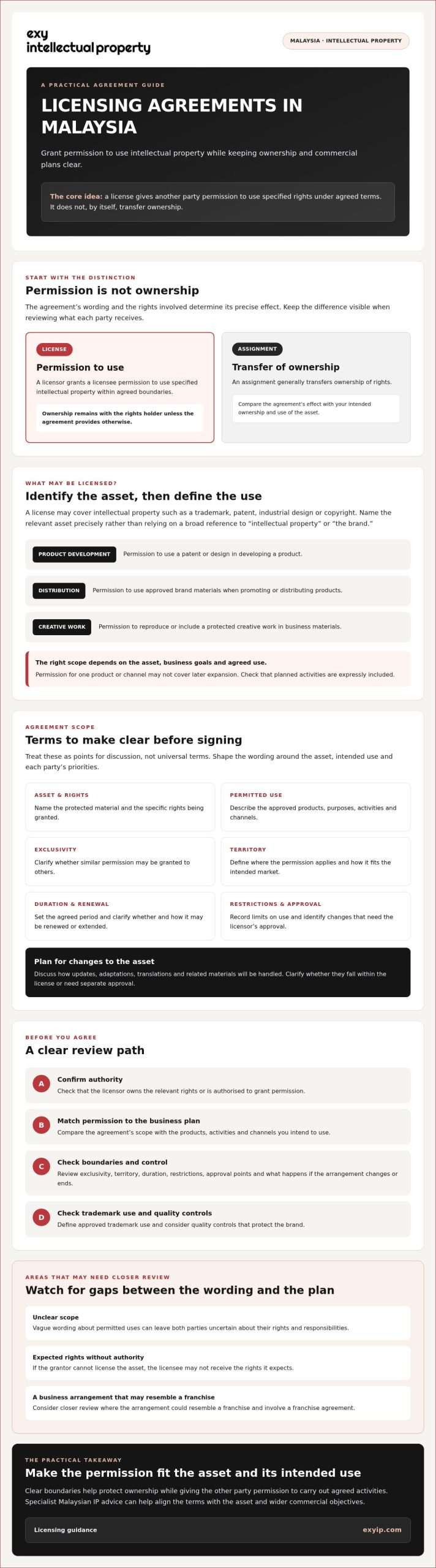
A license is permission from a licensor to a licensee to use specified rights under agreed conditions. In a licensing agreement Malaysia businesses use, the rights may relate to intellectual property such as a trademark, patent, industrial design or copyright. The agreement defines the boundaries of permitted use. It does not, by itself, make the licensee the owner.
That distinction matters when deciding what to sign. An assignment generally transfers ownership of rights, while a license grants permission to use them. The precise effect depends on the agreement’s wording and the rights involved. For a foundational overview, see this legal definition of a license, including its application to intellectual property.
Who grants a license, and who receives it?
The licensor grants permission. The licensee receives it. Before agreeing, both sides should establish that the licensor owns the relevant rights or is authorised to grant permission. If not, the licensee may not receive the rights it expects, and the owner’s interests may not be properly protected.
For example, a business that owns a brand may permit a manufacturer to use its trademark on specified products. The manufacturer is the licensee, but permission to use the mark does not make it the brand owner. The parties should name the mark and define the approved products and uses rather than rely on a general reference to “the brand.”
When might a Malaysian business consider licensing?
Licensing can be useful when another party needs permission to use protected intellectual property in a commercial activity. Depending on the asset and the parties’ plans, a license may support product development, distribution or brand use.
- Product development: A business may allow another party to use a patent or design in developing a product.
- Distribution: A rights holder may permit a business partner to use approved brand materials when promoting or distributing products.
- Creative work: A business may seek permission to reproduce or include a protected creative work in its materials.
These are examples, not standard terms that apply to every license. The right scope depends on the asset, business goals and what the parties agree. A license for one product or use may not cover a later expansion into new products or channels. Identify the planned activity first, then check that the permission expressly covers it. The sections below explain other terms to review.
Which Terms Should a Malaysian Licensing Agreement Define?
Use this checklist to guide discussions before signing. These are negotiation points, not universal legal requirements. The right wording depends on the intellectual property, intended use and each party’s priorities. In a licensing agreement Malaysia businesses negotiate, clear definitions help both sides understand what the permission covers and where its boundaries lie.
How should the agreement define rights and permitted use?
Name the licensed asset precisely, then describe how the licensee may use it. A broad reference to “intellectual property” can leave room for different interpretations. Specify relevant products, sales or distribution channels, promotional activities and other permitted purposes. Record restrictions too, including uses that require the licensor’s approval.
If the asset may change, discuss how updates, adaptations, translations or related materials will be handled. Clarify whether they fall within the license or require separate approval. This helps avoid a common mismatch: one party assumes a permission covers modified materials, while the other expects to approve each change.
How do exclusivity, territory, duration, and payment fit together?
Consider these terms as a group, in light of the commercial plan. A license may be exclusive within a defined area or non-exclusive, allowing the licensor to grant permission to others. Neither model is automatically right. Check how exclusivity fits the territory, intended market and duration, and whether the arrangement leaves room for the licensor’s existing or future activities.
- Asset and scope: Identify the protected material and the rights being granted.
- Products and channels: State what the licensee may make, sell, distribute or promote using the asset.
- Exclusivity and territory: Define whether others may receive similar permission and where the license applies.
- Duration and renewal: Set the agreed period and discuss whether, and how, it may be renewed or extended.
- Payment and records: Agree on the payment structure, any royalty basis, reporting frequency and information each party must provide. The parties may also negotiate an audit process to check reported figures.
- Quality controls: For a trademark license, consider how products or services using the mark will meet agreed quality standards, and how concerns will be raised and addressed.
Test the terms against realistic scenarios. For example, consider whether the licensee could sell through a new channel, or whether the licensor could appoint another partner in the same territory. Reporting provisions should also provide information suited to the payment structure the parties agree on.
Exy Intellectual Property provides licensing agreement support to help businesses assess agreement terms alongside their wider IP and commercial objectives.
Does a Licensing Agreement Transfer Ownership or Limit Your Control?
A license grants permission to use defined rights. It does not automatically transfer ownership, but its practical effect depends on the agreement’s wording and the rights involved. Scope, exclusivity, sublicensing and termination terms can all affect how much control the owner retains during the arrangement.
License or assignment: what is the practical difference?
A license allows a party to use specified intellectual property under agreed terms. An assignment may transfer rights from one party to another, subject to applicable law and the document’s wording. Do not rely only on the label used in a contract. Read the operative terms to understand which rights are granted or transferred and whether any limits apply.
| Point to compare | License | Assignment |
|---|---|---|
| Basic effect | Permission to use defined rights under agreed terms | May transfer rights to another party |
| Owner’s position | May remain the owner, while the licensee receives the stated permission | May change, depending on the rights transferred and the agreement |
| Key review question | What uses, limits and conditions apply? | Which rights are being transferred, and what is retained? |
This is a high-level distinction, not a conclusion about any particular document. If it is unclear whether a proposed licensing agreement Malaysia arrangement grants permission or transfers rights, seek specialist review before signing.
Which clauses can shape ongoing control?
Even when ownership stays with the licensor, contract terms can affect day-to-day control. Check whether the licensee may grant sublicenses and whether the licensor’s approval is required first. For a trademark, consider how quality standards will be maintained and how the licensor can review products or services using the mark. If the licensee may adapt materials, define permitted changes and any approval steps.
- Scope and exclusivity: Check which uses are permitted and whether similar permission may be granted to other parties.
- Improvements and new work: Clarify how the agreement treats modifications, developments or materials created during the relationship. Ownership questions may need tailored legal review.
- Ending the arrangement: Review what happens when the agreed term expires or a party terminates the agreement, including whether use must stop and how existing materials or products will be handled.
Read these clauses together. A broad right to sublicense, modify or continue using material after termination can have different practical consequences from a narrowly defined permission. A Malaysian IP professional can assess the wording in context. This general guide is not a substitute for advice on a specific agreement.
How Can You Review a Licensing Agreement Before Signing in Malaysia?
A structured review helps you test whether the proposed permission fits the asset and your business plans. Use these steps to identify issues for discussion, not as a substitute for advice on a specific agreement.
- Identify the intellectual property. Specify the asset, such as a trademark, patent, industrial design or copyright work. Check that the agreement describes the rights and intended uses clearly enough to distinguish them from other assets.
- Confirm who controls the rights. Ask for evidence that the proposed licensor owns the relevant intellectual property or has authority to grant permission. Check whether existing agreements, co-owners or other third-party interests could affect the proposed use.
- Match the permission to your plans. Compare the permitted uses, products, channels, territory and duration with the business activity you intend to carry out. Identify any important use the wording excludes or leaves unclear.
- Understand the commercial arrangements. Review the payment structure and related reporting provisions against the planned business model. Raise questions about assumptions, calculations or responsibilities that are not clear to both parties.
- Check how the relationship may change or end. Review provisions on amendments, approvals, sublicensing and termination. Consider what happens to continued use and related materials when the arrangement expires or ends.
- Resolve open points before approval. Ask for unclear or high-impact terms to be explained and settled in writing. Seek professional review if the arrangement involves complex rights, cross-border use or wording whose effect is uncertain.
Which Malaysian legal details need specialist verification?
The type of intellectual property can affect which legal issues deserve attention. Depending on the asset, ask a qualified Malaysian IP professional to check the current relevance and application of the Trademarks Act 2019, Patents Act 1983 or Copyright Act 1987. Treat these as prompts for verification, not a conclusion that a particular Act applies to every licensing agreement Malaysia businesses consider.
Do not assume that a specific clause, registration or recordal is required based only on a template or general guide. Ask an adviser to confirm whether a formal step applies to the rights and transaction in question. This can be particularly useful where the agreement covers more than one type of IP or use across borders.
For help assessing how agreement terms fit the asset and intended use, discuss licensing agreement support with Exy Intellectual Property.
How Can Exy Intellectual Property Support Your Licensing Agreement?
A licensing agreement should make sense for both the intellectual property being licensed and the business plan behind it. Exy Intellectual Property provides Licensing Agreements, IP-focused Legal Advisory, IP strategy and commercialization advice. This perspective can help businesses consider how proposed rights, limits and responsibilities relate to the asset and its intended use. Advice should be tailored to the circumstances of the arrangement.
When can specialist IP input add value?
Specialist input may be useful when the parties are uncertain about who controls the rights, which uses to permit or whether an exclusive arrangement fits their plans. Advice can also help connect a proposed license with existing IP protection and future commercialization objectives, rather than treating the contract as a standalone document.
The relevant considerations depend on the asset. A trademark, patent, industrial design or copyright work may raise different questions about scope and use. Valuation or registration advice may be relevant where the business decision calls for it, but not every licensing matter requires either. If the proposed relationship includes the right to replicate a brand’s business model, consider whether franchise-specific guidance, including Exy’s Franchising Consultancy, is relevant.
What should you prepare for an initial discussion?
Bring information that helps an adviser understand the rights and commercial purpose involved. Preparing these details can make the discussion more focused.
- The agreement: Share the current draft, if one exists, and identify clauses you find unclear or significant.
- The asset: Describe the intellectual property involved and any available information showing who owns or controls it.
- The intended use: Explain what the other party wants to do with the asset, including relevant products, channels or activities.
- Your priorities: Note the proposed territory, duration, exclusivity and payment arrangements, along with any terms you want to negotiate.
- Open questions: List concerns about ownership, approvals, sublicensing, termination or how the license fits your wider IP strategy.
These details give the discussion a practical starting point and can help identify where further review may be appropriate, particularly if rights or commercial scope remain uncertain. A licensing agreement Malaysia business owners consider should support the intended use while fitting the longer-term objectives for the asset.
To discuss your IP licensing needs with Exy Intellectual Property, contact the firm about licensing support.
Make Your Licensing Decision with Clarity
A well-planned licensing agreement Malaysia businesses consider should define the permission being granted and how it fits the asset’s intended use. Clear terms on scope, exclusivity, territory, duration and payment help both parties understand the arrangement. A license grants permission, but the agreement’s wording shapes its practical effect. Check ownership, authority to license and provisions that affect ongoing control.
Review the document against your business plans, and seek specialist input if rights, responsibilities or legal details remain uncertain. Exy Intellectual Property provides Licensing Agreements, IP strategy, commercialization, valuation and legal advisory services. This IP-focused perspective can help connect agreement terms with wider commercial objectives where relevant.
If you’re assessing or structuring a license, discuss your IP licensing needs with Exy Intellectual Property.
Frequently Asked Questions
What is a licensing agreement in Malaysia?
A licensing agreement in Malaysia records permission from a licensor to a licensee to use specified intellectual property under agreed terms. It can define the asset and boundaries of use, including scope, duration and territory, alongside other matters the parties negotiate. Its effect depends on the wording and applicable law, so do not assume a general template fits every transaction. Seek tailored professional advice if you need to understand a particular document.
Does a licensing agreement transfer ownership of intellectual property?
Usually, a license concerns permission to use defined rights, while an assignment may transfer rights from one party to another. The document’s label alone does not establish its legal effect. The wording, asset and applicable law all matter. If ownership, ongoing control, sublicensing or rights after termination are unclear, have the document reviewed before signing. Licenses can be structured differently, so do not assume that one agreement’s terms apply to another.
What should a Malaysian licensing agreement include?
A Malaysian licensing agreement may address the asset, permitted uses, exclusivity, territory, duration, payment structure, quality controls, reporting and termination. These are common drafting topics, not clauses that must appear in every agreement. For example, a trademark license may need terms about quality standards, while another type of IP arrangement may raise different concerns. Choose terms that fit the asset, commercial arrangement and objectives of both parties.
Can a licensing agreement be exclusive or non-exclusive?
Yes. An exclusive arrangement can limit the licensor’s ability to grant the defined rights to others, while a non-exclusive arrangement may allow additional permissions. The actual effect depends on the agreement’s scope and wording. Specify the asset, territory and permitted uses, and clarify any rights the licensor retains. Exclusivity can affect future business plans, so consider its commercial implications and seek advice before committing to terms that may restrict other options.
How long should an intellectual property license last?
There is no standard duration for every intellectual property license. The term should fit the asset, commercial purpose and parties’ plans. Consider whether renewal is possible, how early termination works and what happens to existing products, materials or permitted use when the arrangement ends. Read the duration and exit provisions together. If the term could affect ongoing business activity or future use of the IP, ask a qualified professional to review those provisions.
Can a licensee let another business use the licensed intellectual property?
A licensee should not assume it can let another business use the intellectual property. Sublicensing depends on the rights granted and the agreement’s wording. The parties can clarify whether sublicensing is allowed, who may receive permission, which uses are covered and what controls apply. They should also address responsibility for a third party’s conduct. Clear terms can prevent expectations from diverging, so have the relevant clauses reviewed before granting or relying on sublicense rights.
When should a business get legal advice on a licensing agreement?
Consider specialist advice if ownership or authority to license is uncertain, the rights are exclusive, the arrangement spans markets or the terms could have significant business consequences. An IP adviser can help assess the rights alongside your commercial objectives. A qualified Malaysian professional should verify how the law applies to the specific agreement. This guide offers general information, but it cannot determine the legal effect of a particular contract or replace tailored advice.