


What if a franchise disclosure document looks complete but differs from the contract you’re being asked to sign? Understanding franchise disclosure document requirements Malaysia involves more than checking whether a document exists. For prospective franchisees and franchisors, the information needs to be timely, clear and consistent with the proposed arrangement. Under Malaysia’s Franchise Act 1998, as amended, a franchisor must provide the disclosure document at least 10 days before the franchise agreement is signed.
It’s reasonable to want clarity on what the document should cover and which obligations apply to your role. The disclosure document provides information to help prospective franchisees assess the opportunity. The franchise agreement sets out the parties’ contractual rights and responsibilities. Because the documents serve different purposes, check carefully for gaps or conflicting terms before proceeding.
This guide explains how to review the documents against current Malaysian requirements, compare disclosure information with the proposed agreement, and assess information about investment, fees, support, business operations and intellectual property. It also explains how franchising consultancy and specialist legal or intellectual property advice can help you consider both compliance and the commercial decision.
Key Takeaways
- Use franchise disclosure document requirements Malaysia as a starting point, then verify the applicable statutory and official guidance for your situation.
- Check that the parties, franchise concept, proposed territory and operating model are clearly described.
- Compare the disclosure information with the franchise agreement, especially where information is meant to become a contractual commitment.
- Keep a review record of document versions, dates, appendices, schedules and referenced materials.
- Assess how trademark rights, license scope and operating materials fit the franchise model, and seek specialist advice where questions arise.
What Malaysian franchise disclosure requirements are meant to clarify
A franchise disclosure document gives a prospective franchisee information about the franchisor and the proposed franchise opportunity before the parties enter into a franchise agreement. It should help the reader understand what is being offered and identify issues that need further examination. A general overview of a Franchise Disclosure Document can explain the concept, but Malaysian legal requirements must be assessed under Malaysia’s own framework.
The phrase “franchise disclosure document” is commonly used for this information. Verify the exact statutory terminology and applicable requirements against the current Franchise Act 1998, its regulations and official Malaysian guidance. Requirements and procedures can change. A general checklist can organise a review, but it cannot certify that a document complies or that the opportunity is suitable.
How disclosure fits into a Malaysian franchise transaction
Disclosure supports an informed business decision, but it does not replace due diligence or the contract. It may help a prospective franchisee understand the franchisor, proposed business model, support and financial expectations. Rather than assume that a familiar layout is sufficient, assess the material provided against current official requirements.
Separate background information from contractual commitments. A description of how the business generally operates can explain the opportunity, while the franchise agreement sets out the parties’ rights and obligations. If an explanation in the disclosure appears inconsistent with a proposed contract term, record the difference and resolve it before relying on either document.
Who should use this requirements checklist
Both sides have reason to review disclosure, but their priorities differ. A franchisor preparing the information should focus on accuracy, clarity and consistency with the proposed franchise model and agreement. A prospective franchisee should assess whether the information answers practical questions about the offer and supports an informed decision. The relevant checks may also depend on the parties and circumstances of the transaction.
Use franchise disclosure document requirements Malaysia as a prompt to check the applicable rules, not as proof that a particular document is complete. A checklist helps organise questions, but it cannot determine by itself whether every legal duty has been met or whether the commercial terms suit you.
Pay attention to material questions that remain unanswered. If the operating model is unclear, or the proposed arrangement differs from the disclosure, record the issue and have it reviewed. Franchising consultancy and legal advisory can connect document review with the commercial decision. Intellectual property advice can help assess questions about brand rights or a license that shapes the proposed model.
What to check in a franchise disclosure document in Malaysia
Start with the current rules, not assumptions about what every franchise document must contain. Check the Franchise Act 1998, applicable regulations and current Malaysian official guidance before treating any list of headings as complete. The Malaysian Franchise Act 1998 overview can provide background, but it should not replace checking current local requirements. The categories below are practical review prompts, not a legal certificate of compliance.
Read the material as a connected account of the proposed offer. Check whether it identifies the franchisor and proposed franchisee, describes the franchise concept, defines the proposed territory and explains the operating model. If the business description refers to a particular format or range of activities, compare it with the draft franchise agreement and its schedules. Record any mismatch rather than assuming it is only an editorial difference.
Business model, parties, and operating obligations
Review how the business is expected to work in practice. Look for a clear explanation of the operating model, each party’s role, any stated territory and the obligations involved in running the franchise. Then compare those descriptions with the draft agreement. Does the contract set out the same scope, or does it add limits, conditions or responsibilities that the disclosure does not explain?
Keep general descriptions separate from binding terms. For example, a statement about the franchisor’s usual approach to training may not establish a contractual promise. Check whether the agreement addresses the commitment and its limits. The key question is not only what the disclosure says, but where the enforceable obligation appears.
Financial, support, and risk information
Find the explanations of initial and ongoing payment obligations, training, operational support and any financial performance information. Check whether each explanation is specific enough to show what is included, what conditions apply and what remains uncertain. Don’t rely on an attractive headline or general assurance if the documents leave assumptions or limitations unclear.
- Fees and other obligations: identify what each payment relates to, when it applies and where the agreement describes the obligation.
- Training and support: note what is described, who provides it and whether the agreement defines its scope or limits.
- Performance and risk: check the period, operating assumptions or conditions accompanying any performance information, and record risks that could affect the model.
- Restrictions and changes: flag limits on operating choices, territory, renewal or termination for comparison with the contract.
Mark information that is missing, ambiguous or inconsistent, then request written clarification before making a decision. Don’t assume a disclosure statement creates a contractual right unless the agreement or applicable law supports that conclusion. For a structured review that connects document issues with the commercial model, franchising consultancy advice can help you frame questions for specialist review.
Disclosure document vs franchise agreement: compare before proceeding
The documents are related, but they serve different purposes. The disclosure document helps a prospective franchisee understand the offer. The franchise agreement sets out the terms the parties propose to accept. Check whether the picture presented in the disclosure is consistent with the rights and responsibilities in the draft contract. Don’t assume a statement in one document has the same legal effect as a clause in the other.
Disclosure document
Purpose: Present information about the franchisor and proposed franchise opportunity.
Information to compare: The parties, brand, business model, proposed territory, operational expectations, support and other material details.
Review question: Does the information give a clear, consistent account of what is being offered?
Franchise agreement
Purpose: Set out the parties’ contractual rights, duties and agreed terms.
Terms to compare: The parties, scope of the franchise, territory, operating duties, payment obligations, intellectual property permissions and other material conditions.
Review question: Does the proposed contract reflect the offer as described, and are its obligations clear?
This comparison is a review aid, not a conclusion about legal compliance or the effect of a particular clause. A term’s legal status depends on the applicable law and the documents as a whole. Check current Malaysian requirements and obtain qualified advice where interpretation matters. Assess the franchise disclosure document requirements Malaysia separately from the terms the parties would agree to in the contract.
Which details should match across both documents?
Start with the details that define the deal: the parties’ names and identities, brand references, proposed territory and description of the business model. Then compare the permissions to use the brand and related intellectual property. If the disclosure describes use of a trademark in a stated territory or business activity, check whether the draft agreement’s license language sets out the same scope, conditions and limits.
Keep a record of each discrepancy. Note the document name and version, page or clause, wording in each place and the question that needs resolution. This helps distinguish a minor phrasing difference from a material change to territory, operational responsibility or brand-use rights.
How to assess unclear or conflicting wording
A missing explanation is different from a direct conflict. If the disclosure says nothing about a point covered in the agreement, record the information gap. If the documents give different answers, identify the inconsistency without deciding which statement controls. Terms such as “support,” “territory” or “approved use” may also be too broad unless the documents explain what they mean in context.
Request material explanations in writing and retain the versions reviewed, including any later amendments. Before signing, refer legal interpretation and proposed revisions to a qualified Malaysian adviser. Franchising consultancy and legal advisory can connect the document comparison with the wider commercial arrangement.
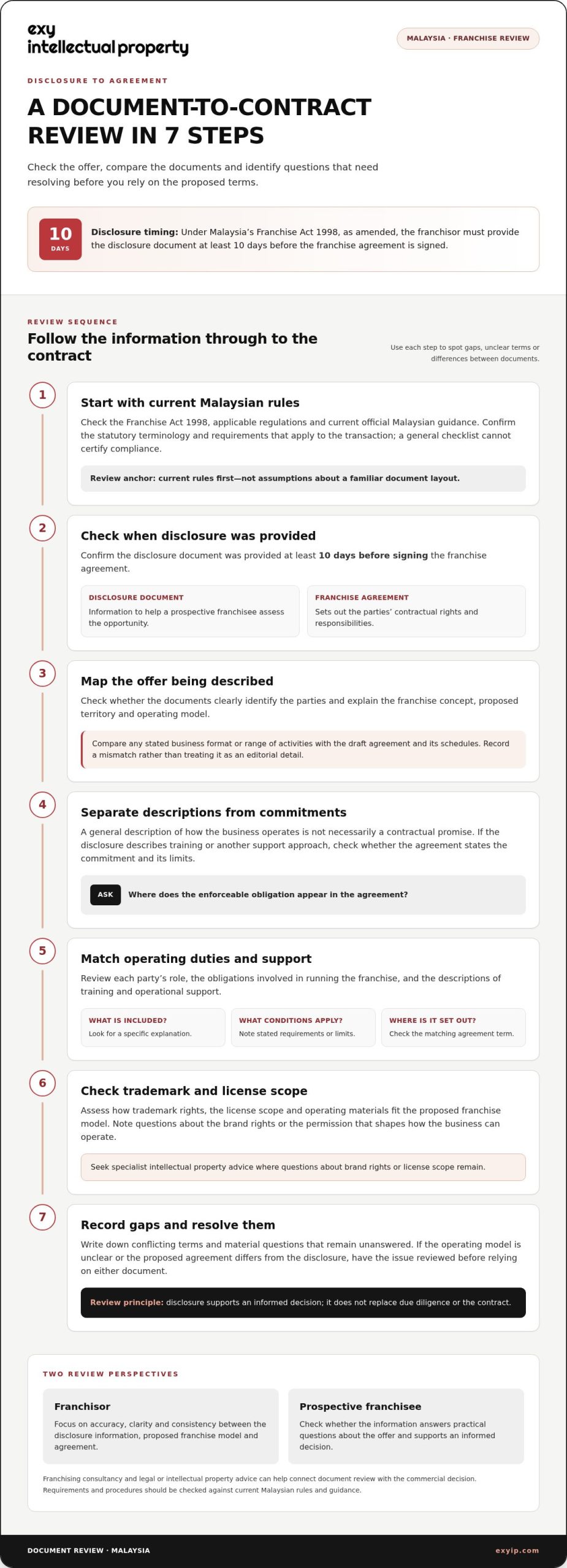
A practical checklist for reviewing franchise disclosure documents
A clear process helps separate questions about legal requirements from questions about whether the opportunity suits your business. Use these steps to organise the review, track unresolved issues and prepare focused questions before proceeding.
Organize the document set and verify current requirements
Gather the disclosure material, draft franchise agreement, schedules, appendices and every document referenced in them. Record each item’s title, version date and date received. Then check current official Malaysian sources for the applicable requirements and procedures. This helps confirm that you have the full set and identify any asserted delivery or submission process that needs verification.
- Collect the current documents. Create an inventory of the disclosure document, agreement, schedules, appendices and referenced materials. Note anything mentioned but not provided, and request the missing item or an explanation of its relevance.
- Check applicable requirements. Verify the current franchise disclosure document requirements Malaysia against the Franchise Act 1998, applicable regulations and official Malaysian guidance. A familiar template or informal summary does not confirm compliance.
- Compare the documents. Review the same subjects across the disclosure material and draft agreement, including party details, territory, operating duties, support, payments, renewal or termination provisions, and brand use. Mark differences for follow-up instead of assuming they are harmless.
- Record questions and evidence. Keep a dated review log with the relevant document version, page or clause, issue and question. Separate a missing explanation from a direct inconsistency. Request material clarifications in writing, and keep updated documents and responses with the original set.
- Seek suitable advice. Refer legal interpretation, compliance concerns and proposed contract changes to a qualified Malaysian adviser. Specialist advice can also help assess the business model and the rights needed to operate it.
Assess the offer and document open questions
Legal compliance and commercial suitability are separate decisions. A legal review asks whether relevant rules and procedures have been followed. A business assessment asks whether the proposed obligations, support and operating model fit your capacity and plans. Consider whether the territory and brand-use terms are workable and whether the license scope matches the activities you expect to carry out.
Use your question log to identify what needs resolution before you decide. For more context on how documents fit into a franchise arrangement, consult this guide to essential franchise legal documents in Malaysia.
For structured, commercially grounded support with the document review, explore Malaysian franchising consultancy.
How franchise and intellectual property advice can strengthen your review
A franchise model depends on more than a business format. It also depends on rights that allow the brand and operating materials to be used consistently as the business expands. Reviewing disclosure alongside intellectual property planning can help show whether the proposed franchise model, brand permissions and commercial plans fit together.
Seeing a brand name and logo in disclosure materials does not, by itself, explain who owns the relevant rights or what use the agreement permits. Review the documents for clear information about the brand, permitted activities, territory and limits on use. These details matter to the franchisee’s plans and the franchisor’s ability to maintain a consistent brand across the network.
Connect disclosure review with brand and license planning
Keep three things distinct: registered intellectual property rights, contractual permission to use those rights, and practical guidance on how the business should operate. A trademark registration concerns protection of a sign. A license sets out permission to use rights under agreed conditions. Operating manuals or training materials may explain how to apply the brand and business methods. These elements are related, but they are not interchangeable.
Check whether the materials clearly describe ownership and permitted brand use, then compare that information with the license and other relevant terms in the proposed franchise agreement. Consider whether the stated scope supports the planned business activities and any expansion strategy. Franchise consultancy in Malaysia can connect franchise documentation with the brand and rights that support the model.
Intellectual property questions can also involve operating materials such as manuals, training content, designs or software used in the franchise. Identify which materials are central to the business, who is permitted to use them and whether the documents explain any restrictions. If the model depends on adapting or commercializing those assets, include that relationship in the wider expansion plan.
Choose next steps based on the issues identified
Group open issues in your review notes before seeking advice. Separate questions about current requirements from document inconsistencies, unclear brand permissions and commercial concerns about whether the operating model is workable. This gives an adviser a focused starting point and links each question to the relevant document or business objective.
- Legal: Which requirements or procedures need verification against current Malaysian sources?
- Documents: Do the disclosure materials and proposed agreement describe the same rights and obligations?
- Commercial and IP: Does the license scope support the intended use of the brand and operating materials?
Exy’s franchising consultancy, licensing agreements and intellectual property strategy can support a structured review of these connected issues. To discuss your franchise and intellectual property objectives, speak with Exy about your strategy.
Make your next decision with confidence
Turn any remaining uncertainty into a clear decision point. Identify which assumptions need testing, what information could change your assessment and how the proposed franchise model fits your business plans. This keeps the review focused on the decision ahead, not just on completing paperwork.
Use franchise disclosure document requirements Malaysia as a reference point for a careful review, while considering the commercial opportunity alongside your long-term objectives. If the documents raise questions about future growth, brand use or the shape of the relationship, focused professional advice can help you consider your options before committing.
Exy Intellectual Property works with businesses on franchise and intellectual property matters in Malaysia. Discuss your franchise and intellectual property strategy with Exy to consider a practical path forward for your business. Clear questions and appropriate advice can help you approach the next stage with greater confidence.
Frequently Asked Questions
Does Malaysia require a standard franchise disclosure document format?
Malaysia’s regulations do not prescribe one universal disclosure document format, but a template is available through the MyFEX 2.0 portal. Treat the template as a reference, not automatic proof that a particular document meets every applicable requirement. Check the current Franchise Act 1998, regulations and official guidance for the transaction. Keep a copy of the version reviewed so you can identify what information the franchisor provided.
How far in advance must a franchise disclosure document be provided in Malaysia?
A franchisor must provide the disclosure document to a prospective franchisee at least 10 days before the franchise agreement is signed. Record when you received it, including the document version and any accompanying materials. If the proposed agreement or disclosure package changes, note what was updated and when. For a transaction-specific view of timing, check the current law and obtain Malaysian legal advice.
Is a franchise disclosure document the same as a franchise agreement?
No. The disclosure document provides information about the proposed franchise, while the franchise agreement sets out the parties’ agreed rights and obligations. For example, disclosure may describe the brand and business model, while the agreement specifies the permitted use and contractual conditions. Read both before deciding, and don’t assume that receiving disclosure means you’ve accepted the contract terms.
Can a prospective franchisee rely on verbal explanations that differ from the written documents?
Don’t treat a verbal assurance that conflicts with the documents as a substitute for written clarification. If a discussion suggests broader territory rights than the draft agreement describes, for example, record the difference and request an explanation in writing. Keep correspondence with the document versions. Whether a statement has legal effect depends on the circumstances and applicable law, so get advice before relying on it when making a commitment.
What should a prospective franchisee do if disclosure information conflicts with the franchise agreement?
Record the conflicting wording, identify each document’s version and page or clause, and request a written explanation before proceeding. For instance, note if the disclosure describes a territory differently from the agreement. Don’t decide on your own which wording governs. Have a qualified Malaysian adviser assess the discrepancy and any proposed revision, then keep updated documents and written responses with your review records.
Do foreign franchisors need to follow Malaysian franchise disclosure requirements?
Yes. Foreign franchisors operating in Malaysia must consider the applicable Malaysian franchise rules, including registration requirements under section 6 of the Franchise Act 1998 and relevant disclosure obligations. The precise steps may depend on the transaction and current procedures. A prospective franchisee assessing an overseas brand should verify the franchisor’s Malaysian status and applicable requirements through official sources, rather than relying only on documents prepared for another country.
Where can I verify current Malaysian franchise disclosure requirements?
Check the current Franchise Act 1998 and applicable regulations, along with guidance from Malaysia’s Ministry of Domestic Trade and Cost of Living and the Registrar of Franchises. Consult the official MyFEX 2.0 portal for current process information and its disclosure template. These sources help verify franchise disclosure document requirements Malaysia, including procedural details. For a legal interpretation of how a requirement applies to your transaction, seek advice from a qualified Malaysian adviser.