


A clean result is not a green light to file. A preliminary malaysia trademark search can reveal names or logos that may raise concerns, but an exact-match check can miss similar spellings, sounds, designs or marks covering related goods and services. Checking whether a business name is available is not the same as searching trademark records.
Before committing to a brand, it helps to know what your search can show and where its limits are. This guide explains how to search Malaysian records through MyIPO’s IP Online portal, when to broaden your search to WIPO’s Global Brand Database, and how to assess results without treating them as a final legal decision.
Follow a practical workflow: search the proposed mark and relevant variations, compare potentially similar marks and their goods or services, then consider whether there may be a likelihood of confusion. You’ll also learn what search results cannot establish, how to spot warning signs and what to do next, from refining a mark to seeking advice on a filing strategy. A search is a risk screen, not a registration guarantee.
Key Takeaways
- A malaysia trademark search is preliminary research, not a final decision on whether a mark can be registered.
- Search the proposed name, spelling variations and any logo or device elements. Keep a record of your search terms and findings.
- Compare potential matches by wording, sound, meaning, visual impression and the goods or services involved.
- Sort results into no apparent match, uncertain result or close potential match to decide what to do next.
- Organise your findings before seeking advice on trademark filing and registration strategy.
What a Malaysia trademark search can, and cannot, tell you
A name that looks original in a company register may still resemble a mark already used or registered for relevant goods or services. A malaysia trademark search is preliminary research into existing marks that may be relevant to the sign your business plans to use. It can help you spot issues before investing in branding, packaging or promotion, while changing direction may be more straightforward.
A trademark search is an early risk screen, not a decision on whether your mark is legally clear or will be registered. It can flag records worth examining, but its usefulness depends on the search terms and records reviewed. No obvious match is useful information, not a guarantee that the mark is available or will be registered. A filing decision may require closer analysis of the mark and the goods or services involved.
What records and signs should a preliminary search consider?
Start with the sign you plan to use. It could be a business or product name, a word or phrase, a logo, or another distinctive sign. A trademark is a sign that distinguishes one business or its products from others. Search the branding you actually plan to use: a name-only search may miss a relevant visual mark, while a logo search alone will not identify similar wording.
For Malaysian records, start with MyIPO’s IP Online portal, the official database identified for trademark searches. Search the wording and any relevant logo or device elements using the options available in the portal. An exact-name search is only a starting point. Variations in spelling, pronunciation or presentation may not appear in its results.
Why a company-name check is not a trademark search
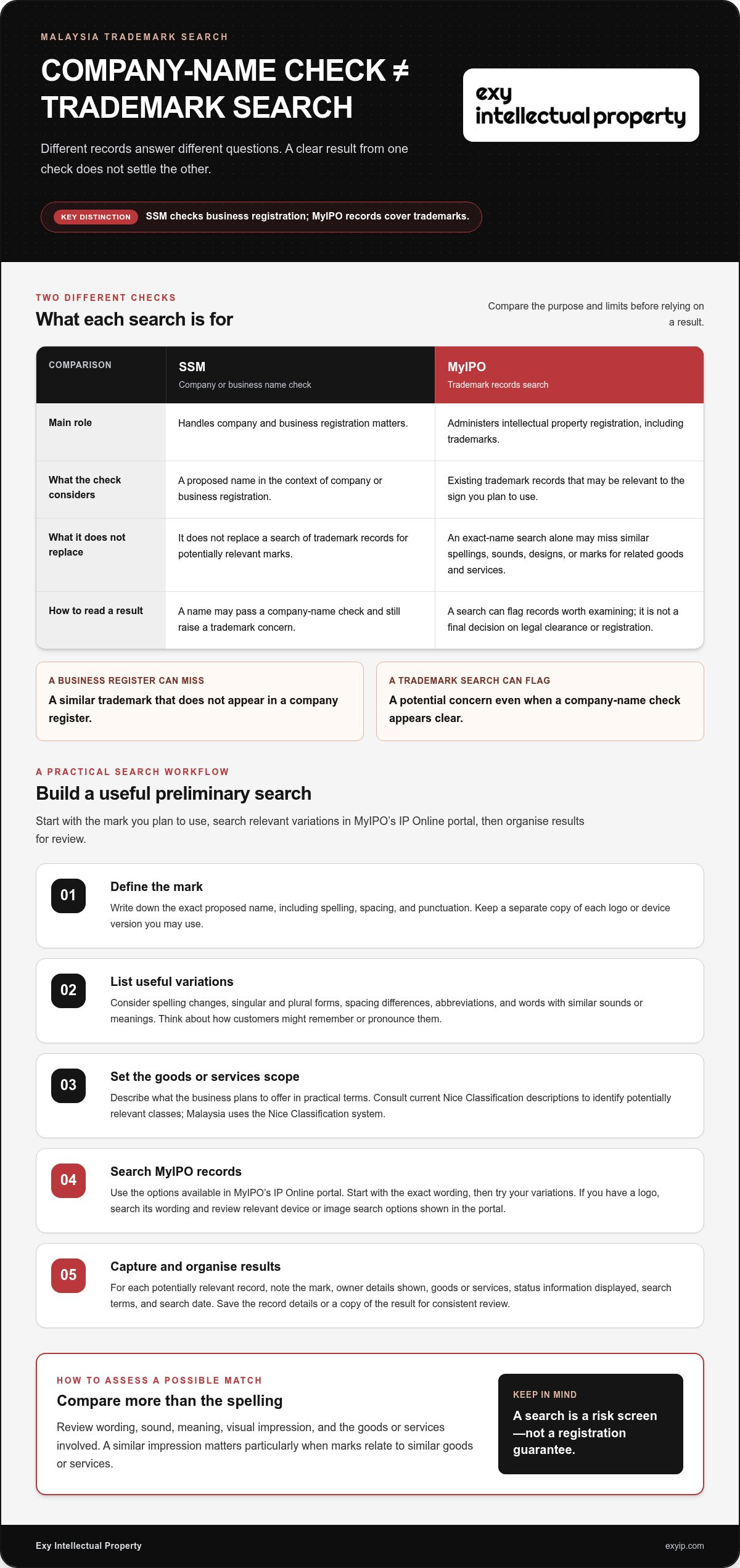
SSM and MyIPO have different roles. SSM handles company and business registration matters, while MyIPO administers intellectual property registration, including trademarks. A company-name check considers a proposed name in the context of company or business registration. It does not replace a search of trademark records for potentially relevant marks.
This distinction matters before you invest in a name across your website, labels, packaging or advertising. A name may pass a company-name check and still raise a trademark concern. A trademark search may also identify a similar mark that does not appear in a company register. Neither result, by itself, settles every legal question. For more context on protection and filing, see Trademark Registration in Malaysia: 2026 Strategic Guide.
Use preliminary findings to guide your next decision, not as permission to proceed simply because a search returned no results. The records you find, the signs you searched and the goods or services you intend to offer all affect how meaningful the result is. If a potential match is unclear, professional advice can help you assess it before filing or making a larger branding commitment.
How to conduct a Malaysia trademark search step by step
A useful malaysia trademark search starts with a clear record of the mark you plan to protect and how you intend to use it. Follow a repeatable process so you can compare results and explain the basis for your next decision.
Prepare the mark and the goods or services before searching
Separate the brand wording from any logo or graphic elements. First describe your planned goods or services in plain language, such as “online retail services” or “skin-care products.” Then consult the current Nice Classification descriptions to identify potentially relevant classes. Malaysia uses the Nice Classification system. The U.S. Department of Commerce’s overview of intellectual property protection in Malaysia offers broader context for planning your search.
- Define the mark. Write down the exact proposed name, including spelling, spacing and punctuation. Keep a separate copy of each logo or device version you may use.
- List useful variations. Note plausible spelling changes, singular and plural forms, spacing differences, abbreviations, and words with similar sounds or meanings. Think about variations customers might remember or pronounce differently.
- Set the goods or services scope. Record what the business plans to offer in practical terms. Use those descriptions to identify potentially relevant Nice Classification classes instead of choosing a class based on a broad guess.
- Search MyIPO records. Open MyIPO’s IP Online portal and use the search options available. Start with the exact wording, then try your variations. If you have a logo, search its wording and review any relevant device or image search options shown in the portal.
- Capture and organise results. For each potentially relevant record, note the mark, owner details shown, goods or services, status information displayed, search terms and date. Save the record details or a copy of the result so you can review it consistently.
Search beyond an exact spelling
An exact match is a useful starting point, but it is not the whole search. Review marks that differ by a letter, word spacing, singular or plural form, or pronunciation. Consider whether a similar meaning or sound could create a comparable impression for customers, particularly when the marks relate to similar goods or services. Keep possible matches for assessment. A search result alone does not establish that an application will be refused.
MyIPO’s portal may display record and status information, but one field or search setting will not necessarily answer every question. Read what the record says and note any uncertainty instead of treating it as a conclusion. Keeping your search terms and results together makes it easier to spot gaps, repeat a search and discuss close findings with an adviser. For a considered review of search results and filing options, Exy Intellectual Property’s trademark filing and legal advisory support can connect preliminary research with a filing strategy.
How to assess similar marks and likelihood of confusion
A search result calls for comparison, not an automatic conclusion that there is a conflict. A useful malaysia trademark search review considers the marks as a whole and the goods or services connected to them. Assess similarity in context, not by spelling alone.
Likelihood of confusion is a legal standard for assessing whether consumers may mistake one product or service for another. The factors below can help you identify records that may need closer attention, but they do not amount to a legal conclusion about your mark.
Compare the marks as consumers may encounter them
Read or view each mark as a customer might see it in ordinary use. Compare the overall impression, along with individual letters, syllables, design features and layout. A shared distinctive element may matter, while a common or descriptive word may carry less weight. The significance of any similarity depends on the full context and requires careful interpretation.
| Comparison point | What to review |
|---|---|
| Wording | Compare the full names and any distinctive shared words, not just one matching fragment. |
| Sound | Say the marks aloud. Consider whether different spellings could be pronounced similarly. |
| Meaning | Consider whether the words suggest a similar idea or impression to customers. |
| Visual impression | Review lettering, logo elements, arrangement and prominent design features together. |
| Goods or services | Compare what each mark is associated with, using the record descriptions rather than class numbers alone. |
For example, two names can differ by a few letters yet sound alike when spoken. A shared word, on the other hand, does not necessarily make two marks similar in their full presentation. Treat each comparison as a reason to examine the record, not as proof that a conflict exists.
Compare the goods and services linked to each mark
Place the record’s goods or services description beside your planned offering. Classification can help organise the comparison, but it does not replace reading the descriptions. Marks covering identical goods are worth reviewing, but identical goods are not the only relevant context. The descriptions may indicate related offerings even when they use different wording.
Do not assign a definitive risk rating based on a class number alone. Classes group goods and services for administrative purposes. The descriptions and the relationship between the offerings also need attention. A potentially relevant record is not, by itself, a confirmed infringement or proof that an application will be refused. Those outcomes depend on assessment beyond a preliminary search. If a result raises questions, organise the mark comparison and goods or services details for professional review before deciding how to proceed.
What to do if a Malaysia trademark search finds a match
A result should guide your next step, not trigger an automatic decision to abandon or file. After a malaysia trademark search, sort your findings into three practical groups: no apparent match, uncertain result or close potential match. Keep the details behind your assessment so you can review it as your brand plans develop.
If the search shows no obvious match
A clean preliminary result is encouraging, but it does not establish that a mark is available or will be registered. Before relying on it, check whether you searched plausible spelling and sound variations, any logo elements you intend to use, and the goods or services most relevant to your business. A narrow exact-name search may leave important gaps.
If those checks reveal no apparent issue, organise the proposed mark and its intended use before planning a filing. Consider how the name and logo will appear across your products, packaging, website and promotion. The search is one input to a filing strategy, not a substitute for considering the full brand and the scope of protection you seek.
If a result appears similar or difficult to assess
Preserve the search terms, date and relevant record details. For each result, note the mark, owner information and status information shown, along with the goods or services listed. Record what caught your attention, such as similar wording, pronunciation, design or a connection between the offerings. This creates a decision trail you can revisit instead of relying on memory or a screenshot without context.
Then decide whether the result is uncertain or close enough to merit professional review. An uncertain record may need closer interpretation; a close potential match deserves careful consideration before you commit further to the brand. Consider whether refining the mark or adjusting the planned goods or services makes commercial sense, but do not assume that changing a name automatically removes legal or market risk. A revised mark may still share meaningful features with an existing one.
Professional advice can help interpret the similarity, the scope of relevant goods or services and the implications for a filing plan. It can put search findings into context without treating a database result as a confirmed infringement or a certain refusal. When you are ready to consider the application stage, the guide How to Register Your Trademark in Malaysia can help you understand the filing process.
For an assessment that connects preliminary findings with a considered filing strategy, seek trademark filing and legal advisory support from Exy Intellectual Property.
Move from Malaysia trademark search to a considered filing strategy
A malaysia trademark search gives you a starting point for a filing decision. Bring the proposed mark, its intended use and the records you found into one clear picture. This turns preliminary research into a practical strategy without treating search results as a promise of acceptance or registration.
What information helps shape the next step?
Organise the key details before deciding how to proceed. Include the exact name or logo you plan to use, how it will appear in the business, and the goods or services it will identify. Add the search terms and date, relevant MyIPO records, and a brief note about any similarity questions that remain open.
- The proposed word mark, logo or other sign, including the versions you are considering.
- The planned goods or services, described in practical business terms.
- Potentially relevant records and the similarities that prompted closer attention.
- Your protection objectives, including the parts of the brand that matter most to the business.
This summary gives a professional review a clear focus. Exy Intellectual Property’s trademark registration, filing and legal advisory work can help assess search findings, consider filing scope and shape a considered route forward. Advice can clarify which issues deserve attention, but it cannot promise a particular application outcome.
When international trademark protection is also relevant
If your business plans to sell or build its brand beyond Malaysia, consider protection in each target market as part of the wider strategy. The Madrid Protocol is an international treaty governing trademark registration across multiple countries. Whether and how to use an international route depends on your business plans and the markets where you seek protection.
For businesses considering overseas expansion, the guide Global Trademark Registration: Strategic Guide for 2026 can help frame international planning alongside local priorities. Consider where the brand will be used, which goods or services it will cover and how Malaysian search findings affect the wider plan. A Malaysian search alone does not answer questions about records or filing strategy in other markets.
Keep the next step proportionate to your findings. If the results appear clear, organise the proposed mark and scope for filing consideration. If records raise unresolved questions, professional advice can help assess similarity and identify options before you commit further to branding or promotion. Exy IP supports Malaysian and global trademark registration and filing, connecting search review with practical planning without assuming an outcome.
If you are preparing to file or weighing a potential match, you can discuss a Malaysian trademark filing strategy with Exy Intellectual Property.
Give your brand a clear next step
Your brand is a business asset, so its protection plan should support your business priorities. Use your search findings to make a considered decision about the mark and its role in your plans. A malaysia trademark search can inform that decision, but the next step should reflect how you intend to use the brand.
If you are weighing a filing decision or have questions about a potential match, a focused review can help you consider your options without assuming a particular outcome.
Discuss your Malaysia trademark filing strategy with Exy IP and take your next step with greater clarity.
Frequently Asked Questions
How do I search for a trademark in Malaysia?
Use MyIPO’s IP Online portal to search for the proposed wording and any relevant logo elements. Search the brand as written and variations customers might hear or see, such as a joined or separated word. Note the goods or services you plan to offer, since a similar name may have different relevance depending on its commercial context.
Is a Malaysia trademark search free?
MyIPO’s IP Online portal is the official starting point for searching Malaysian trademark records. Access to a search is only one part of the decision: its usefulness depends on whether you consider relevant wording, logo elements and goods or services. If the result leaves important questions unresolved, a more detailed review can help you decide what to do next.
Can I use a business name if it appears available through SSM?
An available SSM result does not settle whether a name may raise trademark concerns. Before using it widely, consider the actual sign customers will see and the products or services it will identify. A business name might differ from the brand name on packaging, or a logo may add distinctive wording. Those details can affect which records are relevant, even if the registered company name appears clear.
What if I find a similar trademark in Malaysia?
Save the record and identify the specific point of similarity: wording, sound, design, or the goods or services associated with it. Then consider how customers are likely to encounter both marks and whether the businesses appear connected. Do not assume the result automatically prevents your plans, but do not dismiss it based only on a spelling difference. A professional review can help resolve uncertainty before you commit further.
Does a trademark search guarantee that MyIPO will register my mark?
No. A preliminary search can help identify relevant records, but it cannot determine the final outcome of an application. The search may be limited by the terms used, the records available and the scope reviewed. MyIPO considers an application through its examination process, which is separate from your preliminary research. Treat search findings as information for planning, not as approval or a promise of registration.
Should I search trademark classes as well as brand names?
Yes. Identify the goods or services you plan to offer and review the relevant classification alongside the name. A class number helps organise records, but it does not replace reading the descriptions. For example, two records in one class may cover different offerings, while descriptions across classes may still merit comparison. Use classification as a guide, not a stand-alone measure of risk.
When should I get professional help with a Malaysia trademark search?
Consider professional help if a record shares distinctive wording or design with your mark, if the associated goods or services appear related, or if you are unsure whether your search covered how the brand will actually be used. Bring the relevant records and your intended use to the discussion. This can clarify unresolved questions and inform a considered filing decision before a major branding commitment.