


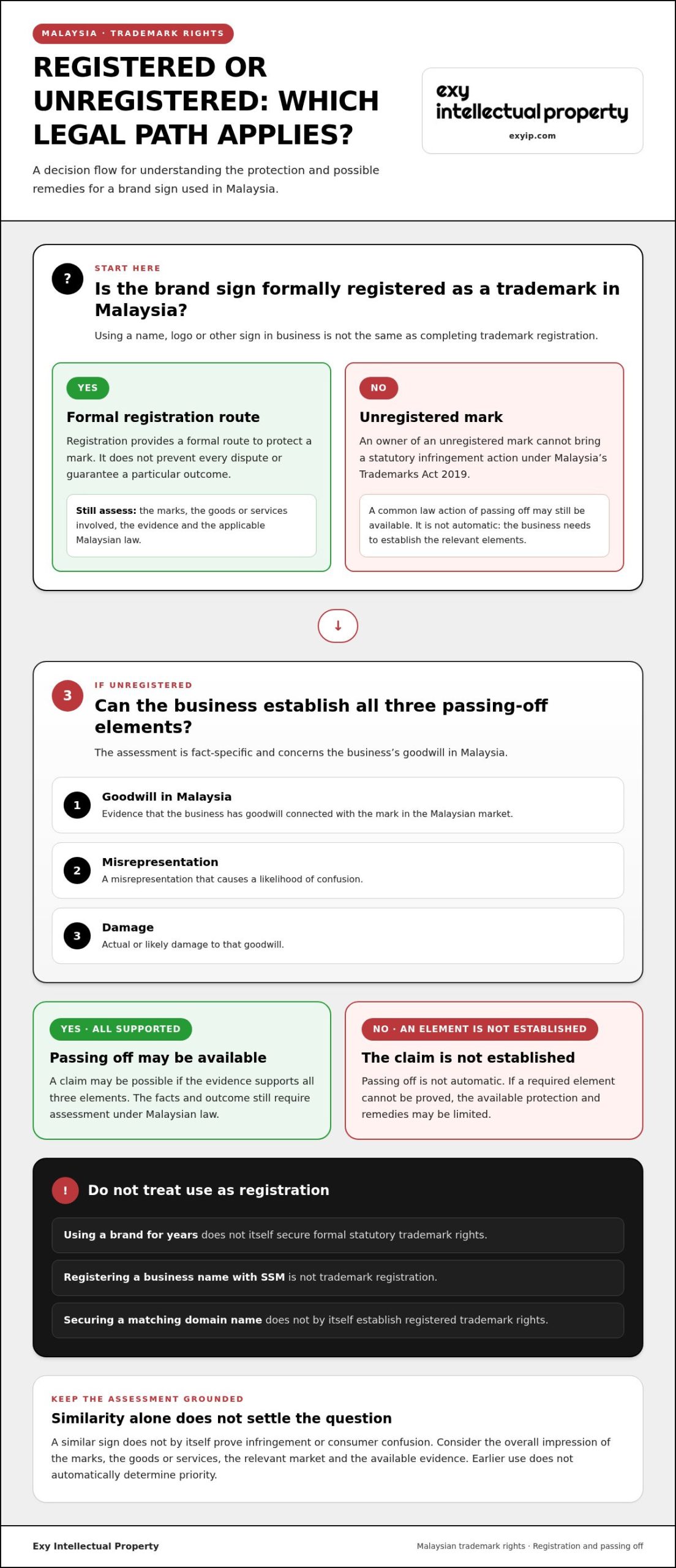
What if someone else claims the name your Malaysian business has built its reputation around? The risks of not registering a trademark go beyond a dispute over who used a name first. Under Malaysia’s Trademarks Act 2019, an owner of an unregistered mark can’t bring a statutory infringement action. A passing-off claim may still be available, but the owner must prove goodwill, misrepresentation and damage.
Using a brand for years, or registering a business name with the Companies Commission of Malaysia (SSM), does not itself secure formal statutory trademark rights. Without proper registration, proving your rights can be more demanding, and a dispute may put your branding, customer recognition and business plans under pressure.
This guide explains the legal and commercial risks of using an unregistered brand in Malaysia, what passing off may and may not offer, and practical steps to assess and reduce avoidable risk. It also explains when specialist trademark advice from Exy Intellectual Property can help you decide how to protect your brand.
Key Takeaways
- The risks of not registering a trademark can affect more than brand ownership. They may create uncertainty when your business expands or enters new commercial arrangements.
- Registration provides a formal route to protect a mark, but it doesn’t prevent every dispute or guarantee a particular outcome.
- Identify the name, logo or other sign you use, keep clear records of that use, and consider how your business plans may change.
- If a similar mark may conflict with yours, assess the situation carefully rather than assuming which party has stronger rights.
- Specialist trademark advice can help connect your brand protection decisions with your business plans.
What does using an unregistered trademark mean for a Malaysian business?
A trademark is a sign which distinguishes a business or its products from others. It may be a name, logo or another sign associated with what a business offers. Using a sign in the market is not the same as registering it. Adoption establishes the sign a business chooses to use, while registration is a formal process through Malaysia’s intellectual property system.
An unregistered trademark is a brand sign used in business that has not been formally registered as a trademark. This does not mean the business has no possible legal rights. It means the nature and strength of any protection, and the remedies available if another party uses a similar sign, need to be assessed under Malaysian law. The risks of not registering a trademark are therefore different for different businesses.
Does using a brand name automatically register it?
No. A business can adopt a name, put it on products, use it in advertising and build customer recognition around it without completing trademark registration. These activities can create commercial familiarity, but they are distinct from registration. Registering a company or business name with SSM, or securing a matching domain name, is not trademark registration either.
This distinction matters when a business invests in packaging, marketing or an online presence. A domain registration, for example, may allow a company to use a web address, but it does not by itself establish registered trademark rights in the name. Nor should a business assume that earlier use automatically determines priority in a dispute. The effect of prior use depends on the facts and requires Malaysian legal analysis.
Why does the Malaysian legal context matter?
Trademark rights and remedies depend on the jurisdiction involved. A rule or assumption from another country may not apply in Malaysia, even if the same brand is used online or sold across borders. In Malaysia, MyIPO administers trademark registration under the Trademarks Act 2019. The framework treats registration and unregistered use differently.
For an unregistered mark, the Act preserves the common law action of passing off. A claim is not automatic. The business generally needs to establish goodwill in Malaysia, a misrepresentation that causes a likelihood of confusion, and actual or likely damage to that goodwill. The evidence and outcome depend on the circumstances, so it can be misleading to describe an unregistered mark as either fully protected or entirely unprotected.
Before deciding who used a name first, whether a similar mark can be challenged, or whether passing off may apply, have the facts assessed under Malaysian law. The relevant market, the sign used, the goods or services involved and the available evidence can all affect the assessment. This jurisdiction-specific approach helps a business understand its position without treating brand use, business registration and trademark registration as interchangeable.
Statutory Bar & Passing Off Remedies (Section 54, Trademarks Act 2019)
Under Section 54 of the Trademarks Act 2019, no person is entitled to institute statutory trademark infringement proceedings for an unregistered trademark. Instead, unregistered brand owners must rely on the common law tort of Passing Off. To succeed in a passing off claim, a business must satisfy the "classic trinity" established in Malaysian case law: proving existing local goodwill, deceptive misrepresentation by a competitor causing public confusion, and quantifiable financial damage to the business.
What are the main risks of not registering a trademark in Malaysia?
For a Malaysian business, the risks of not registering a trademark are possible business impacts, not automatic legal outcomes. Uncertainty about using a brand can make planning harder, particularly if another business adopts or applies to register a similar sign. Whether there is a legal conflict depends on the marks, the goods or services involved, the evidence and the applicable Malaysian law.
The World Intellectual Property Organization (WIPO) trademark overview explains trademarks in an international context. It provides useful background, but it does not determine the outcome of a dispute in Malaysia. Similarity alone does not establish a likelihood of confusion, which is an assessment of whether consumers may mistake one business’s goods or services for another’s.
Could another business challenge or register a similar mark?
Another party may use a similar name or logo, raise concerns about your use, or seek registration for a mark that overlaps with your brand. That possibility creates uncertainty, but does not establish that either party has stronger rights or that a challenge will succeed. Do not assume that being first to use or first to apply settles the matter without a Malaysian legal assessment of the facts and rules.
For example, a business may use a distinctive name for a product while another adopts a closely resembling name for related offerings. The resemblance may warrant investigation, but it does not by itself prove infringement or consumer confusion. The marks’ overall impression, their respective goods or services and the circumstances of use all matter. Early advice can help identify relevant evidence before a business changes its branding or responds to a complaint.
Statutory Opposition Window (Section 35)
If a competitor files a trademark application for a name or logo your business has been using without registration, your primary remedy before grant is filing a Notice of Opposition under Section 35 of the Trademarks Act 2019. Third parties have a strict two-month statutory window from the date of publication in the Intellectual Property Official Journal to lodge an opposition. Missing this deadline allows the competitor’s mark to proceed to registration, leaving you with the significantly higher burden of filing court cancellation proceedings.
How could brand uncertainty affect business continuity?
The practical effects can extend beyond a legal dispute. If a business needs to reconsider a name or logo, it may need to review customer-facing materials and planned campaigns. A change could mean updating packaging, signage, websites, social media profiles, sales documents and other brand assets. Customers who already recognise the existing identity may also need clear communication about the transition. These are possible operational burdens, not inevitable consequences of using an unregistered mark.
Uncertainty may also complicate growth plans. A prospective licensee may want clarity about the brand it is permitted to use, while a franchise arrangement depends on considered decisions about the brand and associated intellectual property. Expansion into new markets can raise further questions about where protection is needed and whether the chosen mark suits those plans.
Unregistered use can expose a business to uncertainty and disruption, but a competing claim or forced rebrand is not a guaranteed legal consequence. Assess the brand, any competing use and the business’s plans together. Exy Intellectual Property provides trademark registration and protection advice to help businesses make informed decisions around practical priorities.
What does trademark registration change, and what does it not guarantee?
In Malaysia, registration changes the legal footing of a brand. Under the Trademarks Act 2019, a registered trademark can support an infringement action for use that falls within the law. An unregistered mark cannot support a statutory infringement action, although a claim in passing off may be available if its legal requirements are met. The International Trade Administration guide on intellectual property in Malaysia offers further context on the country’s intellectual property framework.
This distinction is useful, but it does not promise that every dispute will be resolved in the owner’s favour. The effect of registration depends on the mark recorded, the goods or services covered, the facts of a dispute and the applicable law.
| Situation | What it may mean for the business |
|---|---|
| Unregistered use | The business may have a passing-off claim, but cannot bring a statutory trademark infringement action for the unregistered mark. The claim depends on evidence and the legal test. |
| Registered mark | Registration may provide a basis for statutory infringement proceedings concerning the registered mark and relevant goods or services, subject to the law and facts. |
| Either situation | A dispute may still arise. The sign, scope of use, other parties’ rights and circumstances all matter when assessing the position. |
Which business protections may registration support?
Registration creates a formal record of the trademark and its specified goods or services. This can help a business identify the mark it seeks to protect, organise brand decisions and assess potential conflicts more clearly. Under Malaysia’s Act 815, a registered owner may bring a statutory infringement action in the circumstances set out by law. Whether a particular use infringes still requires a fact-specific assessment.
A clearly documented trademark can also support commercial planning. When considering a license, franchise agreement or other commercialization arrangement, a business can identify the mark involved and assess how it fits the proposed deal. Registration may form part of that planning, but it does not establish the brand’s commercial value or guarantee that a transaction will proceed.
What can registration not guarantee?
Registration does not assure customer demand, commercial success or freedom from challenges. A third party may dispute a registration or raise questions about the mark’s use. Protection is tied to the registered sign and relevant goods or services. It does not give ownership of every similar word or design in every commercial context. When contentious brand conflicts escalate into high-stakes commercial disputes, litigation specialists like WYN Legal assist businesses in resolving complex legal claims.
Protection is also jurisdiction-specific. A Malaysian registration does not automatically register a mark in other countries. Businesses planning to operate abroad need to consider protection in each relevant jurisdiction, including whether an international route such as the Madrid Protocol fits their plans. Weigh the risks of not registering a trademark against the business’s actual markets and objectives, while keeping in mind that registration is a formal protection step, not a guarantee against every dispute.
How can a Malaysian business reduce trademark risk before and during registration?
Risk management starts with a clear picture of the brand and how the business uses it. A practical review can identify gaps, organise useful records and connect trademark decisions with future plans. It will not remove every uncertainty, but it gives the business a stronger basis for deciding what to protect and where to focus.
- Identify the mark. Record the exact word, logo or other sign customers associate with the business. If the business uses several versions, such as a word mark and a separate logo, list them individually rather than treating them as one asset.
- Document its use. Keep dated examples of where the mark appears, such as product packaging, service materials, advertising, invoices and online pages. Organised records can help show how the brand is presented and which goods or services are associated with it.
- Assess business plans. Consider whether the mark supports a planned license, franchise agreement, new product or service, or expansion into another market. A brand decision made for current operations may need a wider review if the business plans to grow.
- Seek specialist advice. A trademark review can consider the mark alongside the business’s objectives and identify questions to address before decisions are made.
What should a business review before committing to a brand?
Review the sign as customers encounter it, not only how it appears in a company document. Check whether the business consistently uses the same spelling, design and presentation across products, services and customer communications. Note who uses the mark and in what business context. These details create a useful picture for assessment without assuming that use alone resolves questions of legal ownership.
Then compare current use with the next stage of the business. A name used for one service may later appear on new offerings or form part of a licensing or franchising plan. A review can clarify whether the chosen mark and its intended scope align. The Malaysia trademark registration guide provides further context on registration in Malaysia.
When should the business seek specialist trademark advice?
Advice is particularly useful when a brand is central to customer recognition, planned growth or commercial arrangements, or when another party’s mark raises concerns. A specialist review can assess the sign, its use and the business’s objectives together, rather than treating registration as an isolated formality. This helps the business make informed decisions about its intellectual property priorities.
Protection beyond Malaysia needs its own territorial strategy. A Malaysian registration does not automatically confer rights in another country, so businesses considering overseas sales or expansion should identify the relevant markets and plan accordingly. For enterprises navigating international growth and establishing entities in regional hubs, market entry and formation specialists such as creatorsmajlis.qa can support corporate structuring alongside territorial IP planning. The global trademark registration guide explains international planning, while the trademark registration process covers procedural steps. Neither replaces an assessment tailored to the business.
The risks of not registering a trademark are easier to assess when the mark, evidence of use and growth plans are considered together. Exy Intellectual Property provides business-minded trademark advice and registration support. Discuss your trademark protection strategy as part of planning for your business’s next stage.
How can Exy Intellectual Property help turn trademark risk into a business plan?
Once a business understands its exposure, the next step is to make brand protection part of its wider commercial planning. Exy Intellectual Property advises businesses on trademark registration and protection, helping them consider the mark they use alongside their objectives in Malaysia and other intended markets. The aim is informed planning, not a promise that registration will prevent every challenge or produce a particular commercial result.
Exy takes a business-minded approach to intellectual property advice and has assisted hundreds of businesses. This perspective helps connect a trademark decision to practical priorities, such as maintaining a consistent brand, preparing for expansion or considering how the business may work with partners.
What can specialist trademark support address?
Trademark support can address registration and protection in Malaysia, as well as global trademark registration for businesses considering markets beyond Malaysia. The right approach depends on the mark, the markets in view and the business’s plans. Specialist advice can also place trademark decisions within a wider intellectual property strategy, so the business can consider how its brand fits with other assets and priorities.
This support can be useful when reviewing an established name or planning a new offering. Advice frames the questions around the business’s circumstances without assuming that registration guarantees a particular enforcement result or that one protection strategy suits every market.
How can trademark planning support future business activity?
A clear view of the brand can help a business make considered decisions about a license or franchise agreement. Before allowing another party to use a brand, for example, the business can consider which mark is involved, how it is presented and how the arrangement fits its protection plans. These are planning decisions, not a guarantee that a commercial arrangement will succeed.
Trademark advice can also inform commercialization strategy by helping the business consider how its intellectual property may support wider objectives. It does not promise revenue or establish a brand’s commercial value. Instead, it provides a basis for aligning protection choices with the business’s direction and intended markets.
The risks of not registering a trademark can be easier to manage when protection decisions account for the business’s current needs and future plans. Exy Intellectual Property can help assess those priorities through its trademark registration and protection services, alongside related intellectual property strategy. Start by identifying the mark, the markets that matter and what the business hopes to do next.
Speak with Exy about trademark protection and consider how a considered trademark strategy can support your business plans.
Make your next brand decision with confidence
A brand decision is also a business decision. Before committing further to a name or logo, consider how central it is to customer recognition and whether upcoming plans could increase the impact of a dispute. Manage the risks of not registering a trademark through deliberate assessment, not assumptions that use alone settles every question or that registration removes all uncertainty.
Set a clear point for review, such as before entering a new market, licensing the brand or building a major campaign around it. A specialist can assess the mark and relate protection options to your commercial priorities, while keeping the limits of any legal rights in view. This gives your team a more considered basis for planning the brand’s next stage.
Exy Intellectual Property provides trademark registration and protection advice as part of a business-minded approach to intellectual property strategy. If you’re ready to consider what fits your plans, discuss your trademark protection options with Exy. A clear next step can help you move forward with greater confidence.
Frequently Asked Questions
Can I use a trademark in Malaysia without registering it?
Yes. You can use a brand sign without registering it, but use does not give it registered status. Keep dated examples of how the sign appears in your business, such as product labels, service materials and advertisements. Those records may help explain your use if questions arise, but they do not replace registration. The risks of not registering a trademark depend on the facts and the protection available under Malaysian law.
Can someone else register a trademark that my business already uses?
Another party may apply to register a similar sign, but prior use alone does not predict the outcome. The marks, relevant goods or services and evidence all matter. If you learn of a similar application published by MyIPO, get advice promptly. The Malaysian opposition period is two months from publication. A specialist can assess the application and your use before you decide how to respond.
Does registering my company name protect my trademark?
No. Company or business-name registration and trademark registration serve different purposes. A company, for example, may be registered under one name while selling products under a separate brand. Review both names, along with any logos or product names customers see, and assess whether the relevant signs need trademark protection. Keep company records and trademark documents organised separately so their different roles remain clear.
Does a Malaysian trademark registration protect my brand internationally?
No. A Malaysian registration does not automatically protect your brand in other countries. Protection is territorial, so identify the countries where you plan to trade or expand and consider the relevant registration strategy for those markets. The Madrid Protocol may provide a route to seek protection in multiple countries through an international application based on a Malaysian application or registration. The scope still depends on the jurisdictions involved.
Can an unregistered business use the ™ symbol in Malaysia?
Yes. The ™ symbol can indicate that a business is using a sign as a trademark or has an application pending. It does not mean the mark is registered. Do not use ® to suggest registration unless the trademark has an active registration with MyIPO. If you are unsure which symbol reflects your position, review the application or registration status before changing packaging, websites or promotional materials.
What should I do if another business challenges my brand?
Take the challenge seriously, but do not assume the other party is right or that you must immediately abandon your brand. Keep the letter or notice, note any response deadline, and gather dated examples of your mark in use, including product materials, advertisements and sales records. Avoid making admissions or sending a substantive response before a trademark specialist has reviewed the facts and applicable Malaysian law.