


The broadest service list is not automatically the best fit. A useful intellectual property services comparison in Malaysia looks at whether support covers patentability assessments and prior art searches, patent drafting and prosecution with MyIPO, and international filings through the Patent Cooperation Treaty. Each supports a different stage of protecting an invention.
It makes sense to compare providers by the work they handle and the jurisdictions they cover. The right choice also depends on what you need to protect, where you plan to do business, and whether you need an assessment, drafting, filing, or advice on rights across borders.
This guide explains how patent services compare, what to consider when planning international filings, and how intellectual property rights can differ between jurisdictions. It also shows how trademark, industrial design, copyright, and related services fit into a protection strategy, helping you identify support that aligns with your business goals.
Key Takeaways
- Match patentability assessments, prior art searches, drafting and filing support to the stage your invention has reached.
- Plan international protection around the markets where you intend to operate; the Madrid System can cover trademark protection in up to 128 countries.
- Compare IP law firms and trademark agents by the work they handle, their jurisdictional scope and how clearly they explain the process.
- Consider risks such as gaps in territorial coverage, unclear ownership or rights that do not align with your business plans.
- Identify whether trademark registration, patent filing, industrial design registration or copyright voluntary notification best fits the asset you want to protect.
Patent assessments, drafting and international filings
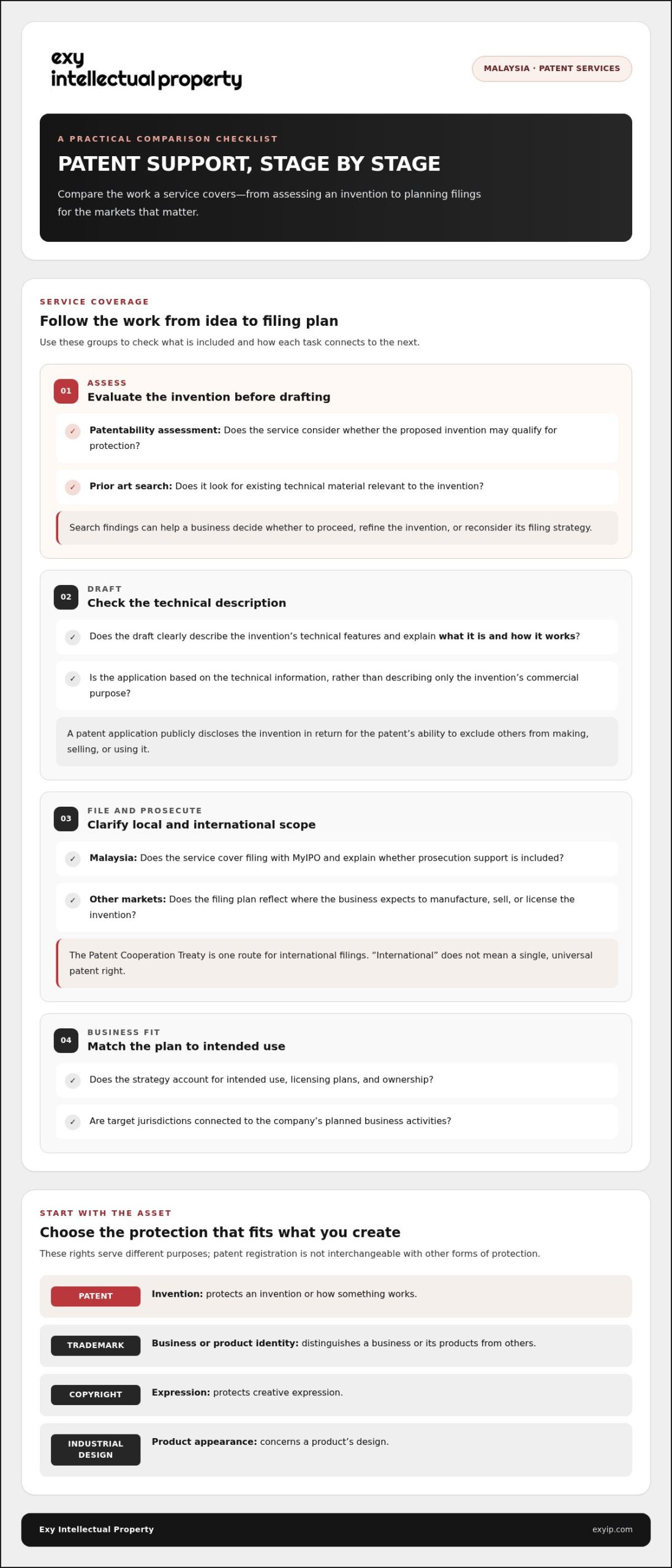
For a Malaysian invention, compare patent services by the work covered at each stage: assessment, drafting, filing, and prosecution. Patentability assessments and prior art searches help evaluate an invention against existing material before drafting begins. Patent services in Malaysia also include filing and prosecution with MyIPO, as well as international filings through the Patent Cooperation Treaty. These are distinct tasks, so a comparison should clarify which stages are covered.
A patent protects an invention or how something works for a set period. It can exclude others from making, selling, or using the invention. In return, the patent owner publicly discloses it. This exchange makes the application’s quality and clarity important: its technical description must explain what the invention is and how it works. For example, an application for a new manufacturing mechanism needs to describe its operation, not just its commercial purpose.
Assessment and drafting serve different needs. A patentability assessment considers whether a proposed invention may qualify for protection, while a prior art search looks for existing technical material relevant to it. The search can help a business decide whether to proceed, refine the invention, or reconsider its filing strategy. Patent drafting then turns the technical information into an application. When comparing patent specialists, look for a clear link between the search findings and the resulting draft.
Filing scope matters, too. A Malaysian filing with MyIPO and an international filing plan address different business intentions. If a company expects to manufacture, sell, or license an invention in other countries, it should map its intended markets before deciding which filings to pursue. The Patent Cooperation Treaty is one route for international filings. A comparison should explain how this route fits the company’s target jurisdictions, rather than present “international” as a single, universal patent right.
Useful comparison points include:
- Assessment: Does the service cover patentability assessment and prior art searches?
- Drafting: Does the application clearly describe the invention’s technical features?
- Filing: Does the scope address MyIPO and relevant international filing plans?
- Prosecution: Is support with MyIPO included in the described work?
- Business fit: Does the strategy reflect intended use, licensing, and ownership plans?
Registration figures can add context, but they don’t establish whether a particular invention is patentable. By October 2026, the Unitary Patent had passed 100,000 registrations, with an uptake rate of 30% in discussion of its registration figures. This is a European example, not a measure of Malaysian patent filings. For businesses comparing services in Malaysia, the more practical question is whether the provider can connect assessment, drafting, and filing choices to the invention and its intended markets.
Patent registration is not interchangeable with copyright or trademark protection. Copyright addresses expression, trademarks distinguish a business or its products, and patents concern inventions and how they work. Identifying the asset first helps avoid choosing a filing route that does not fit. Then consider the application’s technical description, intended jurisdictions, and commercial use. This makes an intellectual property services comparison more useful than comparing service labels alone.
The steps can include a patentability assessment and prior art search, followed by drafting an application that clearly explains the invention and how it works, then filing with MyIPO and handling prosecution. International filings through the Patent Cooperation Treaty may also be considered based on intended markets; no cost details are provided here.
Intellectual property rights across jurisdictions
Intellectual property rights are generally territorial, so protection in one country does not automatically establish the same rights elsewhere. For Malaysian businesses expanding abroad, the key comparison is how each right, filing route, and enforcement process applies in the relevant markets.
Comparing rights across jurisdictions
Comparing rights across jurisdictions means examining how different legal systems protect and enforce intellectual property. A Malaysian registration may not, by itself, address infringement in another country. A business selling products in Malaysia and Australia, for example, should consider protection in both markets and assess the local rules relevant to each asset.
The right depends on what the business wants to protect. A trademark distinguishes a business or its products; a patent concerns an invention; copyright protects expression; and an industrial design concerns a product’s design. These rights serve different purposes, so an application suited to a Malaysian brand may not protect its technical invention or creative materials.
International trademark planning can involve the Madrid System, which can be used to seek trademark protection in up to 128 countries. The Madrid Protocol provides an international filing framework, but businesses still need to identify the countries that matter to their operations. A list of possible territories is not a substitute for evaluating where products will be sold, partners operate, or infringement could affect market entry.
National examples show why local legal context matters. In Australia, registered design rights are governed by the Designs Act 2003, while the Trade Marks Act 1995 governs registered trade marks and associated rights. Australian copyright protection applies automatically when a work is first written down or recorded. These examples should not be treated as Malaysian rules; they illustrate why a law firm’s jurisdictional analysis matters.
For each target country, map the asset, registration route, ownership, and enforcement options. A WIPO directory lists intellectual property offices across countries and regional offices, helping businesses identify the relevant offices. Comparative intellectual property research examines how each legal system treats a right. This can help a business prepare for a dispute and understand what action may be available if infringement occurs.
Registration timelines by right
Registration timelines vary by right and refer to the time involved in obtaining trademark, patent, or design registration in Malaysia. They matter because businesses may need protection to align with product launches, investment decisions, or licensing plans. The process and its progress depend on the right sought and the application’s examination.
A Malaysian trademark, patent, and industrial design each involve a different subject and assessment. MyIPO handles trademark filing and prosecution, patent filing and prosecution, and industrial design filing and registration. Rather than assume one timeline applies to all three, compare the stages involved and the information each application requires.
Application completeness and questions raised during examination can affect how a case progresses. A business planning a brand launch, for example, should coordinate trademark filing with its launch timetable. An invention team may need to align patent work with development and disclosure plans. These steps connect registration planning to commercial activity without relying on a single generic duration.
When comparing firms and partners for international rights, distinguish Malaysian registration from protection in other jurisdictions. A useful assessment identifies the relevant rights, target countries, filing routes, and potential enforcement needs. This gives a business a clearer basis for planning registrations and responding to infringement across its markets.
How can businesses compare IP law firms and trademark agents in Malaysia?
Compare the work each professional handles, not just the label “law firm” or “trademark agent.” For a Malaysian trademark, useful scope may include clearance searches, risk assessments, filing and prosecution with MyIPO, and responses to office actions or objections. Match that scope to your immediate need to understand what the support covers.
Start with the mark and its business use. A name used on a product, a service brand, and a logo can raise different search and filing questions. A clearance search considers potential conflicts, while a risk assessment helps evaluate the likelihood of confusion. For example, when launching a new product name, compare whether the proposed service includes preliminary searching and advice on identified risks.
Next, compare how the MyIPO application itself will be handled. Filing is one stage; prosecution may involve addressing questions or objections raised during examination. A clearly defined scope distinguishes preparation and filing from later correspondence. That matters when a business needs support beyond submitting an application, particularly if the planned mark is central to packaging, advertising, or a franchise agreement.
International plans create another comparison point. The Madrid System can be used to seek trademark protection in up to 128 countries, but a business still needs to identify its target markets. Compare whether the proposed strategy addresses the relevant countries and explains how international filing relates to the Malaysian mark. A company exporting to selected markets, for instance, should focus on those destinations rather than treating “global” coverage as one uniform right.
Consider whether the work aligns with the wider commercial purpose. A registered trademark gives its owner exclusive rights to use, license, or sell it to others. A business preparing a licensing arrangement may therefore need registration planning that fits its commercial plans. If the question concerns a mark’s monetary value, trademark valuation is a separate type of work from filing or prosecution.
- Search and assessment: Does the scope address clearance searches and risks relevant to the proposed mark?
- MyIPO work: Does it cover filing, prosecution, and handling office actions or objections?
- Territorial strategy: Does it distinguish Malaysian protection from selected international markets?
- Business purpose: Does the advice connect the mark to licensing, expansion, or valuation needs?
- Communication: Are the work stages, responsibilities, and next steps explained in plain language?
A practical comparison applies the same example to each scope: a Malaysian company introducing a new brand and planning sales abroad. Map the proposed search, Malaysian filing, any prosecution support, and intended foreign markets. Then compare the stated work against those needs. This keeps the decision focused on useful outputs rather than broad claims or service titles.
Finally, distinguish registration from enforcement and commercial advice. Trademark services may cover filing and prosecution, while an infringement dispute raises a different issue. Clear boundaries help a business identify whether it needs a new application, support with an existing mark, or advice on how the mark fits a commercial arrangement.
Also distinguish trademark work from confidentiality planning. Trade secrets are not registered, and businesses can use confidentiality agreements to help protect confidential knowledge. When comparing providers, ask whether trade secret services include non-disclosure agreements and confidentiality contracts, as well as audits of internal protection frameworks. These tasks address confidential knowledge rather than registration of a mark, so a business can judge whether a proposed scope covers both types of protection without treating them as interchangeable. Terminology may also depend on jurisdiction: in Australia, a trade mark can be a symbol, word, sound, number, image or scent used to represent a business.
For external signals, Asia Business Law Journal compiles The A-List following research that draws on nominations from thousands of in-house counsel in Malaysia and around the world, as well as partners at international law firms. Treat it as one reference point alongside the actual scope of work. Digital processes can support communication and matter handling, but technology alone does not establish suitability. Consider how those processes would serve your needs.
What risks should businesses consider when choosing an intellectual property service provider in Malaysia?
A poor fit can leave a business with work that does not address its actual risk. For example, a trademark filing scope may not cover a patent question, overseas planning, or an ownership dispute. Compare the proposed work with the asset, the business decision involved, and the support needed after the initial task.
Scope gaps. Service descriptions can group distinct tasks under broad labels such as “IP support.” Separate assessment, filing, valuation, and dispute work before deciding what you need. A company preparing to license a registered mark, for instance, may need valuation input as well as registration records. A filing-only scope would not answer the valuation question. A written scope should specify the work product the engagement covers.
Territorial assumptions. An international service description can sound broader than the work involved. Clarify how the proposed scope treats each selected market, who coordinates local filings, and how updates from separate offices are managed. For example, a business planning an overseas launch should understand whether the engagement includes coordination across its chosen destinations or only initial filing instructions. Clear boundaries help align the company’s commercial plan with the assigned work.
Unclear ownership. Gaps in ownership records can complicate licensing, sale, or investment decisions. Before proceeding, assemble documents showing who created, acquired, or transferred the relevant rights. For example, a company commercializing a brand created by a founder should clarify how it obtained the rights. That record can help align later transactions with the intended owner. Conflicting names in internal records can also slow a transaction review.
Valuation assumptions. An IP valuation depends on the asset and its business context. The asset should be legally enforceable and transferable, and its income stream should be identifiable separately from other business assets. A business that treats all product revenue as income from one patent may overlook the contributions of its brand, design, or distribution. Consider how the valuation separates those contributions and what assumptions support its conclusions.
Unclear dispute planning. A provider’s work should distinguish registration from enforcement. If a business alleges infringement, possible paths may include court action, alternative dispute resolution, or licensing the infringing party. IP valuation can help assess those options and calculate damages. A business facing a dispute should understand whether the proposed work concerns valuation, litigation, or another defined task, rather than assume one service covers every stage.
Communication and confidentiality. Patent documents, product plans, and licensing records can contain sensitive commercial information. Identify who will handle documents, what information the work requires, and how updates will be communicated. For example, assign one internal contact to provide technical details and approve drafts. Keeping instructions and decisions in a shared record can reduce misunderstandings during an application or transaction.
- Match the work scope to the specific asset and decision.
- Clarify how international coordination and updates will be handled.
- Organize ownership records before licensing or valuation work.
- Review valuation assumptions against identifiable income and enforceable rights.
- Separate dispute assessment, valuation, and litigation tasks.
For an IP dispute or valuation question, discuss intellectual property litigation or valuation as part of assessing the next business step.
Clarify valuation assumptions: an IP asset’s price is typically what a buyer is willing to pay in an arm’s-length transaction, while its value is calculated using an orderly, tested set of methods and rules.
When IP is used as financing collateral, it should remain valid for at least the financing repayment period and marketable in foreclosure or bankruptcy. The cost method is particularly useful when an IP asset is easy to reproduce or its economic benefits cannot be accurately quantified.
Exy Intellectual Property: Trademark Registration
Exy Intellectual Property helps Malaysian businesses seeking trademark registration to protect a name or sign that distinguishes their products or services. Its trademark work is relevant when a business is preparing a brand launch, formalizing ownership, or considering expansion into additional markets. A sound filing strategy starts with the mark, how it will be used, and the jurisdictions where protection matters.
Businesses with other intellectual property needs can also consider Patent Filing, Industrial Design Registration, or Copyright Voluntary Notification. Each addresses a different type of asset, so the useful next step is to identify what you want to protect and where it will be used. To discuss trademark protection in Malaysia, contact Exy Intellectual Property about your registration needs.
Turn your IP priorities into a clear next step
Make your next decision practical: identify the asset that matters most to your business, the market where it will be used, and the commercial outcome you want to support. A thoughtful intellectual property services comparison should lead to a defined action, not just a longer list of options. That action might be preparing a brand for registration, developing an invention filing plan, or protecting a product’s appearance.
Exy Intellectual Property offers Trademark Registration, Patent Filing, and Industrial Design Registration. These services address distinct business assets, helping you focus the discussion on what you are developing and how you plan to use it. Clear priorities can make the next conversation more useful.
Contact Exy Intellectual Property to discuss the IP step that fits your business plans. A considered approach today can help you move forward with greater clarity and confidence.
Frequently Asked Questions
How do Malaysian IP firms compare on services, expertise, and industry focus?
Malaysian IP firms differ in whether their work focuses on registrations, technical patent matters, commercial strategy, or disputes. Industry fit depends on the assets and business decisions involved. For example, a company developing a technical product may need patent-focused support, while a consumer brand may prioritize trademark strategy and licensing. Compare each firm’s stated work with your product cycle, intended markets, and planned transactions, rather than treating a broad service list as proof of fit.