


A patent grant in Malaysia usually takes several years, although the examination route can affect the timeline. If you’re estimating how long a patent application takes in Malaysia, about three years is a useful planning figure for the standard process.
That wait can feel long when you need to protect an invention and plan what comes next. The timeline also depends on meeting examination deadlines, responding to objections, and choosing an eligible faster route when appropriate.
This guide explains when to request substantive examination, how expedited examination and other routes may shorten the process, and which application factors commonly affect timing. It also covers the steps from filing to grant and how to plan protection around your invention’s commercial goals.
Key Takeaways
- Plan for about three years on the standard examination track, while recognising that the route and examination process affect the overall timeline.
- Track the examination request deadline carefully: it is generally 18 months from filing for a conventional Malaysian application and 4 years from the international filing date for a PCT national-phase application.
- Explore whether an eligible acceleration route fits your application; some routes can shorten examination or grant timelines when their requirements are met.
- Respond promptly to examination objections and formalities requests, as missed deadlines or unresolved issues can extend the process.
- Prepare the application and supporting documents carefully from the outset to reduce avoidable delays during examination.
Substantive examination request deadline
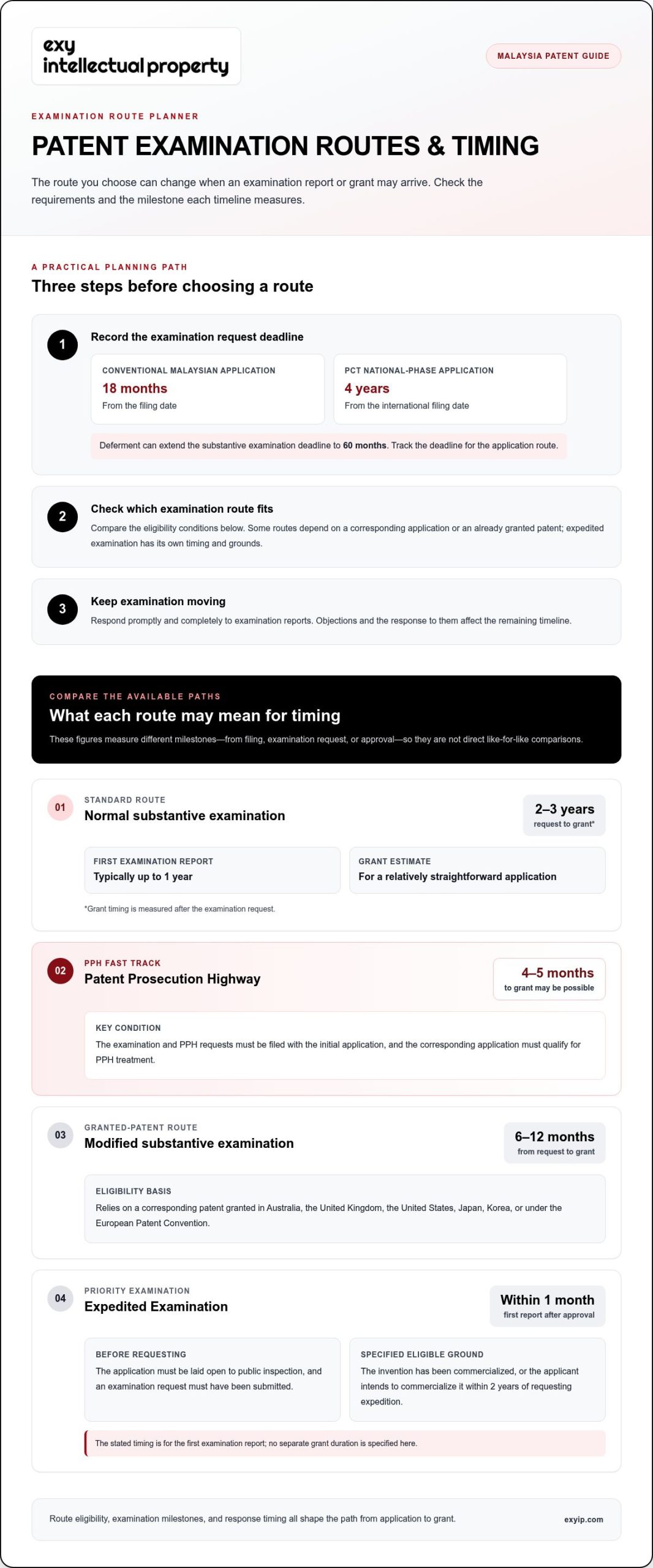
Substantive examination is the review of a patent application’s technical merits before a decision on grant. For a Malaysian application, the applicant must request normal or modified substantive examination, or request deferment, within 18 months of filing. For a PCT national-phase application, the corresponding deadline is 4 years from its international filing date. The deadline for requesting substantive examination can be deferred to 60 months.
A conventional application follows the Malaysian filing route rather than entering through the PCT national phase. Its examination request is due within 18 months from the filing date. A PCT national-phase application has 4 years from its international filing date to request substantive examination, unless deferred. These deadlines describe when to take the examination step, not how long the examination itself will take.
Standard substantive examination is the normal route for assessing an application’s patentability. Modified substantive examination is an alternative route that relies on a granted patent for the corresponding invention in an eligible jurisdiction. Eligibility requires a granted patent in Australia, the United Kingdom, the United States, Japan, Korea, or under the European Patent Convention. For modified examination, deferment can provide an additional 12 months to allow time for a grant in an eligible jurisdiction.
Expedited Examination is a route for seeking faster examination after the application has been laid open to public inspection and an examination request has been submitted. The applicant must establish an eligible ground. One specified ground is that the invention has already been commercialized, or that the applicant intends to commercialize it within 2 years of requesting expedition. The request can be made after the application has been laid open; no time limit for requesting expedition is stated in the available process facts.
Before filing, identify the route and record the deadline that applies. Then choose the examination path and submit the required request or deferment in time. For an invention intended for commercial launch, assess whether the commercialization ground fits and prepare the supporting information for an expedited request. A deadline extension for an examination event may be filed only once, for a maximum of 6 months, so it should not replace tracking the original deadline.
In practical terms, the answer to “What are the deadlines for requesting examination of a patent application in Malaysia?” is 18 months from filing for a conventional application and 4 years from the international filing date for a PCT national-phase application. Deferment can extend the substantive examination deadline to 60 months; the applicable route determines which date to track.
How do I speed up the patent grant process?
Expedited examination prioritises an eligible Malaysian patent application. The route you choose can change the expected time from filing or examination request to grant.
On the normal examination track, the first examination report typically takes up to one year. For a relatively straightforward application, grant follows about two to three years after the examination request. The report and your response to any objections affect the remaining timeline.
The Patent Prosecution Highway (PPH) fast-tracks examination of corresponding patent applications. A Malaysian application using PPH may be granted within four to five months if the examination and PPH requests are filed with the initial application. This route may suit an invention with a corresponding application eligible for PPH treatment.
Modified substantive examination relies on a corresponding patent granted in an eligible jurisdiction. A Malaysian grant is expected within six to twelve months of the request for modified examination. An eligible granted European patent may support this route, provided the application meets the applicable requirements.
Malaysia’s Expedited Examination programme prioritises an application once the request is approved. The first examination report can issue within one month of approval. The applicant should respond promptly to keep the application moving. A prompt, complete response helps keep the application moving.
On the normal track, the first examination report for a Malaysian patent application can take up to one year. A relatively straightforward case may take two to three years from the examination request to grant. PPH and modified examination have shorter timelines when their respective conditions are met.
The available timeline figures do not establish a separate processing duration for a Malaysian utility innovation application. Its grant timing depends on the examination route, the outcome, and how promptly the applicant responds to any report. Because this is a utility innovation application, not a standard patent application, confirm the appropriate filing and examination path before planning around a grant date.
A patent grant is the formal approval of protection for an invention. The grant certificate records that outcome; the processing timeline covers examination and approval, not the certificate’s later use. Filing and grant involve official steps, but this guide does not quote fees or registration costs.
To keep the process moving, identify the route early, coordinate any PPH request with the initial filing, and prepare to respond promptly to examination reports. The priority date and the corresponding application’s examination status can also affect which route is suitable. A patent granted in an eligible jurisdiction may support modified examination, while PPH requires a corresponding application that qualifies for the programme.
Factors that affect patent application processing time
Malaysia’s patent timeline depends on the application route, examination findings, and applicant responses. The deadlines below show where preparation and timely action can help prevent avoidable pauses.
Application Processing Factors
Application processing factors are the filing, examination, and response steps that shape a patent office’s review period. The route can affect when an application enters Malaysia: a PCT national-phase application must be filed within 30 months of its earliest claimed priority date, while a Paris Convention application can be filed within 12 months of the priority application.
After filing, the quality and completeness of the documents matter. Outstanding documents following a formalities report must be filed within 3 months of the report date. An adverse preliminary examination report may require the applicant to address objections before the application can proceed. Missing documents or an incomplete response can therefore leave the file unresolved.
Technical examination also affects the schedule. To be patentable in Malaysia, an invention must be new, innovative, and capable of practical application. A utility innovation must be novel and industrially applicable, but does not need an inventive step. Choosing the correct application type helps ensure the relevant criteria are applied.
Registration Processing Time
Registration processing time is the period from filing to the patent grant. Patent registration in Malaysia takes three years on average, while prosecution may take 3 to 4 years from filing to grant. These figures are planning guides, not fixed stages, because examination reports and applicant responses can extend the process.
For example, an applicant who receives an examination report has 2 months to respond to objections, with a three-month extension available. The response should address each objection clearly and include any necessary amendments. A late or incomplete reply can add time before examination advances.
Publication is another timeline marker: Malaysian patent applications are published 18 months from filing or, where applicable, the priority date. Publication does not itself mean the patent is granted. Applicants should track publication, examination correspondence, and response deadlines as separate steps.
Causes of Delay or Refusal
An application may be delayed or refused if formal or substantive issues remain unresolved. Malaysian applications can face objections if examination raises concerns about whether the invention meets patentability requirements. Discoveries, scientific theories, and mathematical methods are categories that are not eligible for patents in Malaysia.
What causes delays or refusal in Malaysian patent applications? Incomplete formalities, missed response deadlines, and objections to patentability can slow examination or prevent grant. Note each report date, provide outstanding documents within the applicable period, and respond directly to every objection.
Disclosure history can also affect assessment. Malaysia has a one-year novelty grace period for certain disclosures made before filing, but this limited rule does not remove the need to assess the invention’s novelty. Keep records of disclosures and filing dates, then consider the relevant facts against the application route and examination requirements.
Average time from filing to patent grant in Malaysia
Filing is the formal submission that starts the Malaysian patent application process. The average processing time for patent registration is three years, while reported timelines range from two to five years. Patent prosecution, the examination and response process leading to a decision, averages 3 to 4 years from filing to grant. These figures differ because applications follow different routes and may require different examination steps.
For a relatively smooth application on the normal track, grant takes two to three years from the examination request. A first examination report can take up to one year on that track. Formal examination occurs approximately one month after filing, while publication generally occurs 18 months from the filing date or applicable priority date. These are distinct milestones, not interchangeable estimates of the full process.
A PCT national-phase application follows an international filing before entering Malaysia. From national-phase entry, obtaining a Malaysian patent takes 12 to 30 months. By comparison, the timeline for a Paris Convention application may differ, so compare routes from the same starting point. The starting points differ, so compare routes from the same milestone before planning a launch or investment decision.
The filing date anchors several important calculations. A Malaysian patent grant provides protection for 20 years from the filing date, provided annual renewal fees are paid. Renewal payments are tied to the filing date, so keep track of the applicable deadlines. This means the protection term is not counted from the grant date, even if examination takes several years.
Patent prosecution can involve a formalities review, publication, substantive examination, examination reports, applicant responses, and a grant decision. Each stage serves a different purpose. An examination report, for example, may raise objections that require amendments or explanations before the patent office can proceed. The number and complexity of claims, the invention’s technical subject, and the issues raised during examination affect the work involved.
To estimate how long a patent application takes in Malaysia, first identify the application route and its relevant starting date. Then map the expected milestones: filing, formal examination, publication, substantive examination, and grant. For a PCT case, use national-phase entry as the comparison point; for a convention case, track the priority date. This avoids treating a route-specific estimate as a universal filing-to-grant promise.
Use the timeline to coordinate business decisions with the application’s actual milestones. Distinguish the date you submit the application from the date examination begins, then plan internal reviews around incoming reports and required responses. This makes it easier to track progress without confusing publication, an examination report, and the grant decision.
Professional assistance
Professional support can help turn a technical concept into a clear patent application. Start by describing the problem, the proposed solution, and the features that make the invention work. A patent professional can help organise those details into a coherent technical account for the application.
Good preparation starts with records. Gather relevant diagrams, test notes, development documents, and descriptions of different versions of the invention. Organise the materials consistently, and identify which features are essential and which are optional. This gives the drafting process a clearer foundation.
Claim drafting requires careful decisions about the protection sought. A claim should reflect the technical disclosure and distinguish the invention’s defining features. For example, if a device has a core mechanism and optional add-ons, explain their relationship clearly. This helps keep the description and claims aligned.
Prepare for collaboration by recording questions, decisions, and changes made during development. If several people contributed technical input, clarify who can explain each part of the invention. Clear communication helps prevent gaps between the working design and the written application.
Patent novelty searches can inform drafting by identifying potentially similar inventions. Keep the findings with the technical records and note which features appear relevant. This gives drafting discussions a specific reference point rather than relying only on broad descriptions or recollection.
For support with an invention’s application preparation, discuss patent filing support with Exy Intellectual Property. Bringing an organised description and relevant technical records to that discussion can help focus attention on the invention’s defining features and intended protection.
When considering filing options, it can also help to understand the fees involved. Fee arrangements can vary by filing route, so check which charges apply when considering the programme. Keep this point separate from any other filing costs when deciding whether the programme is relevant to an application.
For a Malaysian patent application, the filing fee includes a basic fee and an additional fee for each claim above 10 claims. The proposed claims therefore matter not only to the scope being sought but also to the filing fee structure. Reviewing the claim set with a patent professional can help ensure that each claim has a clear purpose and is supported by the technical description. Discussing these details early can make fee planning part of the preparation, alongside organising records and refining the application.
Exy Intellectual Property: Trademark Registration
Exy Intellectual Property supports businesses seeking to protect inventions through Patent Filing and Patent Registration in Malaysia. As you plan protection for an invention, consider whether the name or sign used to identify your business also needs protection. Trademark Registration addresses this separate part of an intellectual property strategy.
Turn to Exy Intellectual Property when preparing a patent application, considering trademark protection, or assessing how industrial designs and copyright fit into your wider protection needs. The right next step depends on what you’ve created and how you plan to use it. Consider both the invention and your business identity when planning protection around your commercial goals.
Contact Exy Intellectual Property to discuss the intellectual property protection your business needs.
Plan Your Next Intellectual Property Steps
Understanding how long a patent application takes in Malaysia helps you align protection with product development, investment, and market entry. Next, decide which parts of your business need protection and how those rights support your commercial plans.
Exy Intellectual Property offers Patent Filing, Trademark Registration, and Industrial Design Registration. These services protect different assets: an invention, a business sign, or a product’s visual design. Considering them together can help you plan protection around what your business is creating and how it intends to grow.
For a practical discussion of your next steps, contact Exy Intellectual Property. A considered plan can help you move forward with greater clarity and confidence.
Frequently Asked Questions
How long does a standard patent application take in Malaysia from filing to grant?
A standard Malaysian patent application typically takes about three years from filing to grant. If you’re estimating how long a patent application takes in Malaysia, treat this figure as a planning guide, not a fixed outcome. The total can vary with examination findings and your responses. Allow time to review reports and prepare amendments, especially if claims need clarification or the examiner raises substantive objections.
How can applicants expedite patent examination in Malaysia, and how much time does it save?
Where eligible, applicants can consider the Patent Prosecution Highway (PPH), Expedited Examination, or modified substantive examination. A PPH application may be granted within four to five months if both requests are filed with the initial application. Expedited Examination can produce a first report within one month of approval, but this is not a grant-time estimate. Modified examination is expected to lead to grant within six to twelve months of the request.
What are the steps in the Malaysian patent application process and how long does each take?
The process moves through filing, formal examination, publication, substantive examination, responses to reports, and a grant decision. Formal examination occurs approximately one month after filing, while publication is at 18 months from filing or the applicable priority date. On the normal track, a first examination report can take up to one year. The remaining period depends on examination issues and how promptly the applicant addresses them.
Can applicants use a foreign patent examination or PCT application to speed up a Malaysian patent grant?
Yes, but a PCT application does not automatically speed up the Malaysian grant. PPH may accelerate examination of a corresponding eligible application, while modified substantive examination may rely on a granted patent from Australia, the United Kingdom, the United States, Japan, Korea, or under the European Patent Convention. A PCT application provides an international filing route; its Malaysian national phase has its own examination and timeline.