


Not every investor weighs patents equally. Securing investor confidence with patents depends on showing how the protection supports your technology, market position and commercial plans, rather than treating a patent as a guarantee of funding. A clear, well-managed IP position can help investors understand what the business owns and how it may create value.
Investors look beyond the invention itself. They may consider the application’s status, who owns the intellectual property, and whether the patent strategy supports the company’s growth plans. Clear answers help make those discussions more focused.
This article explains how patents can support investor confidence, competitive positioning and company valuation in Malaysia. It also covers how to present patent information in a pitch and why a focused IP strategy should connect protection with commercial objectives.
Key Takeaways
- Prepare a pitch that clearly explains your patent’s filing status, ownership, claim coverage and relevant territories.
- Identify protectable innovation early, then connect each IP asset to the business’s commercial goals and growth plans.
- Assess how patent rights may support competitive positioning, licensing opportunities and future partnerships.
- Keep ownership records and filing information organised so investors can assess the company’s IP position during due diligence.
- Consider patent filing and related IP services when you need to turn an innovation into a clear, business-focused protection strategy.
How Do You Protect a Patent During Your Pitch?
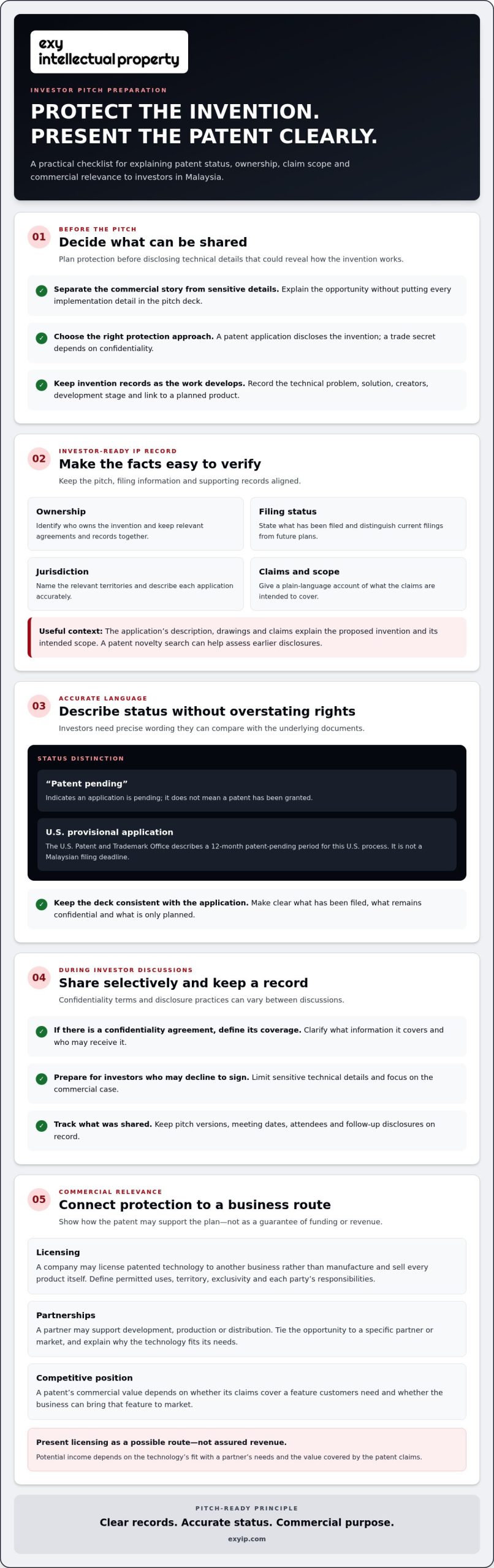
Protecting an invention starts before the investor pitch. In Malaysia, plan local protection before sharing details that could disclose how the invention works. A patent application discloses the invention, while a trade secret depends on confidentiality. Decide which technical details are sensitive and separate them from the commercial story. This lets you explain the opportunity without putting every implementation detail in the pitch deck.
A provisional patent application establishes patent-pending status for 12 months, according to the United States Patent and Trademark Office. That period relates to the United States process, not a Malaysian filing deadline. Describe the actual application status and jurisdiction accurately. “Patent pending” does not mean a patent has been granted, so avoid suggesting it already provides the rights of an issued patent. Investors need precise language they can compare with the underlying documents.
Prepare an IP record for investor discussions. Include the invention’s owner, filing status, relevant territories and a plain-language description of the claims. A patent novelty search can help assess earlier disclosures. The application’s description, drawings and claims explain the proposed invention and intended scope. Keep pitch materials consistent with the application, and distinguish filed material from future plans. This avoids suggesting that protection is broader than the application describes.
If a potential investor agrees to a confidentiality agreement, define the information it covers and who may receive it. Some investors may decline to sign, so limit sensitive technical details and focus on the commercial case. Share documents only as needed. Keep a record of pitch versions, meeting dates, attendees and follow-up disclosures. This gives founders a clearer account of what they shared during discussions.
Patents may support revenue without requiring a startup to manufacture and sell every product itself. A business can license patented technology to a larger company or partner on development, production or distribution. For example, a startup with a protected component could discuss giving a partner permission to incorporate it into a product. Define permitted uses, territory, exclusivity and each party’s responsibilities before treating the arrangement as a commercial opportunity.
Licensing may create non-dilutive funding opportunities because a company can earn income without issuing additional shares. It may also help a startup test demand or reach a market through a partner’s capabilities. The commercial case depends on whether the technology fits a partner’s needs and the patent claims cover relevant value. Present licensing in a pitch as a possible route tied to a specific partner or market, not as assured revenue.
For a Malaysian pitch, identify the application’s jurisdiction, status, ownership and claim scope. Keep filing records with investor materials, and explain which technical details remain confidential. Use consistent language across the deck and supporting documents. Investors can then distinguish current protection from planned filings, assess commercial opportunities and understand what information is available for further discussion.
Founders should plan Malaysian protection before disclosing details that could reveal how an invention works, since a patent application discloses the invention while a trade secret relies on confidentiality. A U.S. provisional application’s 12-month period is part of the U.S. process, not a Malaysian filing deadline, so describe the application status and jurisdiction accurately.
1.1 Do all investors care about patents?
No. Investor priorities vary by sector, business model and growth stage. Patents can be important in technology-led ventures, but investors also assess the team, market demand, ownership and path to revenue.
Start by documenting innovations as they develop. For each invention, record the technical problem, solution, creators, development stage and connection to a planned product. For example, a startup designing a more efficient sensor should document what makes it different, who contributed and how that feature supports customer value. This record helps identify protectable assets before a pitch or product launch.
Reducing Investment Risks Through IP
IP protection can reduce investment risks by clarifying what the company owns and how its innovation is protected. Investors may hesitate if ownership is unclear, an application’s status is misrepresented or a patent appears unrelated to the company’s core product. Keep invention records, agreements and filing details together. This lets potential investors assess specific risks rather than rely on broad claims about intellectual property.
Patents as Market Entry Barriers
A patent can create a market entry barrier by giving its owner exclusive rights over the invention covered by its claims, within the relevant territory. Competitors may need to develop a different solution or seek permission to use the protected technology. For a startup, commercial value depends on whether the claims cover a feature customers need and whether the business can bring that feature to market.
Connecting IP Protection to Business Strategy
Strategic IP protection means selecting rights that support the company’s business plan. A startup planning to license technology may prioritise protection for features a partner needs. A company preparing to sell its own product may focus on inventions central to product differentiation. Investors can then see how each asset supports revenue, expansion or a defensible market position, rather than viewing filings as a disconnected list.
Patent risks that can undermine investor confidence include unclear ownership, narrow or poorly aligned claims, unresolved disputes and a filing status that does not match the pitch. Founders should identify each risk and organise the relevant records before due diligence. A patent filing does not, by itself, establish customer demand or guarantee investment.
Evidence suggests that IP protection can influence funding, though overseas findings should not be treated as a Malaysian forecast. A study by European IP offices found that startups with IP protection were 10 times more successful in securing seed funding than startups without it. The practical lesson is to explain the role of each right, not to present a patent as a funding shortcut.
Before meeting investors, list each invention, its owner, its protection status and the business purpose it serves. This focused overview helps investors assess innovation and capital needs alongside the company’s commercial plan.
Aligning IP strategy with commercial objectives
For Malaysian startups, an IP strategy works best when each right supports a business objective. Patents, trade secrets, trademarks and copyright protect different assets, while filing plans should follow product and market priorities. Connecting rights to commercial goals makes securing investor confidence with patents part of the company’s wider growth plan.
A practical sequence is to identify the invention, assess novelty, prepare the application, file it in Malaysia and respond during examination. For international protection, the Patent Cooperation Treaty gives applicants 30 months from their priority date to decide which countries to enter. That period concerns choosing countries, not a guarantee of patent grant timing.
Building a Focused IP Strategy
A focused IP strategy coordinates patents with other rights that protect the business’s technology, identity and creative materials. This matters because investors assess the company’s full asset base, not just its inventions. For example, a medical device startup might consider patent protection for its technical mechanism, a trademark for its product name, and confidentiality controls for manufacturing know-how kept as a trade secret.
Patents require disclosure of the invention, while trade secrets depend on confidentiality. Trademarks distinguish a business or its products, and copyright protects creative expression. These rights serve different purposes and are not interchangeable. Match each asset to suitable protection, then record its owner, status and commercial role. This gives investors a clearer picture of how intellectual property supports the business.
Aligning IP with Products and Markets
IP choices should reflect the product’s design, target customers and route to market. A startup selling a sensor directly may prioritise inventions central to its product, while a company planning to license sensor technology may focus on rights relevant to potential partners. This directs filing activity toward commercial opportunities instead of treating every development as equally valuable.
Market scope matters too. A Malaysian launch may call for a different filing roadmap from a planned expansion into other countries. Identify where the company expects to manufacture, sell or partner, then connect those markets to the relevant applications. Investors can see how protection supports growth plans, rather than assuming a Malaysian filing protects the invention worldwide.
Planning Strategic Registration
An IP roadmap schedules protection decisions alongside product development, funding milestones and expansion plans. It matters because a pending application, an unfiled improvement and a planned overseas launch each require different attention. Link each application to a milestone, such as prototype completion or partner discussions, and assign responsibility for keeping its records current.
Review the roadmap when the product or market changes. A new product feature may create an invention to assess; a shift toward licensing may change which rights support negotiations. Recording the decision, its reason and the next action makes the plan easier to explain during investor discussions and helps avoid overlooking relevant assets.
Treating IP as a Business Asset
IP becomes a strategic business asset when the company can explain how it supports revenue, partnerships or market position. This connection matters in funding discussions because investors need to understand how protection relates to the business model. For example, a patent may support a licensing opportunity, while a registered brand can help distinguish the company’s product in its chosen market.
Keep ownership documents, application records and agreements together. Connect each asset to a specific objective, such as product sales, a partnership or commercialization. For Malaysian founders, securing investor confidence with patents also means explaining how protected knowledge supports growth, without treating a filing as a substitute for a credible commercial plan.
Market exclusivity and competitive positioning
In Malaysia, patent protection can strengthen a startup’s position when its claims cover technology central to its product. Investors need to understand the commercial advantage those rights may support.
Patent Exclusivity and Competitive Advantage
A patent can give its owner the exclusive right to prevent others from using the protected invention without permission, within the territory where protection applies. This can give a company room to develop its market position, negotiate with partners or license the technology. For example, a Malaysian startup with a patented water-filtration component could pursue product sales or licensing discussions around that component.
The advantage depends on the patent’s claims, not simply its existence. If the claims cover only a minor feature, competitors may develop alternatives without using it. Founders should explain which product functions the claims address and why those functions matter to customers. This helps investors connect the protected technology to a specific competitive benefit.
Exclusivity does not guarantee freedom to sell a product. A company may need to consider third-party rights affecting other parts of its technology or product. For instance, a startup’s patented device component may still rely on separately controlled software or materials. Investors will value a realistic account of the company’s position more than a broad claim of total market control.
Demonstrating Defensible Market Position
A defensible market position is a competitive advantage supported by identifiable assets, including patent claims tied to the company’s core offering. Investors want evidence that competitors cannot easily copy the same value proposition. Show how the patent relates to a product feature, customer need and market opportunity, rather than presenting the filing as proof of success by itself.
Use a simple evidence chain in investor materials: name the protected invention, describe the relevant claim coverage, identify the product feature it supports, and explain its commercial role. A startup developing a medical testing device, for example, could connect a protected measurement mechanism to a faster or more consistent testing process, if product evidence supports that benefit.
Patent records can signal planned development and a serious approach to protecting innovation. But investors may also examine ownership, application status, claim scope and disputes. Keep those details consistent across the pitch deck, agreements and partnership discussions. If an application is pending, label it accurately; do not describe it as a granted patent.
For a Malaysian business considering expansion, distinguish local coverage from protection in other markets. A patent does not automatically create the same competitive position worldwide. Map planned sales and partnerships to the territories where the company seeks protection, then explain how each territory supports its market strategy. This makes the patent’s commercial role easier to assess.
Patent portfolios and company valuation
A patent portfolio can affect how investors assess a company’s assets, commercial potential and exposure to risk. Its value depends on more than the number of filings: relevance, ownership and routes to revenue matter.
Patent Assets and Company Valuation
A patent asset is a protected invention that may contribute to a company’s commercial prospects or negotiating position. Investors may assess whether it covers technology central to the business, supports a product customers need or creates licensing opportunities. A portfolio linked to core products can make the company’s technical position easier to evaluate than a list of unrelated applications.
Reported findings connect patents with funding and valuation, but they are not a formula for pricing a Malaysian startup. Angel-stage startups with patents were valued 93% higher than startups without patents. Companies holding patents received 51.7% higher venture-capital funding amounts than companies without patents. These comparisons describe reported associations, not a guaranteed outcome for an individual company.
For valuation discussions, examine each patent’s legal status, ownership, claim coverage, relevant markets and commercial use. A patent covering a key manufacturing process may matter differently from one covering a feature with limited customer demand. Record whether the asset supports sales, licensing, partnerships or another revenue path. This gives investors a reasoned basis to assess its contribution alongside the company’s other assets.
Presenting Patent Value in a Pitch Deck
Patent valuation estimates an asset’s economic contribution by considering its technical scope, market relevance and potential commercial use. Startups can present the basis for an estimate without treating the filing itself as a fixed monetary amount. A patent valuation can help structure that analysis, especially when discussing a licence, investment or potential transaction.
In the pitch deck, give investors a clear snapshot: identify the invention, state whether its application is pending or granted, show the relevant territory, and explain how it supports the company’s product or business model. Add a concise note on ownership and any licensing arrangements. For example, a biotechnology startup could connect a patent covering a formulation to its development plan and potential licensing pathway.
Keep evidence close to the claim. If the deck describes a patent as critical to the business, show which product feature or technical process it protects. Investors may also assess whether the company has freedom to operate, whether ownership is clear and whether the patent’s scope fits its market. A well-organised portfolio can support discussion, but a patent alone does not determine company valuation.
For a structured assessment of patent assets, consider patent valuation support when preparing investor materials or evaluating licensing opportunities.
Exy Intellectual Property: Trademark Registration
Exy Intellectual Property helps founders connect patent protection with the wider intellectual property needs of a growing business. If your pitch depends on both a technical invention and a distinctive brand, Trademark Registration can help protect the sign that identifies your business or product. Patent Filing, Industrial Design Registration and Copyright Voluntary Notification may also suit other assets in your IP strategy.
Consider these services when preparing investor materials, planning a product launch or clarifying which business assets need protection. A focused approach helps you explain how each right supports your commercial plans, without presenting a patent as a guarantee of funding or valuation.
Contact Exy Intellectual Property to discuss your IP strategy, or visit exyip.com.
Make your next funding conversation more focused
Use your next planning session to identify which business assumptions need stronger evidence. Map the milestones investors will assess, such as a working prototype, customer validation or a route to market, then identify the records that support each one. This shifts preparation from describing potential to showing how the venture intends to test and build it.
Keep the plan current as the business develops. A new partner, product direction or target market can change which questions investors ask and what evidence matters most. Review your pitch materials in light of those changes so the story remains clear and grounded in the company’s present position.
Careful preparation gives founders a stronger basis for productive funding discussions. Set a clear next milestone, assign responsibility for the supporting evidence and keep progress visible to the team. This steady discipline helps your business enter its next conversation prepared and focused.
Frequently Asked Questions
5.1 When to File?
File before publicly disclosing the invention, such as through a product demonstration, conference presentation or online post. A Malaysian startup preparing for investor meetings should first identify which technical details are central to the invention and whether they need protection. If disclosure has already happened, record what was shared, when and with whom. That timeline helps assess the situation and plan the next discussion with an IP professional.
How do patents increase investor confidence in startups?
Patents can give investors clearer evidence that a startup has identified and taken steps to protect technical innovation. They also help frame questions about how the invention supports the product, revenue model or partnership plans. For example, a startup seeking funding for a specialised component can explain how the protected technology fits its product roadmap. Investors still weigh commercial evidence, such as customer demand and execution plans, alongside IP.
What patent evidence do investors expect during due diligence?
Investors commonly need a coherent record of the invention’s application history, current status, ownership and related agreements. Prepare copies of filing acknowledgements, application correspondence, invention assignment records and licence or collaboration terms. Keep the pitch deck consistent with these documents. If a founder’s presentation describes a feature more broadly than the patent claims, make that distinction clear before due diligence begins.
How can Malaysian startups protect inventions before pitching to investors?
Before a pitch, Malaysian founders can limit technical disclosure, keep detailed development records and use confidentiality terms where appropriate. Share the commercial problem, customer benefit and high-level solution first; reserve enabling technical details for a suitable setting. Restrict access to sensitive files and note who receives them. If university research or an external developer contributed, clarify the relevant ownership arrangements before describing the invention as a company asset.
How do investors assess patent ownership, scope, validity, and freedom to operate?
Investors review whether the company can show a clear chain of ownership, whether claims relate to the product and whether the application’s status supports the pitch. They may consider prior art when assessing the strength of the claimed invention. Freedom to operate asks a separate question: whether third-party rights could affect the planned product or activity. These checks help distinguish owning a patent from having room to commercialise.