


A clean registration certificate does not, by itself, make an investment’s intellectual property safe. An IP due diligence checklist for investors should test who owns each asset, which agreements govern its use or transfer, whether open-source software creates obligations, and whether trademark and design rights are secure. For a Malaysian investment, the review should also consider design disclosure risks and the markets where the business operates.
Investors are right to look beyond a company’s asset list: ownership gaps, restrictive licences and unresolved rights can affect how the business operates and grows. This guide explains what IP due diligence covers and provides practical checks for assessing ownership records, employee and consultant agreements, software licences, trademark status and design protection in Malaysia. It also explains how to identify transaction findings that may need attention, helping you assess risks more clearly.
Key Takeaways
- Trace each important asset back to its creator and confirm that ownership records support the company’s claims.
- Review open-source software terms to spot obligations that could affect proprietary code or commercial use.
- Use freedom-to-operate analysis to identify third-party patent rights that may affect a product’s development or sale.
- Check whether licences, assignments and joint development agreements limit use, transfer or future business plans.
- Assess trade mark records, confidentiality protections and design publication history to identify risks that may be easy to overlook.
Does open source software affect IP due diligence?
Yes. For Malaysian companies and cross-border investments, review who owns each asset, which licences govern its use, and where rights are protected. Different jurisdictions can affect registration, transfer and enforcement, so assess the company’s actual markets alongside its ownership records.
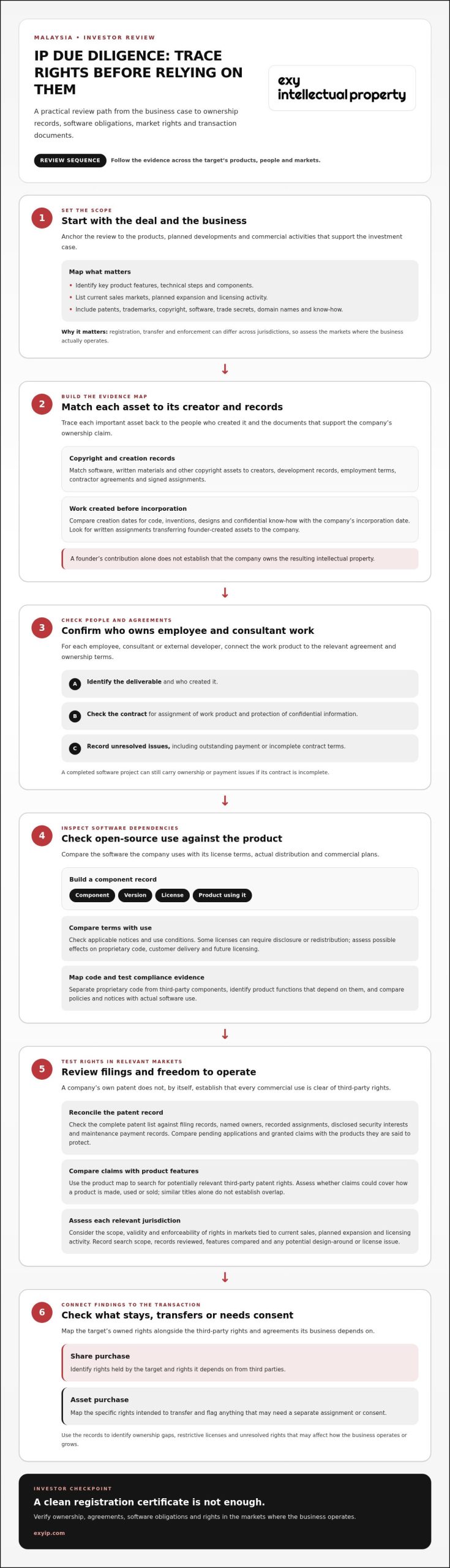
Check copyright ownership and creation records. Match software, written materials and other copyright assets to their creators and supporting documents. Review employment terms, contractor agreements, development records and any assignment signed by the creator. Copyright registration is not the only evidence to assess: records should also show how the work was created and how ownership passed to the company.
Trace pre-incorporation work. Compare the company’s incorporation date with the creation dates of its code, inventions, designs and confidential know-how. If founders created assets before incorporation, look for written assignments transferring those rights to the company. A founder’s contribution alone does not establish that the company owns the resulting intellectual property.
Review consultant-created IP. For each consultant or external developer, identify the deliverable, relevant agreement and ownership provision. Check whether the agreement assigns the work product to the company, protects confidential information and records any outstanding payment. A completed software project, for example, may still carry ownership or payment issues if its contract is incomplete.
Inventory open-source software. Request the component list, licence terms and records showing how each component is used in the product. Compare those terms with the company’s distribution and commercial plans. Some licences can require disclosure or redistribution; determine whether those terms could affect proprietary code, customer delivery or future licensing. Record each component, version, licence and product that uses it.
- Match code to licence terms. Check each component against its applicable notice and use conditions, because combining software can create obligations the company must manage.
- Separate proprietary and third-party code. Map where external components appear, so an investor can identify which product functions depend on them.
- Review compliance evidence. Compare internal policies, notices and distribution materials with actual software use, because written policies alone do not prove compliance.
Assess patents across relevant markets. Reconcile the complete patent list with filing records, named owners, recorded assignments, disclosed security interests and maintenance payment records. Compare pending applications and granted claims with the products they are said to protect. Then assess scope, validity and enforceability in each relevant jurisdiction, rather than treating one registration as worldwide protection.
For cross-border businesses, compare filing territories with current sales, planned expansion and licensing activity. For example, assess a Malaysian company selling in multiple markets against its rights and third-party exposure in each one. This review of ownership, software and filings helps investors identify gaps before relying on an asset’s stated value.
What is Intellectual Property Due Diligence in Malaysia?
For a Malaysian investment, intellectual property due diligence examines the rights and commercial dependencies that could affect a transaction. It helps investors understand whether the target’s intangible assets support its products, revenue model and growth plans. The review can include patents, trademarks, copyright, software, trade secrets, domain names and know-how, with attention to the markets where the business operates.
Freedom-to-operate analysis considers whether a product or process may conflict with third-party intellectual property rights in intended markets. It differs from assessing whether the company can obtain its own patent. A patent may protect an invention, but that alone does not establish that every commercial use of it is clear of other rights.
Begin with the transaction’s commercial purpose. Identify the products and planned developments that support the investment case. Break each product into key features, technical steps and components, then use that map to guide searches for potentially relevant third-party patent rights. This connects the review to the target’s actual business activities, rather than treating its patent portfolio as an isolated list.
- Set the search scope. Identify relevant products, technical features and intended markets so the review focuses on rights that could affect the transaction.
- Compare claims with product features. Assess whether relevant patent claims could cover how a product is made, used or sold; similar titles alone do not establish overlap.
- Evaluate potential restrictions. Consider the status, scope and enforceability of relevant rights in each market tied to the investment.
- Record the reasoning. Document the search scope, records reviewed, features compared and any potential design-around or license issue.
Connect intellectual property to the deal structure. For a share purchase, identify rights held by the target and rights it depends on from third parties. For an asset purchase, map the specific rights intended to transfer and flag anything that may require a separate assignment or consent. This distinction helps investors understand which assets remain with the business and which need transaction documents.
For a Malaysian business with overseas sales or expansion plans, assess relevant rights and third-party exposure market by market. A search covering only current products may miss planned developments, so record the business plans and assumptions used to define its scope. This gives transaction teams a clear basis for deciding whether to update the review if plans change.
Keep the analysis tied to the investment decision. A patent-focused review can examine existing records alongside the target’s claimed position through a patent novelty search.
IP licences, assignments and joint development agreements
Contracts can determine whether intellectual property remains usable after an investment, acquisition or business change. Review signed agreements alongside the asset schedule, then map each right to its owner, permitted users, restrictions and transfer conditions. A patent or software asset may support the company’s position, while a third-party licence limits how the company can operate or transfer it.
To check assignments and agreements, match each employee, consultant and inventor to their signed contract, work product, assignment terms and payment records. Confirm that rights transfer to the company, confidentiality duties cover relevant information, and any outstanding compensation or other payments are identified. A consultant’s code, for example, should be linked to a written agreement and the deliverable it covers.
Review each contract against the proposed deal. Check the clauses below and record any required consent, restriction or unresolved obligation.
- Employee and contractor assignments: Confirm that agreements cover work product and relevant intellectual property, identify the company as recipient, and include signatures and effective dates; missing documents can leave ownership uncertain.
- Inventor and contributor terms: Compare invention records with employment or consultancy agreements, then identify promised compensation and unpaid amounts; this helps reveal obligations tied to specific work.
- Licences to the company: Record the licensed asset, permitted uses, territory, duration, exclusivity, sublicensing rights and termination terms; these define whether the company can operate and scale as planned.
- Licences from the company: Identify each licensee, restrictions, warranties and revenue or performance commitments; existing grants may limit what an investor can acquire or commercialize.
- Joint development agreements: Separate pre-existing intellectual property from jointly created results, and check ownership, access, filing control and future-use rights; unclear terms can obstruct later product development.
- Security interests and other claims: Review disclosed liens, encumbrances, disputes, infringement notices and settlements; a claim against an asset can affect its transfer or use.
For a proposed acquisition, review change-of-control and anti-assignment clauses in every material licence. Identify who must consent, whether the agreement can terminate, and whether assignment requires separate approval. Asset sales and forward mergers are more likely than other transaction structures to trigger anti-assignment clauses, so compare the deal structure with the wording before signing.
Negotiate IP-specific representations and warranties covering ownership, authority to transfer, disclosed licences, disputes and known infringement notices. Consider indemnities tied to identified IP risks, with scope aligned to the assets and claims at issue. Closing conditions can require delivery of signed assignments, specified third-party consents or resolution of a recorded encumbrance before the transfer proceeds.
Document each finding with the relevant agreement, clause, affected asset and proposed action. This creates a practical record for negotiations and post-close integration, including licence updates, assignment records and planned transfer steps.
How can investors verify trademark registration status in Malaysia?
Begin with the target company’s trademark schedule and compare each entry with official Malaysian records. The national intellectual property office administers trademark registration, and the Trademarks Act 2019 is Malaysia’s governing legislation. Search by mark and owner name, then compare the results with certificates, application records and any assignment documents held by the company.
Separate registered marks from pending applications and other status entries. A pending application is not a registration, and a company name or active brand use does not by itself show that the company owns a registered mark. For each material mark, record the applicant or registered owner, application or registration number, status, goods and services, and any available renewal information.
- Match the mark to its use. Compare the registered wording or logo with the name used on products, websites and customer materials, because variations may not be covered by the same record.
- Check the business scope. Compare the goods and services in the record with the company’s actual offerings and planned expansion, noting any important gaps.
- Trace changes in ownership. Match past owner names to assignment documents and the current company record, so the transaction schedule reflects the rights being acquired.
- Record adverse matters. Review available opposition, objection and dispute information, along with notices or settlement documents provided by the company.
Do not rely solely on the seller’s schedule. Search official public records independently, then compare the results with the company’s documents. This can reveal a mark omitted from the schedule, a different recorded owner or an application whose status has changed. Keep a dated record of search terms and results so transaction teams can understand the review’s scope, and consider engaging Exy Intellectual Property to support comprehensive verification.
Trade secrets need a separate evidence trail because they do not appear as registrations in a public trademark search. Identify confidential material such as a formula, customer information or source code, then examine confidentiality agreements and internal access controls. Compare the agreements with actual disclosure practices, including access by employees, consultants and commercial partners.
For example, if a business treats a product formula as a trade secret, review who can access it, how it is shared with manufacturers, and whether relevant agreements restrict disclosure. Written policies should match the company’s day-to-day handling of sensitive information.
Complete the review by matching important copyright works, including software and marketing materials, to creation records and ownership documents. Keep trademark, copyright and trade-secret findings distinct. This separation helps investors utilizing an IP due diligence checklist for investors assess what is registered, what relies on confidentiality, and what evidence supports the company’s ownership claims.
Design registration and prior publication risks
A design portfolio can look complete while overlooking a key risk: public display before registration. In Malaysia, industrial designs are governed by the Industrial Designs Act 1996, and a startup should assess whether displaying a design before registration may create prior-publication issues. For investors using this IP due diligence checklist for investors, the practical task is to connect each design’s ownership, filing history and disclosure record.
Start with the product designs that support revenue, customer recognition or planned expansion. Match each design to its application or registration record, owner, creator and relevant product. Then compare those records with dated evidence of development and disclosure, such as presentation files, product catalogues, launch materials, archived webpages and exhibition documents. A dated product image can help establish when a design appeared publicly.
Apply the same review to designs created before incorporation or by external contributors. Identify the designer, creation date, employer or commissioning party, and any written assignment to the company. If a founder designed a product before the company existed, record the transfer documents and compare them with the company’s claimed ownership. For consultant-created packaging, match the contract to the specific design files and deliverables.
For each design in the portfolio, record:
- Identity: Describe the product and design features, then match them to the relevant application or registration record.
- Ownership: Link the designer and any previous owner to signed assignments and the current company record.
- Filing position: Note whether the design is filed, registered or pending, and identify the market covered by each record.
- Disclosure history: List dated public displays, product launches, sales materials and third-party presentations for review.
- Disputes and permissions: Record challenges, notices, co-development terms or licences that could affect the company’s ability to use the design.
Assess evidence carefully. A launch deck may show that a design was disclosed, while a later registration document may show the company’s filing position. Compare both timelines and flag any public display before filing for closer legal review. Do not treat registration in one market as proof of protection in every market where the product is sold.
Keep design rights distinct from other IP assets. A product’s name may relate to a trademark, its artwork to copyright, and its appearance to a registered design. Domain names can support online sales, but do not establish design ownership. Separating these records helps investors assess the right protection, identify gaps and plan freedom to operate.
For a transaction, place design records, assignment documents and disclosure evidence together in the due diligence file. This makes the basis for each ownership claim easier to assess and highlights designs needing further attention. Review design ownership risks with Exy Intellectual Property before relying on design rights in an investment decision.
Exy Intellectual Property: Trademark Registration
Exy Intellectual Property helps businesses address identified registration gaps through Trademark Registration. Turn to this support when a review finds an unregistered brand, a filing that needs attention or planned expansion into new markets. Clear records help investors understand the company’s trademark position and next steps.
For other assets, Exy Intellectual Property also provides Patent Filing, Industrial Design Registration and Copyright Voluntary Notification. These services can support businesses in organising protection for inventions, product designs and copyright works alongside trademark records.
For an investment review that identifies a specific registration need, contact Exy Intellectual Property or visit exyip.com.
Turn diligence findings into a clear investment plan
Use an IP due diligence checklist for investors to turn review findings into decisions, not just an archive of documents. Prioritise issues by their effect on the deal: which rights support the business’s core revenue, which gaps affect planned expansion, and which contract terms need action before closing. Assign each item an owner and record the evidence or decision needed to resolve it.
Where the next step involves protecting an asset, Exy Intellectual Property offers Trademark Registration, Patent Filing and Industrial Design Registration. These services can help address registration needs identified during an investment review, while a clear record of unresolved issues supports focused discussions between investors and the business.
For guidance on a specific registration need, contact Exy Intellectual Property. A considered next step can help put the investment on a clearer footing.
Frequently Asked Questions
What Is IP Due Diligence?
IP due diligence is a review of intellectual property that may affect a business transaction. It helps investors understand whether the target’s rights support its products, revenue model and growth plans. For example, if a company’s value depends on one software platform, the review can examine whether that platform and its essential components remain available for commercial use after the deal.
What are common IP red flags in transactions?
Common red flags include conflicting ownership records, unsigned creator agreements, undisclosed licences, missed maintenance payments, open-source obligations that conflict with product plans, and unresolved infringement notices. A mismatch between a company’s public brand and its registered trademark owner also deserves attention. Investors should record the affected asset, the evidence supporting the issue and its possible effect on operations or the transaction.
Why is IP due diligence important in mergers and acquisitions?
It helps an investor determine whether valuable rights will remain available after ownership changes. A target may depend on a supplier’s software licence, a founder’s unassigned invention or a brand used with another party’s permission. Identifying that dependency before closing can inform deal terms, consent requirements and integration plans. It also helps distinguish assets that support the purchase rationale from rights requiring further action.
What should an IP due diligence checklist cover for investors?
An IP due diligence checklist for investors should cover the asset inventory, owners and creators, assignment documents, filing and renewal records, licences, disputes, confidentiality controls and software components. It should also note the markets where the business operates and plans to expand. For each finding, record the source document, the affected product or business activity, and any action needed before or after closing.
How can investors verify ownership and chain of title for patents, trademarks, and copyrights?
Build a chain-of-title schedule for each material asset. Start with the creator or original applicant, then match every transfer to a signed assignment and the current registry or company record. Compare names, dates and asset identifiers across documents. For copyright works, include creation records and contributor agreements; for patents and trademarks, match application or registration details to transfer documents.
How can investors assess patent validity, scope, remaining term, and freedom to operate?
Review the patent’s current status, prosecution history, claims, ownership and maintenance records, then compare its claims with the product features it is said to protect. Establish the remaining term from the relevant filing and legal records rather than relying on a portfolio summary. Separately, search third-party rights in the markets where the product will be made, used or sold to identify potential blocking claims.
How should investors review trademark registrations, use, renewals, and potential conflicts?
Compare the trademark register entry with the company’s actual brand use, product range and ownership documents. Record renewal dates and evidence of completed renewals, then flag pending applications and objections separately. Search for similar marks covering related goods or services, and assess whether their use could create a likelihood of confusion. Check key brand variations too, including logos and names used in digital channels.
What copyright and software IP records should investors examine, including open-source licenses?
Review source-code inventories, contributor agreements, development records, copyright notices and documents covering commissioned work. Request a software component list identifying each open-source package, its version, licence and use within products. Compare licence conditions with how the software is modified, combined and distributed. Also examine whether third-party software terms permit the business’s planned operations and whether rights can continue after the transaction.