


A trademark infringement notice in Malaysia can demand that alleged unauthorised use stop, but enforcement may require court proceedings. Under Section 56(1) of the Trademarks Act 2019, a registered proprietor may bring proceedings against a person who has infringed or is infringing the mark. The claim turns on whether the alleged use is likely to confuse or deceive consumers.
A trademark infringement notice in Malaysia can be a practical first step, giving the recipient a chance to stop the use or provide an undertaking. It is not a court remedy. This guide explains what a notice and undertaking may cover, who can bring an infringement action, and which civil remedies a court may grant. It also outlines the evidence and legal distinctions that matter when protecting a registered trademark.
Key Takeaways
- Start by identifying the registered mark, the goods or services it covers, and how the other party is using a similar sign.
- A cease-and-desist letter can set out the conduct to stop and the steps sought to resolve the dispute without immediate court action.
- An undertaking can record commitments made by the recipient, helping clarify what they agree to do next.
- Explore the civil remedies available, including orders to stop infringing use and financial remedies tied to proven loss or profits.
- Understand who may bring an infringement action and why evidence of use, consumer confusion, and resulting harm matters.
Malaysian trademark infringement and enforcement
Registered trademark infringement is unauthorised use of a protected mark in circumstances covered by Malaysia’s Trademarks Act 2019. Section 56(1) gives a registered proprietor the right to bring court proceedings against a person who has infringed, or is infringing, the registered trademark. A notice can raise the concern, but it does not itself determine whether infringement occurred.
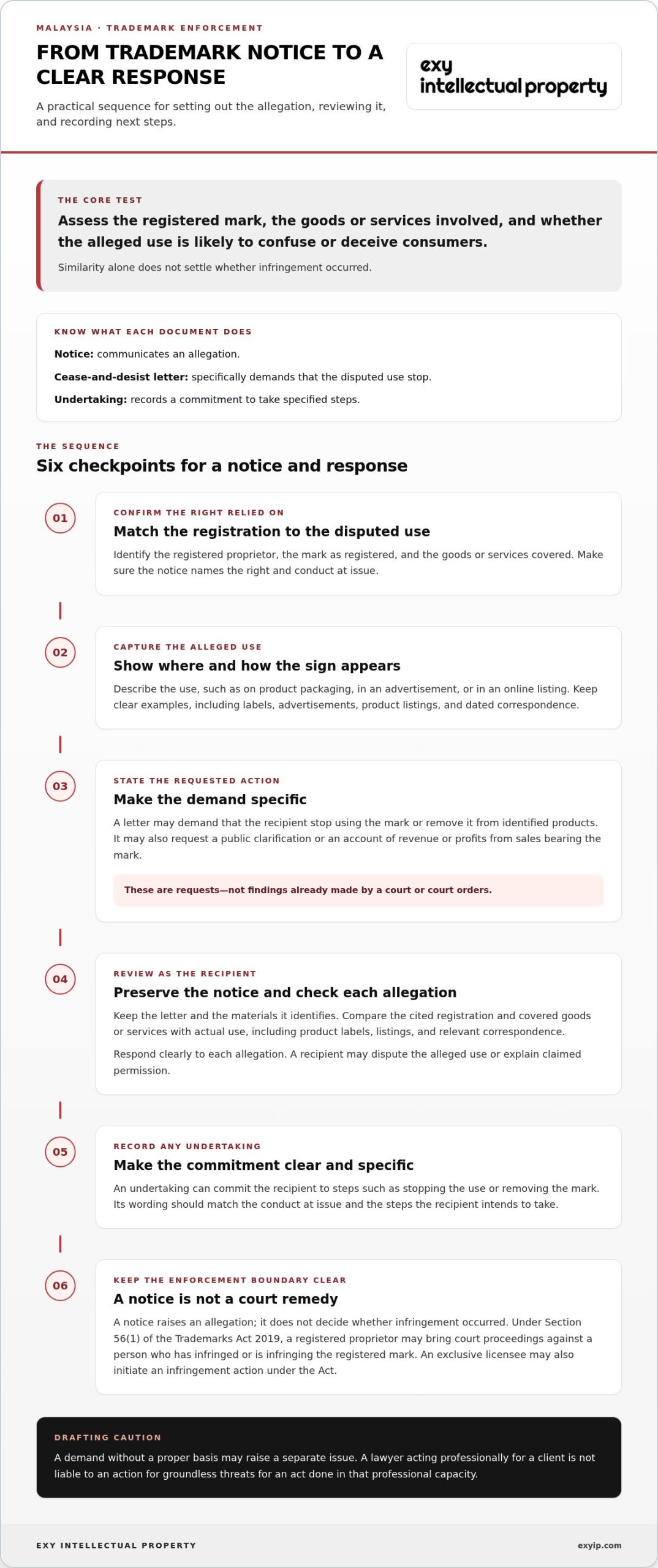
The central test concerns the mark, the goods or services, and the likelihood of consumer confusion. A claim may arise when another party uses a mark identical or similar to the registered mark for goods or services covered by the registration. The question is whether that use is likely to confuse or deceive consumers about the source of the goods or services. Similarity alone does not settle the issue.
Section 54 of the Trademarks Act 2019 is cited in connection with the elements of a registered infringement claim. In practice, compare the signs as used, the products or services involved, and how customers encounter them. For example, a similar mark appearing on competing packaging may raise different concerns from one used in a different commercial context. Keep copies of labels, advertisements, product listings, and dated correspondence to show the alleged use.
Commercial use can matter even when the user does not present the mark as its own brand. In the Malaysian High Court dispute Malaysia Airlines Sdn Bhd and AirAsia Com Travel Sdn Bhd, identified as KLHC Suit No. WA-22IP-14-03/2022, the AirAsia SuperApp displayed Malaysia Airlines’ and Firefly’s registered marks when listing and selling flight tickets. The case illustrates why an enforcement review should examine the full course of trade, not only branding on the seller’s own products.
Responsibility may extend beyond the first seller. In Malaysia, a secondary user may be liable for unauthorised use if they know or have reason to believe that the trademark owner did not authorise it. Relevant evidence may include the user’s role, materials displaying the mark, and communications about permission. These details can help distinguish authorised distribution from use without the proprietor’s consent.
Before taking action against a suspected infringer, match the registration details to the disputed use. Confirm the proprietor, the mark as registered, and the listed goods or services, then preserve clear examples of the use. Section 56(1) identifies the registered proprietor’s court route; an exclusive licensee may also initiate an infringement action under the Trademarks Act 2019. A trademark infringement notice in Malaysia should therefore identify the right relied on and the conduct at issue, rather than treating every resemblance as proof.
Reported decisions provide context, not an automatic result for every dispute. The Federal Court case Ortus Expert White Sdn Bhd v Nor Yanni Bt Adom & Anor is cited as [2022] 2 MLJ 67 when discussing infringement elements. The case Low Chi Yong (t/a Reynox Fertichem Industries) v Low Chi Hong & Anor is cited as [2018] 1 MLJ 175. Together, they reinforce the need to assess the evidence against the registered rights and alleged use.
Cease-and-desist letters and letters of undertaking
A notice or letter can describe an alleged infringement and request a response. Its wording matters: it should distinguish the registered rights claimed from the conduct alleged to breach them.
Notice and Letter Distinctions
A trademark infringement notice communicates an allegation; a cease-and-desist letter specifically demands that the alleged infringer stop the disputed use. The terms can overlap, but the document’s purpose is shown by its contents. Simply telling someone that a trademark is registered is not a threat. A demand without a proper basis may raise a separate issue.
A Malaysian proprietor may use a cease-and-desist letter to demand that the recipient stop using the trademark and remove it from products. The letter may also request a public clarification that the mark was used without consent and that the recipient’s products are unrelated. These are demands, not court orders. A recipient’s agreement or refusal does not itself establish infringement.
Notice Information
A useful notice identifies the proprietor, the registered mark, and the specific use alleged to infringe it. It should describe where the mark appears, such as on product packaging, in an advertisement, or in an online listing. Attach or identify examples so the recipient can understand the allegation and compare it with the claimed rights.
State clearly what action is sought, such as stopping the use or removing the mark from identified products. A letter may request an account of revenue or profits from sales bearing the proprietor’s mark. It may also request a public clarification. Do not present demands as findings already made by a court.
Recipient Responses
After receiving a trademark infringement notice in Malaysia, preserve the letter and the materials it identifies. Compare the cited registration and goods or services with the recipient’s actual use, including product labels, listings, and relevant correspondence. Respond clearly to each allegation rather than treating the letter as a court judgment.
A recipient may dispute the alleged use, explain claimed permission, or offer an undertaking. An undertaking is a commitment to take specified steps, such as stopping the use or removing a mark. Read its wording carefully: the promise should match the conduct at issue and the steps the recipient intends to take.
Before sending a demand, the proprietor should check that the registration and evidence support the specific allegation. A lawyer acting professionally for a client is not liable to an action for groundless threats for an act done in that professional capacity. This protection does not make every demand well-founded or remove the need for accurate wording.
If a recipient considers a threat unjustified, Malaysian law allows an aggrieved person to seek a court declaration that the threat is unjustified, damages for resulting loss, and an injunction against continuing the threat. These possible responses make careful drafting important. For example, a letter should identify the disputed listing or product rather than make broad demands about unrelated activity.
Keep a record of each step: the notice sent or received, supporting examples, replies, and any proposed undertaking. If the parties reach an agreement, its terms should state what use must stop and how existing products or materials will be addressed. Clear records help both sides understand the position and reduce disputes about what was requested or promised.
Civil remedies for trademark infringement
A civil remedy is a court-ordered measure addressing proven trademark infringement. Under Section 56(3) of Malaysia’s Trademarks Act 2019, the court may grant an injunction, damages, or an account of profits. These remedies address different consequences: stopping continued use, compensating proven loss, or accounting for profits connected with the infringement.
Ignoring a notice does not itself prove infringement or automatically create liability. However, the proprietor may pursue court action, where the court can consider the evidence and available remedies. Continued use after receiving a notice may be relevant evidence, but the claimant must still establish the legal basis for the claim and support the remedies sought.
An injunction is a court order restricting specified conduct. In a registered trademark case, it may prohibit further use of the infringing mark. The court may also order the infringer to erase, remove, or obliterate the mark from infringing goods or materials in their possession, custody, or control. For example, an order could address marked stock or packaging held by the defendant.
Destruction is a separate possible order concerning infringing goods, materials, or articles. The court may order their destruction when resolving the case. This differs from removal: erasing a mark may leave an item usable, while destruction addresses the infringing item itself. The remedy concerns the goods or materials involved, not every product associated with the defendant.
Damages are monetary compensation intended to address loss caused by infringement. A proprietor must prove that losses resulted from the unauthorised use. In Wembley Gypsum Products Sdn Bhd v MST Industrial Systems Sdn Bhd [2007] 7 MLJ 193, damages were described as compensating losses sustained from the defendant’s tort. The number of infringing goods sold cannot automatically be treated as the number the proprietor would otherwise have sold.
An account of profits requires the infringer to account for profits connected with the infringement. A proprietor may seek this remedy or damages representing lost profit. Malaysia’s Trademarks Act 2019 allows both damages and an account of profits in a successful action, provided profits have not already been included when calculating damages. The distinction matters: the claim concerns the proprietor’s loss, while the account concerns the defendant’s gains.
The High Court considered damages for trademark infringement and passing off in Warmal Wil Heavy Duty Pumps Sdn Bhd v Pump Matrix Engineering Sdn Bhd [2019] 11 MLJ. Its citation offers a Malaysian example of courts assessing monetary remedies in disputes involving protected marks. Evidence of sales, use, and resulting loss may inform the assessment, but sales figures alone do not establish the proprietor’s lost sales.
For a proprietor, the practical step is to match each requested remedy to evidence. Identify which use should stop, which goods or materials contain the mark, and what loss or profits can be demonstrated. A notice may seek voluntary action, but only a court can grant Section 56(3) remedies. For a recipient, responding to the allegations and preserving relevant records can help clarify the dispute before proceedings advance.
Trademark law and regulations
Malaysia’s trademark framework is the legislation and regulations governing registration and protection of marks. The Trademarks Act 2019 and Trademarks Regulations 2019 came into effect on 27 December 2019, replacing the Trademarks Act 1976 and Trademarks Regulations 1997. For a notice recipient, identifying which law applies helps distinguish a registered infringement claim from other routes, including passing off.
A registered trademark is a mark entered on Malaysia’s register for specified goods or services. Section 48 of the Trademarks Act 2019 provides the registered proprietor’s exclusive statutory right to use it. Registration is territorial: a Malaysian registration does not itself protect the mark in another country. A business trading across borders therefore needs to consider protection in each relevant market, rather than assume Malaysian registration extends worldwide.
Registration lasts 10 years in Malaysia and can be renewed for an additional 10 years. These periods matter when assessing the rights named in a notice: compare the registration record, proprietor, mark, and goods or services with the alleged use. The Intellectual Property Corporation of Malaysia administers the country’s trademark laws and practice, including the registration framework.
Passing off is a common-law claim that may protect an unregistered mark through goodwill and reputation. Sections 159(1) and 159(2) of the Trademarks Act 2019 are cited as preventing an infringement action for an unregistered trademark, while preserving passing off as a possible legal action. A passing-off claimant must establish goodwill or reputation, likely misrepresentation to the public, and actual or potential damage.
The distinction affects how a notice should describe the legal basis. A claimant relying on registration identifies the registered mark and relevant goods or services. A party relying on passing off must focus on reputation, the alleged misrepresentation, and resulting or potential damage. In Mohammad Hafiz bin Hamidun v Kamdar Sdn Bhd [2021] 4 MLJ 878, the Federal Court case is cited in connection with passing-off elements.
Section 24(4) recognises passing off when considering refusal of registration, where a rule of law protects an unregistered trademark or other trade sign. That provision reinforces the distinction between registration rights and reputation-based protection. It does not turn an unregistered mark into a registered trademark or remove the need to establish the elements of passing off.
A threat is a legal communication that alleges infringement or demands action from the recipient. In Malaysia, threatening infringement without basis may be actionable, but simply notifying someone that a trademark is registered is not a threat. A notice should state its legal basis and the alleged conduct accurately. Check whether it relies on registration or passing off, then assess the stated facts against that basis.
Who can send a trademark infringement notice in Malaysia?
A trademark infringement notice is a written allegation that someone is using a protected mark without authorisation. In Malaysia, the registered proprietor is the clearest sender because Section 56(1) of the Trademarks Act 2019 gives that proprietor the right to bring infringement proceedings. A notice is not itself a court action, so distinguish the right to send a demand from the right to sue.
The registered proprietor is the person or entity recorded as owning the Malaysian registration. Before sending a notice, compare the registration details with the proposed sender’s name and the mark being enforced. For a company-owned mark, identify the company as proprietor rather than describing an individual employee as the rights holder. This helps the recipient understand whose rights the notice relies on.
An exclusive licensee is a licensee with exclusive rights under the relevant arrangement. Under Malaysia’s Trademarks Act 2019, an exclusive licensee may initiate an infringement action. That right does not make every licensee an exclusive licensee. A recipient should read the notice’s stated role and authority, while the sender should describe the rights relied upon accurately.
A representative may communicate for a proprietor or licensee, but should clearly identify whom they represent. An advocate and solicitor in Malaysia is not liable to an action for groundless threats for an act done in a professional capacity on behalf of a client. This protection relates to professional conduct; it does not establish that infringement occurred or validate every demand in a letter.
For example, if a notice names a distributor as the rights holder, compare that claim with the registration record. If it names a proprietor and says a solicitor is writing on that proprietor’s behalf, keep the letter and note the stated authority. The sender’s identity, the rights claimed, and the alleged use should be clear enough for the recipient to assess the demand.
A person relying on an unregistered mark should distinguish an infringement claim from passing off. Sections 159(1) and 159(2) of the Trademarks Act 2019 are cited as preventing an infringement action for an unregistered trademark, while passing off remains a possible legal action. In that situation, the notice should not present an unregistered mark as a registered right.
Before sending or responding, follow a practical sequence: identify the registered proprietor, match the mark and goods or services to the registration, then state the sender’s authority and the conduct alleged. A vague ownership claim can obscure the issue. Identifying the proprietor or exclusive licensee gives the recipient a defined basis for assessment.
If you need to clarify who holds the relevant rights, review your Malaysian trademark registration position before preparing or responding to an enforcement notice.
Exy Intellectual Property: Trademark Registration
Exy Intellectual Property provides Trademark Registration for businesses seeking to establish registered rights for their marks in Malaysia. If you are developing a brand or want to strengthen its protection before disputes arise, registration can help define the mark and the goods or services covered. A clear registration record also gives you a firmer foundation when assessing a later infringement concern.
Turn to Trademark Registration when you need to protect a mark used for your business, products, or services. The right filing strategy depends on the mark and the commercial activity it represents. Registration does not resolve every dispute, but it can clarify the rights you rely on when considering enforcement.
For support protecting your business mark, contact Exy Intellectual Property.
Set a Clear Direction for Your Brand
A trademark infringement notice in Malaysia can prompt you to align brand decisions with your wider business plans. Consider how your identity appears across products, promotions, and business channels, and decide who should oversee those choices as your company grows.
A consistent approach helps your team make informed decisions about brand use and communications. It also provides a clearer basis for planning how your business presents itself to customers and partners.
For guidance on your next step, contact Exy Intellectual Property. Move forward with a clear view of your business priorities.
Frequently Asked Questions
How do I enforce my exclusive rights over my trademark against an infringer?
Set an internal process for deciding who handles suspected misuse and which business activities need review. For example, ask the sales team to flag new products or promotions using the disputed sign, while a designated contact coordinates records and communications. Keep enforcement decisions consistent across distributors and sales channels. This helps prevent one team from making concessions or public statements that conflict with the rights holder’s position.
What counts as trademark infringement under Malaysian law?
Use of a mark in business may raise an infringement issue when it draws on a registered mark in a way covered by Malaysian law. Assess the overall presentation, not just a shared word or design element. For example, compare how the sign appears alongside the seller’s own business name and product details. That context can help show whether customers might think the goods come from, or are connected with, another business.
Which laws govern trademark infringement notices in Malaysia?
The principal laws are Malaysia’s Trademarks Act 2019 and Trademarks Regulations 2019. The Act sets the statutory framework for trademark rights, while the regulations form part of the registration and administrative framework. When reviewing a notice, focus on the precise mark and registration entry it identifies. A registration for a particular representation should not be casually treated as covering every brand element a business uses.
How do you send a trademark infringement notice in Malaysia, and what proof of delivery is needed?
Keep an audit trail linking the notice to what the recipient actually received. Save the final document and every attachment, record the recipient details used, and retain delivery acknowledgements or any returned or failed-delivery message. If the recipient replies, preserve the reply with the original notice. These records can help clarify later disputes about which allegations or supporting materials were communicated.
What response deadlines are commonly given in Malaysian trademark infringement notices?
A private infringement letter may state a requested response date, but do not confuse it with a formal opposition deadline. In a Malaysian trademark opposition, an applicant must file a counter-statement within two months of receiving the opposition notice. That timetable concerns opposition proceedings, not an ordinary cease-and-desist demand. Check the document type before treating a stated date as a statutory filing deadline.
What remedies and penalties are available for trademark infringement in Malaysia?
Available civil remedies are court measures, not penalties imposed by a private notice. A demand letter may state the rights holder’s position or requested outcome, but it cannot determine liability or award relief. If a notice claims a specific consequence, distinguish the sender’s demand from a remedy a court may grant. The nature of the claim and the evidence presented shape what the court can consider.
What are the options for resolving a Malaysian trademark dispute without going to court?
Parties can negotiate terms that address future use without leaving operational details open. For example, an agreement could define permitted branding, sales channels, territory, and any transition arrangements. It could also set out how future disagreements will be raised and handled. Clear boundaries help both sides understand what is allowed and reduce the risk of the same dispute returning in another form.