


A cease and desist letter is a warning, not a court order. For a copyright claim in Malaysia, a cease and desist letter template can help explain the alleged infringement and demand that it stop, but the letter itself is not legally enforceable. Malaysia’s Copyright Act 1987 (Act 332) governs copyright protection; if the matter proceeds to court, legal remedies are pursued through that process.
It’s understandable to want a clear, formal way to protect your work, especially when it appears online or is used commercially without permission. A letter can document your position and give the recipient a chance to respond, but it does not establish that infringement occurred or compel compliance.
This guide explains who should receive the notice, what details to include, how to send it, and when a 7-14 days compliance deadline may be appropriate. It also covers the letter’s practical benefits and limits, so you can decide whether it is a suitable first step for your copyright concern.
Key Takeaways
- A copyright cease and desist letter can communicate your position, but it does not compel the recipient to comply like a court order.
- Document the work and the alleged infringement clearly so the recipient can identify what use you are challenging.
- Address the notice to the individual or legal entity responsible, and choose a delivery method that leaves a verifiable record.
- Consider whether a letter is a practical first step, or whether the circumstances call for a different response.
- Understanding the letter’s limits helps you set realistic expectations about what may happen next.
Is a Cease and Desist Copyright Infringement Letter Legally Enforceable?
No. In Malaysia, a copyright cease and desist letter is not a court order and cannot, by itself, force someone to stop using a work. It warns the recipient that legal action may follow if the alleged infringement continues. Its practical value depends on identifying the protected work, explaining the disputed use, and making a clear request.
Before drafting, identify who created the work and who owns the relevant rights. If several people contributed, distinguish their contributions and review any agreements about ownership or permission. This helps you state the basis for your request accurately, without treating authorship, ownership, and authority to act as interchangeable.
Copyright protection in Malaysia arises automatically upon creation, so registration is not a prerequisite to asserting ownership. The Copyright Act 1987 (Act 332) is the primary legislation governing copyright. A claimant should still be able to show why they own, or are authorised to act for, the particular work.
Statutory Evidence via Section 26A Voluntary Notification
While copyright arises automatically upon creation under the Copyright Act 1987, establishing ownership in a contentious dispute can be challenging without formal documentation. Under Section 26A of the Copyright Act 1987, copyright owners can submit a Voluntary Notification of Copyright to MyIPO. An official MyIPO notification certificate serves as prima facie evidence of ownership and creation date in Malaysian courts, significantly strengthening the credibility of a pre-action cease-and-desist notice.
Build a record of ownership before sending a letter. For a photograph, retain the original image file and earlier edits; for a written work, keep dated drafts and source documents. If a freelancer or company created the work, review the relevant agreement to establish who owns the rights. If a licence permits certain uses, compare its terms with the use you are challenging.
The Section 26 Contractor Ownership Trap
Before demanding that a third party cease using creative material, verify whether your business holds actual legal title. Under Section 26 of the Copyright Act 1987, copyright in works created by an employee in the course of employment vests automatically with the employer. However, independent contractors, freelance designers, and third-party agencies retain default copyright ownership of all commissioned works—even after all invoices have been paid in full. To assert rights against infringers, the business must hold an executed, written IP Assignment Deed signed by the creator.
Evidence should connect the recipient to a specific act, not merely show that similar material exists online. Record the page or platform, account or business name, material displayed, and date you observed it. Preserve screenshots and copies of relevant files. For example, a screenshot of a product page may show an image in use, while the original image file may help identify the work.
- Identify the work by title, description, or file, and state how you claim ownership.
- Describe each alleged use, including its location and the date you observed it.
- Keep copies of the work, relevant agreements, screenshots, and communications.
Malaysia’s Copyright Act 1987 (Act 332) includes Section 13, which addresses reproduction rights, and Section 14, which covers distribution rights. Refer to the provision that fits the alleged conduct, rather than listing sections without explaining the connection. A copied image shown on a commercial page, for example, raises different factual details from a work distributed through another channel.
A letter can state the alleged infringement and request that it stop, but the recipient may dispute ownership, permission, or the facts. Section 37 of the Copyright Act 1987 (Act 332) allows claims for actual and statutory damages. A letter does not establish liability or award damages; those outcomes require the matter to proceed through the appropriate legal process.
Correct recipient and service of notice
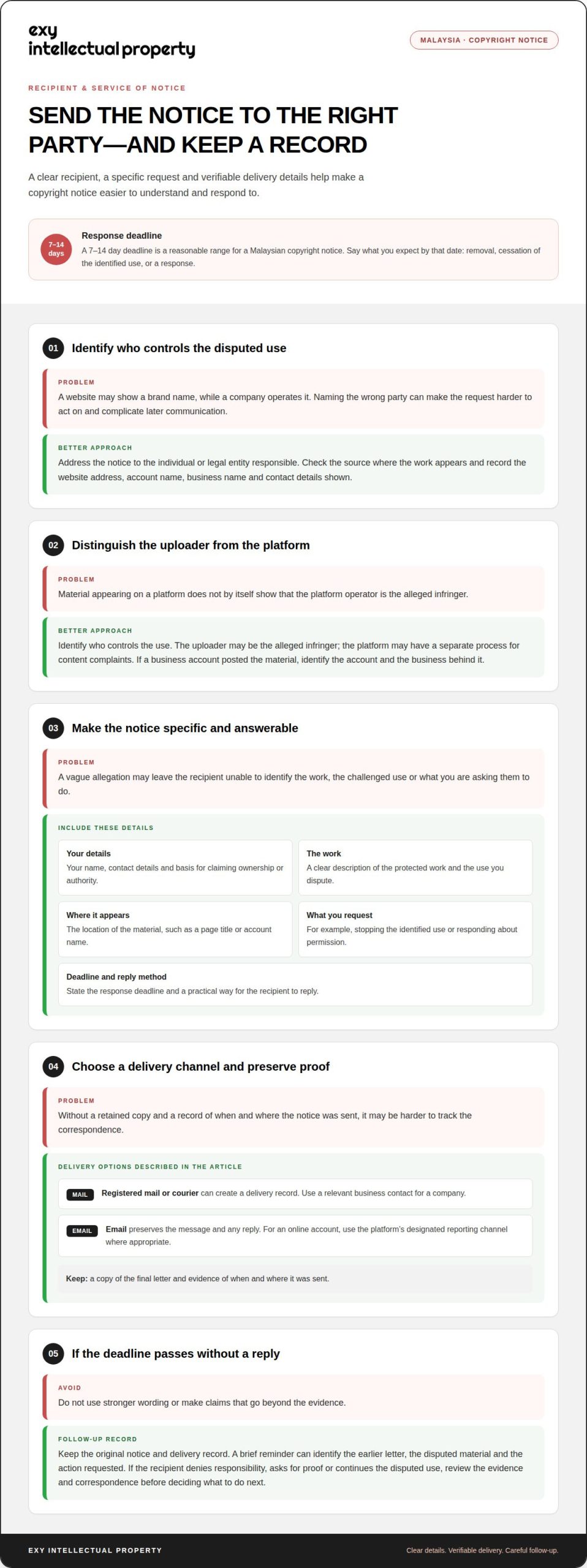
Address the notice to the individual or legal entity responsible for the alleged infringement. A website may display a brand name, while its terms or business records identify the company operating it. Naming the wrong party can make the request harder to act on and complicate later communication.
Match the suspected use to the person or organisation controlling it. If a business account posted a copied illustration, identify the account and the business behind it. If an employee uploaded material to an organisation’s website, direct the notice to the responsible organisation rather than assuming the employee is the only relevant recipient.
Before sending, check the recipient’s details against the source where the work appears. Record the website address, account name, business name, and any contact details shown. If the material appears on a platform, distinguish the uploader from the platform operator. The uploader may be the alleged infringer; the platform may have a separate process for content complaints.
Make the notice easy to understand and respond to. Include:
- Your name and contact details, plus the basis for claiming ownership or authority.
- A clear description of the protected work and the use you dispute.
- The location of the material, such as a page title or account name.
- The action requested, such as stopping the identified use or responding about permission.
- A response deadline and a practical method for replying.
A response deadline of 7-14 days is a reasonable range for a Malaysian copyright notice. State the deadline clearly, and explain whether you expect removal, cessation, or a response by that date.
Send the notice through a channel suited to the recipient. For a company, use its relevant business contact; for an online account, use the platform’s designated reporting channel where appropriate. Keep a copy of the final letter and evidence of when and where you sent it. Registered mail or courier can create a delivery record, while email preserves the message and any reply.
If no reply arrives by the stated deadline, keep the original notice and delivery record before following up. Send a brief reminder identifying the earlier letter, the disputed material, and the action requested. Avoid stronger wording or claims that go beyond the evidence. If the recipient denies responsibility, asks for proof, or continues the disputed use, review the evidence and correspondence before deciding what to do next.
Where documenting a Malaysian work is also part of your next step, copyright voluntary notification may be relevant. Keep that process distinct from serving a notice, which should identify the recipient and the specific conduct you challenge.
Sending the letter by registered mail or courier
Registered mail or courier can give you a verifiable delivery record for a copyright notice. Confirm the recipient’s postal address, prepare the final letter and enclosures, and retain the posting receipt. The record can help show when the notice was sent and whether delivery was recorded. It does not prove infringement or make the letter legally enforceable.
Before dispatch, match the recipient’s name and address to the business or individual connected with the alleged use. If a company operates the website, address the letter to the relevant legal entity rather than relying only on its trading name. For an individual, use the address associated with their role in the disputed use. Clear addressing reduces confusion about who received the notice.
Prepare a complete dispatch set. Keep a copy of the signed letter, every enclosure, and the envelope or courier details. If the letter refers to supporting material, label each attachment so the recipient can identify it. For example, a short enclosure list can distinguish a screenshot from an official intellectual property registration record without changing the substance of your request.
- Record the dispatch date, delivery method, recipient, and tracking reference.
- Save the posting receipt and any available delivery confirmation.
- Keep a copy of the exact letter and documents sent together.
- If delivery fails, retain the returned item or courier notice and reassess the address.
Registered mail or courier is useful when you want a paper trail linked to a physical recipient. Email can provide a separate communication record, but save the sent message and any reply independently. If you send copies through more than one channel, note each dispatch date and recipient so you can tell which record relates to each delivery.
After dispatch, use the tracking information to follow the item’s progress. A delivery confirmation records delivery status; keep it with the final letter, not among unrelated files. If the recipient disputes receiving the notice, these records help clarify what was sent and where. They do not establish the copyright allegation, so keep the supporting evidence organised separately.
For online infringement, a postal notice and a platform complaint serve different purposes. The letter can go to the responsible individual or entity, while a platform’s reporting channel may address content hosted on its service. Keep a copy of any platform submission and response with the postal records, while keeping each action distinct and easy to review.
Official registration details obtained through Exy Intellectual Property can be included where relevant to identify the work and support the notice. Check that the record refers to the same material described in the letter, then retain a copy of the information sent. Accurate attachments help the recipient understand the claim and help you maintain a consistent record of your communication.
When to send a copyright infringement letter
Send a notice after identifying the work, the disputed use, and the responsible person or organisation. In Malaysia, base the timing on the evidence and whether the use is continuing.
Timing for Sending a Notice
Act once you can describe the alleged infringement accurately. For example, if you find your image on a retailer’s product page, record the page, image, and date you saw it before drafting a letter. Do not send a cease and desist letter template for a Malaysia copyright claim until you have checked whether a licence or permission covers the use.
Consider whether the recipient can stop the conduct directly. A business that controls its own website may be able to remove material. If another party controls the page, identify that role before choosing the recipient. Keep the request focused on the specific use and response you want, rather than making broad accusations about every appearance of the work.
A sample letter can use this structure:
- Subject: Copyright concern regarding your proprietary digital marketing banners and graphic designs.
- Ownership: I am the authorized legal representative of Exy Intellectual Property and the exclusive rights holder of the creative works.
- Use identified: The protected work appears without authorization at the public commercial checkout page on your company website and associated social media profiles in the promotional campaign materials.
- Request: Please remove and permanently cease the unauthorized use of the material, and respond by the designated deadline of the fourteenth day following receipt.
- Contact: Please send your formal written response directly to our corporate legal department or designated professional representatives.
Replace every placeholder with accurate information. A Malaysia-specific cease and desist letter template for copyright concerns should reflect the facts and avoid suggesting that a court has already found infringement.
Online Copyright Infringement
For online use, preserve the webpage or post before requesting removal. Save screenshots showing the material, account name, and page location, and record when you captured them. Identify whether the content appears on a business website, social account, or hosting platform, as the responsible party may differ.
The Communications and Multimedia Act 1998 is relevant to copyright infringement occurring through digital means or online platforms in Malaysia. Direct your notice to the party responsible for the disputed use, and use a platform reporting route where available. A copyright owner can also request removal by filing a DMCA takedown request with the hosting platform, but that process should not be confused with a Malaysian legal determination.
If a site republishes an image across several pages, list each page separately. This helps the recipient understand the scope of your request and makes any response easier to assess.
Benefits and limits of a cease and desist letter
A copyright cease and desist letter can make a clear, documented request, but it cannot force compliance. In Malaysia, it is a warning that legal action may follow, not a court order determining whether infringement occurred.
Its practical benefit is clarity. A well-framed notice identifies the work, the use being challenged, and the action requested. For example, a photographer can ask a retailer to stop displaying a particular image rather than making a broad demand about every photograph on the retailer’s site. That precision gives the recipient a specific issue to assess and answer.
A letter may also create an opportunity to resolve a dispute without immediately starting court proceedings. The recipient might remove the material, explain that a licence permits the use, or provide information that changes the owner’s understanding. Each response helps clarify the disagreement. Keep the notice, delivery record, and reply together so the history is clear.
The limits matter. The recipient may ignore the letter, reject the allegation, or continue the use. The letter itself does not establish ownership, decide whether an exception or permission applies, order removal, or award compensation. If the dispute proceeds to court, the copyright owner may seek injunctive relief and attorney’s fees, but sending a notice does not grant those remedies.
An inaccurate or unsupported demand can damage credibility, invite a dispute over ownership or permission, and complicate resolution. Check that you own the relevant work or can act for its owner, and that the evidence supports each use described. Do not present an allegation as a proven finding or demand action against material you have not identified.
Before sending, weigh these practical questions:
- Can you identify the exact work and the specific use you challenge?
- Do your ownership records or agreements support your right to make the demand?
- Is the recipient responsible for the use and able to address it?
- Would a clear request help resolve the issue, or is the dispute already escalating?
A letter is a proportionate first step when the facts are specific and the requested action is achievable. If the recipient disputes the claim or the use continues, assess the evidence and correspondence before choosing what follows. A formal record of copyright ownership can also support rights management; explore copyright voluntary notification as a separate step from demanding that an alleged use stop.
Exy Intellectual Property: Trademark Registration
Exy Intellectual Property can help you consider the next step in protecting creative work and the identity connected to your business. Copyright Voluntary Notification relates to documenting copyright ownership, while Trademark Registration concerns a brand sign, such as a business name or logo. These rights address different assets, so a copyright notice and trademark filing serve distinct purposes.
Consider Trademark Registration if another business is using a sign that identifies your products or services. For original creative work, Copyright Voluntary Notification may be relevant to your records. Exy Intellectual Property also provides Legal Advisory for intellectual property matters, helping you assess what issue your evidence raises and what action aligns with your goals.
For guidance on protecting your work or brand in Malaysia, contact Exy Intellectual Property or visit exyip.com.
Choose a Clear Next Step for Your Work
Your next move can shape how a copyright dispute affects your creative work and business relationships. Before sending a demand or escalating a disagreement, decide what outcome matters most: stopping a particular use, opening a discussion about permission, or preparing for a more formal response. Let that goal guide your wording and the records you keep.
A cease and desist letter template for copyright in Malaysia can provide a starting structure, but it cannot assess the details of your ownership, evidence, or intended outcome. Tailoring the approach to those details helps keep the communication focused and credible. If you need advice on how a copyright concern fits your wider intellectual property position, Exy Intellectual Property can help you consider the next step.
Contact Exy Intellectual Property to discuss your intellectual property needs. A considered plan can help you move forward with greater clarity and protect the value of your work.
Frequently Asked Questions
How Do You Prove Your Right to the Copyrighted Material?
Show how the work connects to you or the person you represent. For a commissioned design, gather the brief, invoices, draft files, and agreement addressing ownership. For work created by an employee, review the relevant employment documents. Keep original files and dated versions together, as they can help explain how the work developed and who created it. If you act for someone else, include evidence of your authority.
What are the requirements for a copyright cease and desist letter in Malaysia?
A letter should identify the work, explain the alleged unauthorised use, state who is making the demand, and specify the action requested. Include enough detail for the recipient to locate the material, such as a page title or account name. Set a clear response deadline and provide a way to reply. These practical elements make the notice understandable; the letter itself does not compel compliance as a court order would.
Is there a Malaysia-specific copyright infringement letter template?
A draft can be tailored to a Malaysian copyright dispute, but a template alone does not establish infringement or compel action. Keep the wording grounded in the Copyright Act 1987 (Act 332) and the particular facts. For instance, a demand about a copied illustration should identify that illustration and its use, rather than rely on US terminology or assume a foreign takedown process governs the Malaysian dispute.
What information should a Malaysian copyright cease and desist letter include?
Include the sender’s identity, the basis for claiming rights, a description of the work, and the specific use being challenged. State what you want the recipient to do, such as remove identified material or stop a particular use. Add a response deadline and contact details. If the work has MyIPO registration details, include the relevant information. Keep the requested action proportionate to the use you have identified.
What evidence should be included when alleging copyright infringement in Malaysia?
Choose evidence that helps identify both the work and the disputed use. For a digital image, this could include the original file, dated drafts, and a screenshot of the page displaying it. For a written work, retain drafts and publication records. If permission or ownership is disputed, relevant agreements may help explain the rights involved. Keep original copies unchanged, and label records with their source and capture date.
How should a cease and desist letter be delivered in Malaysia, and what proof of delivery is needed?
Registered mail or courier can provide a verifiable delivery record. Retain the posting receipt, tracking reference, delivery confirmation, and a copy of the exact letter sent. If you also use email, save the sent message and any reply. Keep these records with the evidence and note which recipient received each copy. A delivery record can show dispatch or receipt, but it does not prove infringement.
What remedies and penalties apply to copyright infringement under Malaysia’s Copyright Act 1987?
Section 37 of Malaysia’s Copyright Act 1987 allows claims for actual and statutory damages. A copyright owner may also seek injunctive relief if the dispute proceeds to court, while the letter itself does not award damages or impose a penalty. The outcome depends on the legal process and evidence. Distinguish a requested remedy in a demand from relief granted through court proceedings.
What can you do if the recipient ignores a copyright cease and desist letter in Malaysia?
Keep the unanswered letter and delivery record, then make a concise follow-up identifying the original notice and unresolved request. Preserve current evidence if the material remains available, such as a dated screenshot or saved copy. If the recipient continues the use or disputes your rights, organise the ownership records, correspondence, and evidence for legal review. A formal notice does not prevent you from considering further steps.