


A Malaysian trademark registration lasts 10 years from its application date and must be renewed every 10 years to remain registered. The trademark renewal process in Malaysia lets you renew before expiry, but missing the deadline can lead to a lapse and a more complicated route to restore the mark.
It’s easy to assume an expired trademark means starting over. The key is to act within the applicable renewal or restoration period and calculate the deadline from the correct registration record.
This guide explains how to check your trademark details in the official online register, determine when renewal is due, and choose the right filing route. It also outlines what may happen if the renewal window passes, so you can plan how to protect your brand rights.
Key Takeaways
- Use the application and registration details in MyIPO’s online register to calculate your trademark’s renewal date accurately.
- Plan for renewal every 10 years, and start preparing before the expiry date so there’s time to choose a filing route.
- Compare filing directly with MYIPO against using an agent, especially if ownership details or the registration record need attention.
- If a mark has expired, act promptly: the available route depends on how much time has passed, and a long lapse can put the registration at risk.
- Learn what renewal protects, what can happen after a lapse, and when trademark registration support may help you manage the next step.
Trademark validity period and how to calculate it
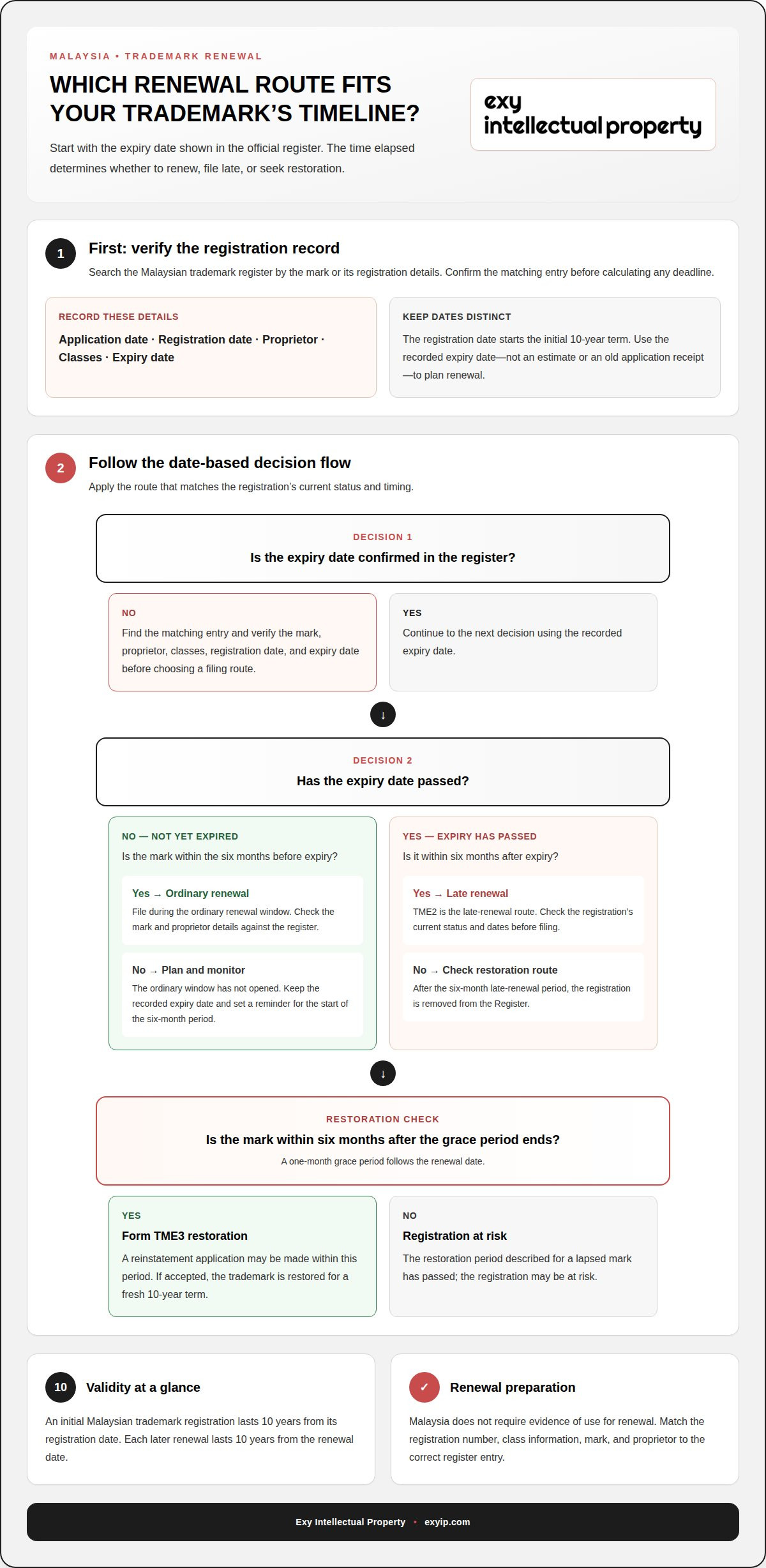
Use the registration record to confirm the current expiry date and identify the applicable filing period. Follow these steps for each Malaysian mark, especially if your business manages several registrations.
- Find the matching register entry. Search the Malaysian trademark register using the mark or its registration details. Record the application date, registration date, proprietor, classes, and expiry date. Label each date clearly: the application date and registration date refer to different events. For a portfolio with several marks, create a separate record for every registration. This reduces the risk of applying one mark’s deadline to another.
- Use the application date to understand validity. A Malaysian registration is initially valid for 10 years from its application date under the Trademarks Act 2019. Each later renewal lasts 10 years from the renewal date. Use the recorded expiry date when planning the next filing, rather than estimating from memory or relying solely on an old application receipt. Keep the record with your trademark documents.
- Plan within the ordinary renewal window. A renewal may be filed during the six months before expiry. Add a reminder at the start of that period, then compare the mark and proprietor details with the register. Allow time to resolve discrepancies before submitting the renewal. Filing during the ordinary window keeps the registration on its regular renewal route and avoids relying on late-renewal procedures.
- Identify the late-renewal period. A one-month grace period follows the renewal date. TME2 is the late-renewal route, and late renewal may be pursued within six months after expiry. Check the registration’s current status and the relevant dates before choosing this route. Malaysia does not require evidence of use for a renewal, so the key preparation is matching the filing to the correct registration and owner.
- Track restoration separately. After the six-month late-renewal period, the registration is removed from the Register, and restoration using Form TME3 is the remaining route described for a lapsed mark. A reinstatement application may be made within six months after the grace period ends. If accepted, reinstatement restores the trademark for a fresh 10-year term. Record restoration as a separate action, not as ordinary renewal.
Before filing, compare your records with the register and confirm which period applies. Accurate dates help distinguish a standard renewal from late renewal or restoration.
Renewal validity under the Trademarks Act 2019
- Use the application date as your starting point. Under the Trademarks Act 2019 (Act 815), an initial Malaysian trademark registration is valid for 10 years from its application date. A trademark application and a registered mark are different stages. For renewal planning, use the date the mark was applied. Compare the registration record with the official register before recording a deadline.
- Record each renewal as a new term. Every subsequent renewal lasts 10 years from the registration’s renewal date. Add that term to your records after the renewal is accepted, then track the next expiry from the renewed registration details. This creates a clear record of successive periods rather than relying on the original application paperwork to calculate every deadline.
- Separate the mark’s validity from its filing history. A filing date identifies when the trademark application entered the process, while the application date starts the initial validity period under Act 815. Keep both dates in your record, labelled clearly. This distinction helps prevent a business from treating an old application receipt as proof that its current registration remains valid.
- Check the renewed record after filing. Once a renewal is processed and accepted, compare the updated registration information with your internal record. Confirm the mark, proprietor details, and renewed term correspond to the right asset. If a business manages several marks, record each registration separately; different application dates can mean different expiry dates and renewal cycles.
- Keep renewal documents distinct from use evidence. Malaysia does not require evidence of use or supporting documents when renewing a registered trademark. Periodic statements of use are also not required for Malaysian registrations. A renewal therefore concerns continuing the registered right, not submitting a routine report of sales or marketing activity. Preserve the registration and renewal records for accurate tracking.
- Plan against the recorded expiry, not an estimate. Build a reminder around the official registration details and review it whenever ownership information changes. A changed business name or proprietor record can make older files harder to match to the right registration. The Trademarks Act 2019 provides the legal framework; accurate records help you apply its 10-year validity and renewal periods to each mark.
Renewing directly with the Malaysian trademark office or using an agent
For a Malaysian trademark renewal, match the registration record to the mark and its owner before filing. Renewal requires registration details, but no supporting documents or evidence of use. Malaysia no longer requires a Power of Attorney for trademark applications. Have the registration number and class information ready before choosing a filing route.
- Find the correct registration record. Search the Malaysian trademark register using the mark or its registration details. Note the registration number, proprietor, classes, and expiry date. The filing date can help identify the application record, but it doesn’t replace checking the current registration status. If your portfolio includes similar marks, match each detail carefully before preparing the renewal.
- Choose direct filing or agent support. You can submit a renewal directly to the Malaysian trademark office or appoint an agent to handle the filing. Direct submission suits owners who can manage the register details, form, and follow-up. An agent may help coordinate a portfolio with different expiry dates or identify mismatches between the registered proprietor and current business records.
- Select the route that matches the deadline. TME1 is used for normal renewal, while TME2 is used for late renewal. The standard filing window is within the six months before expiry. If the mark has expired, check its status and the date before deciding whether TME2 remains available. The appropriate route depends on the registration’s timing, not simply when you prepare the paperwork.
- Prepare owner information if details are changing. Renewal doesn’t require evidence of use or supporting documents. If an owner-detail amendment is pending, renewal may be filed using the pre-amendment details, with updated documents submitted alongside it. Keep both records together so the filing remains connected to the correct rights holder.
- Save confirmation and update your calendar. TME1 renewals are estimated to take 4-6 weeks, while TME2 renewals are estimated to take 6-8 weeks. Retain the filing confirmation and review the register after processing. Record the next expiry date for that specific mark. This final check helps prevent an outdated portfolio record from creating confusion later.
Direct filing may suit a straightforward renewal when the owner details are accurate. Consider agent support if deadlines differ, records need coordination, or a late filing requires closer attention.
Risk of another party registering an expired mark
- Check the registration’s current status. Search the Malaysian trademark register using the mark or its registration details. Note whether the entry remains active, has expired, or has been removed. An expired registration does not automatically transfer ownership, but it can leave the brand without its registered protection. Confirming the status helps distinguish an overdue renewal from a registration that may require restoration or a new filing.
- Act before permanent removal. A Malaysian trademark registration that has been expired for more than 12 months will generally be permanently removed from the Register and cannot be renewed or restored. After removal, another party may seek registration of the same or a similar sign. That application is assessed separately, so another party’s registration is not automatic simply because the earlier mark expired.
- Monitor published applications for similar marks. A person may oppose a published Malaysian trademark application within two months from its publication date. Note the publication date and compare the proposed sign and listed goods or services with your business’s mark. An opposition is a formal response, not an automatic cancellation. Keeping publication dates in your monitoring records helps you identify the relevant deadline.
- Organise records related to the brand. Keep registration details, renewal records, and business documents showing how the mark is used. Renewal does not require evidence of use, but a registration may be challenged on non-use grounds. Invoices, packaging, marketing materials, and licensing records can help document the mark’s commercial role if a dispute or a new application becomes relevant. Non-Use Revocation Exposure (Section 46, Trademarks Act 2019) – While MyIPO does not require declarations or specimens of commercial use to renew a registration, renewing a mark defensively without active trade carries significant legal risk. Under Section 46 of the Trademarks Act 2019, any aggrieved third party can apply to the High Court to revoke a registered trademark if it has not been put to genuine commercial use in Malaysia for a continuous period of three continuous years without valid reasons for non-use.
- Review each country in your portfolio separately. Malaysian registration protects the rights recorded in Malaysia. If your portfolio includes international registrations, track each jurisdiction’s status and renewal deadlines independently. A lapse in Malaysia does not establish that registrations elsewhere have expired. Maintain a country-by-country record of each mark, its status, and the next action, so the right follow-up applies to each registration.
To prepare for a renewal or a possible new filing, note that the described Malaysian trademark renewal process asks the customer to provide the registration details and send a power of attorney. Keep those items with the records for the mark, so they are available if follow-up becomes necessary.
For trademark registration in Malaysia, foreigners must appoint a registered Malaysian trademark attorney to carry out the registration. The average time from filing to trademark registration in Malaysia is 12-18 months, so consider that stated timeframe when assessing a new filing after an expired mark. These process points help distinguish immediate status checks from the steps and time associated with seeking registration again.
Renewal frequency for Malaysian trademark registrations
- Set a repeating ten-year reminder for each mark. A Malaysian trademark registration must be renewed every 10 years. Record the next deadline as soon as a renewal is accepted, then set another reminder for the following cycle. This turns renewal into a recurring portfolio task rather than a one-off administrative fix. Keep the reminder tied to the individual registration, not just the brand name.
- Track registrations separately, even when they protect one brand. A company may hold several Malaysian registrations covering different marks, classes, or filing dates. Each registration has its own renewal cycle, so one calendar entry for the brand can miss a deadline. Use a portfolio table with the registration number, owner, recorded expiry, and next action. Review that table when the business adds a mark or changes ownership details.
- Compare international cycles country by country. Malaysia renews registrations every 10 years, but renewal periods and procedures differ between jurisdictions. An international portfolio should therefore use separate deadlines and filing requirements for each country. Don’t assume a Malaysian renewal also renews rights elsewhere. For marks filed through the Madrid Protocol, track the international registration and relevant designated territories alongside the Malaysian record.
- Decide what scope the business still needs. A registered trademark may cover several goods or services, so review its listed scope before preparing the renewal. A partial renewal is a scope decision: identify the goods and services the business intends to retain, then match the filing to the registration record and relevant classes. This prevents an informal change to the business’s internal list from being mistaken for an accepted amendment to the official registration.
- Keep renewal timing separate from use and commercial review. Malaysia permits a registered trademark to continue through repeated ten-year renewals without evidence of use for renewal. That does not remove the need to review whether the mark still supports the business. Compare the registration’s goods and services with current sales, planned products, licensing arrangements, and brand strategy. A mark can remain relevant even if a product line is temporarily inactive.
- Make the next cycle part of brand planning. A Malaysian registration may potentially last indefinitely if renewed every 10 years. Add renewal dates to the same governance calendar used for product launches, ownership changes, and international expansion. If you’re planning a new Malaysian filing alongside existing registrations, plan a trademark registration with the portfolio’s future renewal schedule in view.
Exy Intellectual Property: Trademark Registration
Exy Intellectual Property provides Trademark Registration for businesses protecting a new mark or considering a fresh filing after an earlier registration has lapsed. If a mark remains active, follow its renewal route. If it has been permanently removed, a new application may be relevant, depending on the circumstances and examination of the application.
Consider support when preparing a new Malaysian trademark application, assessing how a mark fits your business, or organising related intellectual property records. Clear details about the mark, its owner, and the goods or services involved help shape a focused filing plan. Registration does not replace careful monitoring of existing renewal deadlines.
Contact Exy Intellectual Property to discuss Trademark Registration for your business.
Keep your brand protection aligned with what comes next
A renewal calendar is most useful when it reflects how your business is changing. As products, ownership, and markets evolve, review whether your trademark portfolio still matches the brand you’re building. This forward-looking review can help you plan new filings and align intellectual property decisions with commercial priorities.
The trademark renewal process in Malaysia is one part of a wider plan. Exy Intellectual Property offers Trademark Registration, Patent Filing, and Industrial Design Registration to support businesses protecting different types of intellectual property.
If you’re planning a filing or need guidance on your trademark strategy, contact Exy Intellectual Property to discuss the next step. A considered plan can help your business move forward with greater clarity.
Frequently Asked Questions
Do I Have to Start From Scratch?
Not always. If the registration remains eligible for late renewal or restoration, it may continue through the applicable route. First, check its status in the Malaysian trademark register and note the expiry date. If the registration has been permanently removed, it can’t be renewed or restored, so a new application may be needed to seek protection for the mark.
How Long Does a Trademark Registration Last?
A Malaysian trademark registration initially lasts 10 years from its application date. Use the date shown in the registration record, not the date you first remember submitting paperwork. For example, a business that holds several registrations should check each record separately, since different application dates can produce different expiry dates. Keeping both dates together makes the renewal calendar easier to maintain.
What If My Trademark Expired More Than 6 Months Ago?
If more than six months have passed since expiry, ordinary late renewal may no longer be available. The restoration route uses Form TME3 after the late-renewal period has elapsed. A reinstatement application may be made within six months after the grace period ends. Check the registration’s current status, because a mark expired for more than 12 months will generally be permanently removed.
How often must a trademark be renewed in Malaysia?
A Malaysian trademark registration must be renewed every 10 years. For a business with multiple registrations, track each mark separately rather than assigning one renewal date to the whole brand. After each renewal, update the relevant registration record and calendar entry. This makes it easier to spot approaching deadlines when the portfolio includes marks registered at different times.
What is the deadline and grace period for renewing a Malaysian trademark?
If a mark is not renewed prior to expiry, it enters a statutory six-month late-renewal grace period under Section 39(5) of the Trademarks Act 2019. Late renewal is submitted using Form TME2 on MyIPO IP Online, which incurs the standard renewal fee plus a statutory late surcharge. Malaysia does not require evidence of commercial use to process a renewal, so the primary administrative task is matching the filing to the correct registration and registered owner.
How do you renew a Malaysian trademark online?
Find the registration record in the Malaysian trademark register and note its registration number, proprietor, and class details. Select TME1 for normal renewal or TME2 for late renewal, depending on the deadline. Submit the renewal with details matching the record, then retain the filing confirmation. Review the register after processing and update your internal portfolio record with the new information.
Can a Malaysian trademark be renewed after it expires, and what is the restoration route?
Yes, a late renewal may be filed through TME2 within six months after expiry. Once that late-renewal period has passed, restoration using Form TME3 is the route described for a lapsed registration. A reinstatement application may be made within six months after the grace period ends. If accepted, reinstatement restores the mark for a fresh 10-year term.
What happens if a trademark is not renewed in Malaysia?
If the registration isn’t renewed through the applicable route, it may lapse and be removed from the Register. A mark expired for more than 12 months will generally be permanently removed and cannot be renewed or restored. Another party may seek registration for the same or a similar sign. If a similar application is published, an opposition may be filed within two months of publication.