


For a Malaysian applicant without an address for service in Malaysia, appointing a registered trademark agent is required. For other applicants, DIY trademark filing vs hiring an agent depends on how confidently they can choose the right classes, define the goods or services, and handle examination issues.
Filing yourself may seem simpler, particularly when an application looks straightforward. But the form is only one part of protecting a brand: decisions made before filing can affect an application’s scope and progress.
This guide compares the options in Malaysia, explains who can self-file, and outlines common risks that may create extra work later. Use it to weigh control and preparation against professional support, and choose an approach that suits your application and your ability to manage it.
Key Takeaways
- Choose trademark classes and describe your goods or services with care; the scope of protection depends on these filing decisions.
- If you don’t have an address for service in Malaysia, you must appoint a registered trademark agent to file your application.
- Weigh self-filing against professional support by considering your eligibility, the complexity of your application and your ability to manage procedural steps.
- Understand how official filing fees work, including the risk that they are non-refundable if an application is rejected.
- Learn when Exy Intellectual Property’s Trademark Registration service can help move your filing forward with informed support.
What is the most common mistake DIY trademark filers make?
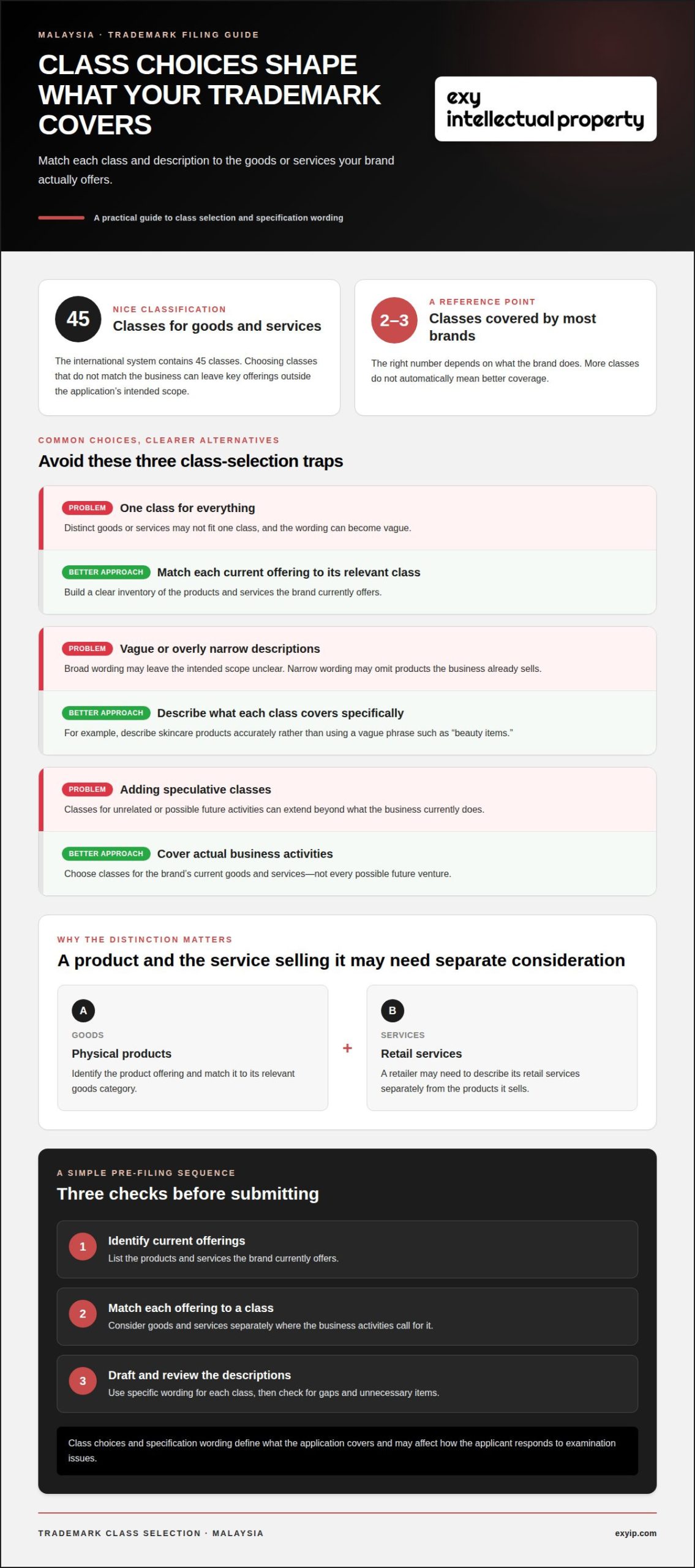
The most common mistake is treating class selection as a formality. The Nice Classification is an international system containing 45 classes for goods and services. Choosing a class that does not match the business can leave key offerings outside the application’s intended scope. Selecting classes without considering the actual services can create the same problem.
To choose the right Nice Classification classes in Malaysia, list the products and services the brand currently offers, then match each item to the relevant category. The application should cover the business’s actual activities, not every possible future venture. A physical product and the retail service used to sell it may fall into different classes.
That distinction matters. A brand selling physical products may need to consider both product-related goods and retail services. Most brands cover 2-3 classes, but the right number depends on what the brand does. Adding a class simply because it seems useful can broaden the application without improving its fit.
Next, draft the specification, the wording that describes the goods or services covered in each selected class. Broad wording may leave the intended scope unclear; wording that is too narrow may omit products the business already sells. For example, a business selling skincare products should describe them accurately rather than use a vague phrase such as “beauty items.” Where relevant, a retailer should describe its retail services separately.
Specification Drafting & MyIPO’s Pre-Approved Terms
Beyond selecting the correct Nice class, applicants must draft a precise specification. Under MyIPO practice, applicants who select items directly from the official Pre-Approved List of Goods and Services pay a lower statutory filing fee (RM950 per class) and significantly lower their risk of formal classification queries. Conversely, self-filers attempting to write custom specifications pay a higher fee (RM1,100 per class) and frequently use ambiguous industry jargon (such as "digital transformation services" or "lifestyle products"), which triggers automatic office actions and administrative delays under Section 29.
Before submitting, work through three steps: identify current offerings, match each offering to the appropriate class, and draft a specific description for that class. Then check for gaps and unnecessary items. This is more useful than choosing classes based only on a broad business label. If an examination issue arises, the class choices and wording may affect how the applicant responds before the deadline.
The table compares common approaches to selecting classes and drafting specifications:
| Approach | Class selection | Specification wording | Main consideration |
|---|---|---|---|
| One class for everything | May miss distinct goods or services | Can become vague | Business activities may span categories |
| Classes based on current offerings | Matches relevant goods and services | Describes each offering specifically | Requires a clear inventory |
| Several speculative classes | May include unrelated categories | Can extend beyond actual activity | More classes do not automatically mean better coverage |
Choose the approach that accurately covers the brand’s current goods and services, using precise wording for each class.
How to Register a Trademark in Malaysia: Self-Register or Hire an Agent?
Both routes use the official intellectual property office application process, but eligibility and the handling of objections differ. A registered trademark agent prepares, files, and prosecutes applications before the intellectual property office.
Application Steps and Timelines
Start by identifying the applicant, the mark, and the goods or services it will cover. The application then proceeds to the registry for substantive examination. A straightforward Malaysian trademark application typically takes 12-18 months to reach registration if no objections are raised.
The substantive examination typically takes 6-8 months. If accepted, the application is published with a 2-month public opposition window. After opposition is resolved in the applicant’s favour, or none is filed, registration typically takes a further 1-2 months. The certificate comes after registration, not at submission.
Preparing an application typically takes 3-7 days. Those stages explain why filing promptly does not mean protection follows immediately. An agent manages procedural steps, while the applicant remains responsible for supplying accurate business and mark details.
Objections, Errors, and Rejection Risks
An examination may raise an objection that requires a response. Each round of examiner objections can add two to six months. Application prosecution means managing the examination process, including preparing responses to issues raised by the examiner. An agent may handle this work, while a self-filer must monitor correspondence and response deadlines.
Errors in the mark details, class selection, or specification can cause problems during examination. A pre-filing search can help identify conflicts, while careful drafting aligns the listed goods and services with the business’s activities. If an objection arrives, its substance and the application record guide the response; simply resubmitting the original wording may not resolve the issue.
Publication creates a separate risk: a third party may oppose the application during the 2-month window. Registration depends on examination, publication and any opposition, matters an agent does not control. The key difference is who prepares and manages the procedural response, not who controls the registry’s decision.
Substantive Examination: Sections 23 & 24 Criteria
MyIPO examiners scrutinize applications against two statutory hurdles:
- Section 23 (Absolute Grounds for Refusal): Prohibits signs devoid of distinctive character, purely descriptive terms, or generic trade indicators.
- Section 24 (Relative Grounds for Refusal): Prohibits marks identical or confusingly similar to earlier registered trademarks or pending applications covering identical or similar goods/services.
Statutory Fast-Track: Expedited Examination (Form TMA4)
While standard prosecution takes 12–18 months, applicants with immediate commercial needs—such as active licensing negotiations, imminent overseas launches, or suspected infringement—can request Expedited Examination under Section 31 by submitting Form TMA4 alongside statutory fees and supporting evidence, shortening the examination decision window to 4–6 months.
Application Requirements and Documents
A Malaysian trademark application needs the applicant’s details, a representation of the mark, and descriptions of the goods or services in the relevant classes. These form the core application information; the class and wording choices define what the application covers. Prepare the details consistently before submitting.
Applicants without an address for service in Malaysia must appoint a registered trademark agent to file there. Only a person or firm entered on Malaysia’s Register of Trademarks Agents may act in that role. A local address for service is therefore an eligibility requirement, not simply a matter of preference about getting help.
For applicants who can self-file, the choice depends on whether they can prepare accurate application details and manage examination correspondence. Applicants without the required local address must appoint a registered agent. In either case, the official examination and the possibility of objections shape the path from application to registration, and partnering with professionals like Exy Intellectual Property can streamline this journey.
Comparing self-registration and hiring a licensed agent
Self-filing leaves preparation and procedural follow-through to the applicant. A registered agent can handle filing work and application prosecution before MyIPO. The choice in a DIY trademark filing vs hiring an agent comparison is about responsibility, capability, and the application’s needs, not just who enters information into a form.
Submitting the form accounts for about 10% of a professional trademark agent’s contribution; the remaining 90% involves strategic risk management. This can include assessing the application’s scope, preparing the filing, and managing procedural correspondence. MyIPO still examines applications and makes its own decisions, so professional assistance does not control registration.
Direct filing may suit an eligible applicant with a straightforward mark and the capacity to manage correspondence. The applicant must prepare accurate details, monitor communications, and respond to any issues raised. For example, a business with one established product line may be comfortable handling an uncomplicated filing if it can track the process and make timely decisions.
A registered agent can be helpful when a filing involves several business activities, potential conflicts, or complex drafting. The agent can help align the application wording with the applicant’s commercial plans and manage procedural steps. The applicant still needs to provide clear information about the mark and intended goods or services.
In Malaysia, the title matters. Only a person or firm entered on the Register of Trademarks Agents may act as a trademark agent. For this purpose, a lawyer and a registered agent are not interchangeable terms. If an applicant must appoint an agent, the person or firm acting in that role must meet the register requirement.
Neither route eliminates the possibility of an examiner objection or third-party opposition. MyIPO’s examination, publication, and any opposition affect the outcome. A professional can prepare and manage responses but cannot promise that an application will proceed to registration. Treat any guarantee of approval with caution because the decision is not within the representative’s control.
To decide, list the filing tasks and assign responsibility for each: preparing the application, managing correspondence, and responding to procedural issues. Then consider whether the person responsible has the time and skills to do the work. This practical test makes the DIY trademark filing vs hiring an agent decision specific to the business, rather than a general preference for self-service or professional help.
Self-filing or Appointing a Malaysian Trademark Agent
Eligibility depends first on the applicant’s address for service in Malaysia. Applicants without one must appoint a registered trademark agent to file there. This requirement determines whether self-filing is an option before convenience or familiarity with MyIPO enters the decision.
An address for service gives MyIPO a local point of contact for official application communications. Applicants based outside Malaysia who lack such an address must appoint an agent. Applicants with an address in Malaysia can consider self-filing, but must still manage notices, responses, and procedural deadlines throughout the process.
Use this decision sequence before preparing the application:
- Identify the applicant. Confirm whose name will appear on the Malaysian trademark application, such as the business or an individual.
- Assess the address requirement. Determine whether that applicant has an address for service in Malaysia. – Statutory Requirement for Overseas Entities (Section 19, Trademarks Act 2019) – Under Section 19 of the Trademarks Act 2019 and Regulation 10 of the Trademarks Regulations 2019, any applicant whose ordinary residence or principal place of business is outside Malaysia must appoint a registered trademark agent entered on MyIPO’s Register of Trademarks Agents to serve as their official address for service. Direct self-filing by foreign entities without a registered Malaysian agent is invalid under procedural law.
- Choose the filing route. If there is no Malaysian address for service, appoint a registered agent. Otherwise, weigh self-filing against professional handling.
- Plan for correspondence. Decide who will monitor MyIPO notices and prepare each response within the applicable deadline.
Agent status matters. Only a person or firm entered on Malaysia’s Register of Trademarks Agents may act as a trademark agent. Registration with MyIPO is distinct from simply offering general help with forms. An agent prepares, files, and prosecutes applications before MyIPO, following Malaysian trademark procedures.
That procedural role determines how responsibilities are divided. The applicant still supplies accurate information about the mark and the goods or services. The agent handles filing steps and administrative requirements, including procedural actions and deadlines. For example, if MyIPO issues an examination objection, someone must review it and prepare a relevant response. Hiring an agent assigns that work to a registered professional; it does not transfer control of the application’s commercial decisions.
A distinctive mark does not remove the address-for-service requirement. Nor does a simple list of goods or services change the rule for an applicant without an address in Malaysia. Eligibility is the first question; for applicants who meet the requirement, application complexity and available time help determine the right approach.
For example, a Malaysia-based sole proprietor with an address for service may choose to self-file if they can manage MyIPO correspondence. An overseas business without an address in Malaysia must appoint a registered agent, even if its application covers one straightforward mark. In either case, the applicant should decide who will monitor communications from submission through examination.
Use the local-address test to establish eligibility first, then assess who can manage each filing task and response. This distinguishes a mandatory appointment from a preference for professional support.
Trademark registration costs and non-refundable fees
Cost is only one part of planning a Malaysian trademark application. Also consider who will prepare the filing, keep a clear record of decisions, and manage follow-up work. These responsibilities differ between self-filing and professional support, even when the business details are the same.
DIY Filing Costs
Self-filing puts preparation and submission in the applicant’s hands. Before starting, assemble the exact mark to be filed, the applicant’s correct legal name, and a reliable description of the goods or services. Consistency matters: a mismatch between the business records and application details can lead to avoidable clarification work.
Keep one working record of the application information and decisions. Note which version of the mark is being submitted, who owns the application, and which business activities it is intended to cover. This record can help the applicant respond clearly if questions arise later. It also makes responsibility for each filing task visible within the business.
Self-filing may suit an applicant who can prepare accurate information and monitor MyIPO correspondence. Plan who will track notices and who can make decisions if the application needs further attention. Treating these tasks as part of the filing process helps prevent a gap between submission and follow-up.
Official Fees and Professional Costs
Professional assistance changes who handles preparation and procedural work, not who makes the registration decision. MyIPO examines applications and determines how they proceed. An agent may coordinate the application materials and subsequent correspondence, while the business remains responsible for supplying accurate details and choosing the commercial scope of protection.
Compare the work involved rather than assuming every filing follows the same path. A business with one established offering may need less preparation than a company covering varied activities or planning a significant brand expansion. The key question is whether the applicant can manage the work internally or wants a professional to handle filing tasks.
Before starting, clarify internal responsibilities: who provides the mark and business information, who approves the scope, and who tracks communications. This can prevent duplicated effort and missed handoffs. It also helps the business maintain a useful record of the application and the decisions behind it.
If you want support assessing the filing work and responsibilities involved, discuss your trademark application needs with Exy Intellectual Property.
Exy Intellectual Property
Exy Intellectual Property helps businesses assess trademark filing needs and navigate Malaysia’s registration process. Its support can clarify application preparation and the procedural work involved, helping business owners decide whether to manage a filing themselves or seek professional assistance.
Turn to Exy Intellectual Property for guidance on a trademark application or support with registration. The right approach depends on your eligibility, the mark, and the goods or services involved. A discussion can clarify what your filing requires and where professional support may help.
Contact Exy Intellectual Property to discuss your trademark filing needs.
Make your next trademark decision with purpose
Your decision on DIY trademark filing vs hiring an agent should involve more than the effort of submitting a form. Consider who can prepare the application, manage correspondence, and make informed decisions as your brand develops. Filing is part of a broader intellectual property strategy, and the right level of support depends on your business priorities.
Exy Intellectual Property offers trademark registration, as well as patent filing and industrial design registration for businesses protecting other forms of intellectual property. If you are deciding what to do next, a focused discussion can help identify relevant support without assuming every application needs the same approach.
Contact Exy Intellectual Property to discuss your trademark registration plans. A clear next step can help you move forward with greater confidence in how you protect your brand.
Frequently Asked Questions
Can I file a trademark myself in Malaysia without a lawyer?
Yes. If you’re eligible to self-file in Malaysia, you can submit an application without hiring a lawyer. Before preparing it, decide who should own the trademark and ensure that choice reflects the business’s arrangements. For example, if a company uses the brand, consider carefully whether the company or an individual should be the applicant. Clear ownership planning can prevent complications when the business undergoes corporate restructuring, shareholder transitions, or future financing.
What does a trademark agent actually do beyond filling out a form?
Beyond preparing forms, an agent can help organise the application strategy and manage the filing’s progress. For example, the agent may coordinate the mark representation, applicant details, and intended business coverage into a consistent application record. This can be useful when several people provide information or approve the filing. The applicant still sets the business priorities and supplies the underlying information.
How much do Malaysian trademark agents or lawyers charge to file an application?
There is no single professional fee for every Malaysian application. The amount depends on the application’s scope, the preparation required, and whether subsequent procedural work is included; it is provided after a quote request. When comparing proposed work, distinguish professional services from official charges and note whether the engagement covers only the initial filing or follow-up as well. This makes the quoted scope easier to assess.
What are the risks of filing a trademark yourself, such as incorrect classification or objections?
Another risk is naming the wrong owner or submitting a mark that differs from the version the business uses. For instance, a company may prepare an application using a founder’s details even though the business expects to own the brand. Inconsistent records can raise questions later, including during a transfer or business transaction. Before submitting, align the applicant’s identity, mark representation, and intended ownership.
What happens if MyIPO issues an objection or a third party opposes a trademark application?
First, identify whether the notice is from MyIPO or a third party, then preserve it and the application records relevant to the issues raised. Gather material explaining the mark’s use, business context, or connection to the goods and services. Keep each response focused on the concerns rather than adding unrelated background. The response strategy depends on the notice’s substance and the evidence available.
When is hiring a trademark agent worthwhile compared with filing directly with MyIPO?
Professional support may be worthwhile when the brand is central to a planned licensing arrangement, investment, or business sale, as ownership and application records may receive closer scrutiny. Direct filing can be practical when the applicant has the time and capability to manage the work independently. Consider the mark’s commercial importance and the consequences of administrative errors, not just the convenience of submitting a form.