

Using a trademark in Malaysia doesn’t require registration, but registration can provide a clearer legal foundation for your brand. A trademark is a sign that distinguishes one business’s goods or services from another’s. To understand how to register a trademark in Malaysia, begin with MyIPO’s application process and the classes that define the goods or services you want to protect.
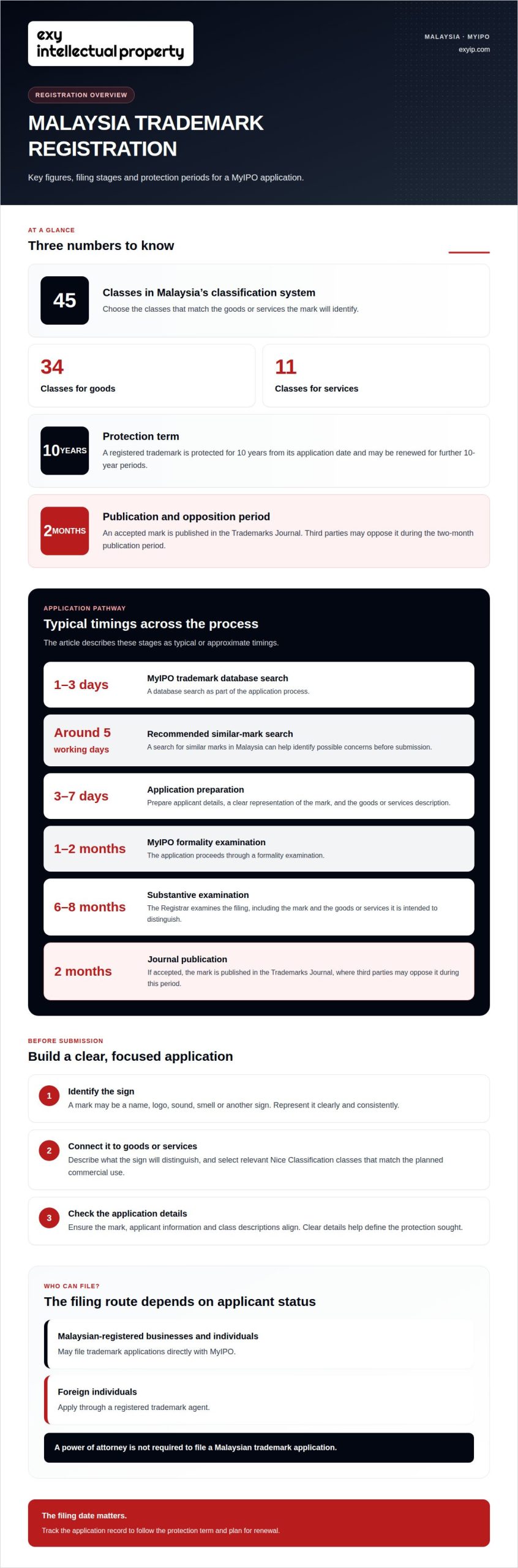
The process is structured, but each decision matters. The mark you apply for, the classes you select and any objections raised during examination can affect the outcome. A registered trademark is protected for 10 years from its application date and can be renewed for further 10-year periods.
This guide explains how MyIPO registration works, what an application needs, and how examination and publication proceed. It also covers what to consider if an application is rejected, helping you understand possible next steps and make informed decisions about protecting your brand in Malaysia.
Key Takeaways
- Choose a mark that distinguishes your goods or services, then identify the relevant classes from Malaysia’s 45-class system.
- Understand who can file directly with MyIPO and when an agent is part of the application process.
- Plan for examination and publication, including the two-month period when third parties may oppose an accepted mark.
- Know how long protection lasts and what renewal involves so you can maintain your trademark rights.
- Learn how Malaysian trademark law and MyIPO shape registration, and what steps may follow if an application is rejected.
Trademark Eligibility and Registrable Marks in Malaysia
Malaysia’s Trademarks Act 2019 sets the framework for which marks may be registered. Trademark guidelines describe a trademark as a sign capable of graphic representation that distinguishes one organisation’s goods or services from another’s. The practical question is whether the proposed sign can identify your business as the source, rather than simply describe the product. A distinctive brand name or logo may perform that identifying role.
A trademark can take forms beyond a business name. The Trademarks legislation allowed non-traditional marks, including sounds and smells. This means the sign considered for protection need not always be a word or image. Each application still needs to identify the sign clearly and connect it to the goods or services it distinguishes. For example, a sound associated with a product differs from the product itself.
Who applies affects the filing route. Malaysian citizens, residents, and locally incorporated businesses with an address for service in Malaysia may file trademark applications directly with MyIPO. However, under Section 19 of the Trademarks Act 2019, any foreign individual or overseas corporate entity without a principal place of business or residence in Malaysia is statutorily required to appoint a registered Malaysian trademark agent. The route therefore depends on the applicant’s status, not just the type of mark. A power of attorney is not required to file a Malaysian trademark application.
Before filing, define the goods or services the mark will identify. Malaysia uses a classification system with 45 classes: 34 for goods and 11 for services. For example, a business selling physical products and providing related services may need to consider both sides of its operations when identifying relevant classes. The selection should reflect the actual commercial use planned for the mark, rather than every possible future activity.
Use these checks to assess the mark and filing route:
- Identify the sign. Decide whether the application concerns a name, logo, sound, smell, or another sign.
- Connect it to your business. State which goods or services the sign distinguishes.
- Select relevant classes. Use the 45-class structure to match the application to the goods or services.
- Choose the filing route. Malaysian businesses and individuals may file directly; a foreign individual applies through a registered trademark agent like Exy Intellectual Property.
These points help frame a national application, but they do not automatically make every proposed mark eligible. The mark must distinguish the goods or services, and the application must identify the protection sought. For example, consider a brand name alongside the specific products it identifies. This gives the application a focused basis for examination.
How to Register a Trademark in Malaysia
Start by defining the sign and the protection your business needs. MyIPO’s trademark application process links the proposed mark to its applicant and the goods or services it will distinguish. Clear details help keep the application focused. For example, represent a name consistently throughout the application.
Before filing, organise the key information: identify the applicant, show the mark clearly, and describe the goods or services to be covered. Select the relevant Nice Classification classes to match those goods or services. A broad or imprecise description can make it harder to understand the scope of protection sought.
A search is a practical first step. A MyIPO trademark database search typically takes 1-3 days as part of the application process. A recommended search for similar marks in Malaysia takes around 5 working days. These searches help identify earlier marks that may raise concerns before you submit. They do not replace examination by the Registrar.
- Prepare the mark. Set out the word, logo, sound, smell or other sign consistently. For a logo, use a clear representation that shows the features you want examined.
- Identify the applicant. Provide the correct applicant details and ensure the application identifies the person or business seeking registration.
- Describe the goods or services. List the commercial areas linked to the mark, then select the relevant Nice Classification class or classes.
- Review for consistency. Check that the mark, applicant details and class descriptions align before submission to MyIPO.
- Submit the application. Malaysian businesses and individuals may file directly with MyIPO. A foreign individual applies through a registered trademark agent.
A power of attorney is not required to file a Malaysian trademark application, but the application information must still be accurate. The Registrar examines the filing, so clarity about the mark and its goods or services matters from the outset.
Preparing an application typically takes 3-7 days. MyIPO’s formality examination typically takes 1-2 months, followed by substantive examination, which typically takes 6-8 months. These stages make accurate classification and complete information valuable: errors or objections can affect the path to registration.
For businesses seeking support with preparation and submission, Trademark Filing can help structure the application around the mark and its intended goods or services.
How Long Does Trademark Protection Last in Malaysia?
A registered trademark in Malaysia is protected for 10 years from its application date. The initial term is followed by renewable 10-year periods. This makes the filing date relevant to the protection timeline, not just the date MyIPO issues a certificate. Keep the application record so the owner can track the registration and plan for renewal.
Registration follows examination and publication. MyIPO reviews the application before an accepted mark appears in the Trademarks Journal. Publication lasts 2 months, giving third parties an opportunity to file an opposition. An opposition raises a challenge to registration; it is separate from an objection made by the examiner during review.
If no opposition is filed during the publication period, the application may proceed toward registration, provided no other issue prevents it. The absence of opposition does not skip MyIPO’s examination or remove any objections. The Registrar’s review and a third-party challenge are distinct parts of the process, and each must be addressed before registration is complete.
- Examination: MyIPO assesses the application and may raise objections or issue a provisional refusal if a concern arises.
- Publication: An accepted mark is published in the Trademarks Journal for 2 months.
- Opposition: A third party may challenge the mark during that publication period.
- Registration: If the application can proceed after publication, MyIPO can complete registration.
A provisional refusal means MyIPO has identified a reason the application cannot proceed as filed. Read the stated grounds carefully and address each point in a response. For example, if the concern relates to how the mark distinguishes the listed goods or services, the response should speak directly to that issue. The examination period is typically 6-8 months, so an objection can affect the overall timetable.
Opposition also calls for a focused response. Review the challenge and the mark’s application details, including the goods or services claimed. The dispute may concern whether the mark should be registered as applied for. Its outcome can affect whether the application proceeds, so avoid treating publication as a formality. The 2-month publication period is a defined stage, not an extension of the protection term.
A provisional refusal under Section 29 means MyIPO has identified statutory grounds preventing registration—most commonly under Section 23 (Absolute Grounds), such as the mark being descriptive or lacking distinctive character, or Section 24 (Relative Grounds), where the mark conflicts with an earlier registered or pending trademark. Applicants generally have a strict two-month window to file written legal submissions, submit evidence of acquired distinctiveness, or amend the specification.
Once registration is secured, diarise the 10-year renewal cycle from the application date. A renewal preserves the registration for another 10 years. The protection period and the application’s examination timetable serve different purposes: one concerns the duration of rights, while the other concerns progress toward registration.
With tens of thousands of national and Madrid Protocol trademark applications filed annually with MyIPO, clearance searches and precise class scoping are essential before filing. Defining your target markets, exact goods and services, and corporate applicant details early prevents avoidable office actions and keeps the scope of registration defensible.
Malaysia Trademark Law and MyIPO
Malaysia’s trademark system is national: registration in Malaysia does not create worldwide protection. MyIPO handles Malaysian trademark applications under the country’s trademark framework. The Trademarks Act 2019 sets out marks that can and cannot be registered. For a business planning expansion, the key distinction is territory. Protection must be sought in each jurisdiction where rights are needed.
Malaysia is also a member of the Madrid Protocol, which allows an international application to seek protection in 120+ countries. That route can support a broader filing strategy, but it does not create one worldwide registration. Each designated jurisdiction considers protection in its own territory. A Malaysian registration and an international filing therefore serve different geographic objectives.
You do not have to register a trademark before using it in Malaysia, but using a mark and registering it have different legal implications. Registration rights take effect from the application filing date, which can matter when establishing the timeline of a claim. Keep the MyIPO application record and identify the applicant entity clearly.
The symbols also signal different statuses. In Malaysia, ™ may indicate that a sign is being used as a trademark, whether registered or not. The ® symbol is reserved for marks registered with the relevant trademark office. For example, using ™ before registration does not prove that MyIPO registration is complete.
Statutory Penalty for Misusing the ® Symbol (Section 104, Act 815)
In Malaysia, the ™ symbol may be used immediately to assert common-law trademark claims while a brand is unregistered or pending examination. However, the ® symbol is strictly reserved for marks officially entered on the Register. Under Section 104 of the Trademarks Act 2019, falsely representing an unregistered or pending trademark as registered (including by displaying the ® symbol) is a statutory offence punishable upon conviction by a fine not exceeding RM10,000.
Registration and enforcement are related, but they are not the same process. Registration and enforcement are related, but they operate through distinct channels. While MyIPO administers registration under the Trademarks Act 2019 (Act 815), criminal complaints against commercial counterfeiting are governed by Part XV of the Trademarks Act 2019 alongside the Trade Descriptions Act 2011, enforced by the Enforcement Division of the Ministry of Domestic Trade and Cost of Living (KPDN). A certificate records statutory ownership, whereas a KPDN complaint initiates criminal seizure and prosecution. This concerns complaints, rather than the application route for obtaining a MyIPO registration. A certificate records a registration, while a complaint addresses alleged conduct.
- For Malaysian protection: Identify the national scope of the rights sought and the relevant goods or services.
- For wider coverage: Consider the Madrid Protocol route when protection is sought across multiple jurisdictions.
- For symbol use: Use ™ to indicate trademark use; reserve ® for a registered mark.
- For enforcement concerns: Distinguish a registration application from a complaint about alleged infringement.
The practical takeaway is to match the filing route to the markets where the brand needs protection. A Malaysian application addresses national rights, while the Madrid Protocol can support applications across selected countries. For guidance on a Malaysian or international filing strategy, discuss trademark registration.
More than 30,000 trademark applications were filed in Malaysia in 2022. That filing volume provides context for businesses assessing a Malaysian application: the local process is a distinct step in a broader protection plan, not a substitute for deciding where else rights are needed. Applicants can use the figure as a reminder to define the markets, goods or services, and intended applicant before proceeding, while keeping the scope of any sought registration clear.
Exy Intellectual Property
Exy Intellectual Property supports businesses seeking trademark protection in Malaysia. Its Trademark Registration service can help address the decisions covered in this guide: which mark to protect, which goods or services it identifies, and how to pursue registration. Exy Intellectual Property is a licensed intellectual property firm. Turn to the firm when you need help moving from questions about MyIPO to a clear next step for your brand.
A trademark application involves more than choosing a name. The mark, applicant details, and class descriptions need to match the protection sought. If you are deciding what to file, prepare the mark you use or plan to use, a description of your goods or services, and any MyIPO correspondence. These materials provide a practical starting point for discussing your application.
Exy Intellectual Property also supports businesses with other forms of intellectual property protection. Patent Filing is relevant when seeking protection for an invention. Industrial Design Registration concerns design protection, while Copyright Voluntary Notification addresses a separate type of intellectual property. These services are distinct from trademark registration but may be relevant when protecting different business assets.
- Trademark Registration: For businesses seeking to register a sign that distinguishes their goods or services.
- Patent Filing: For an invention-related filing matter that calls for patent protection.
- Industrial Design Registration: For a business seeking protection connected to an industrial design.
- Copyright Voluntary Notification: For a matter concerning voluntary notification of copyright.
Consider contacting Exy Intellectual Property if you are preparing a Malaysian trademark application, deciding which goods or services to include, or responding to an examination concern. You can also raise a wider intellectual property question about a brand, invention, design, or copyright-related material. Distinguishing these matters helps clarify which service fits each asset.
For a focused discussion, gather the mark, a concise description of the business activity connected to it, and any relevant MyIPO documents. If the application has received an objection or third-party opposition, include that correspondence. The issue may concern the application details, the mark itself, or another intellectual property matter, and understanding it helps identify relevant guidance.
Contact Exy Intellectual Property to discuss your trademark registration question or related intellectual property needs.
Put Your Brand Protection Plan Into Action
Your next step is to connect trademark protection with your business plans. Consider how the brand will appear across products, services, and future markets, then decide which identity should remain consistent as the business grows. This practical view turns how to register a trademark in Malaysia into a broader decision about your brand’s role in the company’s long-term direction.
If you are preparing an application, have received an examination concern, or are considering protection beyond Malaysia, tailored guidance can help you assess the way forward. Exy Intellectual Property provides Trademark Registration alongside other intellectual property services, including Patent Filing and Industrial Design Registration. The right focus depends on the asset and the protection you seek.
Contact Exy Intellectual Property to discuss your trademark plans and identify a practical next step. With a clear direction, you can move forward with greater confidence in how your brand supports the business.
Frequently Asked Questions
What is a Trademark?
A trademark helps customers recognise the source of a business’s goods or services. For example, a distinctive name on a product label can distinguish its maker from other businesses selling similar items. The key is the sign’s identifying role in the market: a product description tells customers what an item is, while a brand sign points to its commercial source.
Which Malaysian laws and authorities govern trademark registration in Malaysia?
MyIPO handles trademark applications under Malaysia’s Trademarks Act 2019. Keep the application process distinct from enforcement matters: the Trade Description Act 1972 is associated with complaints about alleged infringement to the Enforcement Division. This distinction helps a business identify whether its immediate need concerns registering a brand or raising a complaint about another party’s conduct.
Who can apply to register a trademark in Malaysia, including foreign applicants?
Malaysian-registered businesses and individuals may apply directly, while a foreign individual applies through a registered trademark agent. Before filing, decide who should own the mark. The owner is the applicant seeking the rights, not simply the person preparing or submitting paperwork. If a founder created the brand, deciding between personal and business ownership is a useful early planning step.
How do you search for existing trademarks in Malaysia before applying?
Use search results to inform your decision, not as a simple pass-or-fail test. A close result may prompt you to reconsider the proposed mark, narrow its commercial scope, or seek advice before filing. Record the marks reviewed and why each result appears relevant. This gives you a clearer basis for deciding whether to proceed with the proposed identity or revise it.
What marks can be registered, and what grounds can cause a trademark application to be rejected in Malaysia?
A mark needs to distinguish the applicant’s goods or services. The Trademarks Act 2019 sets the registration boundaries, and an application may encounter an objection if MyIPO considers the sign ineligible. The assessment concerns the mark as presented and the commercial context described in the filing. If an objection arrives, focus on its stated reason rather than assuming every application concern has the same solution.
What are the step-by-step procedures for filing a trademark application with MyIPO?
Plan the filing around three decisions: which sign represents the business, who will own it, and what commercial use it should cover. After submission, keep the application reference and correspondence together, and assign someone to monitor notices. This recordkeeping helps the business respond in context if MyIPO raises a question or a third party challenges the application.
What documents and information are required for a Malaysian trademark application?
Prepare information that lets MyIPO understand the proposed mark, its owner, and the commercial activity it identifies. Check that the applicant’s details consistently use the intended owner’s name and that any logo image matches the version the business plans to use. Organising these materials before filing can prevent confusion between the mark and the goods or services associated with it.
What should a business keep after filing a trademark application?
Keep the submitted application, mark representation, goods or services description, and all MyIPO correspondence together in an accessible record. Note who is responsible for monitoring updates. These records help the owner understand what was filed and maintain continuity if staff or advisers change. They also make it easier to refer to the application accurately in future business discussions.