


What if the business operating your brand did not have to own its intellectual property? An IP holding company structure in Malaysia separates ownership from day-to-day operations: one entity holds assets such as trademarks, patents, copyright and designs, then licenses them for business use. In a common two-company arrangement, the holding company owns the operating subsidiary.
Separating IP can help a business organise ownership, manage access and distinguish valuable assets from operational activity. But forming another company does not transfer intellectual property by itself. Ownership and use must be addressed through appropriate assignments and agreements.
This guide explains what an IP holding company does, why a business might separate its IP, and how royalty arrangements, jurisdiction choices and centralised management fit into the structure. It also covers practical considerations for Malaysian businesses, including control, agreements and the relationship between the holding company and the operating business.
Key Takeaways
- Separate ownership from operations by transferring intellectual property to a holding company and setting clear terms for how operating businesses may use it.
- Assess royalty arrangements alongside the tax treatment in each relevant jurisdiction; where the rights are used and how the entities operate can matter.
- A separate entity can help ring-fence intellectual property from operating-company risks, but it does not remove every liability risk.
- BEPS Action 8 mandated transfer-pricing rules or special measures for transfers of hard-to-value intangibles to prevent base erosion and profit shifting through movements among group members, according to United Nations Statistics Division.
- Centralised management works best when ownership records, written assignments and licensing agreements are organised across the group.
What Is an IP Holding Company?
An IP holding company is a separate legal entity that owns intellectual property, such as a patent, trademark, copyright or design. A related operating company can use those assets under a licence, separating legal ownership from day-to-day commercial activity.
Ownership and Licensing Arrangements
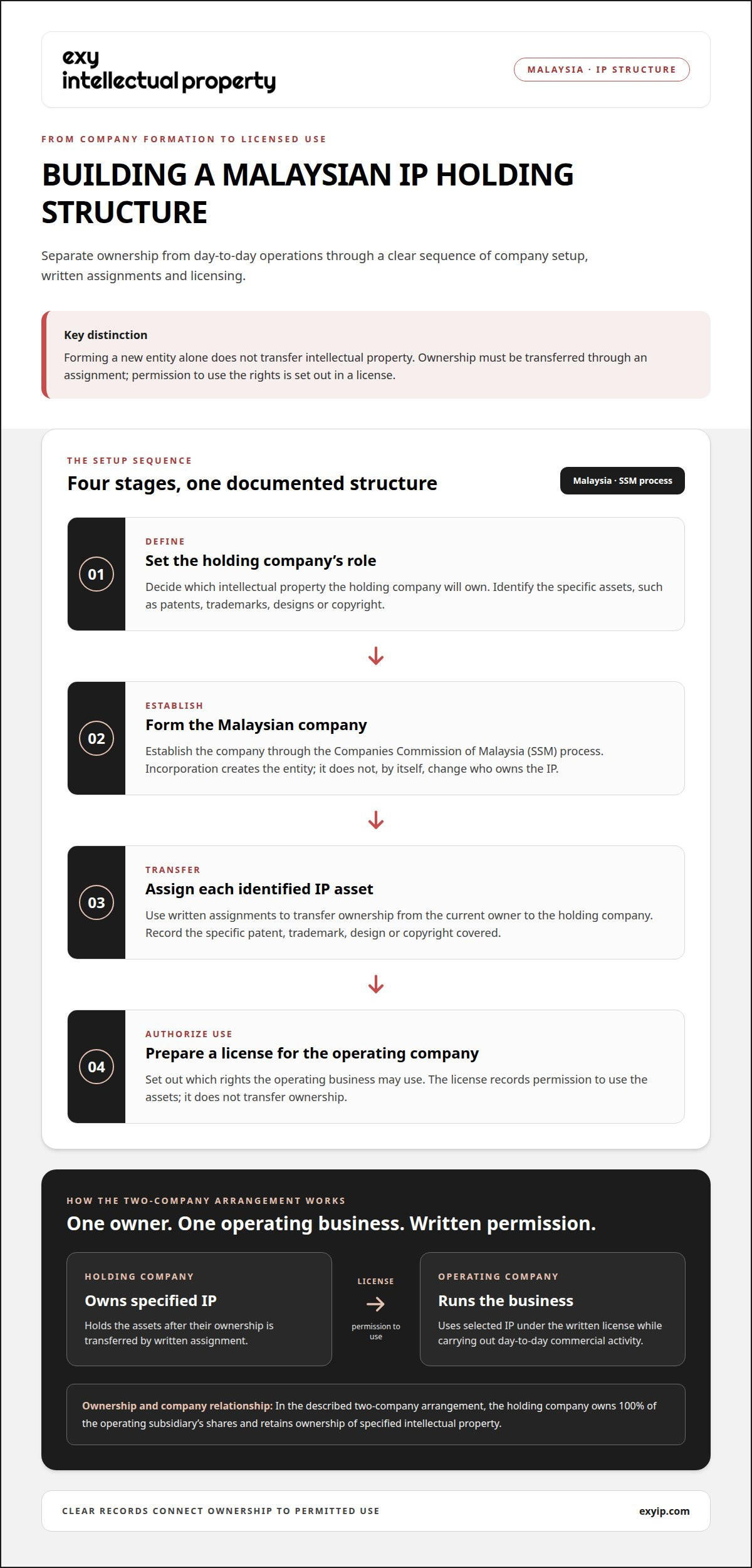
Ownership and licensing arrangements define which company holds each IP right and which company may use it. In a two-company structure, the holding company owns 100% of the operating subsidiary’s shares, while retaining ownership of specified intellectual property. The operating company receives permission to use those assets under a written license.
This distinction matters when a business earns revenue from products, services or a brand. For example, the holding company might own a patent while the operating company manufactures and sells the patented product. An agreement can define permitted use and royalty terms, giving each company a documented role.
Transferring IP and Licensing It Back
Transferring IP means legally assigning ownership from the operating company or another owner to the holding company. Forming a new entity alone does not change ownership. A written assignment records the transfer and identifies the specific patent, trademark, design or copyright covered.
The holding company can then license the transferred rights to the operating business. This creates a clear record of who owns an asset and who may use it. For creative works and software, documenting copyright assignments helps identify which rights have moved into the holding company. Separate licence terms define the operating company’s permission.
Cross-Border IP Structures
A cross-border structure places IP ownership or licensing activity in more than one jurisdiction. For example, a Malaysian operating company could use a trademark owned by a related holding company in another country under a licence covering the relevant business activity.
Global arrangements need consistent records of ownership, permitted use and royalty payments. The jurisdiction of each entity can affect how the group manages its IP and revenue, so the structure should reflect where assets are held and where businesses use them. An assignment transfers ownership; a licence grants permission without transferring it. These distinctions matter when a business expands into another market or commercialises a patent internationally.
Malaysian Entity Types and SSM Setup
A company can own intellectual property in Malaysia. The structure described here places a holding company alongside an operating company. These are company roles, not separate IP rights: the holding company owns the assets, while the operating company conducts business and uses selected rights under licence.
To establish the arrangement, first define the holding company’s ownership role and identify the assets it will own. Next, form the Malaysian company through the Companies Commission of Malaysia (SSM) process. Then execute written assignments to transfer each asset and prepare licences for the operating company. This sequence distinguishes incorporation from the subsequent transfer of IP ownership.
Offshore IP holding companies and royalty taxation
An offshore holding company may receive royalties when a subsidiary uses its intellectual property. The tax result depends on the jurisdictions involved, the licensed rights and where the relevant activity takes place.
Subsidiary Royalty Fees and Withholding Tax
A subsidiary royalty is a payment for permission to use intellectual property owned by its holding company. The licence should identify the rights covered and explain how the royalty is calculated.
Withholding tax can affect the amount received by the holding company. In Hong Kong, withholding tax on certain royalty payments ranges from 2.475% to 16.5%. That range makes the payment’s classification and the parties’ position relevant to cash-flow planning.
Related-Party IP Licences and Transfer Pricing
Transfer pricing examines the terms of transactions between related companies, including IP licences. For Malaysian related-party IP licences, assess whether the royalty reflects the rights actually granted and the commercial terms between the entities.
Document the licensed asset, permitted use, royalty method and basis for the agreed rate. For example, a patent licence limited to one product line grants different rights from one covering a global product portfolio. This distinction helps explain the commercial basis for payments from a subsidiary.
IP Royalties and Tax Planning
Royalty tax planning compares how each relevant jurisdiction treats the payment and the income it generates. Hong Kong’s Inland Revenue Department says royalties are taxable if the licence or right of use is acquired and granted in Hong Kong.
Hong Kong also amended its foreign-sourced income exemption rules in 2023 and 2024. Foreign-sourced income, including IP income, may be deemed Hong Kong-sourced and subject to profits tax unless an exception applies. An offshore address alone therefore does not establish the tax treatment.
Before setting a royalty, map ownership, licence terms, payment routes and business activity across the group. This helps distinguish the legal owner’s income from the operating subsidiary’s revenue and shows how the arrangement supports the group’s commercial position. It also brings tax treatment into the same analysis as investment decisions, capital needs and expected profit.
For example, a Malaysian subsidiary licensing a trademark from a Hong Kong holding company should have terms that match the rights it receives. The agreement can specify territory, permitted use and payment method. The Hong Kong tax analysis should then consider where the licence or right of use is acquired and granted, alongside the treatment of foreign-sourced IP income.
Royalty amounts should have a reasoned connection to the licensed asset and business arrangement. An intellectual property valuation can help assess an asset’s commercial position when a group considers royalty terms.
Why Separate IP from the Operating Company?
Keeping intellectual property in a separate entity can distinguish valuable rights from the operating company’s business risks. The structure may support continuity, but it does not remove every liability exposure.
Protection from Operating-Company Liabilities
Separating IP puts ownership in one company while another handles daily operations, which may help ring-fence those assets from operating risks. For example, if a Malaysian operating company faces financial distress, a separate holding company may continue to own its patent or trademark. The operating business’s ability to use the asset depends on its licence, rather than ownership being held by the operating company.
This separation can also support continuity if the operating business is sold or discontinued. The holding company may continue licensing or selling the IP assets, keeping the rights commercially active outside the former operating business. This distinction can matter when a product line ends but its brand or technology still has value.
There are limits. A holding company may not be protected from liability if the operating company engages in fraud or if the companies are not found to have separate management during liquidation. Separate ownership should therefore reflect actual management and business arrangements, not just a transfer recorded on paper.
Asset Protection and Financing
Asset protection and financing intersect when intellectual property is treated as a distinct business asset. A holding company can keep ownership records and licensing income separate from operating activity, helping the group present its IP portfolio clearly when considering financing.
For example, a lender assessing a business with a patented production method may need to know who owns the patent, who uses it and what licence terms apply. Clear ownership records and agreements can make the asset’s role easier to assess. A separate structure may make IP financing easier to evaluate, but it does not ensure financing will be available.
Before seeking financing, the group can organise its asset records by patent, trademark, design or copyright. It can document ownership, transfers and licences, then identify which operating company uses each right. This creates a clearer picture of the IP assets and their commercial use.
For a business operating across Southeast Asia, a central holding company can coordinate ownership records and licensing arrangements across markets. For example, a Malaysian group expanding into another regional market can track which entity owns a trademark and which local operation uses it. Records should distinguish each right and licence, so a change in one operating company does not obscure ownership elsewhere.
This structure is most useful when it reflects real business activity. The holding company must have a distinct ownership role, while operating companies use IP under documented arrangements. If management, ownership and use become blurred, the intended separation may be harder to sustain during a dispute or liquidation.
Tax considerations when choosing an IP holding jurisdiction
Choosing a jurisdiction means weighing tax treatment against where the group owns, manages and uses its intellectual property. Malaysia and Singapore present different factors to assess, so a headline tax rate alone cannot settle the decision.
Comparing Malaysian and Singapore IP Holdings
A Malaysian holding company keeps the ownership structure in Malaysia, while a Singapore holding company places ownership in another jurisdiction. The comparison matters because each country’s tax framework and the group’s actual activities affect its commercial position.
Singapore’s prevailing corporate tax rate is 17%, and its double-taxation treaty network extends to about 100 countries. Singapore’s IP tax incentives apply only to persons carrying on a trade or business, so a holding company must meet that requirement. A Malaysian company should be assessed against its own applicable rules and the group’s operating footprint.
For example, a group with Malaysian operations and international partners should map where its agreements, staff and IP-related decisions are based. This helps show whether a Malaysian or Singapore structure better matches the business, rather than choosing solely for a perceived tax advantage.
Tax Incentives and IP Income Exemptions
A tax incentive or income exemption applies only if the relevant eligibility conditions are met. A Malaysian IP holding company should not assume that owning a patent, trademark or copyright creates an automatic exemption.
Assess the specific incentive, type of income and company activities before placing IP in the structure. For example, royalty income and income from a franchise arrangement may arise from different agreements and uses. Distinguishing those income streams helps identify which rules apply to each.
Compare the expected treatment of IP income in Malaysia with the requirements of any alternative jurisdiction. Singapore’s trade-or-business condition illustrates why legal incorporation alone may not satisfy an incentive’s criteria.
Substance and Anti-Avoidance Risks
Substance risk arises when a company’s claimed ownership and tax position do not match its actual functions and decisions. For a Malaysian holding company, records should connect its ownership role with the agreements, management decisions and income it reports.
BEPS Action 8 mandated transfer-pricing rules or special measures for transfers of hard-to-value intangibles to prevent base erosion and profit shifting through movements among group members, according to United Nations Statistics Division. This makes the commercial basis for an international IP transfer relevant, especially where related corporations move valuable rights.
A practical review should trace each asset from transfer through use and income. Match the assignment, licence, decision-making records and reported income. Investigate gaps, such as a holding company claiming royalty income while another entity controls the IP decisions.
These checks also help establish whether a structure reflects commercial activity or mainly shifts income between group members. For example, document why a Malaysian company owns a patent, which partners use it and how the related agreements support that arrangement. Include copyright and other rights in the same ownership analysis rather than treating each transfer as an isolated tax entry.
Centralising IP management
Centralised IP management coordinates ownership records and administration, often through a holding entity. For a group with several operating companies, this can make it easier to identify who owns each asset, which business uses it and what agreements govern that use. The benefit is clearer oversight of trademarks, patents, designs and copyright.
Start with an asset register that identifies each right, its owner, the relevant jurisdiction and any licence granted to an operating company. Link each entry to its assignment and licensing documents. For example, if two subsidiaries use the same trademark, the register can show whether each has permission and which terms apply.
Centralised records also help a group spot gaps between legal ownership and commercial use. Compare registry information, written assignments and current agreements. If a subsidiary developed software but another entity claims ownership, the group can identify the missing transfer document and address the discrepancy before relying on the asset in a new product or transaction.
Management should include recurring audits. An IP audit at least once every two years is a useful baseline, with intervals adjusted to the company’s IP activity. A business filing patents, launching products or entering markets may need reviews aligned with those changes. Each review can record new rights, changes in ownership, expired or unused licences and follow-up actions.
Trademarks need consistent oversight across group companies. A central record can identify approved users and help monitor quality-control terms in licensing agreements. In Malaysia, trademark registration is valid for ten years from the application date and may be renewed every ten years. Recording those dates centrally helps the group plan renewals and avoid overlooked deadlines.
Central management can extend beyond forming a separate entity. A large group may need to reorganise ownership records, transfer rights through written assignments and align agreements across operating companies. For example, a business expanding through franchising can map which entity owns the brand and which franchisees receive permission to use it. This makes the links between ownership, licensing and commercial activity easier to follow.
Accurate records also support tax and cross-border planning. A central register can connect each asset to its owner, user, licence terms and relevant jurisdiction, giving the group a consistent basis for reviewing royalty flows. Records should reflect actual arrangements, not simply a preferred tax position.
To bring brand rights into a coordinated portfolio, plan trademark registration as part of the group’s wider IP management approach.
Exy Intellectual Property
Exy Intellectual Property helps Malaysian businesses address the IP considerations behind ownership, protection and commercial use. Turn to the firm when you need support identifying suitable protection for group assets or formalising rights before licensing them to an operating company.
Its services include trademark registration, patent filing, industrial design registration and copyright voluntary notification. These can support a broader IP strategy by helping businesses protect distinct assets before arranging ownership and use across related entities. The right approach depends on the type of creation and its role in the business.
If you are assessing how to protect intellectual property within your company structure, contact Exy Intellectual Property to discuss your needs.
Put Your IP Strategy Into Action
An IP holding company structure in Malaysia should support how your business creates, manages and commercialises intellectual property. Before changing ownership, map the decisions ahead: which assets need protection, how related businesses will use them, and whether future partnerships or market expansion could affect the arrangement. This forward-looking approach helps connect legal ownership with the company’s commercial plans.
Exy Intellectual Property can help protect relevant rights through trademark registration, patent filing and industrial design registration. These services address the underlying assets as you shape a broader ownership and licensing approach. The next step is to discuss the IP questions your business needs to resolve and how they relate to its plans.
Contact Exy Intellectual Property to discuss your IP strategy. A clear plan can help your business move forward with greater confidence.
Frequently Asked Questions
What is an IP holding company structure in Malaysia?
An IP holding company structure in Malaysia is a group arrangement that places intellectual property ownership in a Malaysian company separate from the businesses that commercialise it. This can help a group coordinate decisions when several subsidiaries rely on shared technology or a common brand. The arrangement works best when each entity’s role is clear, including who approves changes to the IP portfolio and how those decisions affect operating businesses.
What annual compliance planning should a Malaysian holding company consider?
Plan separately for the holding company’s corporate administration and the ongoing care of its intellectual property. The company’s obligations depend on its structure and activities, while IP maintenance depends on the rights it owns and the markets where they are protected. A practical planning document can assign responsibility for each workstream and identify when ownership, business activity or protection needs to change.
How are royalties and IP licensing income taxed in Malaysia?
Tax treatment depends on the transaction and the circumstances of the companies involved, so calling a payment a royalty does not determine the result. For a Malaysian group, make the commercial purpose of each payment clear and connect it to the business activity it supports. Cross-border arrangements also require attention to the countries involved, since one jurisdiction’s treatment does not establish Malaysia’s.
What Malaysian withholding tax applies to royalties paid to a Malaysian IP holding company?
The applicable treatment depends on the payment’s character, the parties and the circumstances involved. A payment between Malaysian entities should not be assessed using a rate mentioned for another country or a different transaction. Keep supporting documents consistent with the payment’s purpose and recipient, and distinguish domestic payments from royalties involving a non-resident recipient.
How should IP ownership and licensing agreements be structured between a Malaysian holding company and operating subsidiaries?
Build agreements around how each subsidiary actually uses the relevant IP in its business. Consider what should happen if a subsidiary changes its product range, leaves the group or is sold. Addressing these events can reduce uncertainty about continued use and the transition of operations. Agreements should also identify who can approve material changes to the subsidiary’s use of the IP.