

The highest-ranked firm isn’t automatically the right fit. A useful Intellectual Property Firm Services Comparison in Malaysia weighs the trademark and other IP services you need alongside relevant experience, location, rankings, and application filing support. For context, a Malaysian trademark registration is valid for 10 years from its filing date and is renewable every 10 years.
Choosing an IP firm means deciding how to protect business assets, not simply who will complete a form. A useful Intellectual Property Firm Services Comparison shows which services fit your priorities and how each firm handles the work.
Compare trademark services, relevant IP experience, geographic coverage, and application preparation and filing. These criteria help you identify what matters most for your business and its intellectual property.
Key Takeaways
- Compare firms by the trademark work they handle, from searches and filing to enforcement and portfolio management.
- Look for relevant intellectual property experience and a track record with work that matches your business needs.
- Consider how a firm’s reach and working arrangements support your business across Malaysia.
- Understand how application preparation, filing, and responses to office actions fit into the support you need.
- Match the firm’s services to your assets, whether you need trademark, patent, industrial design, copyright, or commercialization support.
Trademark searches, filing, enforcement and portfolio management
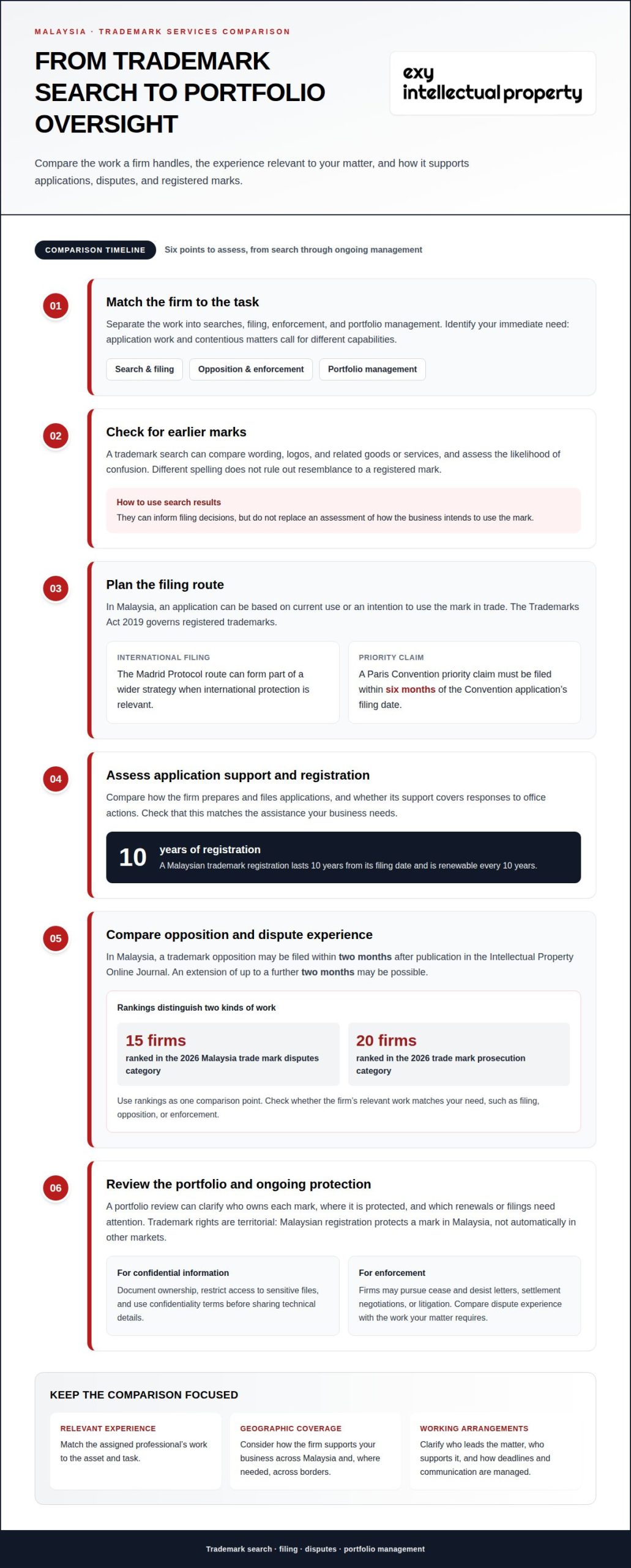
A trademark search can identify earlier marks that may conflict with a proposed application. It can compare wording, logos, related goods or services, and the likelihood of confusion. For example, a proposed name may resemble a registered mark despite a different spelling. Search results can inform filing decisions, but they do not replace an assessment of how the business intends to use the mark.
In Malaysia, applications can be filed based on current use or an intention to use the mark in trade. The Trademarks Act 2019 governs registered trademarks. Registration lasts 10 years from the filing date and is renewable every 10 years. If international protection is relevant, Malaysia’s Madrid Protocol route can form part of a wider filing strategy. A Paris Convention priority claim requires filing within six months of the Convention application’s filing date.
Enforcement becomes relevant when another business uses a similar sign or challenges ownership. In Malaysia, a trademark opposition may be filed within two months after publication in the Intellectual Property Online Journal, with a possible extension of up to a further two months. An IP firm can assess the mark, publication timeline, evidence, and available dispute options. Compare dispute experience separately from application prosecution, because filing and contentious work require different capabilities.
Rankings offer one comparison point, not a complete measure of fit. The 2026 Malaysia trade mark disputes category ranks 15 firms, while the trade mark prosecution category ranks 20 firms. These categories distinguish dispute experience from application work. Consider whether a firm’s relevant expertise matches your immediate need, such as filing, opposition, enforcement, or managing a registered portfolio.
Portfolio management connects registrations with business ownership and deadlines. A practical review can clarify which entity owns each mark, where it is protected, and which renewals or filings need attention. Trademark rights are territorial, so Malaysian registration protects a mark in Malaysia, not automatically in other markets. For confidential information and trade secrets, document ownership, restrict access to sensitive files, and use confidentiality terms before sharing technical details. For example, avoid circulating a product formula broadly while assessing a patent strategy.
An IP lawyer can conduct an IP audit to assess portfolio strength, value, and legal compliance, then recommend improvements to asset management. Searches and due diligence can also help identify potential conflicts and infringement risks. These reviews show how a mark fits the wider IP portfolio instead of treating registration as a standalone task.
Trademark protection can help a business establish a distinct market identity, build consumer trust, and encourage customer loyalty. It also provides a legal framework for enforcing rights and seeking remedies in disputes. IP lawyers may pursue enforcement through cease and desist letters, settlement negotiations, or litigation. A firm may also advise on passing-off actions in Malaysian courts, including misrepresentation, trade dress, evidence gathering, and litigation strategy. These capabilities matter when a business needs to address confusing market activity or protect the goodwill associated with its marks.
Intellectual property practice experience
Experience should match the IP asset and task, rather than a firm’s general legal profile. An Intellectual Property Firm Services Comparison is most useful when it distinguishes technical patent work from trademark prosecution and disputes. Patent drafting and novelty assessments require technical understanding, while trademark prosecution focuses on applications and examination. A business facing an ownership dispute may need lawyers with relevant dispute experience. Compare the named professionals’ work with your immediate objective.
For Malaysian patent agents and trademark representatives, assess the qualifications and professional standing relevant to the specific role. Patent and trademark work are distinct, so compare the representative’s authority and applicable Malaysian professional rules with the work required.
Individual experience can offer useful context. Bee Yi Lim has more than 14 years of intellectual property experience, while Kherk Ying Chew has practised for more than three decades. These examples illustrate why a firm’s overall profile and the assigned lawyer’s background should be considered separately. Ask which professional would handle the work and what comparable matters they have managed.
Regional reach matters when a company owns assets or operates across borders. A client portfolio spanning more than 25 jurisdictions demonstrates experience with regional IP management. For a Malaysian business expanding into several international markets, consider whether the team can coordinate filing strategy and explain how territorial rights affect each market. The key comparison is relevant cross-border experience, not a long list of countries alone.
Firm size can affect how work is allocated. A larger team may have lawyers focused on different areas, while a smaller practice may offer fewer points of contact. Neither structure proves expertise on its own. Compare who leads the matter, who supports research or filings, and how the team manages deadlines and communication. A patent dispute and a multi-market trademark portfolio, for example, may call for different specialists.
Industry knowledge adds practical value when a firm understands the commercial context of an asset. A technology business may need patent-focused advice, while a consumer brand may prioritize trademarks and licensing. A useful Intellectual Property Firm Services Comparison weighs relevant industry experience alongside asset type and matter complexity. This is more meaningful than relying on firm size or years in practice alone.
Geographic considerations
For a Malaysian patent filing, timing depends on preparation, examination, and any responses required during prosecution. A request for modified substantive examination may be deferred for a maximum of five years from the Malaysian filing date. Consider the procedural stages rather than relying on a single headline timeline.
Geographic fit across Malaysia is about coordinating work with the business, its records, and its decision-makers. A company operating in multiple states may need consistent advice for teams in different parts of the country. Compare how the advisory process handles document exchange, approvals, and communication when key people work in different locations. Each person should understand what information is needed and when decisions are due.
MyIPO handles Malaysian IP filings, while a business may operate across the country. A company, for example, may develop an innovation in one part of Malaysia and manage its IP through a team elsewhere. Accurate ownership details help align the application with the entity responsible for the asset. A clear process identifies the applicant, gathers technical or brand information, and resolves questions before filing.
Patent timelines can also depend on examination events. In Malaysia, a voluntary divisional patent application may be filed up to three months after the mailing date of the first examination report issued to the parent application. Tracking correspondence and internal decisions is therefore important. Recording the report date and routing it promptly helps the team assess the available procedural step within the applicable period.
Geography matters when protection needs to extend beyond Malaysia. A local filing does not protect every overseas market, so businesses should align each intended market with its own protection strategy. For example, a Malaysian company preparing to commercialize technology internationally may need patent advice coordinated with its expansion plans. Copyright, trademarks, and patents raise different questions, while litigation requires a separate assessment of the dispute and relevant location.
Limited expertise can leave technical disclosures, ownership details, or filing deadlines inadequately addressed. Unclear engagement terms can also create uncertainty about who prepares documents, manages examination correspondence, or advises on next steps. Compare the scope of work and communication process before proceeding. Clear responsibilities help protect innovation and keep each application stage on track.
Timelines depend on preparation, examination, and any responses required during prosecution. A request for modified substantive examination may be deferred for up to five years from the Malaysian filing date. A voluntary divisional application may be filed up to three months after the first examination report is mailed to the parent application.
Preparing and filing IP applications
A strong application starts by identifying the asset, its owner, and the protection sought. For a patent, the preparation team reviews the technical description and assesses whether the invention appears novel, involves an inventive step, and is industrially applicable. These are the Malaysian patentability criteria. A novelty search can inform drafting before filing.
Patent drafting turns technical information into a structured application. The draft should explain how the invention works and define the protection sought through its claims. Drawings can clarify technical features where relevant. For example, an application for a mechanical component should explain how its parts work together, not simply name the product.
Applicant and ownership details also need careful attention. If a company files for an invention developed by employees, the named applicant should align with the intended ownership arrangement. The filing team can organize technical materials, prepare the application, submit it to MyIPO, and manage prosecution correspondence. Clear internal records help resolve ownership questions before submission.
Examination may result in an office action requiring a response. IP lawyers can prepare and file applications, manage prosecution, and respond to office actions. Their review connects the examiner’s points with the application’s technical disclosure and claims. Any proposed amendment requires careful analysis of its effect on the protection sought.
Different assets require different application materials. A trademark filing focuses on the sign and its associated goods or services. An industrial design application concerns the design being protected, while a patent application describes an invention. Matching the application type to the asset helps distinguish a brand identifier, product appearance, and technical solution.
Filing strategy can affect later steps. In Malaysia, an applicant may defer a request for modified substantive examination for a maximum of five years from the filing date. A voluntary divisional patent application may be filed up to three months after the mailing date of the first examination report issued to the parent application. Tracking these milestones helps teams coordinate decisions and maintain progress.
After filing, attention shifts to maintaining rights and coordinating deadlines. IP lawyers can monitor patent and trademark validity, renew registrations, and manage filing deadlines. A Power of Attorney is not required to file a trademark application in Malaysia, and legalization or notarization is not required. Keeping these requirements in view helps teams organize the process without adding unnecessary formalities.
Portfolio planning can cover multiple jurisdictions and asset types. Exy Intellectual Property provides local and international trademark portfolio management and strategy, including Madrid Protocol international filing strategy. For industrial designs, its services include filing and registration with MyIPO, novelty assessments, enforcement, customs seizures, and litigation support. This lets businesses consider registration alongside portfolio management and enforcement. For each asset, identify the relevant service and coordinate it with filing and ownership records.
What intellectual property services do Malaysian IP firms offer?
Malaysian IP firms may support several asset types, from inventions and brand names to creative works and product appearance. Patent work can include novelty searches, drafting, filing, prosecution, and registration. Trademark support may cover searches, applications, portfolio management, and disputes. Industrial design services address products’ visual features, while copyright advice concerns original creative works. The right mix depends on what the business owns and plans to protect.
Patent services connect technical assessment with application strategy. In Malaysia, an invention must be novel, involve an inventive step, and be industrially applicable to qualify for patent protection. A firm may assess the invention, prepare its written description and claims, file the application, and respond to examination issues. A manufacturer developing a new mechanism, for example, may need both technical drafting and ongoing prosecution support.
Industrial design protection focuses on a product’s appearance rather than its technical function. Malaysia registers industrial designs under the Industrial Designs Act 1996. Firms may assist with filing, registration, portfolio management, and related disputes. A distinctive furniture profile or the shape of a consumer product can raise design questions that differ from patentability or trademark protection. Comparing these services helps match the application to the asset.
Copyright services address works such as writing, music, and artistic material. Under the Copyright Act 1987, copyright subsists automatically upon creation of an original work, without registration. Voluntary notification can still form part of a business’s record-keeping approach. Firms may also advise on licensing, ownership clarification, anti-piracy measures, takedown notices, and disputes. For example, a company commissioning design work may need to clarify rights before commercial use.
Commercial agreements connect IP assets with business operations. Firms may prepare or negotiate licensing, assignment, technology transfer, and franchise agreements. These arrangements define permitted uses and clarify ownership responsibilities. A business licensing a product design, for instance, needs terms that address the asset and the parties’ agreed scope. Firms may also advise on commercialization planning, valuation, due diligence, and IP financing.
Some practices also handle enforcement and litigation, including disputes involving trademarks, patents, copyright, or designs. Others advise on geographical indications, protected in Malaysia under the Geographical Indications Act 2000. Compare service categories against the immediate business need: an application, a contract, a valuation, or a dispute calls for different work. This service-by-service view helps identify whether one firm can support connected stages of an IP strategy.
Exy Intellectual Property
Exy Intellectual Property is licensed and helps Malaysian businesses connect their IP needs with practical protection steps. Its services include trademark registration, patent filing, industrial design registration, and copyright voluntary notification. Because each option addresses a different asset, start by identifying what the business needs to protect and how that asset supports its plans.
A business preparing to protect a brand can consider trademark registration. Relevant details include the mark, the applicant, and the associated goods or services. These clarify the application’s scope and its connection to the business identity. A mark for a new product line, for example, raises different planning needs from an invention or product design.
Patent filing is relevant when a business seeks protection for a technical invention. The application requires technical information and a defined filing strategy. When comparing firms, consider whether you need an initial filing or support connected to broader patent protection plans. This is particularly relevant when an invention forms part of a product roadmap or commercial development effort.
Industrial design registration protects a product’s visual appearance. A business developing distinctive packaging, furniture, or consumer goods may consider design protection alongside its other IP assets. Distinguishing visual features from technical function helps identify the appropriate protection route. Copyright voluntary notification can also support record-keeping for original creative works, such as marketing materials or artistic content.
Seek support as an asset approaches launch, commercial use, or broader protection planning. A company may have a brand ready for market while its product design and technical development are still evolving. Considering these assets together can align application choices with business ownership and future plans, rather than treating each filing as an isolated task.
Use the comparison criteria in this guide to identify your immediate need, the relevant asset, and the support required. Exy Intellectual Property handles registration and filing work for Malaysian businesses, including trademark, patent, industrial design, and copyright matters. The next step is to discuss the asset and the outcome you want to pursue.
Contact Exy Intellectual Property to discuss your intellectual property needs.
Frequently Asked Questions
How do Malaysian IP firms compare for patents, trademarks, copyright, and industrial designs?
Compare how each firm connects IP advice to a business milestone, not just a list of services. Use a product refresh as a practical test for an Intellectual Property Firm Services Comparison: does the proposed plan consider changes to the brand, product appearance, and technical development together? This shows whether protection work can be coordinated with launch plans and ownership decisions instead of handled as isolated paperwork.
What should businesses consider when choosing an IP firm in Malaysia?
Prepare a concise matter brief covering the business goal, asset owner, key dates, existing documents, and pending decisions. Then assess whether the proposed approach explains how sensitive materials are handled, who approves key choices, and how recommendations are recorded. An Intellectual Property Firm Services Comparison can help identify an approach that fits your governance process, especially when several teams contribute information or approvals.