


A squatted brand can cost a business control over its name, even before a dispute reaches court. If you’re asking what to do about brand-name squatting, start by preserving evidence and assessing the trademark rights and filings involved. The appropriate response depends on where the mark is registered and used.
Creating a brand or using it first does not necessarily protect it everywhere. Trademark rights are territorial, so protection in one jurisdiction does not automatically extend to another. This can leave businesses exposed when entering new markets, while consumers may struggle to distinguish the genuine brand from an unauthorised use.
This article explains trademark squatting, why it can arise across borders, and how it affects business operations, consumers and brand reputation. It also covers what to consider when responding to suspected squatting and how early trademark planning can help protect a brand’s commercial value.
Key Takeaways
- Trademark rights are territorial, and first-to-file systems can put a brand at risk if someone files before its owner in a new market.
- A squatted domain name and a squatted trademark are different problems, so the response depends on what has been registered and where.
- Brand squatting can disrupt expansion, weaken commercial control and make it harder for customers to identify the genuine business.
- Assess the evidence, the relevant trademark rights and the domain’s use before deciding whether to contact its registrant or pursue a formal response.
- Early trademark planning in the markets where a business intends to operate can help reduce exposure to later disputes.
How does the trademark system affect trademark squatting?
Trademark squatting exploits differences between registration systems and territorial rights. For a Malaysian business expanding abroad, protection in one market does not automatically cover another.
First-to-File Registration and Prior Trade Names
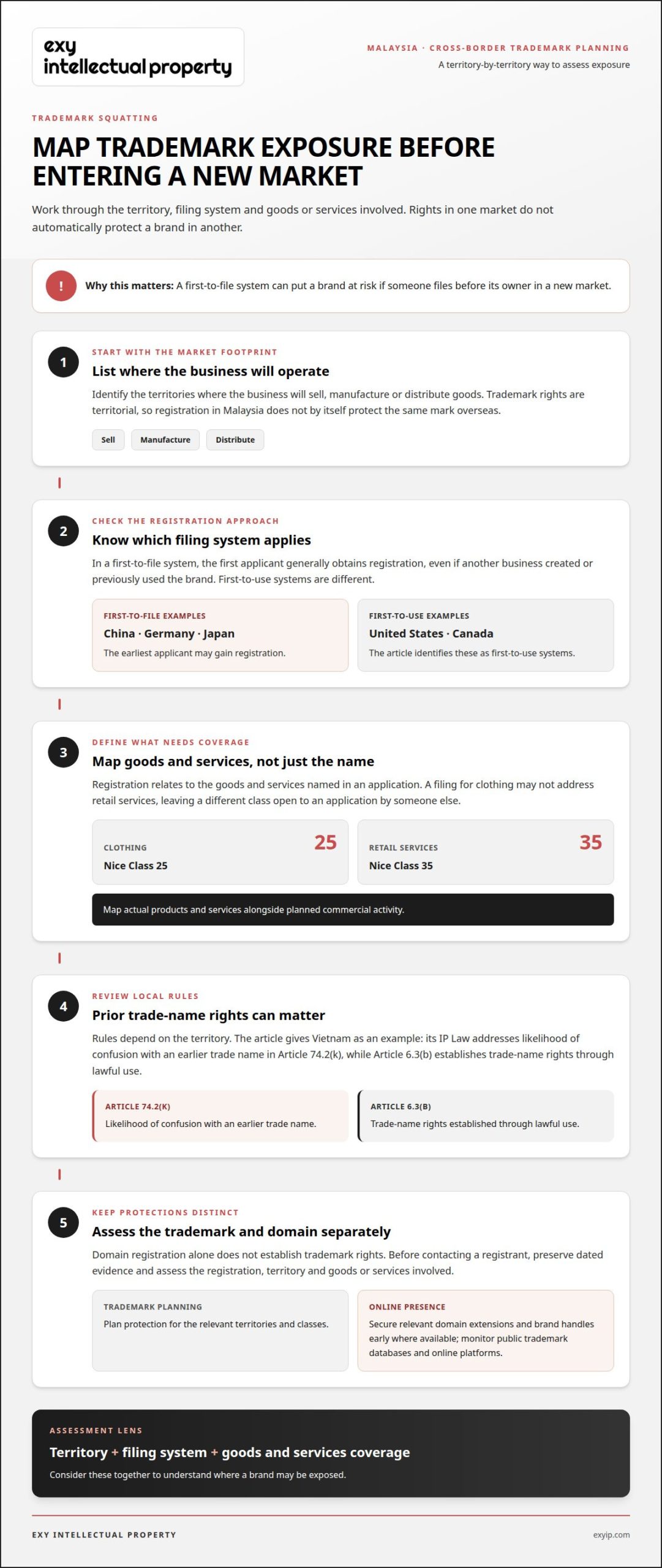
In a first-to-file system, the first applicant generally obtains registration, even if another business created or previously used the brand. That can leave an established business disputing rights in a new market. Prior trade-name rights may matter under different national rules: Vietnam’s IP Law addresses likelihood of confusion with an earlier trade name in Article 74.2(k), while Article 6.3(b) establishes trade-name rights through lawful use. The rules depend on the territory.
Territorial Rights Create Openings
Trademark rights are territorial, so registration in Malaysia does not by itself protect the same mark overseas. A squatter may target a market where the brand owner has not applied, particularly where first-to-file rules favour the earliest applicant. China, Germany and Japan are examples of first-to-file systems; the United States and Canada are examples of first-to-use systems. Before entering a market, identify where the business will sell, manufacture or distribute goods, then plan protection for those territories.
Goods and Services Classes Shape Coverage
Registration also relates to the goods and services named in an application. A filing for clothing may not address retail services. One example is a business filing in Nice Class 25 for clothing but not Class 35 for retail services, leaving a different class open to a squatter’s application. Map the brand’s actual products and services before filing, and consider planned commercial activity too. A name can face conflict in a class the owner did not cover.
Business and Consumer Harms
A squatted mark can obstruct market entry, trigger a rights dispute or limit a business’s control over its name. Consumers may encounter a similar mark on goods or services from an unrelated trader and mistake the source. Trademark law generally bars similar marks for the same category of goods within the same territory to protect intellectual property rights and reduce consumer confusion. Assess the mark, territory and relevant classes together to understand the exposure.
Risks of Paying or Public Confrontation
Paying a squatter may reward a bad-faith filing and encourage further demands, while public confrontation can escalate the dispute or reveal your response strategy. Before making contact, preserve dated evidence and assess the registration, territory and goods or services involved. To reduce exposure across domains and social media, secure relevant domain extensions and brand handles early where available, then monitor public trademark databases and online platforms. Domain registration alone does not establish trademark rights, so treat these protections separately.
What is trademark squatting and why is it a growing issue?
For a .com domain dispute, the Uniform Domain-Name Dispute-Resolution Policy (UDRP) provides an administrative route for certain registrations. It is separate from a court case and focuses on the disputed domain. A Malaysian business considering what to do about brand name squatting should understand that a UDRP decision concerns the domain, not every use of the brand or every related claim.
Whether the UDRP applies depends on the domain extension and the dispute. A complaint should connect the domain to the complainant’s trademark rights and explain why the registrant’s conduct is being challenged. The domain’s content, communications between the parties and how the name is being used can help explain the dispute. A name pointing to a competing store raises different concerns from one used for commentary or left inactive.
The Uniform Rapid Suspension System (URS) is narrower. It applies only to newer generic top-level domains and has a higher burden of proof than the UDRP. The domain ending is therefore an important factor when assessing whether URS is available. A business should not assume that a process with a faster-sounding name suits its case; eligibility limits and the evidence standard matter.
For a Malaysian brand owner, domain procedures and national legal claims serve different purposes. A UDRP or URS case addresses the domain registration under its applicable process. It does not itself decide a separate Malaysian trademark infringement or passing-off claim. Keeping these tracks distinct helps prevent a domain decision from being mistaken for a complete resolution of the business’s rights in Malaysia.
Before choosing a route, organise the case around the domain’s actual use. A useful case file can include the relevant trademark record, dated captures of the domain, the page’s commercial purpose and correspondence with the registrant. Note whether the site displays competing products, offers the domain for transfer or redirects visitors. These details help show why the dispute may fit a domain procedure, rather than relying only on the similarity of the names.
Asking what to do about brand name squatting should lead to a process-specific assessment, not an automatic complaint. Compare the domain extension, the available evidence and the outcome you want. UDRP and URS are not interchangeable, and neither replaces advice on a Malaysian claim. A focused assessment can identify the appropriate route while keeping customer communications and separate legal issues clear.
Business consequences of a squatted brand
A squatted trademark can restrict a company’s ability to trade under its established name. Someone else’s registration may complicate product launches, distribution agreements or entry into a new market. The affected business may need to challenge the registration, negotiate access or adjust its branding. Each option can divert management time from sales and operations. Trademark protection helps establish a stronger position, but its practical value depends on the territory and goods or services covered.
Apple’s iPad dispute in China illustrates how a brand conflict can affect expansion. Apple paid to settle the trademark dispute in 2012, after a local firm had registered the iPad mark. The example shows that a well-known international business can still face a local registration challenge. If a squatter controls a mark in a market where a company plans to sell, launch timing and commercial plans may be disrupted.
Sulbing’s experience illustrates another consequence. The Korean dessert business withdrew from China after a trademark dispute and refunded local partners. A dispute can affect more than the right to use a name: it may also strain partner relationships, delay operations and undermine plans to establish a local presence. For businesses working with distributors or franchise partners, uncertainty over brand rights can complicate ongoing commitments.
Tesla also faced a trademark dispute in China involving a demand for damages. A dispute of this kind can put a company’s intellectual property position under scrutiny while it continues operating in the market. The commercial impact may include delayed decisions, internal work to gather evidence and uncertainty for customers or business partners. A domain name dispute can add another layer if customers reach an unauthorised site instead of the company’s official channel.
The effects can spread across teams. Marketing may need to pause campaigns, while sales staff explain which products or channels are genuine. A squatted mark can also weaken brand value if consumers associate the name with goods the business does not control. For a Malaysian company preparing an overseas launch, a clear record of brand use and registration status supports planning before commitments are made.
Assess the exposure systematically. Identify the country, disputed registration, goods or services involved, and any actual use by the other party. Preserve dated evidence of the company’s branding, sales and communications. Then consider the effects on current operations, partners and planned expansion. This review helps distinguish an immediate market-access problem from a domain or reputation issue, giving decision-makers a clearer basis for choosing their next step.
Consumer confusion and brand reputation risks
Confusion starts when customers encounter the same or a similar name on unrelated goods, websites or social accounts. A shopper in Malaysia might see a familiar brand on an unauthorised online store and assume the trademark owner operates it. If the seller provides poor service or questionable products, customers may blame the recognised business. The association can damage its reputation even when it had no role in the transaction.
Online channels can make a product’s source difficult to identify. A domain combining a brand with words such as “official” or “Malaysia” may look credible to a hurried customer. A similar social media handle can create the same impression through copied logos, product images or brand language. Customers may then share complaints or warnings about the wrong business, spreading confusion beyond the original purchase.
For the trademark owner, the problem is not limited to lost sales. Conflicting names can make customer support more difficult because staff must distinguish genuine products from unauthorised offers. A customer who receives an item that differs from expectations may still associate the experience with the brand. Keep records of the affected domain, account name, displayed branding and customer reports. These details can help establish what customers saw and when.
A trademark registration can clarify a business’s rights in the territory and for the goods or services it covers. It does not automatically eliminate confusion in every national market or online channel. A Malaysian registration, for example, is not a substitute for planning protection in another country where the business intends to trade. Before deciding how to challenge a disputed use, assess where it occurs and which registrations apply.
Public responses also require care. A hurried accusation against a named account may identify the wrong party or amplify a misleading post. First preserve screenshots and customer messages, establish which channels are genuine, then provide clear customer guidance through verified accounts. If a dispute is active, coordinate statements with those handling the matter. Consistent messages can help customers distinguish the real brand from an unauthorised seller.
Monitor customer-facing channels as part of brand protection. Search for the brand name alongside product terms, review reports about confusing listings and track new trademark filings in relevant markets. When customers ask whether a page or seller is official, answer directly through an established channel. Recurring questions can reveal where confusion persists and help the business refine its messaging, without suggesting that every similar name is automatically unlawful.
Should you contact the domain registrant, negotiate a purchase, or send a cease-and-desist letter?
If you’re deciding what to do about brand name squatting, start by identifying the domain, its use and your rights. Preserve dated screenshots, registration details and messages. Record whether the site sells goods, redirects visitors, displays advertising or remains inactive. These facts help distinguish an attempt to exploit your brand commercially from a domain that merely shares similar wording. Avoid paying or making public accusations before assessing the evidence and available dispute routes.
Direct contact can clarify whether the registrant will transfer or change the domain. Keep your first message factual and professional. Identify the domain and your relevant trademark rights, state the issue clearly and retain the full exchange. Avoid disclosing confidential launch plans or making unsupported threats. Public confrontation can amplify the disputed address, draw attention to it and complicate later negotiations.
Negotiation may resolve a domain dispute, but payment has strategic consequences. It can reward someone who registered a confusingly similar domain in bad faith and may signal that the brand owner will pay to recover other names. Before discussing a transfer, establish the registrant’s identity, the domain’s use and your rights in the relevant country. Compare negotiation with formal options, including a domain-name dispute process, when deciding what to do about brand name squatting.
A cease-and-desist letter puts the brand owner’s position in writing and asks for the disputed conduct to stop. It should identify the rights relied on, the domain or activity at issue, and the action requested. An unsupported allegation can weaken credibility or escalate the dispute. Preserve evidence first, then have the letter reviewed against the registration, actual use and applicable jurisdiction.
The United States offers a specific example, not a rule for Malaysia. The Anti-Cybersquatting Consumer Protection Act, at 15 U.S.C. Section 1125, addresses bad-faith registration, trafficking in or use of confusingly similar domain names with intent to profit from another party’s trademark goodwill. That US law does not decide a Malaysian dispute. For a domain used across borders, identify the registrant’s location, the domain extension and the markets targeted before choosing a process.
Use a measured sequence: preserve evidence, assess the rights and conduct, then select contact, negotiation, formal notice or a domain dispute process. Keep customer-facing communications separate from legal correspondence. For a Malaysian business, seek legal advisory on a trademark dispute to assess the rights and response strategy before taking a position with the registrant.
Exy Intellectual Property
Exy Intellectual Property helps businesses consider trademark protection as part of a broader intellectual property strategy. If someone else is using or registering a brand name, clarity about relevant markets, existing records and intended business activity can help shape the next decision.
For businesses planning protection in Malaysia or other markets, Trademark Registration and Global Trademark Registration can support a considered approach to securing brand rights. The appropriate scope depends on where the business operates and the goods or services associated with its mark. Early planning matters before a launch, distribution arrangement or international expansion makes the brand more visible.
Contact Exy Intellectual Property to discuss your brand protection needs and possible next steps.
Set a clear direction for your brand
If you’re deciding what to do about brand-name squatting, make your next move part of a broader intellectual property plan. Consider where the brand will operate, which goods or services it represents, and whether other business assets also need attention. This provides a practical basis for prioritising action rather than responding to each online use in isolation.
Exy Intellectual Property offers Trademark Registration, Patent Filing and Industrial Design Registration. These services can support businesses planning to protect their brand and other intellectual property as they develop or enter markets. The right focus depends on your business’s needs and current position.
A considered plan can help you move forward with greater clarity. Discuss your next steps with Exy Intellectual Property.
Frequently Asked Questions
Are there markets where companies need to be especially careful?
Yes. China, the United States and the European Union are identified as common risk areas, though their trademark systems differ. China is a first-to-file example, while the United States is a first-to-use example. An EU trademark covers 27 countries. For a Malaysian business, prioritise markets connected to planned sales, manufacturing or distribution, then align filing decisions with the brand’s goods and services.
Can I cancel a trademark registered in bad faith?
Yes. Bad-faith registrations can be challenged through cancellation actions in Egypt, Saudi Arabia and the UAE, including after registration. The appropriate route depends on the country and the evidence supporting the challenge. Organise documents showing your brand’s earlier use, reputation and business activity in the relevant market. A cancellation process in one jurisdiction does not automatically cancel the same mark elsewhere.
Can I oppose a trademark someone filed on my brand name in Egypt?
Yes. A trademark opposition in Egypt must be filed within 90 days of Official Gazette publication. The publication date is therefore central to deciding whether the opposition window remains open. Gather the application details and documents showing your earlier rights or use, then prepare the objection for the relevant Egyptian process. Missing the opposition period may mean considering a different route to challenge the registration.
What is brand name squatting and how is it different from cybersquatting?
Brand name squatting involves seeking trademark rights in another business’s brand, often to block its use or demand a transfer. Cybersquatting concerns a domain name registered or used to target another party’s mark. For example, a third party might file a brand as a trademark in one country while separately registering a matching “.com” address. The trademark and domain disputes involve different registrations and processes.
What should a Malaysian business do if someone registers its brand name as a domain?
First, record the full domain, its extension, any available registrant details and what the site displays. Save dated screenshots, especially if the page offers goods, redirects visitors or imitates an official channel. Then assess trademark rights in the relevant territory and whether a domain dispute process fits the extension. Keep customer notices factual, and do not treat domain registration alone as proof of trademark ownership.
What evidence should you collect to prove bad-faith domain name squatting?
Build a dated record linking the domain to the suspected conduct. Keep screenshots of the website, sales offers, redirects, copied branding and any messages offering to transfer the name. Preserve records showing your trademark rights, brand use and customer confusion. Note when you first found the domain and save changes over time. A clear chronology helps explain why the registration or use appears connected to your brand.
How can you file a UDRP complaint for a squatted .com domain?
Start by identifying the domain’s registrar and the applicable UDRP dispute provider. Prepare a complaint that identifies the domain, your trademark rights, the registrant and the conduct you challenge. Attach supporting records, such as registration documents, dated website captures and relevant correspondence. Follow the provider’s filing instructions and response process. Keep the complaint focused on the domain dispute, since it does not decide every separate trademark claim.