

A patent demand is an allegation to assess, not proof of infringement. Effective patent troll defense strategies begin by examining the patent and the accused technology, then testing the claim for noninfringement or possible invalidity. For a Malaysian business, the response should also account for where the patent is asserted and which legal process applies.
A patent troll, also called a non-practising entity (NPE), is an individual or company that acquires patents and targets businesses with infringement claims. A demand can feel urgent, but a measured review gives you a clearer basis for deciding what to do next. This article explains how to assess a demand, investigate patent validity, understand the role of US Patent Trial and Appeal Board proceedings in a US-linked dispute, and consider designing around an asserted patent.
Key Takeaways
- Assess the patent claims against the accused technology and relevant prior art before deciding how to respond.
- Keep a patent demand letter and its deadlines under review; request clear details about the alleged infringement.
- Understand how US post-grant reviews and PTAB proceedings may apply when a dispute involves a US patent.
- Consider whether a design change can avoid the specific claims while still meeting your business and technical needs.
- Patent searches and filing support can help strengthen your intellectual property position as you assess your next steps.
1. Prior-art searches and patent validity challenges
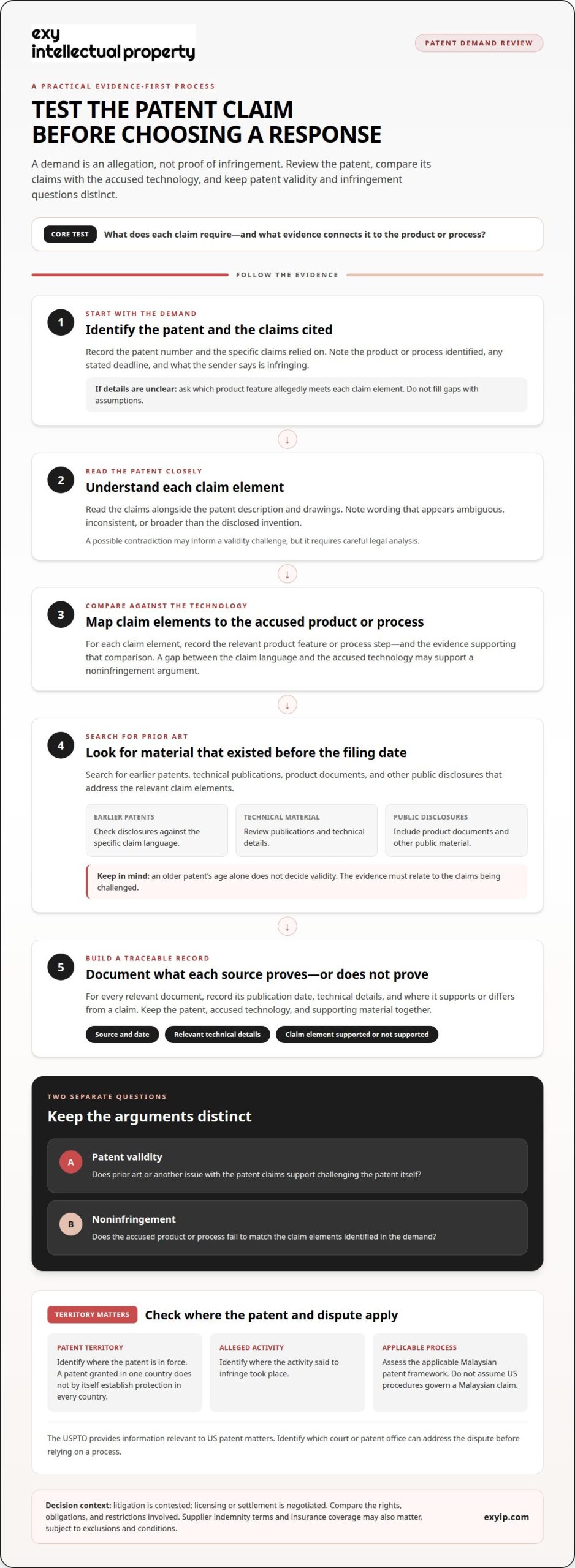
A prior-art search looks for material that existed before a patent application’s filing date. This can include earlier patents, technical publications, product documents, and other public disclosures. The key step is matching each relevant item to the patent claims, not simply finding an invention that looks similar. A patent about placing suspicious objects into quarantine, for example, dated back to 1995. Its age alone would not decide validity; the evidence must relate to the specific claims being challenged.
Start with the patent number and claims cited in the demand. Map each claim element against the accused product or process, then search for earlier disclosures addressing those elements. Record publication dates, technical details, and where each document supports or differs from a claim. This evidence may support an invalidity argument, while a gap between the claim language and the accused technology may support noninfringement. Keep these arguments distinct: one challenges the patent, the other challenges the allegation.
Clarity matters too. Read the claims alongside the patent’s description and drawings, and identify wording that may be ambiguous, inconsistent, or broader than the disclosed invention. A contradiction between a claim and its supporting description may inform a validity challenge, but it requires careful legal analysis. Test the demand against its evidence as well: ask the claimant to explain which product feature allegedly meets each claim element.
International disputes require attention to territory. A patent granted in one country does not, by itself, establish protection in every country. Identify where the patent is in force, where the alleged activity occurred, and which court or patent office can address the dispute. The United States Patent and Trademark Office (USPTO) provides information relevant to US patent matters; do not assume its procedures govern a Malaysian claim.
In Malaysia, assess the asserted patent, the alleged acts, and the evidence under the applicable Malaysian patent framework. The label “patent troll” does not establish infringement or invalidate a patent. Litigation is a contested route; licensing or settlement is negotiated. Compare the rights, obligations, and restrictions involved rather than assuming one option will always have a lower business impact.
Businesses can reduce exposure by reviewing supplier contracts for indemnity provisions covering third-party intellectual property claims. Insurance terms may also define whether patent disputes are covered, subject to exclusions and conditions. A managed patent portfolio, supported by novelty searches and clear filing records, can help document a company’s innovations and inform negotiations. These steps do not defeat every claim, but they give decision-makers organized evidence and defined options.
2. Staying calm after receiving a patent demand
A patent demand can disrupt decisions across a business, but a controlled response helps protect the company’s options. Treat the letter as an allegation, not a finding of infringement. Assign one person to coordinate the response, preserve the original letter and envelope, and record when and how it arrived. Keep related emails, product documents, contracts, and sales records together so the facts remain traceable.
Next, identify exactly what the sender demands. Does the letter name a patent, quote particular claims, identify a product, and explain the alleged infringement? A demand that says only “your software uses our invention” leaves key details unclear. Note each missing point, including the product feature implicated and the activity the sender says infringes. Do not fill gaps with assumptions or treat the sender’s interpretation as established fact.
Before replying, check whether the letter sets a deadline, threatens litigation, or requests a license. A stated response date is not automatically a court deadline, but it still requires attention. Avoid ignoring the letter, making admissions, or promising payment before assessing the claims. Keep communications factual and direct. If the recipient is a company, staff should route inquiries to the designated decision-maker rather than improvising separate responses.
A useful reply can ask for the patent number, the specific claims relied on, the product or process identified, and the evidence connecting each claim element to that technology. Request clarification where the letter uses broad labels such as “platform” or “system” without identifying a feature. A precise request creates a record of what remains disputed and can reveal whether the demand is based on an analysis of an actual product or a general accusation.
Also identify the sender and the rights it claims. A non-practising entity may own patents without making or selling products; a practising entity may compete in the same market. That difference does not decide whether infringement occurred, but it can help explain the sender’s commercial position. Search the company name, patent number, and named affiliates in available business and court records. Treat similar claims against other companies as context, not proof that this demand is invalid.
In Malaysia, distinguish a demand letter from filed court documents. If the papers include a court name, case number, hearing date, or formal response requirement, escalate them promptly for legal review. Keep the patent, accused product, sales territory, and relevant contracts in the same case file. These records help an adviser assess the allegation without confusing a negotiation request with an active court process.
For an international business, note which country’s patent and law the letter invokes. A US demand, for example, should not be treated as automatically governing activity in Malaysia. Careful intake gives the business a reliable basis for deciding whether to request details, contest the allegation, negotiate, or prepare for litigation.
3. America Invents Act post-grant reviews
The America Invents Act (AIA) changed how some issued US patents can be challenged. The US Congress passed the AIA in September 2011, introducing post-grant procedures at the Patent and Trademark Office. These proceedings give an accused party a route to challenge a questionable patent before the agency, rather than relying only on arguments in court. They concern US patent rights, not a patent granted solely in Malaysia.
A post-grant review may matter when a demand relies on an allegedly weak US patent. Start by identifying the patent, the claims cited in the letter, and the US Patent and Trademark Office’s examination record. Then compare the claims with the evidence supporting the challenge. Earlier publications, patent documents, and technical records may help show why the alleged invention should not retain its claimed scope.
A patent office proceeding is not a general complaint about a claimant’s conduct. The challenge must address the patent itself and connect evidence to a legal basis available in the relevant proceeding. A broad assertion that a patent is “obvious” or “unclear” is not enough on its own. The case needs a reasoned explanation of how the cited material relates to specific claim language.
Preparation also means assessing the business position before choosing a proceeding. Consider whether the asserted patent covers a core product, whether the challenged claims matter to the demand, and what records can support the argument. An engineering document describing an earlier design, for example, may be useful only if its date and technical content are established. A clear evidence map helps keep the challenge focused on the patent’s intellectual property merits.
Post-grant proceedings are not interchangeable with every court defence. Depending on the facts and forum, a business may dispute infringement separately, negotiate a licence, or defend litigation. A patent office challenge focuses on validity; it does not automatically resolve every allegation about a product. A favourable result on a patent issue can affect the claimant’s position, but the effect depends on the claims and proceedings involved.
For a Malaysian business, jurisdiction is central. A US post-grant route addresses a US patent and does not itself cancel or determine rights granted in Malaysia or another country. If a demand alleges activity in several markets, list each patent, country, and accused product separately. This comparison helps distinguish the US administrative option from local questions about Malaysian patent rights and alleged infringement.
Use an AIA procedure only after confirming that the asserted right and dispute fit the US process. Organize the patent record, claim language, prior-art material, and commercial impact before selecting a response. This focused review distinguishes a challenge to the patent’s validity from arguments about the accused technology, while helping preserve a clear position for any parallel negotiation or court dispute.
4. Inter partes review and other PTAB proceedings
The US Patent Trial and Appeal Board (PTAB) handles administrative proceedings that can affect an asserted US patent. Its post-grant options include inter partes review (IPR), Post-Grant Review, and ex parte proceedings. These are distinct routes, not interchangeable labels for one challenge. Before weighing this option against court litigation, identify the patent, the disputed claims, and the available proceeding.
An IPR is a process a US patent defendant may consider when challenging patent validity. It focuses on the patent, not on whether a particular product infringes. Practical preparation begins with a claim-by-claim review and prior art tied to the challenged language. For example, a technical publication may matter if it addresses an element in a claim. General similarity between an older product and the patented invention does not explain the challenge on its own.
Post-Grant Review is another PTAB proceeding among the available options. The choice between it and IPR depends on the patent and the grounds available under the applicable US process. Ex parte proceedings provide a separate route involving the patent office. Because these procedures have different rules and purposes, do not assume evidence suitable for one automatically fits another.
Before selecting a route, organize the patent’s examination record, asserted claims, and prior-art documents. Then identify the specific validity issue each document supports. A useful evidence chart connects each claim element to a passage or feature in the cited material. This makes gaps visible and helps distinguish a focused patent challenge from a broad objection to the claimant’s conduct. The PTAB process concerns US patent rights, even when the business operates in Malaysia.
The America Invents Act included changes to joinder rules in September 2011. Joinder can affect how parties participate in proceedings, so businesses facing related claims should consider whether another entity is challenging the same patent. Shared interests may create opportunities to coordinate, but each party’s product, evidence, and legal position still require separate attention. Similar allegations do not establish that claims are invalid.
An IPR may be faster than federal court litigation, but speed alone does not make it the right choice. Compare the patent claims at issue, available evidence, parallel disputes, and business impact of the challenged rights. A PTAB result may affect the asserted patent, but it does not automatically resolve every infringement allegation or negotiation. Depending on the parties’ objectives, they may still discuss a separate license agreement.
For a Malaysian business, keep territorial scope clear. A US PTAB challenge does not itself determine the validity of a Malaysian patent or settle alleged conduct in Malaysia. List each patent by country, then match each demand to the relevant proceeding and evidence. This prevents a US administrative strategy from being mistaken for a complete response to every international claim.
5. Designing around asserted patents
A design-around changes a product or process to avoid one or more asserted patent claims. Start with the claim language, not the patent title or a broad description of the invention. For example, if a claim requires a particular sensor arrangement, engineers can assess whether an alternative configuration meets the same business need without using that arrangement.
Map each element of the relevant claims against the accused design. Mark which features appear to be present, which differ, and which need technical evidence. Under Germany’s Patent Act, patent scope is determined by the claims, interpreted with reference to the description and drawings, according to Gesetze im Internet. This illustrates why a design-around requires close reading, not a superficial comparison.
Next, have engineering teams develop alternatives based on the specific claim elements. Document each proposed change, its technical purpose, and how it affects performance, manufacturing, and customer use. If a claim requires a particular sequence, for instance, a revised workflow may be worth evaluating. Assess the change against the full claim, since changing one feature may not avoid every asserted claim.
Noninfringement and patent exhaustion are distinct defences. Noninfringement argues that the accused product or process does not meet the elements of the asserted claims. Patent exhaustion concerns whether rights in a particular patented item have been exhausted after an authorized sale; its application depends on the relevant facts and jurisdiction.
A design-around may help the parties negotiate, but it does not automatically resolve existing lawsuits or past allegations. Before changing a product, assess whether the patent applies in each sales territory and whether the redesign affects other intellectual property or contractual commitments. A change that works in one country may not address a separate patent asserted elsewhere.
Compare the proposed redesign with the business objective. A technically sound alternative may still require new testing, supplier changes, or customer communication. Record the decision process and preserve design documents. If the parties later settle, clear records can help distinguish the revised product from the version named in the demand and define what the agreement covers.
Patent troll defense strategies can include a design-around, but it should follow a claim-focused assessment rather than a rushed product change. For support evaluating patent scope and technical options, consider patent legal advisory.
Exy Intellectual Property
Exy Intellectual Property helps businesses protect and formalize intellectual property as they assess their innovation strategy. If a patent demand prompts a closer look at the company’s own inventions, its Patent Filing service can help prepare an application, while Patent Registration supports protection for eligible inventions. Industrial Design Registration may also be relevant when a product’s appearance is central to its commercial identity.
These services focus on building and protecting your own intellectual property position; they do not replace a case-specific response to an active infringement allegation. A clear picture of what the business has created and documented can inform wider decisions about products and protection. Contact Exy Intellectual Property for guidance on the appropriate next step.
Make your next decision with a clear IP position
A patent demand can affect product plans well beyond the immediate dispute. Treat your response as part of a wider business decision: protect innovation, understand the rights around your products, and keep future development moving. A considered approach to patent troll defense strategies can help align the dispute response with the company’s intellectual property priorities.
Exy Intellectual Property supports businesses with related protection needs, including Patent Filing, Trademark Registration, and Industrial Design Registration. These services can help formalize rights in inventions, brand identifiers, and product designs as your business develops. They address protection and registration needs, while the right response to a demand depends on the patent, the allegations, and the relevant territory.
When you’re ready to discuss your intellectual property needs, contact Exy Intellectual Property. A clear next step can help you move forward with greater focus and confidence.
Frequently Asked Questions
What are NPEs and How Do Patent Trolls Work?
NPE describes an entity that does not practise the patents it holds; it does not determine whether a patent is valid or infringed. The business issue is how the patent is asserted: a demand may seek a license, while a lawsuit asks a court to decide a dispute. Keep the entity’s status separate from the evidence about the patent and the alleged use.
What is a patent troll and how do patent assertion entities operate?
“Patent troll” is a critical label, not a legal finding. A patent assertion entity may hold rights through a corporate structure, so identify the named patent owner and any affiliates or partners involved in the claim. Ownership details matter when assessing who is asserting rights and who could grant a license. The entity’s operating model alone does not show whether its patent claims are valid.
What should a company do after receiving a patent infringement demand letter?
Keep public statements separate from the legal response. If the company is considering discussing the dispute publicly, review any proposed confidentiality terms carefully, especially language that could restrict future statements. Preserve the letter and related communications, and limit internal discussion to people responsible for the matter. This helps avoid inconsistent public and internal accounts while the company assesses its position.
How can a business assess the validity and scope of an asserted patent?
For a US patent, examine the application record for material inconsistencies between what was disclosed and what was represented during examination. When assessing a patent challenge, examine the application record for inconsistencies and supporting evidence. A business can also compare the asserted claims with the patent’s description and drawings to understand the claimed scope.
What are the steps and deadlines for challenging a patent in court or before the USPTO?
There is no single deadline that applies to every US patent challenge. In US infringement matters, a venue challenge must be made in a timely manner or it may be waived. A US patent owner may also allege infringement that occurred before the patent expired, subject to a six-year statute of limitations. These rules concern US proceedings and should not be treated as Malaysian deadlines.
How can prior art searches and invalidity arguments help defend against patent claims?
Strong prior-art evidence needs a reliable connection to the patent’s filing date. Preserve complete copies of relevant publications and technical records, including dates and context that help establish when they were available. A document that mentions a similar idea may not address the specific features of the claimed invention. An invalidity argument is clearer when it explains precisely what the evidence shows and which claim language it relates to.
When should a company negotiate, settle, or refuse a patent troll’s demand?
Before accepting a settlement, examine what the agreement would permit after signing. Patent infringement settlements are typically structured to grant the defendant a perpetual license. Review whether the proposed rights cover the relevant products and business activities, and whether future changes are addressed. Negotiation is a business decision as well as a legal one, so compare the agreement’s practical effect with the company’s plans.
How do patent litigation, licensing, and settlement compare?
Patent litigation, licensing, and settlement involve different rights and obligations. A settlement may grant a perpetual license, but the terms can vary. Compare the rights and obligations rather than assuming settlement is always preferable.