

A product can be original and still raise patent infringement concerns in a market where you plan to sell it. Knowing how to conduct a freedom to operate search means identifying relevant patents and published patent applications in Malaysia, then assessing whether their claims may cover features of your product or steps in your process. It is a clearance exercise, not a test of whether your invention qualifies for a patent.
That distinction matters. A patentability search asks whether an invention may qualify for patent protection; an FTO search assesses potential infringement risks if a product or process enters a market. The search also needs a clear scope: the product features or process steps being assessed, the countries involved, and the relevant patent rights.
This guide explains what an FTO search can reveal, why product clearance matters before development or launch, and how to define the search scope around your plans in Malaysia. You’ll also learn how professionals compare patent claims with product features, assess potential risks, and use the findings to inform business decisions. The aim is to clarify which issues to address before committing to commercialization.
Key Takeaways
- Understand how a freedom to operate search identifies patent rights that may affect a product or process in its target market.
- See why comparing patent claim elements with product features is central to assessing potential infringement risk.
- Identify the product details and business background that help shape a useful clearance search.
- Define the search around the countries where you plan to make, use, sell, offer or import the product.
- Learn how search findings can inform decisions about product development, launch planning and patent protection.
What is a Freedom to Operate (FTO) Search?
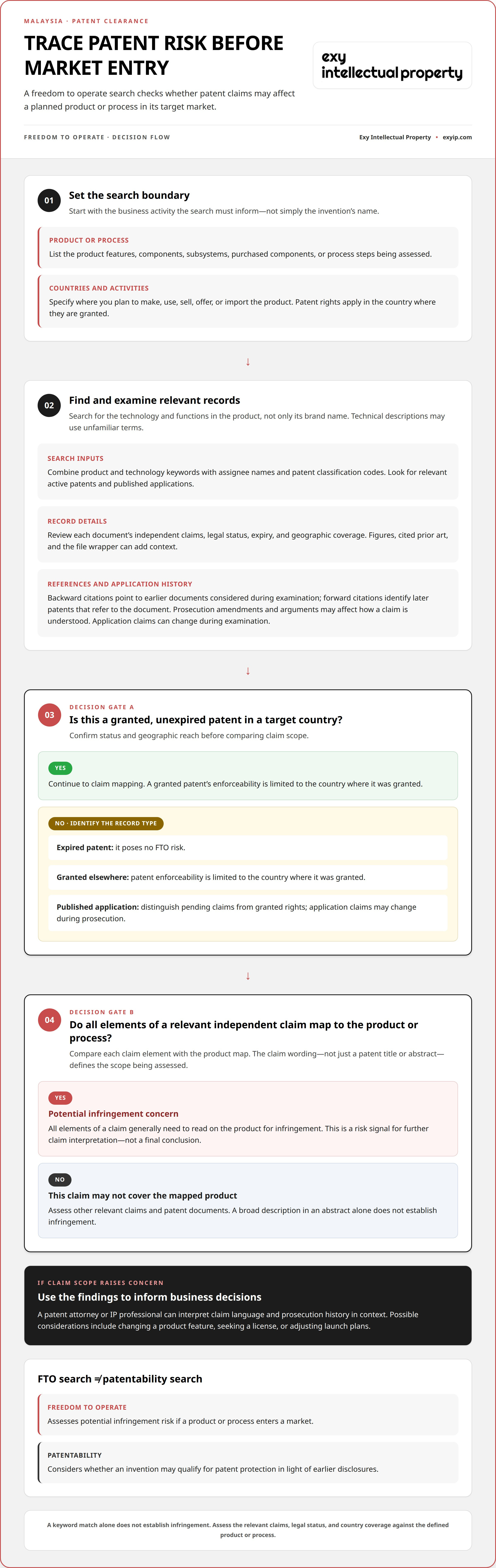
Professionals search patent databases using product terms, assignees, and classification codes to find relevant active patents and published applications. They assess each document’s legal status, expiry, claims, and geographic coverage, since patent rights apply in the country where they are granted.
-
How Professionals Search Patent Databases
Search patent databases for the technologies and functions found in the product, not just its brand name. Professionals combine relevant keywords with assignee names and patent classification codes, then review results for active patents and published applications. WIPO PATENTSCOPE and databases from national or regional patent offices can help locate records. Search variations matter: a patent may describe a familiar product feature in technical language rather than everyday terms.Keep the search tied to the product’s intended use and target markets. A search covering only one feature or jurisdiction can miss relevant rights affecting another component or market. Professionals also consider related patent families and applications, since application claims can change during examination.
-
How Professionals Review Patent References and Prosecution Records
Review the patent’s independent claims, figures, cited prior art, and file wrapper. Backward citations point to earlier documents considered during examination; forward citations can identify later patents that refer to the document. These references help show how a technology developed and which parts of the patent record may need closer review.Then examine prosecution records for amendments and arguments made while the application was assessed. Those details can affect how a claim is understood, but they do not replace analysis of the granted claim’s wording. For example, narrowing a claimed feature through an amendment may change how it compares with a product. Patent attorneys and IP professionals can interpret technical language and prosecution history in context.
3. 3. Mapping Patent Claims to Product Features (The All-Elements Rule)
Break the product into features, components, or process steps, then compare each relevant independent claim element with that product map. Under Section 23 of Malaysia’s Patents Act 1983 and purposive claim construction principles applied by Malaysian courts, the claims define the legal scope of patent protection—so a broad description in a patent abstract is not enough to establish infringement. Under the all-elements rule, infringement generally requires every essential integer of an independent claim to be present in the accused product or process. For example, a product may contain features A, B, C, D, and E, while a claim covers only A, B, and C. Include subsystems and purchased components, not only the main assembly.
4. 4. Assessing Patent Scope and Infringement Risk Under Malaysian Law
Confirm each relevant patent’s legal status and geographic coverage before assessing risk. Under Section 36 of the Patents Act 1983, a granted Malaysian patent gives its owner the exclusive right to exploit the patented product or process—covering making, importing, offering for sale, selling, or using the product in Malaysia (for up to 20 years from the filing date, subject to Section 35 annual renewal fees). Conversely, an expired patent or a patent granted only overseas poses no direct infringement risk in Malaysia. Clearance searches must also check Certificates for Utility Innovations granted under Section 17A, which protect incremental technical improvements for up to 20 years and can block commercial launches just like standard patents.
Definition and purpose of an FTO search
- Define an FTO search as a market-focused analysis of potential conflicts with existing intellectual property rights. Understanding how to conduct a freedom to operate search starts with identifying the planned product or process and the business decision the search must support. Its central question is whether commercial activity may fall within active patent claims in the countries where the product will be made, used, or sold.The search supports decisions about commercial activity; it does not establish whether an invention is patentable. A useful analysis considers technical features, relevant patent rights, and intended activities together. It may also include non-patent literature, industry publications, and other relevant sources. These materials can provide context for technical terms or developments not fully explained by patent records alone.
- Read search results as evidence for a defined decision, not as a simple list of matching documents. Professionals assess each relevant patent’s claims against the product or process, then consider its status and geographic reach. A keyword match alone does not establish infringement; the claim’s required elements must be compared with the product’s actual features.For example, a patent title may describe a broad technology, while its independent claims cover a narrower combination of components. That distinction can change the analysis. An attorney can interpret claim language and explain how prosecution records, figures, and cited references inform the assessment. Patent scope depends on the claims, not merely the title or abstract.
- Use the findings to frame practical choices. If an active patent appears relevant, a business may consider changing a product feature, seeking a license, or adjusting launch plans. If parties hold patents that may affect one another, cross-licensing may also be considered. The suitable option depends on the claims, product design, and commercial objectives.An FTO analysis may also help identify grounds to challenge a blocking patent when supporting evidence exists. Patent litigation is a separate legal process, not an automatic result of a search. The search’s value lies in surfacing issues for informed consideration before a business commits to a launch or expansion.
- Keep the conclusion tied to the search’s limits. Applications may publish later, claims can change during examination, and interpretations can vary. A finding that no potentially blocking patents were identified applies to the records, product details, jurisdictions, and review date covered. It is not permanent clearance across every market or future product version.Reassess when the design changes, a new market is added, or relevant patent records evolve. Professionals determine how to conduct a freedom to operate search in a way that fits the business decision and the product version under review. This keeps the analysis connected to innovation and launch planning, rather than treating it as a one-time database exercise. For a professional view, discuss your patent-related questions with an IP professional.
Why is Product Clearance Search Important?
Before an FTO search begins, professionals need a description of the product or process, its planned launch timing, and intended sales countries. They also need relevant technical and business background to identify which features and jurisdictions should shape the clearance review.
- Define the product version and decision date. Describe its purpose, how it works, and the features planned for launch, including those still under development. A product’s design can change between prototype and final release, so the search scope should reflect the version being assessed. For a connected device, this may include its physical structure, software functions, and communication methods.Record whether the decision concerns continued development, manufacturing, selling, importing, or entering another market. These activities can involve different product elements and jurisdictions. A precise description helps professionals focus on relevant patents instead of searching a broad technology area without a clear commercial question.
- Map the complete product and its components. Include subsystems, individual parts, and components purchased from other suppliers, because each may use technology covered by a patent. For example, a finished appliance might combine a housing, control unit, power system, and purchased sensor. Assessing only the housing could leave other relevant features outside the clearance review.Describe what each component does and how it interacts with the rest of the product. For a process, provide its stages, equipment, and sequence of operations. This detail lets professionals compare the actual product or process with patent claims rather than relying on a high-level product label.
- Gather background that explains the technology and business plan. Useful details include intended launch timing, planned sales countries, known competitors, key inventors, and litigation in the relevant technology area. This information helps professionals understand which patent owners, terminology, and technical developments may be relevant to the search.Include product specifications, diagrams, prototypes, and technical descriptions where available. Identify design changes and explain which functions are essential to the product. For instance, if a prototype uses one operating method but the planned version uses another, that difference can affect which claims need closer assessment.
- Set the jurisdictions according to actual business plans. Identify where the product will be made, used, sold, offered for sale, or imported, then align the search with those markets. Patent rights are territorial, so clearance in Malaysia alone does not address planned activity in another country. A component licensed for use in a new jurisdiction also needs assessment for protection there.Arrange the search before development commitments or launch, then revisit it when product features or target markets change. Finding a blocking patent while a product is still at the prototype stage can leave room to assess alternatives before tooling and marketing commitments. Patent infringement can lead to litigation, heavy fines, or sales injunctions, so timely clearance matters to launch decisions.
Statutory Exhaustion & Judicial Clearance Tools (Patents Act 1983)
In Malaysia, a comprehensive clearance review also evaluates Section 58A of the Patents Act 1983 (international exhaustion of rights), which confirms that importing or using genuine patented components placed on the market anywhere in the world by or with the patent owner’s consent does not infringe the Malaysian patent. Where a competitor’s patent claim remains ambiguous despite technical review, a business can apply to the Specialized IP High Court for a Declaration of Non-Infringement under Section 62 prior to commercial rollout.
Defining the search scope
Set the scope around the product, planned activities, and markets the FTO analysis must address. For Malaysia and other target markets, professionals can search WIPO PATENTSCOPE and databases offered by national and regional patent offices.
-
How Professionals Define the Geographic Scope
Identify every country where the business plans to make, use, sell, offer for sale, or import the product. Patent rights apply in the country where granted, so a Malaysian search alone will not address planned sales elsewhere. Match each jurisdiction to the product activity there. For example, a product assembled in one country and sold in Malaysia may raise different territorial questions in each market.
-
How Professionals Select Patent Databases for Key Jurisdictions
Select patent databases that cover each target jurisdiction, then search relevant national and regional records alongside WIPO PATENTSCOPE. Include granted patents and published applications, and prioritize active documents for the FTO analysis. Search approaches can combine technical keywords, assignees, and patent classification codes. A single database may not offer the same coverage as checking records relevant to every planned market.
- Define the activity and product version the search will assess. Specify whether the business plans to manufacture, use, sell, offer, or import the product, and identify the relevant features, components, or process steps. A product change can affect which patent claims matter. For instance, replacing a component or changing a manufacturing sequence may mean the professional needs to revisit the search scope.Set the search date and document the assumptions behind the assessment. Patent applications can publish and claims can change during prosecution, so a search reflects the records available at the time of review. Later product-development gates or a new market entry may call for an updated FTO analysis. Recording the product version and intended activity helps decision-makers understand what the findings cover.
- Use the scope to guide the review and next steps. Professionals assess the status and claims of relevant patents in each jurisdiction, while expired, rejected, withdrawn, or revoked documents may serve as potential clearing documents. The findings can help frame an opinion on identified risks, but they do not establish clearance in markets or for activities outside the defined scope.If a potentially blocking patent appears, the business can consider whether design changes or licensing may address the concern. A license may grant permission to use protected technology; whether that option is suitable depends on the patent and business plans. If the search instead informs a patent filing strategy, keep that decision distinct from FTO: patentability and freedom to operate answer different questions.
Freedom to operate search definition
- Define an FTO search as a market-focused analysis of potential conflicts with existing intellectual property rights. Its central question is whether a planned product or process may fall within active patent claims in the countries where it will be made, used, or sold. The search supports decisions about commercial activity; it does not establish whether the invention itself is patentable.That distinction shapes the work. A useful analysis considers the product’s technical features, relevant patent rights, and intended activity together. It can also include non-patent literature, industry publications, and other information sources, depending on the technology and search scope. This broader context may help explain technical terminology or identify developments that patent records alone do not capture.
- Read search results as evidence for a defined decision, not as a simple list of matching documents. For each relevant patent, professionals assess its claims against the product or process, then consider its status and geographic reach. A keyword match alone does not establish infringement; the claim’s required elements must be compared with the product’s actual features.For example, a patent title may describe a broad technology, while its independent claims cover a narrower combination of components. That difference can change the analysis. An attorney can interpret claim language and explain how prosecution records, figures, and cited references inform the assessment. This interpretation matters because patent scope depends on the claims, not merely the patent’s title or abstract.
- Use the findings to frame practical choices. A business may consider changing a product feature, seeking a license, or adjusting its plans when an active patent appears relevant. If parties hold patents that may affect one another, cross-licensing may also be considered. These options depend on the claim analysis, product design, and commercial objectives.An FTO analysis can also help identify grounds to challenge a blocking patent when relevant evidence supports that approach. Patent litigation is a separate legal process, not an automatic outcome of a search. The value of the search is to surface issues for informed consideration before a business commits to a launch or expansion.
- Keep the conclusion tied to the search’s limits. Patent applications may publish later, claims can change during examination, and interpretations can vary. A finding that no potentially blocking patents were identified applies to the records, product details, jurisdictions, and review date covered by the analysis. It should not be treated as permanent clearance across every market or future product version.Reassess when a design changes, a new market is added, or relevant patent records evolve. This makes freedom to operate a continuing input into innovation and launch planning, rather than a one-time database exercise. For a professional view of the issues, discuss your patent-related questions with an IP professional.
Navigating MyIPO Databases and Pending PCT Blind Spots
Conducting an FTO clearance search in Malaysia requires accounting for specific procedural windows under the Patents Act 1983 and the Patent Cooperation Treaty (PCT):
The 18-Month Unpublished Application Blind Spot (Section 34)
Under Section 34 of the Patents Act 1983, Malaysian patent applications remain confidential and are laid open to public inspection only after 18 months from the filing or earliest priority date. Consequently, no public database search on MyIPO’s IP Online portal can detect competitor applications filed within the preceding 18 months. Scheduling a follow-up clearance refresh shortly before mass production helps capture newly published filings.
Pending PCT National Phase Entries (Section 78O)
An international PCT application published on WIPO PATENTSCOPE has up to 30 months from its earliest priority date to enter the Malaysian national phase under Section 78O. Whenever a relevant PCT filing falls within that 30-month window, patent counsel must monitor whether the applicant enters Malaysia—even if no Malaysian national application record appears yet on MyIPO’s database.
Deferred Examination Windows (Section 29A)
Because Malaysian patent applicants may defer substantive examination for up to 18 months (or up to five years for Modified Substantive Examination), pending applications can remain unexamined for extended periods. FTO opinions must evaluate the broadest published claims of pending Malaysian applications alongside granted patents.
Exy Intellectual Property: Patent Novelty Search
Exy Intellectual Property offers Patent Novelty Search for businesses assessing whether an invention may qualify for patent protection. This addresses a different question from an FTO search: novelty searches examine prior art, while FTO analysis considers potential conflicts with existing patent rights in target markets.
Consider a novelty search when evaluating an invention before deciding whether to pursue patent protection. The findings can inform next steps, including Patent Drafting or Patent Filing, depending on your objectives. They do not replace an FTO assessment of product features, jurisdictions, and relevant patent claims.
For guidance on the right intellectual property step for your invention, contact Exy Intellectual Property.
Make Your Next IP Decision With Confidence
Knowing how to conduct a freedom to operate search is a starting point for making informed decisions about a product’s future. The next step is to connect the findings with your commercial plans: decide which issues need attention, which markets matter next, and whether your intellectual property strategy should evolve alongside the product.
That strategy may extend beyond patents. A business developing a new product may also consider Patent Filing, Trademark Registration, or Industrial Design Registration as distinct parts of its IP portfolio. Each addresses different rights and should align with the product and brand you intend to bring to market, where working with legal professionals like Trademark Doctor can help you develop and protect your brand assets.
A professional discussion can help turn search findings into practical next steps for your business. Contact Exy Intellectual Property to discuss your intellectual property needs and plan a considered path forward.
Frequently Asked Questions
Does an FTO search guarantee no infringement risk?
No. An FTO search cannot guarantee that infringement risk is absent. New applications may publish after the search, pending claims can change, and legal interpretations may differ. For example, a product modification after review can introduce features that were not assessed. Treat the findings as applying to the product information and markets considered at that time, and revisit them when relevant designs or business plans change.
How is FTO different from a patentability search?
An FTO search assesses whether commercial activity may conflict with existing patent rights, while a patentability search considers whether an invention may qualify for patent protection. A new kitchen appliance, for example, could appear novel yet still include a mechanism covered by another party’s patent. The searches may examine overlapping patent documents, but support different decisions: market activity in one case, and seeking protection for an invention in the other.
What can I do if there are blocking patents?
Options may include redesigning the affected feature, negotiating a license, purchasing the patent, or considering a cross-licensing agreement. The appropriate route depends on the patent claims, the product’s technical requirements, and the parties’ commercial interests. An FTO analysis may also identify grounds to challenge a blocking patent. For example, a design change could address one claim element, but the revised product still needs assessment against all relevant claim elements.
When should a company do an FTO search?
Consider an FTO search before major product-development commitments, a planned launch, entry into a new market, or an acquisition involving technology. For example, a business preparing to sell an existing device in another country should assess rights relevant to that market. Revisit the work when product features, suppliers, manufacturing methods, or target countries change, since each change may affect which patent rights are relevant.
What is a freedom to operate (FTO) search and what does it cover?
An FTO search investigates intellectual property that could affect a planned product or process in its intended markets. It typically covers granted patents and published patent applications, and may consider other rights or sources where relevant. For a manufacturing process, the review could examine protected methods as well as the equipment used. The agreed scope determines which product elements, business activities, and jurisdictions the analysis addresses.
How does a professional define the product, features, countries, and launch date for an FTO search?
A professional uses the product’s technical description, diagrams, development status, planned activities, and target markets to set the search parameters. A launch date helps frame when the findings need to support a business decision, while intended sales countries identify relevant jurisdictions. For example, a company planning a software-enabled device can explain its hardware, software functions, and planned markets so the review reflects the version it expects to commercialize.
How does a professional identify potential patent infringement risks and analyze claim scope?
A professional identifies relevant patent records, checks their legal status, and compares the claims with the product’s actual features or process steps. The review focuses on the elements required by each claim, not just matching words in a patent title. For example, a claim requiring a particular component arrangement must be assessed against the product’s design and operation. This helps distinguish a relevant patent from a document concerning only similar technology.
How can patent counsel verify FTO search results and provide a freedom-to-operate opinion?
Patent counsel can review the search strategy, source records, patent status, claims, cited references, and prosecution history. They can then assess how the identified claims relate to the specific product, activities, and markets under review, and set out the reasoning in a freedom-to-operate opinion. A clear opinion should identify its scope and assumptions so decision-makers understand which product version and business plans the analysis addresses.