


What if your most valuable business asset isn’t your product, but the legal fortress you build around it? Many entrepreneurs hesitate to share their vision because they fear a competitor might launch a similar concept first. It’s a common anxiety. You want to grow, but you’re worried about whether you can truly secure an "idea" before it’s fully realized. Understanding how to protect a business idea in Malaysia is the critical difference between owning a market and watching it get snatched away.
We understand the weight of this responsibility. You need more than just a filing; you need a commercial strategy. This 2026 guide provides the exact legal frameworks and strategic steps required to transform a vulnerable concept into a protected, valuable corporate asset. We’ll clarify the confusing differences between trademarks, patents, and copyrights. You’ll gain a clear roadmap of what to register and when. By the end, you’ll have the confidence to pitch to investors safely, knowing your intellectual property is in capable hands. Let’s turn your intellectual capital into a secure foundation for growth.
Key Takeaways
- Identify the critical shift from abstract concepts to tangible expressions to ensure your business vision meets Malaysian legal standards.
- Discover the essential frameworks for how to protect a business idea in Malaysia by strategically deploying trademarks, patents, and industrial designs.
- Utilize Non-Disclosure Agreements as a proactive security layer when sharing sensitive details with potential partners or investors.
- Navigate the MyIPO registration process with confidence by conducting professional novelty searches to verify your competitive edge.
- Unlock the commercial potential of your intellectual property through professional valuation and strategic licensing agreements.
The Reality of Idea Protection: Idea vs. Expression in Malaysia
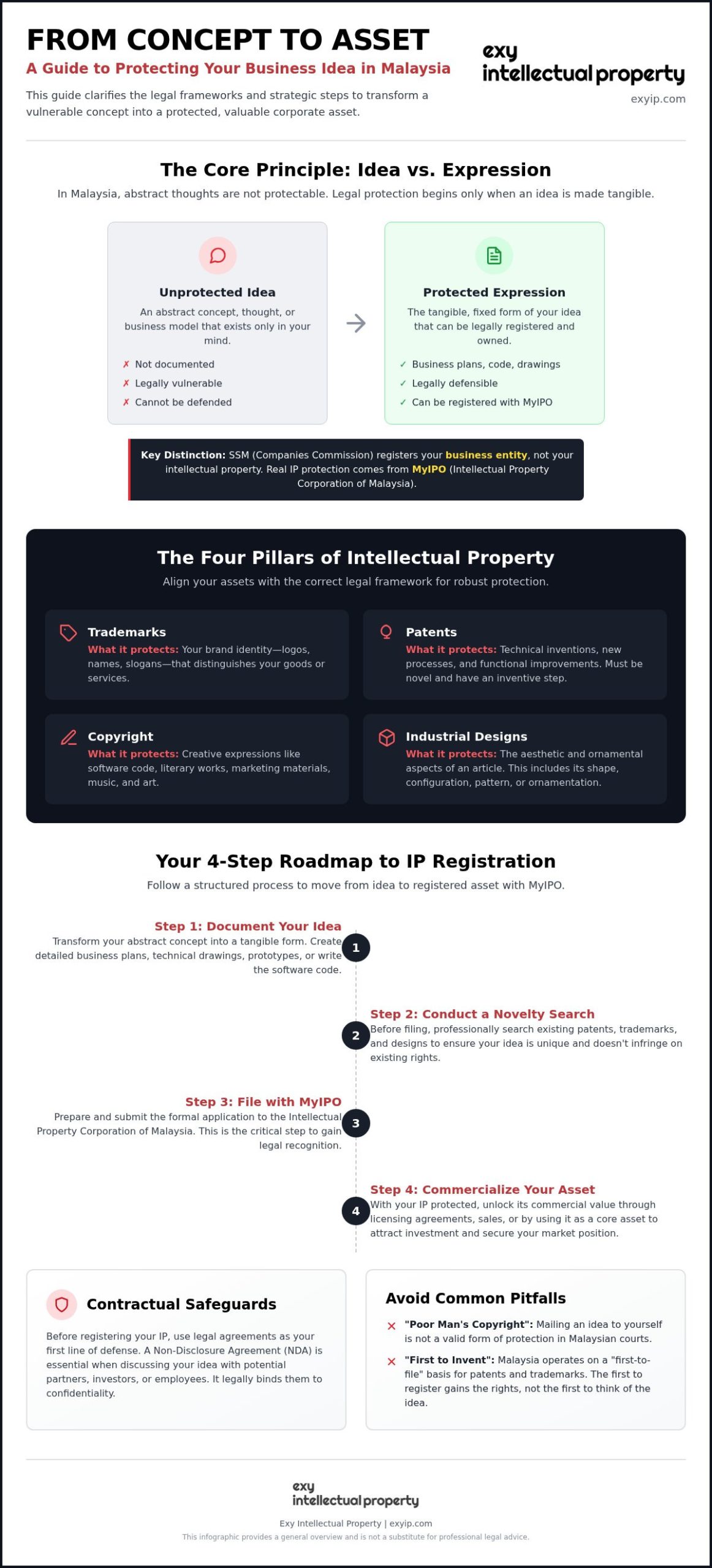
In the 2026 legal landscape, a mere idea exists in a state of vulnerability. You might have a revolutionary concept for a digital marketplace or a new manufacturing process; however, the law doesn’t grant ownership to thoughts alone. To understand how to protect a business idea in Malaysia, you must first recognize the "Idea-Expression Dichotomy." This legal principle dictates that protection only begins once an idea is expressed in a tangible, fixed form. Until you transform that mental spark into a document, drawing, or prototype, it remains legally elusive.
A frequent mistake among local entrepreneurs is assuming that a Suruhanjaya Syarikat Malaysia (SSM) registration provides intellectual property (IP) security. It doesn’t. SSM registers your business entity and name for administrative and tax purposes. It doesn’t prevent a competitor from using your unique business model, internal processes, or logo if you haven’t filed for specific IP rights. Real protection comes from the Intellectual Property Corporation of Malaysia (MyIPO). This statutory body oversees the registration of IP assets, ensuring that your commercial interests are backed by the force of law. Without their certification, your idea remains a secret that is incredibly difficult to defend in a courtroom.
The Legal Threshold for Protection
Tangibility is the gateway to legal standing. In practice, this means your idea must be documented through detailed business plans, technical drawings, or software code. Documentation acts as your first line of defense. It proves the existence and scope of your creation at a specific point in time. Transitioning from a "trade secret" to a "protected asset" requires moving beyond the conceptual stage into a format that MyIPO can recognize and register. We view this transition as a critical milestone where your intellectual capital becomes a measurable corporate value.
Common Misconceptions Among Malaysian Entrepreneurs
Many founders rely on the "Poor Man’s Copyright" myth, which involves mailing a description of an idea to yourself to prove a date of creation. This method often fails in court because it doesn’t meet the formal requirements of Malaysian copyright law. Additionally, Malaysia generally operates on a "first to file" basis for trademarks and patents. If you disclose your invention publicly before filing, you risk losing the "novelty" required for patent protection. Security isn’t about who thought of it first; it’s about who documented and filed it correctly. Mastering how to protect a business idea in Malaysia means prioritizing formal filing over casual disclosure.
The Four Pillars of Intellectual Property in Malaysia
Securing a concept requires moving beyond generalities into specific legal categories. In Malaysia, intellectual property is structured into four primary pillars, each serving a distinct commercial purpose. By aligning your business assets with the correct pillar, you ensure that your innovation is not just a secret, but a defensible asset. Understanding which tool to use is the first step in learning how to protect a business idea in Malaysia effectively.
Trademarks and Brand Identity
Your brand is the face of your business. The Trademark Act 2019 provides the framework for protecting logos, names, and even slogans that distinguish your services from others. Before you invest in marketing, a comprehensive search is essential to ensure your brand doesn’t infringe on existing rights. This proactive step prevents costly rebranding efforts later. For a deeper dive into this process, consult our Trademark Registration in Malaysia: 2026 Strategic Guide.
Patents for Technical Innovations
Technical solutions and unique processes fall under patent protection. To qualify for a standard patent in Malaysia, your invention must demonstrate novelty, an inventive step, and industrial applicability. For smaller improvements that lack a significant inventive step, a Utility Innovation certificate offers a shorter term of protection. This distinction is vital for entrepreneurs determining how to protect a business idea in Malaysia that involves functional improvements rather than entirely new inventions. You can explore these options in our guide on Strategic Patent Filing Services in Malaysia: A Business Leader’s Guide (2026).
– Defending Inventions Against Post-Grant Opposition
In 2026, securing a patent grant is only part of the protection strategy. Under Sections 55A and 56A of the Patents (Amendment) Act 2022, third parties have a strict, non-extendable six-month window from the date a grant is published in the IP Official Journal (IPOJ) to file an administrative post-grant opposition directly with MyIPO. Ensuring your initial patent claims feature layered dependent claims protects your technical asset from post-grant competitor challenges.
Copyright and Voluntary Notification
Creative expressions, including software code, manuals, and marketing literature, are governed by the Copyright Act 1987. While protection is technically automatic upon creation, Malaysia offers a unique Voluntary Notification system through MyIPO. This filing provides prima facie evidence of ownership, which is crucial during legal disputes or when pitching to investors. Utilizing this mechanism is recognized globally as a best practice for firms operating in Southeast Asia.
Industrial Designs and Aesthetic Appeal
If the primary value of your product lies in its unique shape, configuration, or pattern, Industrial Design registration is the appropriate path. This protects the aesthetic "look and feel" of a product rather than its function. Combining these pillars creates a multi-layered defense for your business. If you’re unsure which category fits your concept, developing a professional commercialization strategy can help clarify your path to market and ensure every asset is accounted for.
Contractual Safeguards: NDAs and Employment Agreements
Statutory registrations like patents and trademarks provide "hard" protection against the general public. However, private contracts serve as a critical "soft" defense during the early stages of development. When entrepreneurs ask how to protect a business idea in Malaysia, they often look first to the Intellectual Property Corporation of Malaysia (MyIPO). While that’s correct, your first line of defense during a sensitive pitch is often a Non-Disclosure Agreement (NDA). These contracts create a confidential relationship between you and a potential partner, investor, or employee before you’re ready to file for formal protection.
It’s vital to remember that an NDA is a contract, not a property right. This distinction is where many founders stumble. An NDA only binds the person who signs it. If a third party who didn’t sign the agreement discovers your idea, the NDA provides no legal leverage against them. This is why we view contractual safeguards as a strategic bridge. They protect your secrets while you prepare the technical drafting or brand classification required for registration. They’re a complement to, not a replacement for, formal IP registration.
Crafting an Enforceable NDA in Malaysia
A generic template rarely offers the security a growing business needs. To ensure your agreement holds weight in a Malaysian court, you must define "Confidential Information" with surgical precision. Overly broad definitions can be struck down as being in restraint of trade. Every effective NDA should include:
- The Purpose Clause: This limits the use of the shared information strictly to a specific project or evaluation.
- Specific Exclusions: Clearly state what isn’t confidential, such as information already in the public domain.
- Term and Jurisdiction: Define how long the obligation lasts and confirm that Malaysian law governs any disputes.
Founder and Employee IP Assignments
Securing your vision also means looking inward. You must ensure the company, rather than an individual founder or staff member, owns the developed assets. While Malaysian law generally recognizes "work for hire" principles, ambiguity can lead to expensive litigation during a company exit or funding round. Clear IP assignment clauses in employment contracts are essential. These clauses should explicitly state that any innovation created during the course of employment belongs to the entity. By establishing these rules early, you prevent internal IP leakage and ensure your corporate assets remain consolidated and valuable. This proactive stance is a hallmark of a legal advisory approach that prioritizes long-term corporate health.
Step-by-Step Roadmap to Securing Your IP with MyIPO
Securing intellectual property is a methodical journey that demands precision at every stage. Once you’ve identified your assets, the next phase involves navigating the Intellectual Property Corporation of Malaysia (MyIPO) registration process. This roadmap ensures your concept moves from a vulnerable state to a legally recognized corporate asset. Understanding the administrative hurdles is a core part of your strategy for how to protect a business idea in Malaysia.
The Critical Search Phase
Before submitting any application, you must verify that your idea is truly unique. A professional patent novelty search is non-negotiable. Many entrepreneurs attempt a DIY search; however, these often miss "prior art," which includes existing patents or public disclosures that can invalidate your application. Identifying these obstacles early prevents you from wasting resources on a filing that MyIPO will inevitably reject. We specialize in deep-dive searches that provide the clarity you need to proceed with confidence. A thorough search acts as a feasibility study for your IP, ensuring your investment is grounded in reality. It’s the most effective way to understand how to protect a business idea in Malaysia without incurring unnecessary legal costs.
Drafting and Filing Strategy
Precision in documentation defines the strength of your protection. For inventions, professional patent drafting ensures that your claims are broad enough to prevent competitors from "designing around" your idea, yet specific enough to be enforceable. For brands, selecting the correct classes under the Nice Classification system is vital. If you file in the wrong category, your trademark may not cover your actual business activities. This technical alignment is what transforms a simple filing into a robust corporate shield.
Managing timelines is equally important for your 2026 business planning. Currently, trademark registration typically takes 12 to 24 months from filing to certification, provided no oppositions arise. Industrial designs generally move faster, with a registration window of 9 to 12 months. Submitting through the MyIPO IP Online Portal is the standard, but the real work often happens during the examination phase. If MyIPO issues an "office action" or objection, you must provide a technically sound legal response to keep your application alive. Maintenance doesn’t end at the grant; trademarks require renewal every 10 years, while industrial designs must be renewed in 5-year blocks to remain valid. To ensure your application is handled with expert precision, contact us for a professional patent novelty search to secure your innovation today.
Strategic IP Management: From Protection to Commercialization
Registration is the first step toward commercialization. Once you’ve secured your rights through MyIPO, the focus shifts from defense to maximizing commercial utility. In the 2026 business environment, intellectual property isn’t just a legal certificate; it’s a financial instrument. Mastering how to protect a business idea in Malaysia includes knowing how to leverage that protection for capital, expansion, and market dominance. We view IP not as a static shield, but as a dynamic engine for corporate growth.
Unlocking Value through IP Valuation
Understanding the economic worth of your protected ideas is essential for long-term strategy. If you’re preparing for mergers, acquisitions, or venture capital fundraising, you must prove the value of your intangible assets to stakeholders. We use sophisticated methodologies to assess the price of a trademark or patent, considering market trends and income potential. Our firm provides professional Intellectual Property Valuation reports that translate legal filings into clear financial data. This process turns a "legal cost" into a quantifiable balance sheet asset, giving you the leverage needed during high-stakes negotiations.
Scaling via Franchising and Licensing
Scaling a business doesn’t always require heavy capital investment. Franchising and licensing allow you to expand your market footprint by leveraging the resources of partners. In Malaysia, franchising is a highly regulated field with specific legal requirements that must be met before you can offer your system to others. We provide comprehensive Franchising Consultancy to ensure your business model is compliant and scalable. Similarly, drafting precise Licensing Agreements is critical. These contracts allow you to generate royalty streams while maintaining strict control over your brand’s integrity. By acting as a "Business-Savvy Guardian" of your own assets, you can scale safely without diluting the core value of your innovation.
Protection without enforcement is hollow. If you encounter infringement in the Malaysian market, your registered IP provides the necessary standing for Intellectual Property Litigation. Beyond defense, your assets can unlock unique funding opportunities. Modern financial institutions increasingly recognize IP as valid collateral for business expansion. Through Intellectual Property Financing, your protected ideas can directly fund your next phase of innovation. If you’re ready to move beyond basic protection and start generating real returns, our commercialization strategy services can help you unlock the full economic potential of your business vision.
Securing Your Intellectual Legacy for 2026
Transforming a vision into a protected asset is a journey from abstract thought to concrete legal standing. You now understand that while ideas are free, their expressions are valuable. By layering Non-Disclosure Agreements with formal MyIPO registrations, you create a defensible perimeter around your innovation. Mastering how to protect a business idea in Malaysia isn’t just about legal defense; it’s the essential groundwork for future commercialization and market leadership. It’s the difference between a fleeting concept and a lasting corporate legacy.
We’re dedicated to being the proactive guardian of your professional interests. Our team is specialized in Patent Drafting and Novelty Searches to ensure your technical edges are unique and defensible. We also provide expert IP Valuation for scaling businesses and strategic advisory for those ready to explore franchising and licensing. Secure your business future with a professional IP consultation from Exy IP today. Your hard work deserves a secure foundation and a clear path to growth. Let’s turn your intellectual capital into your greatest competitive advantage.
Frequently Asked Questions
Can I protect a business model or a general idea in Malaysia?
You cannot protect a business model or a general idea in its abstract form under Malaysian law. Legal protection only applies once the idea is expressed in a tangible medium, such as a written business plan, software code, or a technical drawing. To understand how to protect a business idea in Malaysia, you must convert these expressions into registered intellectual property assets like patents or copyrights. Without this transformation, your concept remains legally unenforceable.
Does an SSM registration protect my brand name from competitors?
An SSM registration does not provide brand protection against competitors. It merely registers your business entity for administrative and tax purposes. If another company uses a similar name to sell competing products, your SSM certificate offers very little legal recourse. To truly secure your brand identity, you must file for a trademark with MyIPO. This registration grants you the exclusive right to use the name and prevents others from infringing upon your market presence.
How long does it take to get a trademark registered with MyIPO in 2026?
Trademark registration in Malaysia typically takes between 12 to 24 months from the initial filing date to the issuance of a certificate. This timeline assumes there are no oppositions from third parties or objections from the examiner. While the process is methodical, your protection is backdated to the filing date once approved. We recommend starting the process early to ensure your brand is secured before you scale your operations significantly in the 2026 market.
What happens if I pitch my idea to an investor without an NDA?
Pitching without a Non-Disclosure Agreement (NDA) exposes your concept to significant risk. You lose the contractual leverage to prevent the investor from sharing or using your information. Additionally, public disclosure without an NDA can destroy the "novelty" required for future patent applications. If you haven’t yet filed for formal protection, an NDA is your primary safety net. It establishes a confidential relationship that allows you to share details while maintaining your legal rights.
Is a Malaysian patent valid in other countries like Singapore or the US?
Patents are territorial assets, meaning a Malaysian patent only provides protection within Malaysia. To protect your idea globally, you must file in each target country.
However, Malaysia participates in international work-sharing programs like the Patent Cooperation Treaty (PCT), the ASEAN Patent Examination Co-operation (ASPEC), and bilateral Patent Prosecution Highway (PPH) pilot programs (such as with the USPTO, KIPO, and IPOS). If your patent claims are deemed allowable by a PPH partner office, you can request accelerated examination in Malaysia—reducing substantive review timelines from 24–36 months down to under 12 months.
What is the difference between a patent and a utility innovation?
The primary difference lies in the level of inventiveness required for the filing. A standard patent protects inventions that are new, involve an inventive step, and have industrial applicability, lasting for 20 years. A utility innovation, often called a "small patent," is for incremental improvements that are new and useful but don’t meet the high threshold of an inventive step. Utility innovations are valid for an initial five years and can be renewed for two additional five-year terms.
Can I register a copyright for my business website and marketing materials?
You can and should submit a Copyright Voluntary Notification for your website content, software code, and marketing materials. While copyright protection is automatic in Malaysia, a voluntary notification provides official evidence of ownership. This documentation is invaluable during disputes or when proving the value of your assets to investors. It covers original literary and artistic works, ensuring your brand’s unique "voice" and digital presence are legally recognized and defensible under the law.
What should I do if I find someone using my registered trademark in Malaysia?
If you discover an infringement, your first step should be to issue a formal cease and desist letter through legal counsel. This puts the infringer on notice and often resolves the issue without a court battle. If the infringement continues, your MyIPO registration allows you to pursue intellectual property litigation for damages or an injunction. Taking swift action is vital to prevent brand dilution and to demonstrate that you are a proactive guardian of your corporate assets.