

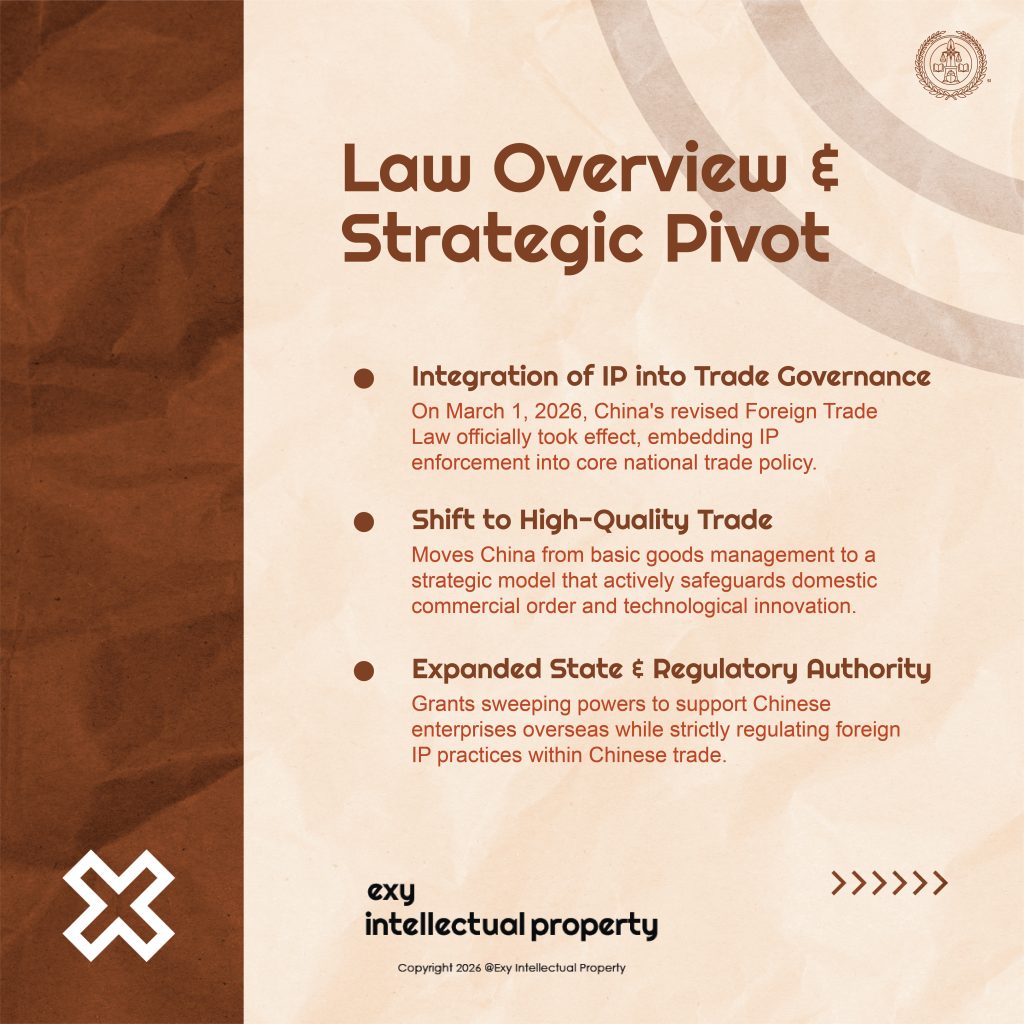
On March 1, 2026, China officially brought into force its revised Foreign Trade Law, marking the most significant structural overhaul of the country’s international trade governance in over two decades. Approved by the Standing Committee of the National People’s Congress, this updated statute explicitly integrates Intellectual Property (IP) rights into foreign trade enforcement for the first time. By shifting from traditional volume management toward high-quality trade governance, the law establishes robust protective tools for domestic exporters while strictly regulating foreign IP usage within Chinese trade channels.
Decoding the Key IP Provisions in the 2026 Foreign Trade Law
The legislative updates introduce several unprecedented enforcement tools and regulatory mechanisms:
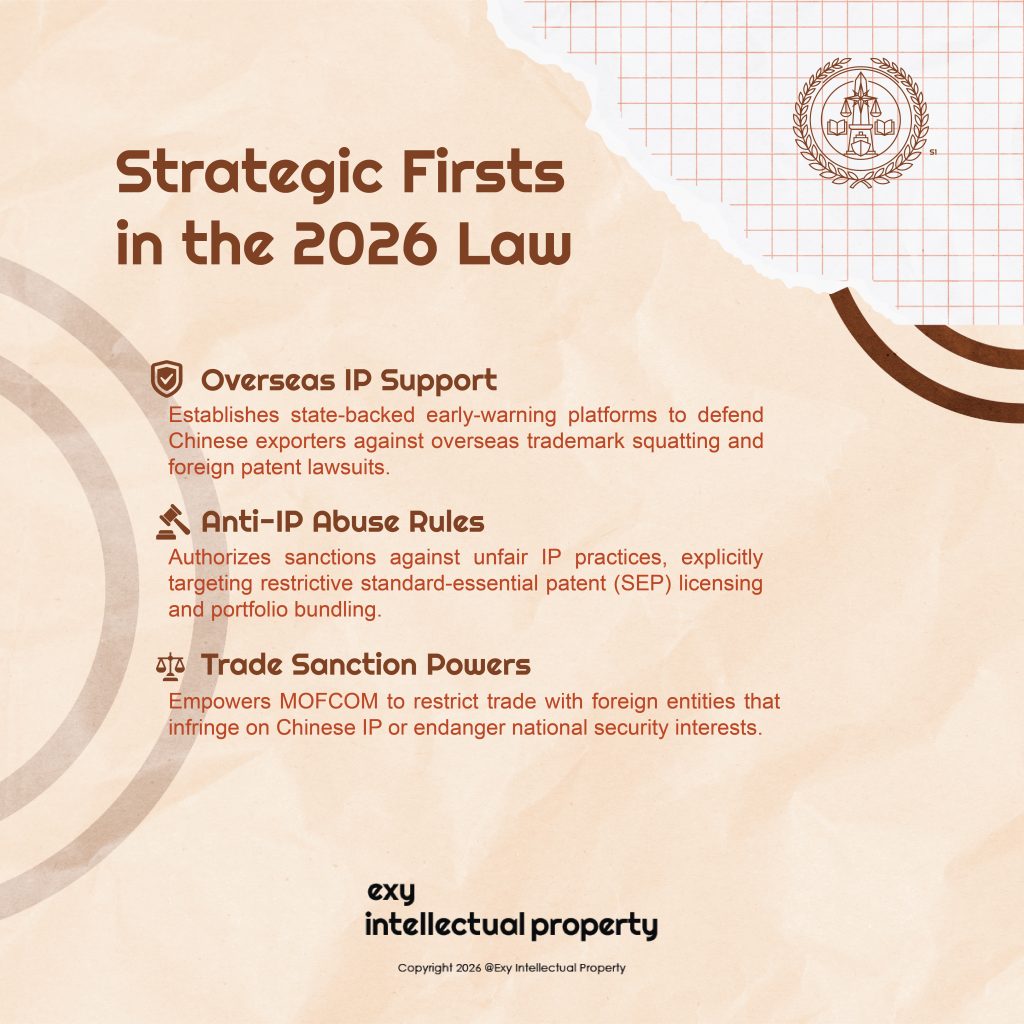
- Targeting Unfair IP Licensing Practices: The law explicitly targets restrictive licensing provisions that disrupt trade order. Specific prohibitions apply to non-challenge clauses in Standard-Essential Patent (SEP) agreements, mandatory cross-licensing, and portfolio license bundling.
- Creation of an ITC-Style Trade Sanction Framework: Giving the Ministry of Commerce (MOFCOM) broad enforcement authority, the statute allows China to restrict or prohibit imports and exports from entities that infringe Chinese IP or endanger national security interests.
- State-Backed Overseas IP Assistance Platforms: The law mandates the creation of early-warning platforms and legal support networks designed to protect domestic exporters facing foreign IP litigation and trademark squatting abroad.
- Negative List Framework for Service Trade: International trade in services now operates under a transparent “Negative List” system, granting default market access to foreign service providers in all unlisted sectors.
- National Security & Reciprocal Countermeasures: Article 40 empowers authorities to impose reciprocal trade and IP restrictions against foreign jurisdictions that enforce discriminatory trade or IP measures targeting Chinese businesses.
Actionable Execution Plan for Global Businesses
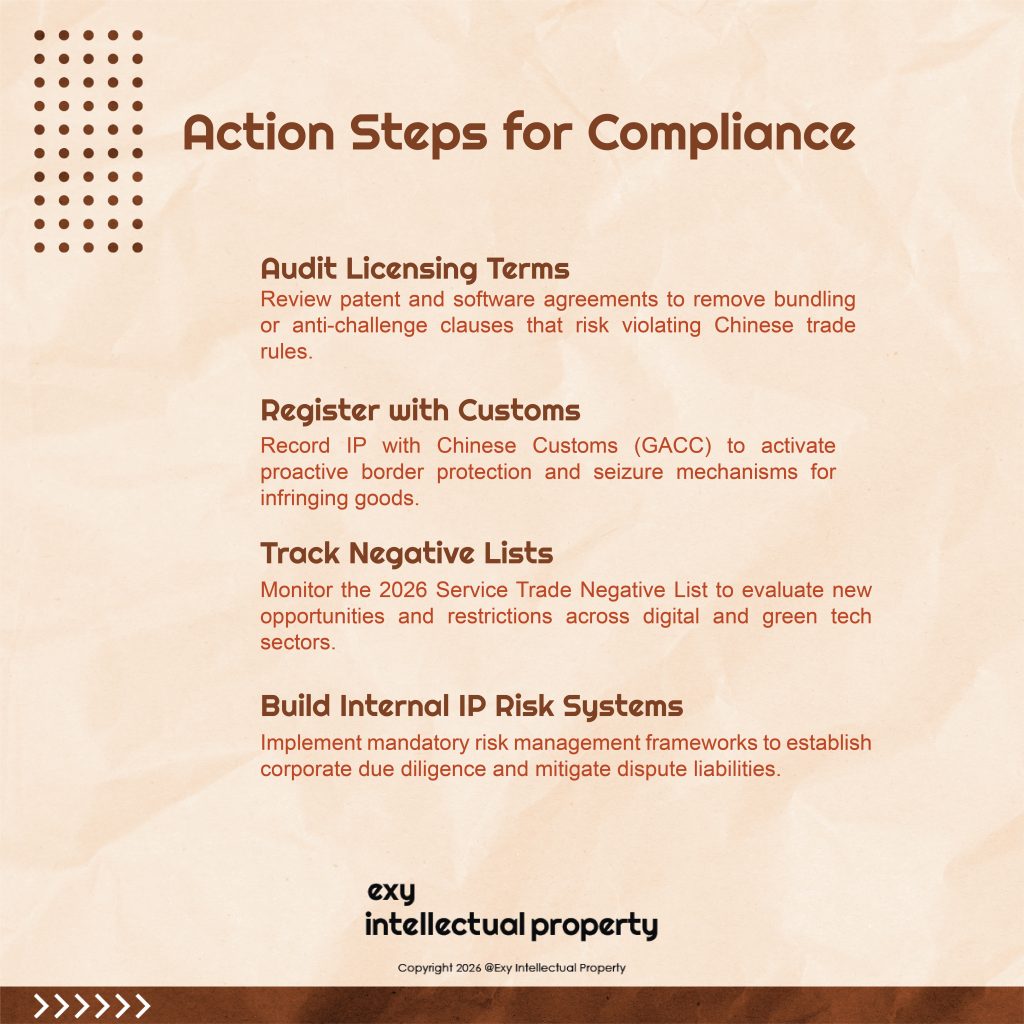
To maintain regulatory compliance and defend market access under China’s expanded trade regime, rightsholders and trade operators should execute the following steps:
- Audit Technology Transfer & Patent Licensing Agreements: Review existing licensing contracts touching Chinese operations to eliminate portfolio bundling or non-challenge covenants that could be flagged as trade-order violations.
- Record IP Rights with General Administration of Customs (GACC): Both foreign and domestic brand owners should ensure active customs registrations to benefit from ex-officio seizure mechanisms at border control points.
- Establish Internal IP Risk Management & Due Diligence: Implement formalized internal risk management programs. Demonstrating active due diligence mitigates regulatory exposure and potential administrative fines during trade audits.
- Monitor the Cross-Border Services Negative List: Analyze the updated service trade catalogue to identify new commercial opportunities or structural restrictions in high-tech and digital sectors.