


Your brand’s value isn’t just in your products; it’s in the legal right to replicate your success. Scaling a business through franchising is an ambitious milestone, but it’s also a process where your most valuable assets are at their most vulnerable. You’ve likely spent years perfecting your model, so the fear of legal non-compliance or a rogue franchisee damaging your reputation is completely natural. Protecting IP in a franchise agreement Malaysia is the single most important step you’ll take to ensure your brand remains secure while it grows. It’s the difference between a controlled expansion and a legal liability.
You’ll discover the exact legal and operational requirements needed to transition from a single entity to a national network in 2026. This guide breaks down the complexities of the Franchise Act 1998 and the MyFEX 2.0 registration process into manageable steps. We’ll walk through the mandatory disclosure documents, the RM1,000 registration fee requirements, and the strategic framework for a scalable model that generates consistent royalty income. We provide a clear roadmap to transform your business into a protected, profitable franchise system that stands the test of time.
Key Takeaways
- Assess your prototype outlet’s stability and replicability to ensure your business model can be successfully scaled by third parties.
- Secure the legal foundation of your expansion by prioritizing trademark registration and protecting IP in a franchise agreement Malaysia before you begin operations.
- Master the mandatory documentation requirements, including the Franchise Disclosure Document (FDD), to maintain full compliance with the Registrar of Franchises.
- Utilize intellectual property valuation to determine strategic franchise fees and enhance your brand’s appeal to potential investors.
- Navigate the MyFEX 2.0 registration portal with professional guidance to avoid costly administrative delays and secure your status as a registered franchisor.
Evaluating Your Business for Franchise Readiness
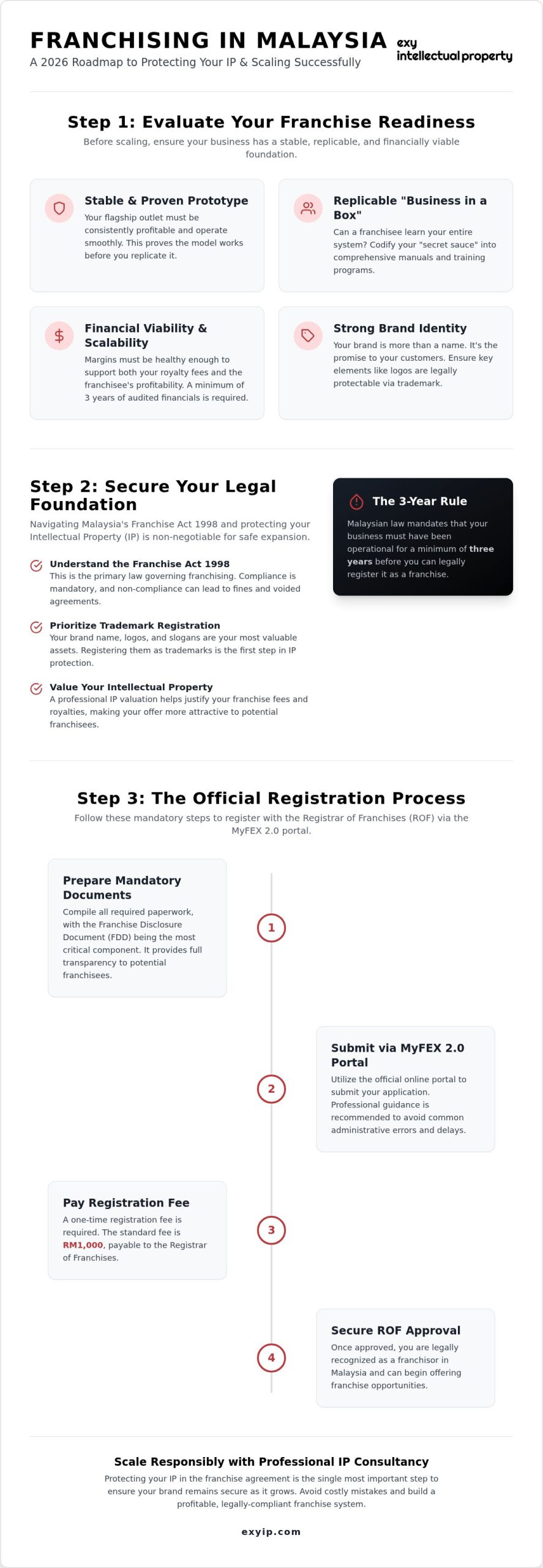
Success in a single location is a triumph; turning that success into a system is a strategy. Before you register your business with the Registrar of Franchises, you must determine if your prototype outlet is truly ready for the leap. A profitable outlet is the foundation, but stability is the actual goal. You need to look beyond your bank balance to ensure your operational processes are fully documented in comprehensive manuals. This preparation is the first step in protecting IP in a franchise agreement Malaysia, as your manuals themselves constitute proprietary intellectual property that requires legal shielding.
A strong brand identity is equally vital. It’s more than a catchy name; it’s the emotional and commercial promise you make to your customers. Gaining a deep understanding intellectual property allows you to identify which parts of your brand, from logos to unique service methods, can be legally protected and licensed. If your brand relies solely on your local reputation or personal presence, it isn’t ready to be franchised. You must be able to hand over a "business in a box" that functions independently of its founder.
The Replicability Test for New Franchisors
Can a franchisee learn your entire system within a reasonable training period? This is the core of the replicability test. If your business model requires your specific expertise or a "magic touch" that cannot be taught, it’s a lifestyle business rather than a franchise. You must identify your "secret sauce," whether it’s a proprietary recipe, a specific software workflow, or a unique supply chain. Once identified, these elements must be codified. Systematic processes allow a stranger to produce the same results you do, ensuring brand consistency across multiple locations. This codification also makes protecting IP in a franchise agreement Malaysia much simpler, as it defines exactly what the franchisee is permitted to use.
Financial Viability and Scalability
Scalability requires healthy margins that support two separate entities. Your business model must be profitable enough for the franchisee to earn a living after paying you royalties and contributing to marketing funds. Many businesses fail to scale because they haven’t accounted for these extra layers of cost. You need to analyze your current margins to ensure there’s enough "meat on the bone" for both parties to thrive long-term. Under KPDN guidelines, an entity seeking registration as a local franchisor or master franchisee must have operated the business concept for at least three years and submit audited financial statements for those three years to prove operational stability. This track record provides the historical data needed to convince potential franchisees that your model is a secure investment.
Understanding the Legal Landscape: The Franchise Act 1998
The law provides the essential framework for your expansion. In Malaysia, the Franchise Act 1998 is the primary legislation governing franchise operations. It’s a robust set of rules designed to protect both the franchisor and the franchisee. You cannot legally offer your business as a franchise until you’ve successfully registered with the Registrar of Franchises (ROF). This body, operating under the Ministry of Domestic Trade and Cost of Living, acts as the official gatekeeper for the industry. It ensures that every franchisor entering the market has a proven model and a transparent offer.
Compliance isn’t optional. If you attempt to sell franchise rights without ROF approval, the consequences are severe. You may face significant fines, and more importantly, your franchise agreements could be declared void by a court. This would leave your brand assets unprotected and your future revenue streams at risk. Protecting IP in a franchise agreement Malaysia starts with this regulatory step. By following the legal roadmap, you ensure that your business remains on the right side of the law while building a secure foundation for sustainable growth.
The 5-Year Registration Validity Cycle
Under the Franchise (Amendment) Act 2020 and MyFEX 2.0 rules, approved franchise registrations are valid for five years from the date of approval. Franchisors must apply for renewal via MyFEX 2.0 within 30 days prior to expiration to maintain active legal standing and avoid severe monetary penalties for operating an unregistered franchise network.
Key Legal Definitions You Must Know
Understanding the difference between a franchise and a simple license is vital. A franchise under Malaysian law involves a continuous relationship where the franchisor provides ongoing support and exercises significant control over the business operations. It’s a partnership built on shared systems and protected intellectual property. Conversely, a simple license often lacks this level of operational oversight. Additionally, the "3-year rule" is a mandatory requirement. You must have operated your business for at least three years before you’re eligible to register as a franchisor. This period proves that your model is stable and capable of being replicated by others.
The Role of the Ministry of Domestic Trade
The Ministry of Domestic Trade and Cost of Living oversees the entire franchise ecosystem. They ensure that the market remains competitive and that all participants adhere to high standards of transparency. Navigating Protecting Intellectual Property in Malaysia is a central part of their vetting process. In 2026, all franchise applications must be submitted through the MyFEX 2.0 digital portal. This system has digitized the filing process, making it faster but also more demanding in terms of document accuracy. Working with a specialist in franchising consultancy can help you navigate these digital requirements and ensure your application is successful on the first attempt.
Protecting IP in a franchise agreement Malaysia: The Foundation
Your franchise isn’t just selling products; it’s selling the right to use your brand’s unique identity and proven systems. This intellectual property is the engine of your growth. Without a secured foundation, you’re essentially handing over your hard work without a legal safety net. Adhering to Malaysian IP laws ensures that every asset, from your logo to your operations manual, remains under your absolute control. Protecting IP in a franchise agreement Malaysia is the primary way you prevent your brand from being hijacked by an ambitious but rogue partner.
Beyond trademarks, you must consider your trade secrets. These proprietary systems are often protected through copyright voluntary notification and strict confidentiality clauses in your agreements. If your business features a unique store aesthetic or specialized packaging, industrial design registration provides an additional layer of exclusivity that competitors cannot legally mimic. These assets have tangible commercial value. Conducting a formal IP valuation is a strategic move that helps you justify your initial franchise fees and ongoing royalty percentages to both the Registrar of Franchises and potential investors. If your franchise model incorporates any proprietary technology or innovative processes, exploring global patent registration services can provide an additional layer of protection as you expand into new markets.
Trademark Registration: Your Most Valuable Asset
A registered trademark is a legal prerequisite for franchise registration in Malaysia. You can’t simply rely on "common law" rights when you’re inviting third parties to trade under your name. Official trademark registration provides the nationwide exclusivity you need to grow with confidence. Attempting to franchise with a pending or unregistered mark is a high-stakes gamble that frequently leads to application rejection by the authorities. It’s vital to secure your brand identity early by following a comprehensive guide to trademark registration Malaysia to avoid these common administrative hurdles.
Licensing Agreements and IP Commercialisation
The licensing agreement is where the "rules of the game" are established. You must clearly define territorial rights to prevent franchisees from cannibalizing each other’s markets. Usage limitations ensure that your brand is presented consistently across every outlet, regardless of location. If these terms are vague, you risk brand dilution and a total loss of quality control. Engaging in expert franchise consultancy Malaysia ensures that your agreements are robust enough to withstand legal challenges while allowing for smooth, structured commercial expansion.
Developing Essential Franchise Documentation and Registration
Documentation turns your intangible ideas into a transferable system. It’s the physical evidence of your brand’s value. In Malaysia, this process is strictly regulated to ensure that prospects aren’t misled. You aren’t just selling a dream; you’re providing a structured, legal package that includes your trademarks, trade secrets, and operational methods. Every page of your documentation should reinforce your authority and protect your long-term interests. Without these manuals and agreements, your business remains a single outlet rather than a scalable asset.
The registration process involves four critical steps. First, you prepare the Franchise Disclosure Document (FDD). Second, you draft a robust Franchise Agreement. Third, you compile a detailed Operations Manual. Finally, you submit the application through the MyFEX 2.0 portal, which is the official digital system for franchise management in Malaysia. This platform has streamlined the process, but it requires absolute precision in the documents you upload. Any discrepancy can lead to the official approval fee (RM1,000 for local franchisors, plus a RM50 processing fee) being delayed or forfeited upon administrative rejection. To ensure you have every document in order before submission, consult our comprehensive guide to franchise legal documents Malaysia requires for a complete and compliant application.
The Franchise Disclosure Document (FDD) Requirements
Transparency is the law. The FDD must provide a comprehensive view of your business, including your financial history and any previous litigation. It’s designed to give potential franchisees all the facts before they commit their capital. You must detail every fee, from the initial registration costs to ongoing royalties and advertising fund contributions. By law, you must provide this document to prospects at least 10 days before they sign any agreement or pay any money. This cooling-off period is a mandatory safeguard that ensures the franchisee is making an informed commercial decision.
Statutory 7-Working-Day Cooling-Off Period
Under Section 18 of the Franchise Act 1998, every franchise agreement executed in Malaysia must contain a mandatory cooling-off period of at least seven working days. During this window, the franchisee retains the statutory right to terminate the executed agreement, and the franchisor must refund all payments collected (minus reasonable administrative expenses actually incurred).
The Operations Manual: Your Business Blueprint
Consistency is what makes a franchise valuable. Your Operations Manual documents every step of the customer journey, from the moment they walk in to the final product delivery. It sets the non-negotiable standards for branding, hygiene, and service levels. If a franchisee fails to meet these standards, the manual serves as a vital legal reference. It provides the evidence needed to issue a default notice or terminate an agreement. Protecting IP in a franchise agreement Malaysia relies heavily on this manual, as it defines the "system" that you’re licensing. Without a clear manual, you have no objective way to enforce quality control across your network.
Drafting these documents requires a blend of legal precision and operational insight. If your documentation is weak, your entire expansion is at risk of legal challenges or administrative rejection. For expert support in preparing these mandatory filings and securing your brand’s future, consider our franchising consultancy services to ensure your registration is handled correctly the first time.
Scaling Responsibly: Why Professional IP Consultancy Matters
Expansion is the ultimate reward for your hard work and preparation. However, scaling too quickly without a robust legal framework is a common pitfall that can lead to catastrophic brand dilution. Professional consultancy ensures that you avoid administrative errors, such as missing MyIPO renewal deadlines or failing to update your disclosure documents as your model evolves. Protecting IP in a franchise agreement Malaysia is an ongoing commitment that extends far beyond the initial registration phase. It requires a proactive strategy to monitor how your brand is used across multiple outlets to ensure every franchisee maintains the high standards you’ve established.
Strategic growth often requires external capital. By commissioning a formal IP valuation, you transform your intangible assets into documented financial value. This report is essential when you’re negotiating with banks for expansion financing or presenting your business to potential investors. It provides a clear, data-driven justification for your franchise fees and positions your brand as a sophisticated, investment-ready entity. This commercial approach turns your legal protections into active financial tools.
Strategic Commercialisation of Your Brand
Domestic success is often the first step toward international franchising. When you prepare to cross borders, your IP strategy must become global. This involves registering trademarks in target markets and ensuring your licensing agreements are enforceable under different legal jurisdictions. For franchisors with proprietary innovations, leveraging global patent registration services is a critical step in securing your competitive advantage across multiple jurisdictions before competitors can replicate your methods. Using your intellectual property as collateral for business expansion financing is a modern approach to growth that many traditional business owners overlook. We act as your Business-Savvy Guardian, providing the strategic oversight needed to navigate these complex commercial waters while you focus on operational excellence. Our goal is to ensure your brand remains secure, no matter how far it travels.
Next Steps: From Business Owner to Franchisor
Before you sell your first franchise, conduct a final, comprehensive IP audit. This ensures every trademark is active, every manual is copyrighted, and every trade secret is legally shielded. You also need to establish the support infrastructure required to train and assist your franchisees effectively. Transitioning from a business owner to a franchisor is a significant shift in identity. It requires you to move from "doing the work" to "managing the system." To streamline the legal filing process and ensure your registration with the Registrar of Franchises is seamless, contacting a specialist in intellectual property and franchising consultancy is the most efficient path forward. Secure your foundation today to build the empire of tomorrow.
Securing Your Brand’s Future in the Malaysian Franchise Market
Transitioning from a single successful outlet to a national franchise network is a significant commercial evolution. It requires a shift from daily operational management to strategic system oversight. You now understand that sustainable success depends on a replicable model, audited financial performance, and absolute transparency within your mandatory disclosure documents. These elements form the bedrock of a healthy franchisor-franchisee relationship and ensure long-term stability.
The most critical component of this expansion remains protecting IP in a franchise agreement Malaysia. This ensures your trade secrets, unique store designs, and trademarks remain under your absolute control as you scale. We provide the specialised IP valuation reports and comprehensive franchise legal support needed to navigate the complexities of the MyFEX 2.0 portal. Our firm maintains a proven track record in MyIPO registrations, offering the security you need to grow with confidence.
Secure your brand and scale your business with Exy Intellectual Property’s Franchise Consultancy. Your business has the potential to become a household name across the country. By securing your foundation today, you ensure your future growth is both rapid and legally resilient. We’re ready to help you turn your vision into a protected, profitable reality.
Frequently Asked Questions
How long does it take to register a franchise in Malaysia in 2026?
Franchise registration in 2026 typically takes between three to six months for approval through the MyFEX 2.0 portal. This timeline assumes all your documentation, such as the Franchise Disclosure Document and operations manuals, is accurate and complete. Any discrepancies in your filing can lead to delays or administrative rejections. It’s vital to have your trademark secured first, as the Registrar of Franchises won’t process applications without a registered mark.
Can I franchise my business if my trademark is still under application?
You cannot legally register as a franchisor if your trademark is still pending. Under the Franchise Act 1998, a registered trademark with MyIPO is a mandatory prerequisite before you can even apply to the Registrar of Franchises. This requirement ensures that you have the legal right to license the brand identity to others. Attempting to bypass this step puts your entire expansion at risk and will result in an immediate rejection of your application.
What is the minimum number of years a business must operate before franchising?
Your business must have a proven track record of at least three years of operation before you can apply to become a franchisor. This period demonstrates that your business model is stable, profitable, and capable of being replicated by third parties. The Registrar of Franchises requires audited financial statements for these years to verify your claims. This rule protects potential franchisees by ensuring they are investing in a tested and viable system rather than an unproven concept.
What is the difference between a license and a franchise in Malaysia?
The primary difference lies in the level of control and the nature of the relationship. A franchise involves a continuous partnership where the franchisor provides ongoing support and exercises significant control over the franchisee’s operations. In contrast, a simple license usually only grants the right to use intellectual property without the same level of operational oversight. In Malaysia, any agreement that meets the specific criteria of the Franchise Act 1998 is legally classified as a franchise.
Is it mandatory to join the Malaysian Franchise Association (MFA)?
Joining the Malaysian Franchise Association (MFA) is not a legal requirement, but it is highly beneficial for your brand’s credibility. While your mandatory registration is with the Registrar of Franchises (ROF) under the Ministry of Domestic Trade, the MFA provides a platform for networking and industry recognition. Many successful franchisors find that MFA membership helps in attracting quality franchisees. It’s a strategic move for those serious about long-term growth within the Malaysian ecosystem.
What are the typical costs involved in franchising a business?
You should budget for several mandatory government fees. The initial franchise registration application fee is RM1,000, and a trademark application with MyIPO costs RM900 per class. Beyond these, you’ll incur costs for drafting disclosure documents, operations manuals, and audited financial reports. Investing in professional consultancy is essential for protecting IP in a franchise agreement Malaysia, as it prevents costly legal errors that could void your agreements or lead to significant fines for non-compliance. A thorough review of all franchise legal documents Malaysia mandates will help you budget accurately and avoid unexpected administrative costs.
Can a foreigner franchise their business in Malaysia?
Foreign franchisors can certainly expand into Malaysia, but they face stricter registration requirements. Under the Franchise (Amendment) Act 2020, foreign entities must register their franchise under Section 6 and obtain specific approval under Section 54. The renewal fee for foreign franchisors is RM5,000 every five years. It’s essential for international brands to localize their agreements to comply with Malaysian law while ensuring their global intellectual property rights remain fully protected throughout the expansion.
What happens if a franchisee uses my trademark after the agreement ends?
Unauthorized use of your trademark after an agreement ends constitutes a serious legal breach. Your franchise agreement should include clear post-termination clauses that stop the franchisee from using any of your brand assets immediately. The Franchise Act 1998 also prohibits former franchisees from engaging in a similar business for two years after termination. Protecting IP in a franchise agreement Malaysia involves active monitoring and, if necessary, initiating intellectual property litigation to stop rogue operators from damaging your brand’s reputation.