


Determining trademark valuation in Malaysia involves using certified income, market, or cost methods to establish brand equity for licensing, mergers, or reporting. Engagements typically range from standard market assessments to comprehensive valuation reports depending on business complexity. Professional intellectual property valuation helps directors document exact financial values for strategic decisions.
Request valuation when restructuring, licensing, or preparing a sale
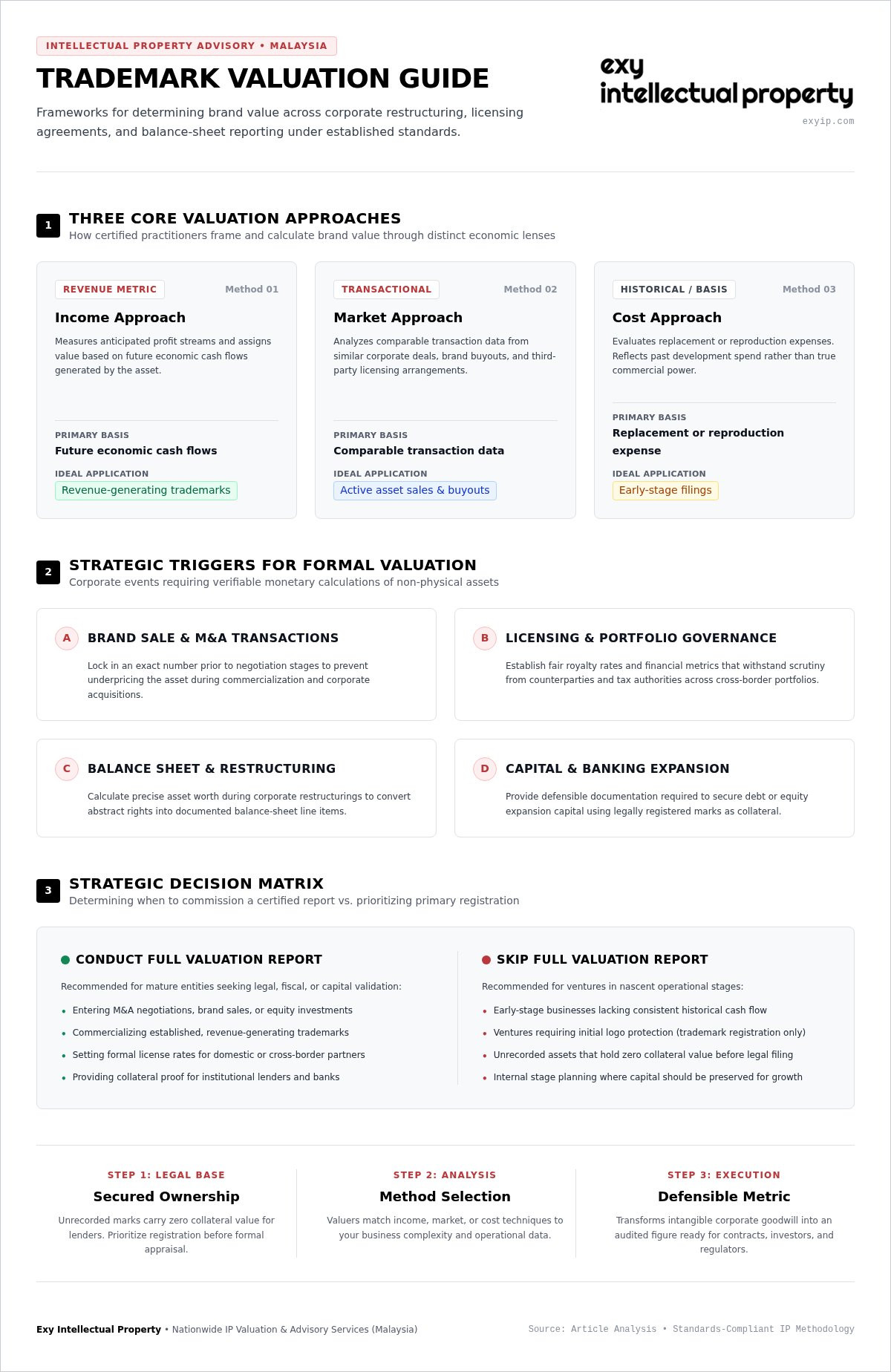
You need a formal assessment when strategic corporate changes alter your brand value (intellectual property valuation).
- Sale of the brand (commercialization) or an M&A deal: lock in an exact number before negotiations so you do not underprice the asset.
- Licensing or cross-border portfolio work: set royalty rates and financial metrics that hold up with counterparties; for regional portfolios, clear metrics support Intellectual Property Malaysia & Singapore, Trademark positions.
With clients we see that calculating precise asset worth during corporate restructuring supports proper balance sheet reporting. You should also request valuation before selling the brand or entering M&A transactions. Knowing the exact figure prevents underpricing your assets during negotiations. Brand value calls for expert financial analysis in the same way a property appraisal does for real estate.
Licensing deals are another trigger: knowing your worth establishes fair royalty rates. Timing the engagement before you face tax authorities or prospective investors turns intangible marks into measurable financial tools.
IP valuation turns intangible rights into balance-sheet figures
An IP valuation calculates the formal financial worth of your intangible assets under established accounting and legal standards. It transforms abstract operational recognition into a clear balance sheet line item. Corporate finance teams rely on these calculations during mergers, fundraising, tax planning, and internal restructurings.
Legally protected non-physical assets allow owners to earn recognition or financial benefit from what they invent or create. Determining this monetary figure strengthens your hand in investor negotiations.
If you plan on selling the brand, a defensive brand value report helps you avoid leaving capital on the table. You can protect your visual identity through trademark registration in Malaysia before presenting figures to potential financiers. Securing legal ownership first remains the sound decision, because unrecorded assets hold zero collateral value for lenders.
Income, market, and cost approaches frame brand value differently
The three main methodologies for valuing brand value are the income, market, and cost approaches. Each strategy assesses proprietary assets through a different economic lens. Valuers select methods from the context and the data you can supply. When you evaluate Malaysian business assets, an IP specialist familiar with local practice helps your brand value calculation meet international financial standards.
Historic creation expenses rarely reflect true commercial power. Cost approaches only measure past spend, so established brands usually obtain higher valuations through income or market metrics.
| Valuation Approach | Primary Calculation Basis | Ideal Application |
|---|---|---|
| Income Approach | Future economic cash flows | Revenue-generating trademarks |
| Market Approach | Comparable transaction data | Active asset sales |
| Cost Approach | Replacement or reproduction expense | Early-stage filings |
The income model works best for profitable enterprises, while early filings suit cost estimation. The income method measures anticipated profit streams; the market model relies on similar licensing transactions.
Verified brand value supports capital, licensing, and deal terms
Determining a fair brand value transforms abstract legal rights into concrete financial assets for your enterprise.
Businesses frequently underutilize their registered marks during major banking transactions. Precise fiscal assessments provide the documentation needed to secure expansion capital against non-physical assets. Selling the brand requires a verified monetary baseline so you do not underprice your corporate identity. Founders seeking equitable licensing agreements or equity investment rely on a formal assessment for the same reason. You can review available IP service options to align corporate holdings with growth plans. A precise report reduces costly miscalculations during joint ventures and gives finance teams clearer asset metrics. More on this: EXY IP Services.
Skip a full report when you only need early logo protection
Skip formal valuation entirely if your business is early-stage, lacks revenue, or merely requires initial logo protection (trademark registration).
Startups often rush into expensive reports before generating consistent cash flow, which is like buying an insurance policy for a house you have not built yet. Early-stage ventures often only need basic brand value assessments for internal planning.
Formal reports fit mature entities pursuing commercialization, bank collateral, or legal disputes. If you only require internal clarity, avoid full audits. To judge whether a full report is necessary, Exy Intellectual Property can help you assess your current growth phase. Save capital for core business expansion instead.
Five stages that produce a defensible trademark valuation report
A formal valuation follows a strict sequence to produce a defensible report. Exy Intellectual Property runs the work through five distinct stages.
1. Asset Identification & Ownership Audit: Verifying MyIPO registration certificates, class coverage, and chain of title.
2. Financial Isolation: Separating brand-attributable earnings from general operating revenues.
3. Methodology Selection: Applying IVS 210-compliant Relief-from-Royalty or Discounted Cash Flow (DCF) models.
4. Risk-Adjusted Stress Testing: Discounting for market volatility, remaining legal life, and competitive threats.
5. Final Certified Report Issuance: Delivering a defensible financial document ready for M&A, banking collateral, or tax reporting.
Historical marketing budgets often contain hidden proofs of goodwill that raise final figures. One client path runs as follows: incomplete earnings splits blocked a clean commercialization figure; isolating brand-linked revenue in stage two, then stress-testing royalty assumptions in stage four, produced a certified report the buyer and advisers could use. Skipping the financial-analysis stage leaves the final balance sheet value open to challenge. Exy Intellectual Property aligns each stage with statutory requirements so logo protection investments stay protected during transactions.
Compliance with IVS 210 Standards:
For a trademark valuation report to hold weight with Malaysian banks, tax authorities (LHDN), or M&A auditors, the assessment must adhere to International Valuation Standards (IVS 210 for Intangible Assets). Adherence to IVS 210 ensures that income-based models (specifically Relief-from-Royalty), discount rates (WACC plus asset-specific risk premiums), and Tax Amortization Benefits (TAB) meet institutional due diligence requirements.
Legal Robustness & Enforceability:
Unregistered marks or marks facing active invalidation/revocation proceedings carry heavy valuation discounts. Securing an official registration certificate via MyIPO under the Trademarks Act 2019 establishes a statutory monopoly, providing the clean chain of title required to convert brand equity into bankable collateral.
Records you need before a certified valuer starts work
Treat the file as the evidence pack for your business assets. Collect legal ownership certificates, pending applications, and registration renewal receipts. Financial records matter equally: audited financial statements from the past three to five years, plus clear breakdowns of revenue generated directly by the asset. Historical marketing budgets and promotional expenses help establish cost-based brand value. Add active licensing agreements, franchise contracts, and court documents regarding disputes.
Proper audit records prevent delays, and having this paperwork ready speeds up the assignment significantly.
Fees, extras, and timelines you should plan for in Malaysia
Service fees and timelines vary widely among service providers when establishing brand value in Malaysia.
Business owners frequently overlook search expenses and official filing fees; unexpected revisions can push total costs past original estimates.
Valuation timelines typically run from two weeks to several months. A provider that states clear, fixed pricing reduces the risk of budget overruns. Exy Intellectual Property gives transparent guidance so you know what to expect at each step. Client feedback shows how structured case handling keeps demanding IP work on track.
Among Exy Intellectual Property’s Google reviews, Hong (5★) wrote:
Would like to praise YeongBoon and Wai Nee for their excellent service, will be engaging them again for further overseas trademark applications 👍🏻"
Clear communication and dedicated support make international IP requirements manageable for growing businesses.
Hire a Kuala Lumpur valuer banks and regulators will accept
You must hire a credentialed evaluator whose reports meet local banking and regulatory standards. Malaysian financial institutions require rigorous assessments before accepting brand value as loan collateral. Choose a practitioner registered with recognized local bodies to ensure compliance. Uncertified firms risk immediate rejection by lenders.
Accredited professionals produce reports that stand up in audit. Exy Intellectual Property delivers compliant reports tailored to local financial frameworks. Request a quote when you need a valuation lenders will accept.
Frequently asked questions
What is IP valuation?
IP valuation calculates the monetary financial worth of intangible assets such as brand value owned by your business. Independent valuers analyze financial metrics, market opportunities, and legal strength to determine a fair market figure.
Why is IP valuation important?
Knowing your IP asset value strengthens commercial negotiations during fundraising, corporate mergers, or selling the brand. Accurate reports provide valid legal documentation for tax assessments, banking security, and corporate accounting requirements in Malaysia.
What assets can be valued?
You can value legal assets including logo protection, patents, industrial designs, trade secrets, software code, and copyright materials. Certified experts assess each asset based on future revenue potential and registered protection status.
How do certified IP valuers conduct valuations?
Certified valuers use income, market, and cost approaches to assess your asset portfolio. Practitioners review past earnings, comparable market transactions, and current legal validity to calculate the final figure.
What elements are identified for IP valuation practice?
A comprehensive evaluation identifies legal ownership titles, economic life expectancies, industry market trends, and specific revenue streams linked to the assets. Those drivers help your brand value assessment withstand audit scrutiny.
Summary
Accurate trademark valuation Malaysia processes help businesses turn intangible holdings into strategic growth assets. Clear methodologies and local regulatory insight are what you use to pin down brand value for real decisions.
Systematic evaluations strengthen corporate positions during key financial negotiations. Formal assessments provide necessary documentation for investors and financial institutions alike.
Contact Exy Intellectual Property for a tailored consultation on how these assets support expansion. Advisors there help companies organize brand value work in a structured way. Reach out when you want a clear reading of your portfolio.