


Securing multi-jurisdictional brand protection (intellectual property) across ASEAN requires working with national IP offices, local representation mandates, and distinct fee structures. You can streamline your Southeast Asia trademark registration by using direct filings or international trademarks based on your target expansion timeline and budget.
3 Ways to Route Your ASEAN Brand Filings
You can secure trademark protection across Southeast Asia through national filings, a blended regional plan, or international systems.
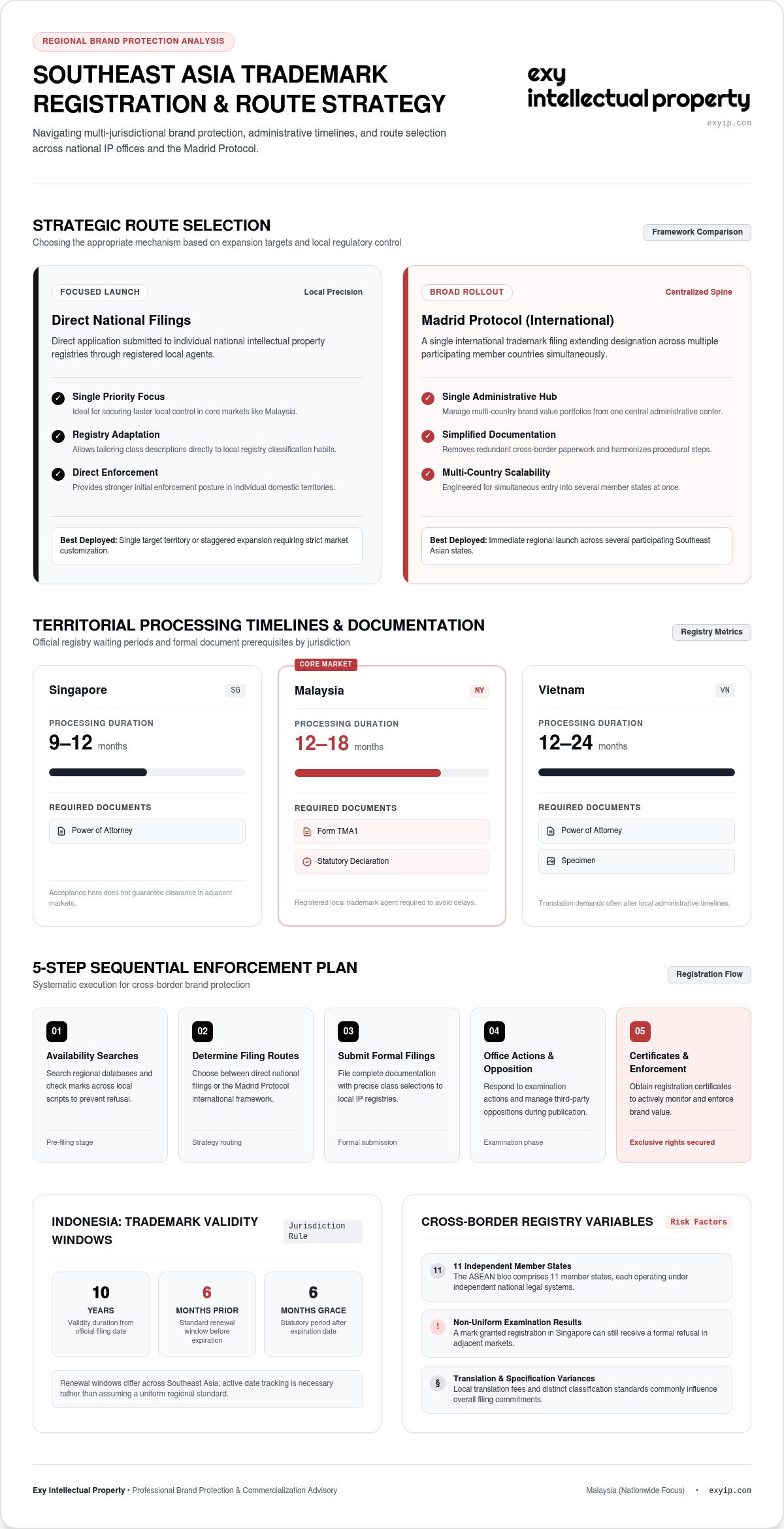
- One priority market (for example Malaysia): file direct at the national office for faster local control over brand value (commercialization).
- Several ASEAN countries at the same time: file an international trademark (Madrid Protocol) application so you manage the portfolio from one center.
For local applications, hire a registered trademark agent in Malaysia to avoid procedural delays. Direct filings give you tighter control in core markets; Madrid filings suit simultaneous multi-country expansion. Exy Intellectual Property matches the pathway to your timeline and budget so you lock the route before first filing.
Are These The Problems You Face When You Seek For IP Protection in Southeast Asia?
Navigating trademark protection across ASEAN means handling distinct national legal frameworks, uneven timelines, and strict local filing rules at the same time.
Cross-border expansion without local expertise leaves you juggling separate office practices: a mark accepted in Singapore can still face refusal next door. According to the official ASEAN 2024 Wikipedia overview, the regional economic bloc brings together eleven diverse member states, each with its own independent legal system.
You protect regional brand value only after you clear national quirks before the first application. Review the five pre-filing tasks so specification standards, translation demands, and power-of-attorney notarization do not trigger administrative delays. An international trademark route simplifies paperwork; direct national filings still give stronger individual control in a single strategic market.
Direct national filings fit a focused launch. Centralized routes fit a broader rollout.
Budgeting your expansion means mapping trademark protection costs and waiting periods in each target country.
| Country | Processing Timeline | Required Documents |
|---|---|---|
| Singapore | 9–12 months | Power of Attorney |
| Malaysia | 12–18 months | Form TMA1, Statutory Declaration |
| Vietnam | 12–24 months | Power of Attorney, Specimen |
Application expenses shift with class selections and local legal representation. A personalized cost breakdown clarifies total spend before you file in several offices. Those variables sit among the main reasons to register your trademark when you secure regional assets. Each national registry runs its own timeline and clearance process, so you plan port by port rather than assume one schedule fits all.
Local translation fees for trademark specifications often push total filing costs above official government charges. National direct filings fit targeted local launches; an international trademark route fits broad regional rollouts. File early enough to protect priority and avoid later conflicts.
Direct Filings vs Madrid Protocol: Strategic Choices
The choice between direct national applications and international trademark filings turns on where you expand first. In practice, localized filings often support stronger initial enforcement in specific Southeast Asian territories. Direct applications let you tailor class descriptions to local registry habits; a single international filing keeps management centralized across participating states.
Local registries give you precision tools for one job. An international application gives you one filing spine for regional expansion. A practical 2026 Southeast Asia brand roadmap often blends both so brand value stays protected while you scale.
Direct filings suit immediate, tailored trademark protection in priority markets. The centralized route suits companies entering several participating countries together. Speak with local experts and build a country-by-country quote around the markets you actually need.
Leveraging ASPEC Work-Sharing
For businesses opting for direct national filings, examination timelines can be compressed by leveraging the ASEAN Patent Examination Co-operation (ASPEC) and regional trademark work-sharing initiatives. If your mark or patent receives an initial allowance in a participating ASEAN office (e.g., Malaysia or Singapore), you can submit those examination results to fast-track subsequent national filings across neighboring member states.
5 Steps to Secure Your Southeast Asia IP Rights
Regional trademark protection holds only when you follow a clear multi-jurisdictional sequence. Cross-border filings across varied local systems reward discipline at each stage.
- Conduct availability searches in each target market using regional databases.
- Determine filing routes via national offices or the international trademark system.
- Submit formal documentation with accurate class selections to local intellectual property offices.
- Respond to official actions and handle any third-party oppositions during publication.
- Obtain registration certificates to actively monitor and enforce your brand value.
Enforcing via Border Customs Recordals
Once registration certificates are granted, establish Customs Recordals in key transit hubs (such as Malaysia, Thailand, and Vietnam). Recording your registered marks directly with national customs authorities enables border officials to ex-officio detain suspected counterfeit shipments at ports of entry before they enter local retail supply chains.
Exy Intellectual Property keeps each stage aligned with local statutory standards. Choose national filings for single-market focus, or the international system when you expand across several countries at once. Exy Intellectual Property can sequence searches, filings, and responses so deadlines do not slip.
Tip: Perform thorough pre-filing availability searches in local scripts to prevent costly refusal decisions.
How Long Is a Trademark Valid in Indonesia? Check This Out
A registered trademark in Indonesia remains valid for ten years from the official filing date.
Renewal windows differ across Southeast Asia, so you need active date tracking rather than a single calendar rule. File for renewal in the six months before expiration to keep trademark protection continuous. Indonesian law also provides a six-month grace period after the expiration date to renew, which means a late filing in that grace window can still preserve rights instead of forcing a full re-filing from scratch. Exy Intellectual Property tracks these dates across borders so you act inside the correct window. Oppose conflicting marks promptly when competitors file similar signs; early oversight costs less than a later dispute. Exy Intellectual Property can align Indonesia renewals with the rest of your ASEAN portfolio.
When Single-Country Filings Waste Your Expansion Capital
Filing separate national applications across several Southeast Asian Nations multiplies attorney fees, translation costs, and official agency charges in every jurisdiction.
That pattern fragments portfolio oversight and raises long-term compliance spend. From client work, businesses moving into three or more regional markets often burn budget on standalone filings that a coordinated route could have absorbed. Exy Intellectual Property steers growing brands away from piecemeal filings when the expansion plan is already multi-country.
Single-country paths still fit a limited local launch. Centralized registration fits regional scaling. Map the full country list first, then decide where a direct filing still earns its keep. Ask for a coordinated multi-office estimate before you instruct separate agents in parallel.
Professional IP Services and Regional Management
Trademark protection across ASEAN markets needs a centralized legal strategy so brand ownership claims do not conflict. Separate agents in each country create gaps and delay. From client work, unified regional oversight cuts cross-border registration errors and protects brand value against local squatters before launch.
Strategic coordination simplifies filings and keeps the portfolio consistent. A dedicated ASEAN partner holds one process instead of disconnected national threads. Exy Intellectual Property folds regional filings into that single workflow so you see status, deadlines, and ownership in one place.
How a centralized team runs your regional portfolio shapes expansion speed and dispute risk.
Among Exy Intellectual Property’s Google reviews, Hong (5★) wrote:
Would like to praise YeongBoon and Wai Nee for their excellent service, will be engaging them again for further overseas trademark applications 👍🏻"
That feedback reflects how one coordinated team supports overseas trademark filings without scattering instructions across unrelated offices.
Streamline Your Workflow via Digital IP Platforms
Digital platforms unify trademark protection management across your target markets. Separate filings in multiple countries create missed deadlines and version conflicts. Exy Intellectual Property centralization software connects cross-border portfolios in a single dashboard.
Scattered spreadsheets usually fail once expansion accelerates. A centralized hub consolidates document filing, tracks local status changes, and automates monitoring for conflicting marks. Managing filings through one specialized interface cuts errors and frees administrative hours. Exy Intellectual Property keeps you in control of regional brand value without juggling fragmented national portals.
Frequently asked questions
What specific documents are required to register a brand logo in individual ASEAN countries?
Required filing documents usually include a signed power of attorney and clear graphical samples of your logo. You also supply precise descriptions of the goods and services under each country’s trademark rules. Share your target jurisdictions and the team will outline the exact document set for each office.
How do filing fees and government expenses vary across Southeast Asian national IP offices?
Government expenses vary because each national IP office charges its own administrative tariffs by class count. Total costs depend on how many markets and product classes you cover. A line-item estimate across those offices gives you a workable multi-country budget before you file.
Should you file trademarks directly with regional offices or via the Madrid Protocol?
Direct filings fit targeted single-country launches; an international trademark route fits broad multi-country expansion. The direct route can establish localized trademark protection faster in a priority country. Exy Intellectual Property can review your trade footprint and recommend which route (or blend) fits the plan. Exy Intellectual Property will map that recommendation to your launch sequence.
How long does the average registration process take in major ASEAN target markets?
Examination timelines typically run from several months to well over a year by country. Local office backlogs, formal oppositions, and administrative queries change the exact duration. Build brand value timelines around those ranges so product launch and enforcement plans stay realistic.
Securing your expansion in 2026
The same decision that opens this guide closes it: pick direct national filings, an international trademark route, or a blend, based on your timeline and budget, then file before launch pressure forces rushed classes and weak specifications.
From client work, early regional applications prevent ownership disputes and protect brand value before products reach the shelf. The Exy Intellectual Property team structures that roadmap across your target countries. For an international trademark plan or a country-by-country filing sequence, request a detailed consultation at Exy Intellectual Property.