


Intellectual property financing Malaysia gives SMEs a path to use trademarks, patents and other intangible assets as loan collateral through specialised valuation frameworks. Asset-light enterprises can access collateralised credit when registered rights are valued and perfected to lender standards.
You face a practical decision: which of your rights can support borrowing, which funding model fits your stage, and whether the cost of valuation and enforcement still leaves the facility worthwhile. This guide walks those questions in order so you can choose with clear criteria before you apply in 2026.
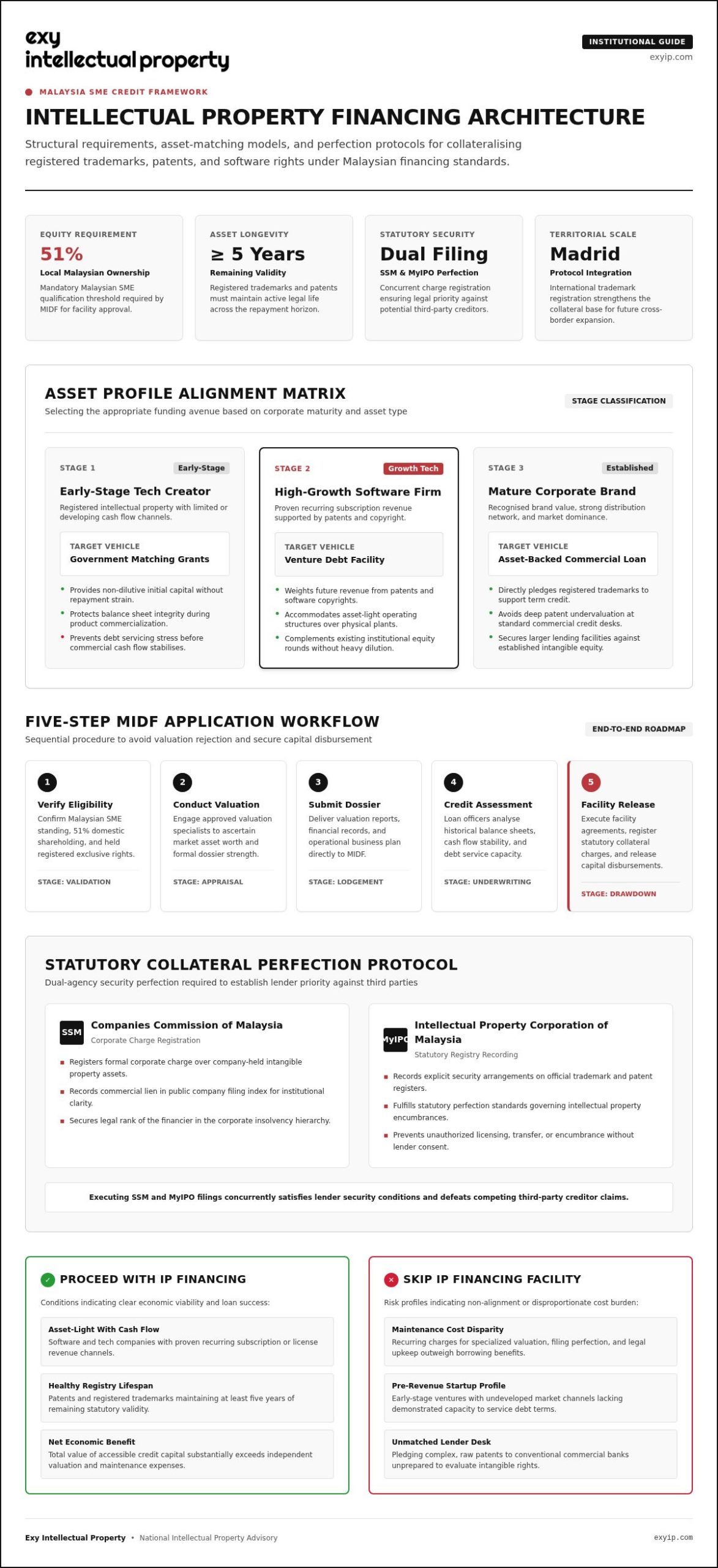
Key Takeaways: Malaysian SMEs can secure capital by pledging registered patents or trademarks as collateral through MIDF, provided assets are valued by approved experts and perfected.
- MIDF requires 51% local ownership and registered rights with at least 5 years of remaining validity.
- Skip it when the recurring costs of valuation and legal maintenance exceed the loan’s economic benefit.
- Best for asset-light tech firms with proven revenue streams rather than early-stage startups with undeveloped channels.
- The five-step MIDF application process requires dual filing with both SSM and MyIPO to ensure priority.
Match Your Asset Profile to the Right IP Funding Model
Your asset profile determines which intellectual property financing option yields workable capital terms in Malaysia.
Typical situations and a concrete next step from the same facts:
- Early-stage tech creator with registered rights but thin cash flow: prioritise government matching grants for non-dilutive initial funding.
- High-growth software firm with proven recurring cash flows: weigh venture debt that values future revenue from patents and software copyrights.
- Mature brand owner with strong market recognition: use asset-backed commercial loans secured by registered trademarks rather than pledging raw patents to a conventional credit desk.
Asset-light tech startups often fit equity-backed IP grants or venture debt, because those models weight future revenue from registered patents and software copyrights over tangible machinery. Established brand owners, by contrast, can use traditional bank loans secured by registered trademarks. When you pledge assets, debt financing uses valuable property as a security interest according to the Wikipedia Collateral (finance) entry from 2026 (finance).
Selecting a structure means evaluating three main avenues:
- Government matching grants suit early-stage tech creators needing non-dilutive initial funding.
- Venture debt fits high-growth software firms with proven recurring cash flows.
- Asset-backed commercial loans serve mature corporate brand owners with high market recognition.
A mismatch slows growth. Pledging raw patents to traditional commercial banks often leads to severe undervaluation.
Valuation criteria are easier to meet when advisers assess your intangible assets before you apply. You can consult Exy Intellectual Property to audit portfolio strength ahead of a funding submission. Early preparation supports a stronger valuation file.
Perfect IP Collateral Filings Before the Lender Reviews Priority
Securing a commercial loan against your intangible assets requires registering a charge with the Companies Commission of Malaysia (SSM). When you choose structured corporate finance, knowing how assignment and charge registration work removes uncertainty about using IP as security.
That process places the financier in a position to rely on the intangible property as collateral. You also need the security arrangements reflected in the records maintained by the Intellectual Property Corporation of Malaysia (MyIPO) in line with applicable statutory requirements.
For detailed updates on statutory perfection rules, explore the IP financing Archives, ExyIp resource page.
Dual filing supports a valid charge and helps establish priority. Executing the SSM and MyIPO steps together is the practical way to protect priority against third-party creditors.
Exy Intellectual Property guides businesses through these statutory filings so your perfection package meets lender expectations.
Follow Five MIDF Application Steps Without Valuation Rejections
MIDF financing needs a clear application workflow if you want non-dilutive capital against intangible assets. In our professional view, seeking early assistance from a specialist on the about us page helps you avoid common valuation rejections during eligibility checks.
- Verify eligibility: Confirm your Malaysian SME status, 51% local ownership, and hold registered rights.
- Conduct valuation: Engage an approved IP valuer to assess your market asset worth.
- Submit application: Deliver your valuation file, financial records, and business plan directly to MIDF.
- Undergo credit assessment: Allow the loan officers to review your cash flow and repayment capacity.
- Receive approval and disbursement: Sign the facility agreement to release your funding.
Securing an international registration (Madrid Protocol) early expands your collateral base for later cross-border expansion financing: few applicants build that layer before the first local facility.
SMEs often meet vague eligibility wording, limited rate visibility and multi-step collateral checks. Preparing clear registration documents upfront addresses those friction points.
This structured pilot process gives lenders the clarity they need to decide on your loan.
Tip: Ensure all registered trademarks and patents have at least 5 years of remaining validity before submitting your valuation file.
Working with an experienced team helps your IP documentation meet strict institutional standards.
Among Exy Intellectual Property’s Google reviews, Hong (5★) wrote:
Would like to praise YeongBoon and Wai Nee for their excellent service, will be engaging them again for further overseas trademark applications 👍🏻"
That review reflects a full arc you can copy in your own file: overseas trademark work was handled with care, the client received responsive support from the advisory team, and the same client planned further filings on the back of that result. Clean ownership evidence of that kind is what valuation officers expect to see when they test collateral strength.
Evaluating IP-backed loans alongside traditional financing means comparing valuation requirements, collateral types and interest rate structures. Traditional business loans usually demand physical real estate or machinery as security. IP financing accepts patents, trademarks or software code as primary collateral.
The choice depends on your asset structure. Fixed assets suit traditional term loans; asset-light tech firms gain more from intangible evaluation.
| Loan Element | Traditional Asset Financing | IP-Backed Financing |
|---|---|---|
| Collateral Type | Real estate, equipment, physical inventory | Registered patents, trademarks, industrial designs |
| Rate Basis | Prime lending rate plus fixed margin | Valuation-adjusted risk rate |
| Value Assessment | Standard physical appraisal | Specialised intangible valuation |
Borrowers often face uncertain valuation fees and interest spreads that are harder to read than standard bank offers. Traditional loans rely on established property values. IP funding costs depend on market adoption, remaining patent life and formal legal audits. To build a strong foundation for financing applications, you can secure trademark and patent protection through the firm’s services and use those registrations to prove asset ownership.
Unique assets draw deeper scrutiny, and rates reflect that specialised risk profile. A certified intangible asset valuation clarifies total borrowing limits early and reduces avoidable delay in credit assessment.
Skip IP Financing When Maintenance Costs Exceed the Benefit
IP-backed lending becomes a poor financial strategy when the cost of maintaining your valuation exceeds the loan’s economic benefit. Borrowing against intangible assets requires continuous legal enforcement and active commercialisation. If your trade secret or patent lacks immediate revenue streams, traditional bank financing remains a safer alternative.
Securing cash with intangible assets involves periodic audits and legal re-evaluations. Those recurring requirements can drain a young enterprise’s cash reserves. An IP portfolio only supports debt when you can fund the ongoing maintenance that keeps the rights enforceable and the valuation current.
Early-stage startups with undeveloped commercial channels should avoid this funding route. Standard commercial loans suit fixed physical assets; IP financing fits companies with established licensing revenues.
If you assume any granted patent qualifies for a bank loan, recalibrate: valuation officers require proven market demand before approving capital.
When the numbers still favour an IP-backed facility, ask the advisory team for a tailored quote on portfolio preparation.
Frequently asked questions
Which organisations funded and implemented the pilot?
The pilot was implemented together with the Intellectual Property Corporation of Malaysia, with MIDF operating as a financing channel for eligible SME applications.
Which organisations are involved in the pilot programme?
The pilot programme involves the Intellectual Property Corporation of Malaysia and financing institutions that accept approved IP valuations for SME credit assessment.
Who provides valuation input lenders will accept?
Lenders rely on approved IP valuers to assess intangible assets; you should engage a valuer recognised for that purpose before you submit a MIDF file.
What eligibility points do Malaysian SMEs need for IP-backed MIDF financing?
You need Malaysian SME status, at least 51% local ownership and registered IP rights, plus a valuation file, financial records and a business plan for credit assessment. Remaining validity of at least five years on pledged trademarks or patents strengthens the submission.
Securing Capital Through Your Portfolio
Intellectual property financing Malaysia still turns on the same decisions you met at the start: whether your rights can carry a charge, which model fits your stage, and whether valuation plus enforcement costs leave enough benefit.
Protecting intangible assets demands precision. Advisers at Exy Intellectual Property assist with portfolio audits and legal charge perfection so files meet lender requirements. You can read more about protecting and monetising your assets at Exy Intellectual Property.