


A patent can protect an invention, but protection alone doesn’t create a commercial return. Searching “how to monetize a patent Malaysia” is often the first step toward a bigger question: which route fits the invention, the market, and your business goals?
A license can let another party use the patent under agreed terms while you retain ownership. An assignment may transfer the rights, while direct commercialization means building a business around the invention yourself. Each route calls for a clear view of the patent’s status, market demand, and the information you share with potential partners.
This 2026 guide compares practical commercialization routes for Malaysian patent holders and explains the trade-offs to consider. You’ll learn how to assess deal readiness, prepare a credible proposition, and approach discussions while managing technical disclosures carefully. We’ll also cover when patent, licensing, valuation, or commercialization strategy advice may help align your rights with your commercial objectives. A sound next step is to match the patent to a credible market opportunity and a deal structure that supports it.
Key Takeaways
- Compare licensing, assignment, and developing the invention through your own business to understand how each affects control and operational responsibility.
- Learn how to monetize a patent Malaysia by connecting patent rights with a credible market need and a suitable commercial route.
- Assess deal readiness by examining ownership, patent status and scope, likely users, competing solutions, and evidence of demand.
- Plan your next steps around clear commercial objectives, careful review of proposed terms, and relevant Malaysian legal and MyIPO checks.
- See when patent searches, drafting, licensing agreements, valuation, or commercialization strategy may help inform decisions, without guaranteeing a deal or revenue.
How can a patent create commercial value in Malaysia?
A patent can support a business strategy, but ownership alone doesn’t prove that customers want the invention or that a partner will pay to use it. Commercial value depends on how the protected invention addresses a market need, whether the relevant rights support the proposed activity, and whether the parties can reach a workable commercial arrangement.
Patent commercialization is the process of bringing a patented invention to market through business activity or a commercial arrangement. It doesn’t guarantee sales, royalties, or other financial returns. For a high-level overview of approaches such as licensing and selling, see Patent monetization.
Subject to legal review, a patent’s exclusive right may help its owner negotiate permission for another party to use the protected invention or support the owner’s own market strategy. The scope and status of the rights matter. Patent registration records a legal right, but doesn’t by itself establish demand or create a deal. Enforcement addresses alleged unauthorized use, while broader intellectual property management involves decisions about protection and business priorities across rights. Monetization focuses on connecting patent rights to commercial activity.
What does it mean to monetize a patent?
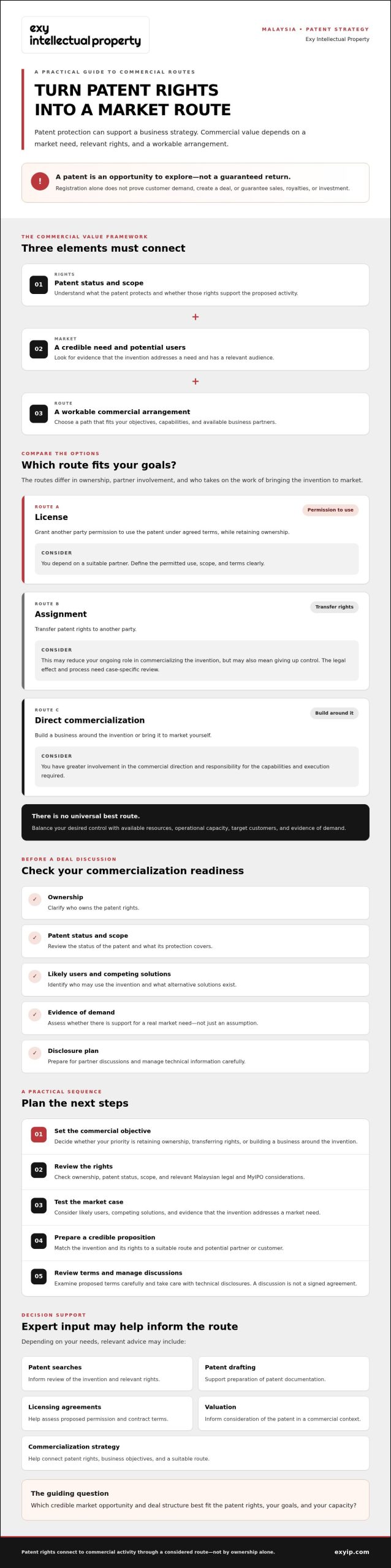
Monetization connects three elements: patent rights, a market need, and a commercial route. That route might involve a license, a transfer of rights, or selling a product that uses the invention. Each creates a possibility, not a confirmed return. A discussion with a potential partner isn’t a signed agreement, and estimated revenue potential isn’t the same as earned royalties, completed sales, or secured investment.
Illustrative example: A business holds a patent for a device that could help manufacturers reduce material waste. If a manufacturer sees a fit and both parties agree on terms, the owner might license use of the invention. Until demand is tested and an arrangement is made, the patent is an opportunity to explore, not assured income.
Who may benefit from commercializing a patent?
Inventors, startups, established businesses, and research-led organizations may all consider commercialization. An inventor may have developed a useful solution but lack the capacity to produce it. A startup might seek a partner with manufacturing or distribution capabilities, while a larger business could assess whether the invention complements an existing product or plan. Research-led organizations may look for a route that connects an invention with industry use.
There’s no universal best route. An owner seeking continued control may weigh a different arrangement from one seeking to transfer rights or build a business around the invention. Available resources, appetite for operational responsibility, target customers, and evidence of demand all shape the decision. For anyone asking how to monetize a patent Malaysia, a practical starting point is to match the patent’s commercial potential with the owner’s goals and capacity.
Which patent monetization route fits your Malaysian business?
The right route depends on how much control you want to retain, what capabilities you can commit, and whether a suitable business partner is available. Licensing, assignment, and commercialization through your own business can each connect patent rights with market activity, but they place different demands on the owner. Compare those demands before choosing a structure.
- Licensing: You grant another party permission to use the patent under agreed terms. You may retain ownership, but the arrangement depends on a partner and clearly defined terms.
- Assignment: You may transfer patent rights to another party. This can reduce your ongoing role in commercializing the invention, but may also mean giving up control. The legal effect and appropriate process need case-specific review.
- Direct commercialization: You build a business around the invention or bring it to market yourself. This gives you greater involvement in the commercial direction, while making you responsible for the capabilities and execution required.
When might a patent license make sense?
A license may suit an owner who wants to retain patent ownership while allowing another party to use the invention. A potential partner’s manufacturing, distribution, or market capabilities may be relevant, but discussing a deal doesn’t guarantee access to those capabilities.
Before agreeing, consider how the contract defines permitted use, scope, duration, and each party’s responsibilities. The right terms depend on the invention, business objectives, and applicable Malaysian law. Specialist review can help align patent rights with commercial goals and clarify what the agreement does and doesn’t allow.
When should an owner consider assignment or direct commercialization?
Assignment may be worth considering if your priority is to transfer rights rather than remain involved in commercial activity. Direct commercialization may better fit an owner with the capacity and appetite to develop, produce, market, or otherwise bring the invention to customers. Neither route guarantees a sale or market demand.
Ask what matters most: retaining strategic control, limiting operational responsibility, or building a business around the invention. Then compare those priorities with available resources and potential partner interest. For context on Malaysia’s intellectual property framework, consult the International Trade Administration’s Protecting Intellectual Property in Malaysia guide. It’s also useful to review related information on patent filing services in Malaysia when considering how protection connects to a future commercial plan.
Contract terms and the legal implications of licensing or transferring patent rights need case-specific professional review. If you’re weighing a license, licensing agreement support may help you assess how proposed terms align with your objectives.
Is your patent ready for commercialization or a licensing discussion?
A search for “how to monetize a patent Malaysia” may lead straight to potential partners. Before sharing a proposal, check whether the invention addresses a clear commercial problem and whether you understand the patent rights well enough to support the discussion. Deal readiness depends on both evidence of a market need and a clear understanding of the rights being offered.
Start with the market. Who might use the invention? What problem would it solve, and how do potential users address that problem now? Look at competing solutions and gather evidence that helps distinguish observed interest from assumptions. Customer feedback, testing, or other validation may inform your case, but describe what each piece of evidence actually shows. An expressed interest, for example, isn’t the same as a purchasing commitment.
Review the rights separately. Confirm ownership, current patent status, scope of protection, and the territories relevant to the proposed market with qualified patent support. Don’t assume that a patent’s existence answers every question a prospective partner may raise. A professional review can help identify what the rights cover and whether they fit the commercial proposal.
What evidence should you prepare before approaching a partner?
Prepare a concise, plain-language summary of the invention, its intended use, and the problem it aims to address. Add relevant use cases and any available validation evidence. Identify likely customer groups and explain why the invention may suit their needs, while clearly marking untested assumptions. This gives an initial conversation substance without overstating market demand.
Plan what you can safely discuss. Keep an initial overview separate from sensitive technical details, including information that could make the invention easier to reproduce. Before sharing those details, consider appropriate confidentiality arrangements and seek advice on disclosure risks. A clear boundary helps you explore interest while protecting information that may matter to the invention’s commercial position.
How can patent valuation support a commercialization decision?
Patent valuation is an assessment input, not a promise of sale value, partner interest, or financing. Its usefulness depends on the decision you need to make. An owner exploring a license may have different questions from an organization reviewing a patent portfolio or deciding whether to invest further in commercialization. Clarify the purpose first, then consider the assessment alongside market evidence and the patent’s status and scope.
For more context, consult a guide to intellectual property valuation methodology when deciding what questions an assessment should address. Exy IP provides patent valuation and commercialization strategy as professional support options; neither can assure a deal or revenue.
How to monetize a patent in Malaysia: plan the process
A clear process helps turn an initial idea into a considered business discussion. Start with the outcome you want, then check whether the patent rights, potential partner, and proposed arrangement fit that objective. Official intellectual property registries and relevant Malaysian legal references can help identify questions to verify. Confirm current procedures and legal implications with qualified professionals rather than relying on assumptions.
What steps can an owner take before contacting licensees?
Prepare before approaching potential licensees. A useful sequence is:
- Set your objective. Decide whether you want to retain ownership, explore a license, transfer rights, or develop the invention through your own business.
- Identify the partner’s role. Consider which capabilities the other party would need to contribute, such as production, distribution, or access to a relevant market. Treat these as criteria to assess, not benefits you can assume a partner will provide.
- Organize your records. Gather available patent documents and ownership records. Ask qualified patent support to review ownership, status, scope, and territories relevant to your plans.
- Prepare an initial summary. Explain the invention and its intended commercial use in non-confidential terms. Keep sensitive technical details separate until you have considered disclosure risks and obtained appropriate advice.
- Assess counterparties. Look for potential partners whose market fit, capacity, and strategic priorities align with the opportunity.
This preparation can make early conversations more focused and help you identify unresolved questions before discussing terms or sharing detailed information.
What should a patent license discussion cover?
Put a proposed arrangement in writing and ask a qualified professional to review its legal and commercial implications. Discussion topics may include permitted activities, territory, duration, payment structure, and each party’s responsibilities. Depending on the arrangement, the parties may also need to consider reporting, quality controls, improvements to the invention, and how disputes would be handled.
These are discussion points, not a universal checklist of legal requirements. Suitable terms depend on the patent, the parties, and their objectives. Confidentiality, ownership records, and the relationship between the patent rights and proposed terms all warrant careful review before an agreement is finalized. Official registry information may serve as a reference point for patent matters, while legal advice can address the specific transaction and current Malaysian rules.
After reaching an arrangement, track agreed responsibilities and review how the collaboration is working against its objectives. For guidance connecting patent protection with a commercial plan, explore strategic patent filing services in Malaysia. Exy Intellectual Property also provides licensing agreements and commercialization strategy support. Discuss patent licensing and commercialization support as you assess your next steps.
How Exy IP can support patent commercialization next steps
Professional input can help connect patent rights with a commercial objective. It can clarify questions, inform decisions, and help you prepare for discussions. It can’t guarantee that a partner will agree to a deal or that the invention will generate revenue. Choose support based on what you need to establish or decide next.
Which professional support may be relevant?
Start with the question you need answered. If you need to understand the invention’s patent position or strengthen its documentation, patent searches and drafting may be relevant. These services can inform your understanding of the material you have, but their role and scope depend on your circumstances.
If you’re exploring a license or another commercial arrangement, licensing agreement support can help you consider proposed terms alongside your objectives. Commercialization strategy can help you assess possible routes and how they relate to your business priorities. Neither service creates market demand or ensures that a counterparty will proceed.
Patent valuation may help inform a defined decision, such as considering a patent’s role in a business plan or reviewing a portfolio. Intellectual property financing may also be relevant to a business decision, but it shouldn’t be treated as a promise of funding. Clarify the question you want an assessment to address before deciding whether that support is suitable.
What should you prepare for an initial advisory discussion?
A concise preparation file can help keep the discussion focused. Include a plain-language summary of the invention, available patent information, your commercial objective, and the questions you need answered. Note what you know about potential users, competing solutions, and market interest. Separate confirmed evidence from assumptions, and flag uncertainties rather than presenting them as established facts.
- Objective: Explain whether you’re considering a license, direct commercialization, or another route.
- Rights: Gather relevant patent and ownership records for review.
- Market: Summarize known user needs, evidence of interest, and any gaps in your research.
- Questions: List concerns about readiness, disclosure, potential counterparties, valuation, or agreement terms.
This preparation gives an adviser a clearer view of your priorities and where further review may help. Exy Intellectual Property provides patent searches, drafting, licensing agreements, patent valuation, intellectual property financing, and commercialization strategy support in Malaysia. These services can inform your next steps, but don’t assure a transaction or financial outcome. If you’re considering how to monetize a patent Malaysia, Discuss your patent commercialization goals with Exy Intellectual Property.
Take the next step with a clear commercial plan
A patent can create a business opportunity, but the right route depends on market evidence, the rights available, and your capacity to act. Compare licensing, assignment, and developing the invention through your own business against your goals and resources.
Before approaching a potential partner, clarify ownership and patent information, prepare a credible account of the market need, and decide what technical details are appropriate to share. Review proposed terms with qualified support. These steps can inform a sound decision, but they can’t guarantee a partner, deal, or revenue.
Exy IP offers licensing agreements and commercialization strategy services, with patent valuation and intellectual property financing also among its services. The right support depends on the decision in front of you, whether you’re assessing a possible arrangement, clarifying a patent’s business role, or planning your next move. Discuss your patent commercialization goals with Exy IP and take a considered step toward putting your rights to work.
Frequently Asked Questions
Can I monetize a patent in Malaysia without manufacturing the invention?
Yes. Manufacturing the invention yourself isn’t the only route. You could explore a license that permits another party to use the patented invention under agreed terms while you retain ownership. A potential partner’s production or distribution capabilities may be relevant, but they don’t guarantee interest or commercial success. Before sharing sensitive technical information or discussing terms, check your patent position and get advice suited to the proposed arrangement.
What is the difference between licensing and assigning a patent?
A license gives another party permission to use a patent under agreed terms, while the owner generally retains ownership. An assignment may transfer patent rights to another party. The practical and legal effects depend on the transaction and applicable Malaysian law, so don’t rely on a general description to finalize a deal. Have a qualified professional review the proposed arrangement, including the rights involved and the terms being discussed.
How do I find a company interested in licensing my patent?
Start by identifying businesses that serve likely users or face the problem your invention addresses. Look for potential partners whose market, capabilities, and strategic priorities appear to fit the opportunity. Prepare a concise, non-confidential summary of the invention and the evidence behind its potential use. Treat interest as something to test, not assume, and get advice before sharing sensitive technical details or proposing license terms.
Does owning a patent guarantee that it can earn revenue?
No. A patent doesn’t by itself create customer demand, a commercial partner, sales, royalties, or investment. Revenue potential depends on factors such as market need, the rights available, and whether a suitable commercial arrangement or business route can be established. If you’re researching how to monetize a patent Malaysia, assess evidence of demand and confirm the patent’s ownership, status, and scope before treating it as a business opportunity.
What information should I prepare before approaching a potential licensee?
Prepare a plain-language invention summary, relevant patent and ownership information, intended use cases, and your commercial objective. Gather available evidence about user needs or market interest, and distinguish confirmed findings from assumptions. Consider what you can safely share in an initial discussion and keep sensitive technical details separate until you’ve obtained advice on disclosure risks. A clear, measured summary can make early discussions more focused without overstating demand.
Can a patent be used as an asset for business financing in Malaysia?
A patent may be considered in a business financing discussion, but that doesn’t mean a provider will accept it or offer financing. Any assessment depends on the circumstances, the rights involved, and the provider’s criteria. Exy Intellectual Property lists intellectual property financing among its services, but this shouldn’t be read as a promise of funding. Seek professional advice to understand whether this option fits your business objective.
When should I get a patent valuation before commercialization?
Consider valuation when you have a defined decision to inform, such as assessing a possible license, reviewing a patent’s role in a portfolio, or planning commercialization. It can provide an assessment input, not a guaranteed sale value, partner offer, or financing outcome. First clarify what question the valuation should address, then consider it alongside market evidence and a review of the patent’s ownership, status, scope, and relevant territories.