


A close resemblance is not proof of patent infringement. A product may look different yet still raise concerns, or appear similar without falling within the patent’s claims. In patent infringement Malaysia disputes, the key questions are what rights the patent protects, how its claims apply to the product or process, and what the evidence shows.
If you’re concerned about a competing product, it’s reasonable to want a clear answer before taking action. A premature accusation or missing technical evidence can complicate your next steps. This guide explains how to assess suspected infringement in Malaysia, what information to preserve, and which actions may be better left until the facts have been reviewed.
It also distinguishes patent concerns from other intellectual property disputes and explains when specialist patent and legal advice may be appropriate. The aim is practical clarity: connect the patent documents, technical evidence, and business decision before deciding how to respond.
Key Takeaways
- In patent infringement Malaysia matters, resemblance alone is not enough. The patent’s enforceable claims and the conduct in question both need careful review.
- Start with the relevant patent, check its status, and compare its claims with documented product or process features.
- Separate observed facts from assumptions. Similar appearance or shared function may raise questions, but neither settles the assessment on its own.
- Preserve relevant records and avoid public accusations or rushed responses while the patent rights and evidence are being reviewed.
- Specialist patent advice can help connect claim interpretation, technical evidence, and business priorities before you decide what to do next.
What does patent infringement mean in Malaysia?
In plain language, patent infringement may occur when someone, without the patent owner’s authorization, carries out an act covered by the exclusive rights of an in-force Malaysian patent. For a product patent, relevant conduct may include making, using, selling, or importing the patented product. For a process patent, it may include using the protected process or dealing with a product obtained directly from it.
Patent infringement in Malaysia depends on the scope of the enforceable Malaysian patent rights and the specific conduct alleged, not simply on whether two inventions appear alike. Patent rights are territorial: a patent granted in another country does not, by itself, establish patent protection in Malaysia. For a general introduction to the concept, see Patent infringement. The relevant rights and legal assessment must be considered under current Malaysian law.
Keep the type of intellectual property clear. If a rival uses a protected technical feature in a machine, the concern may involve a patent. If it uses a similar business name or logo, that may raise a trademark issue. Copying text, photographs, or software expression may instead raise copyright questions. One commercial dispute can involve more than one type of right, but each protects different subject matter and must be assessed separately.
What does a Malaysian patent protect?
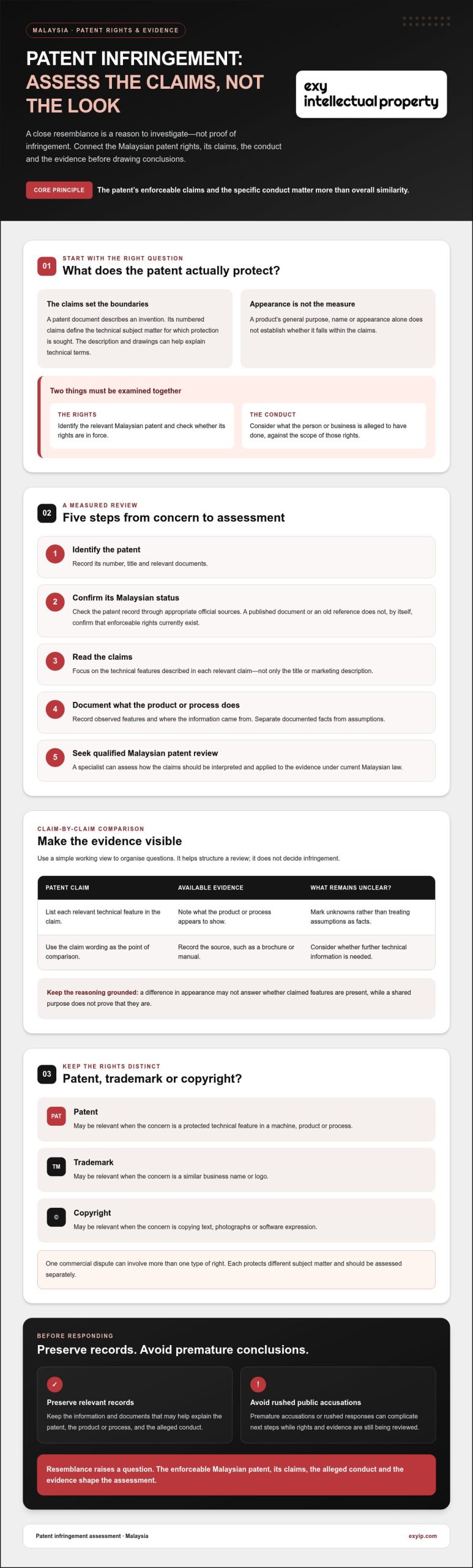
A patent document describes an invention and sets out claims: numbered statements that define the technical subject matter for which protection is sought. The claims are central to understanding the patent’s boundaries. The description and drawings may help explain technical terms, but a product’s general purpose or appearance alone does not show whether it falls within those boundaries.
Protection depends on the relevant Malaysian patent rights being in force. Before assessing a concern, identify the patent and check its record and current status through appropriate official databases and professional guidance from Exy Intellectual Property. A published document or an old reference to a patent does not, on its own, confirm that enforceable rights currently exist.
Does a similar product automatically infringe a patent?
No. Visual resemblance or shared functionality may be a reason to investigate, but neither settles the question. Start by comparing the patent claims with the product’s or process’s technical features, using reliable information about how it works. A difference in appearance may not answer whether relevant claimed features are present, and a shared purpose does not prove that they are.
That comparison can involve technical language and complex facts. A qualified review can help interpret the claims, distinguish documented features from assumptions, and consider the issue under current Malaysian law. Treat an initial resemblance as a prompt to investigate, not as a legal conclusion.
How is suspected patent infringement assessed against the patent claims?
A useful review moves from documents to conduct, then to qualified analysis. For a suspected patent infringement Malaysia matter, use a measured process: an early concern is a reason to gather facts, not a conclusion about liability.
- Identify the patent. Record its number, title, and relevant documents.
- Confirm its status. Check the Malaysian patent record through appropriate official sources.
- Read the claims. Note the technical features each claim describes, rather than relying on the patent title or a product’s marketing description.
- Document the conduct. Record what the product or process appears to do and where that information came from.
- Seek legal review. Have a Malaysian patent professional assess how the claims should be interpreted and applied to the evidence under current law.
Claim-by-claim comparison matters because a product’s name or overall appearance cannot show whether its technical features fall within the patent’s protected scope. The comparison must be assessed in light of the claims and current Malaysian law. This is an explanatory framework, not a legal test or advice on a particular dispute.
How do patent claims define the comparison?
Claims identify the features that form the basis of the comparison. An element-by-element review can help organise it: list each feature in a relevant claim, then note what the evidence appears to show about the product or process for that feature. For example, a brochure may describe a component’s purpose, while a manual may explain how it operates. This framework helps identify questions, but it does not decide them. Ask a Malaysian patent professional to verify the interpretation.
What evidence can help clarify the facts?
Preserve dated product images, manuals, brochures, sales materials, and relevant communications. Keep the source and date with each item. Record firsthand observations of how a product or process operates, but do not alter it or access restricted systems to gather information.
Separate what you directly observed from what you infer. “The manual describes a rotating component” is an observation about a document. “That component meets a patent claim” is a technical and legal conclusion that requires assessment. Product documents, public materials, and independent technical analysis may each help clarify different aspects, but none should be treated as decisive in isolation.
The International Trade Administration’s Protecting Intellectual Property in Malaysia guide provides broader context on Malaysia’s intellectual property system. For a review connecting patent documents, technical evidence, and business priorities, consider specialist patent legal advisory.
Patent infringement or a close call: what facts change the analysis?
Early signs can point in different directions. A product may look like a patented invention, share its purpose, or include a feature described in a patent. Those facts may justify further review, but they do not settle whether the relevant Malaysian claims apply. In a patent infringement Malaysia assessment, the patent’s status, ownership, claim wording, and reliable evidence can all affect the analysis.
| Fact observed | What it may suggest | What remains unproven |
|---|---|---|
| Products look alike | There may be reason to compare their technical features. | Appearance alone doesn’t show that the relevant claims are met. |
| Products perform the same function | They may address a similar practical need. | Shared purpose doesn’t establish that they work in a way covered by the claims. |
| Documents describe features also set out in a claim | The documents may help focus a technical comparison. | The wording, context and actual operation still need review. |
| The patent record shows a grant or a named rights holder | It may help identify a relevant right and person to contact. | Current status, ownership and the scope of enforceable rights must be confirmed. |
When is a product resemblance not enough?
Consider a hypothetical kitchen appliance with a similar shape and purpose to a patented appliance. The resemblance may prompt questions, but it does not establish that the features in the relevant claims are present. A manual or technical inspection might reveal meaningful differences that are not visible in photographs. Conversely, an initial visual comparison may overlook an internal feature. Technical and legal review can therefore reach a different view from appearance alone.
Why do patent status and ownership matter?
Before drawing conclusions or contacting another business, check the relevant Malaysian patent record and current status through appropriate official sources. Confirm who holds the rights, since the applicant named in an older document may not establish who currently owns them. Read the exact claim wording as well, since small differences in language can affect interpretation. For an overview of the broader legal context, see this guide to Malaysian patent litigation.
For background on how protection is pursued through filing, readers can also look for the article “Strategic Patent Filing Services in Malaysia.” Treat these factors as prompts for investigation, not a finding of infringement or a defence. Whether an exception or other legal issue applies depends on current Malaysian law and the specific facts, so avoid assumptions until those have been reviewed.
Handling Suspected Patent Infringement in Malaysia
Whether you believe your patent rights are being affected or your business has received an allegation, take a measured approach. Preserve relevant information and have the patent, evidence, and business context reviewed before making public statements or taking a position. In a patent infringement Malaysia matter, formal communications and possible remedies should be considered with advice based on current Malaysian law and the specific evidence.
If you believe your patent is being infringed
Before contacting another business, assemble a clear record for review. Keep copies of the patent documents and information about ownership, along with dated evidence of the product or process and the conduct that concerns you. Relevant business records may include product materials, communications, and notes showing when and where you observed the activity.
- Organise the documents by date and note where each item came from.
- Record what you observed separately from your conclusions about how the product works or whether it falls within a claim.
- Avoid threats or public accusations while the patent’s status, ownership, and claim scope are being assessed.
- Ask a qualified adviser to review the evidence and discuss possible next steps under Malaysian law.
A careful review helps ensure that any formal communication reflects the rights and facts that can be supported. It can also identify gaps in the record before decisions are made.
If your business receives an infringement allegation
Take the communication seriously, but do not assume the allegation is established. Preserve the original notice and related emails or letters, relevant product and sales records, and internal discussions about the issue. Retain records in their existing form and note who handled them.
- Don’t destroy or alter relevant documents, product records, or communications.
- Don’t make admissions or send a detailed response before obtaining independent advice.
- Don’t ignore formal communications. Record when they arrived and refer them promptly for review.
- Before changing business activity, seek advice on the patent, the claims identified, and the evidence relied on.
Both sides benefit from separating verified information from assumptions. A professional can review whether the cited patent and claims relate to the conduct described, then advise on appropriate communications or other options. The right approach depends on the rights, technical facts, and current law, so do not rely on a template response or a general online explanation as a substitute for case-specific advice.
Exy Intellectual Property provides legal advisory and intellectual property litigation services in Malaysia. If you need patent-focused guidance on organising the documents and assessing your response, contact Exy Intellectual Property for legal advisory.
How can Exy Intellectual Property support a patent infringement matter?
A suspected patent infringement Malaysia issue can involve more than matching a product to a patent document. The claims need to be considered alongside technical evidence, the status and ownership of the rights, and the business decisions at stake. Exy Intellectual Property provides patent-focused legal advisory and intellectual property litigation services in Malaysia, helping clients assess these connected factors without promising a particular outcome.
Depending on the matter, relevant support may also include a patent novelty search or patent drafting. A search can help examine patent-related information, while drafting supports the preparation of patent documents. Which service is appropriate depends on the question being addressed. Any assessment or next step depends on the rights involved, available evidence, applicable law, and case-specific review.
What information should you prepare before seeking advice?
A clear starting file can make an initial discussion more focused. Gather the relevant patent documents and ownership records, information about the product or process, and communications connected to the concern or allegation. Add a concise timeline of key events, including when you became aware of the issue and any business decisions that may need attention.
- List the questions you need answered, such as which claims or product features require review.
- Identify decisions that may affect business operations, without assuming that a particular legal deadline applies.
- Keep observed facts separate from your technical or legal conclusions.
- Before sending confidential technical material, clarify how it should be shared and handled.
This preparation does not replace professional review. It helps connect the documents and evidence to the practical decisions your business may need to make.
How does patent support fit broader intellectual property planning?
A patent may be one part of a business’s intellectual property position. Other rights may be relevant to different features of the same offering. For example, if product appearance is part of the concern, industrial design protection may warrant separate consideration from technical patent claims. The article “Industrial Design Protection in Malaysia” may provide related context; broader dispute considerations are addressed in “Managing Intellectual Property Litigation.” These topics are distinct, so the relevant rights should be assessed on their own facts.
For a suspected or alleged patent infringement matter, speak with Exy Intellectual Property about patent-focused legal advisory or intellectual property litigation. A discussion can help clarify which documents and technical evidence need review, and what options may be appropriate for your circumstances.
Take a Clear, Informed Next Step
Patent infringement Malaysia concerns call for more than a quick visual comparison. The patent’s current status, ownership, claim wording, and available technical evidence all matter. A careful review can help separate what you know from what still needs to be established.
If you suspect infringement or have received an allegation, preserve relevant records and avoid rushed public statements or admissions. Specialist input can connect the patent documents and technical facts to your business decisions, while keeping the assessment grounded in the rights and evidence involved.
Exy Intellectual Property provides patent-focused legal advisory and intellectual property litigation, as well as patent novelty searches and drafting. The appropriate support depends on your matter, and no review can guarantee a particular outcome. Discuss your patent matter with Exy Intellectual Property to consider a measured next step. Clear information and informed advice can help you move forward with greater confidence.
Frequently Asked Questions
What counts as patent infringement in Malaysia?
Patent infringement in Malaysia may occur when someone, without authorization, carries out an act covered by the exclusive rights of an in-force Malaysian patent. For a product patent, relevant acts may include making, using, selling, or importing the patented product. For a process patent, they may include using the process or dealing with a product obtained directly from it. The patent claims and the specific conduct need to be assessed under Malaysian law.
Can a similar product infringe a patent in Malaysia?
Yes, it may, but resemblance alone does not establish infringement. The key question is whether the product’s technical features fall within the relevant patent claims, which requires more than comparing appearance or general purpose. For example, two devices may perform the same function but use different technical features. A claim-by-claim review, supported by reliable product information and technical assessment, can help clarify the issue. A Malaysian patent professional can review the facts and applicable law.
How do I check whether a Malaysian patent is still in force?
Start by identifying the patent number and checking its record through the Intellectual Property Corporation of Malaysia (MyIPO), the official agency that administers patents. Review the grant and available status information, including whether renewal or lapse information affects the rights. A document showing that a patent was granted does not alone confirm its current status. If the record is unclear or a business decision depends on it, seek qualified advice to verify the position.
What evidence should I keep if I suspect patent infringement?
Keep dated copies of product images, manuals, brochures, sales materials, and relevant communications. Record where each item came from and when you obtained it. Note how the product or process appears to operate, but separate firsthand observations from conclusions about whether it meets a patent claim. Avoid altering products or accessing restricted systems to gather information. Organised, unaltered records can help a specialist assess the patent, the technical facts, and any gaps in the evidence.
What should I do if my business receives a patent infringement letter?
Preserve the letter, related communications, product and sales records, and internal discussions about the allegation. Note when it arrived and avoid destroying or altering relevant material. Don’t ignore formal communications, make admissions, or send a detailed response before obtaining independent advice. A qualified adviser can review the patent and claims cited, the evidence provided, and the business context, then help you consider an appropriate response under current Malaysian law.
Can I resolve a patent infringement dispute without going to court?
Potentially. Depending on the rights, evidence, and positions of the parties, discussions may lead to a negotiated resolution, which could include a license or other agreed terms. An outcome outside court is not assured, and any proposal should be assessed carefully before acceptance. Specialist advice can help clarify the strengths and uncertainties in the matter, support communications, and assess whether negotiated steps are suitable or whether court proceedings may need consideration.
For patent-focused legal advisory or intellectual property litigation support in Malaysia, contact Exy Intellectual Property to discuss your matter.