


What if a royalty rate looks fair, but the license gives away more control than your business can afford? Negotiating a patent license agreement involves more than agreeing on payment terms. Exclusivity, permitted uses, territory and performance obligations all shape how the patent can support your commercial plans.
It can be difficult to know which terms deserve priority, especially when different deal structures make proposals hard to compare. Start with your goals: how the patent will be used, which rights you are willing to grant and what each party needs to make the arrangement workable.
This 2026 guide explains how to prepare for negotiations, compare royalty structures and assess key clauses before finalising an agreement. It also covers how patent valuation and your commercialization strategy can inform the deal, and how specialist IP advice can help align the terms with your business plans in Malaysia or internationally.
Key Takeaways
- Define the patent rights the licensee may use, and distinguish that permission from a transfer of patent ownership.
- When negotiating a patent license agreement, prioritise scope, exclusivity, territory, field of use and term before settling operational details.
- Compare proposals by weighing each business benefit against the obligations it creates, including royalty calculations, reporting and performance commitments.
- Record decisions and unresolved questions at each stage, from preparation and term-sheet discussions through final review.
- Align license terms with commercialization plans, and use patent valuation to test the assumptions behind the deal.
Negotiating a Patent License Agreement Starts with the Deal You Need
A patent license agreement gives a licensee permission to use specified patent rights under agreed conditions, while ownership remains with the patent owner. The agreement defines the boundaries of that permission. It does not, by itself, transfer ownership of the patent.
That distinction matters. A patent owner may allow another party to make, use or sell a product within an agreed scope without giving up ownership. The exact activities allowed depend on the terms. For an overview of licensing concepts and common agreement types, see Understanding Patent Licensing Basics.
Before negotiating a patent license agreement, clarify what each party needs from the arrangement. The patent owner may be seeking a route to commercialization, while the licensee may need rights that support product development or entry into a market. The goal is not simply to secure the broadest rights or minimise obligations. It is to define permissions, control and commitments around a workable business purpose.
Set the commercial objective before discussing terms
Describe the proposed deal in practical terms: which technology and product are involved, which market the parties intend to serve, and how the licensee expects to use the patented technology. A license for a specific product application, for example, may serve a different purpose from one intended to support a wider collaboration. Defining the objective helps keep discussions focused.
Separate essential outcomes from preferences. The patent owner might need limits that preserve other commercialization plans, while the licensee might need enough certainty to invest in development. Record which outcomes are firm, which could change through negotiation and what obligations each party would accept in return. This makes trade-offs visible before they appear in formal drafting.
Map the patent and proposed use
Identify the patent rights the parties intend to include, the relevant territories, the available information about patent status and the proposed application. Then describe the licensed activities as clearly as possible. If the business purpose concerns one defined product, avoid wording that could unintentionally extend permission to unrelated products or activities.
Keep a list of questions for review under applicable law. For example, confirm that the rights identified match the technology the licensee plans to use, that the intended activity fits the proposed scope and that the patent status is described accurately. A patent reference alone does not resolve those questions. Specialist review can connect the agreement’s language to the parties’ actual plans.
A clear commercial objective and a carefully mapped use give both sides a sound basis for deciding which rights, limits and obligations belong in the proposed terms.
Which Patent License Terms Should You Negotiate First?
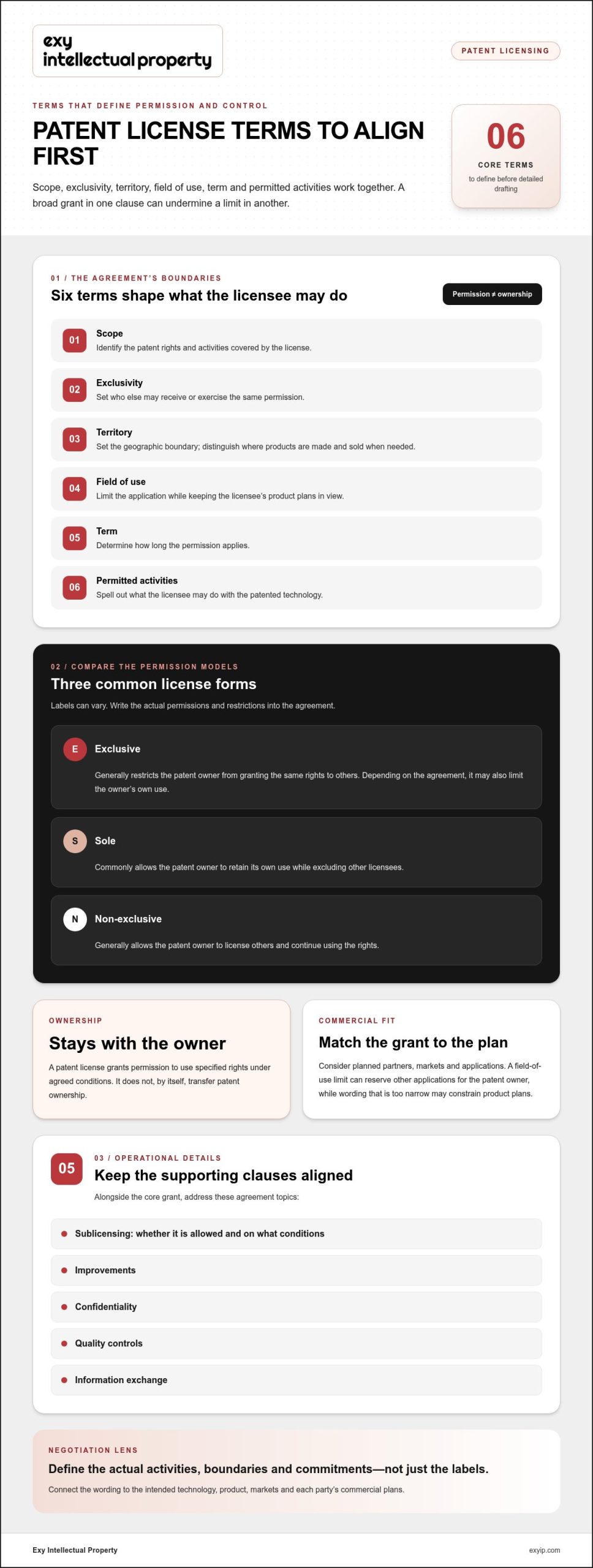
Set priorities before exchanging detailed drafts. The core clauses define what the licensee may do, where and for how long, and what each party must provide in return. Scope identifies the patent rights and activities covered; exclusivity limits who else may receive or exercise permission; territory sets the geographic boundary; field of use limits the application; term determines duration; and permitted activities specify what the licensee may do. These terms work together, so a broad grant in one clause can undermine a limit in another.
Define scope, exclusivity, territory, and field of use
Choose the level of exclusivity that fits the commercial plan. In common usage, an exclusive license generally restricts the patent owner from granting the same rights to others and may also limit the owner’s own use, depending on the agreement. A sole license commonly allows the owner to retain its own use while excluding other licensees. A non-exclusive license generally allows the owner to license others and continue using the rights. Labels alone are not enough: spell out the actual permissions and restrictions because terminology can vary.
Align territory and field of use with the parties’ operations. If a licensee plans to manufacture in one territory and sell in several others, distinguish those activities in the agreement. A field-of-use limit can reserve other applications for the patent owner, but wording that is too narrow may constrain the licensee’s product plans. An exclusive right can also limit the owner’s future licensing options, so consider planned partners, markets and applications before granting it.
Set royalties, reporting, and operational obligations
The royalty structure should match how the parties expect the technology to generate value. A fixed royalty is set by the agreement rather than calculated from sales; a running royalty is linked to an agreed measure of activity or revenue; a milestone royalty is triggered by a defined event; and a mixed structure combines approaches. For each option, define the calculation base, permitted deductions or adjustments, payment trigger and treatment of returns or bundled products where relevant. Unclear accounting language can make an apparently simple structure difficult to apply.
Reporting should give the parties enough information to check that calculations follow the agreed method. Specify what each report must contain, when it is due, how long supporting records are retained and what verification or audit process applies. Define the review’s scope, how discrepancies are handled and who may access sensitive records.
Also address sublicensing, improvements, confidentiality, quality controls and information exchange. State whether sublicensing is allowed and on what conditions. Clarify how improvements developed by either party will be treated, and set boundaries for sharing technical or commercial information. If product quality or development milestones matter, identify each party’s responsibilities, the evidence of progress and the consequences of missed commitments. Terms should support commercialization without imposing obligations a party cannot realistically meet.
Exy Intellectual Property provides support with patent licensing agreements, helping align the clauses with the intended use of the patent rights and the parties’ commercial plans.
How to Compare Patent License Proposals and Negotiate Trade-Offs
A proposal may look attractive because it offers broad rights or strong market control, yet include obligations that are difficult to meet. Compare each offer as a package, not as a collection of isolated clauses. For every proposed term, record the business benefit, the commitment it requires and the risk if circumstances change. This makes trade-offs easier to assess before either party accepts a headline term.
A simple comparison table can help. Give each proposal its own column, then assess the same factors in each row:
- Control: What use can the licensee make of the patent rights, and what options does the patent owner retain?
- Market reach: Which territories, applications or customer groups are covered, and do they fit the parties’ plans?
- Reporting effort: What information must be recorded and supplied, and can the responsible teams manage the work?
- Development risk: Who bears the work and uncertainty involved in adapting, testing or bringing the licensed technology to market?
- Future flexibility: Can the parties respond to a new application, market shift or change in business priorities?
For example, broader rights may give a licensee room to develop multiple applications, but could restrict the patent owner’s ability to license those applications elsewhere. A narrower grant may preserve the owner’s options while limiting the licensee’s commercial reach. The right balance depends on the parties’ objectives and ability to meet their commitments.
Compare exclusive and non-exclusive arrangements
Exclusivity can offer market control, but it also creates a commitment. The licensee may seek protection from competing licensees in a defined market; in return, the patent owner may give up the ability to grant similar permissions there. A non-exclusive arrangement can preserve the owner’s ability to work with additional licensees, while giving each licensee less control over who else may enter the market.
Neither structure is automatically better. Tie any exclusivity to clearly defined fields of use and territories, along with performance expectations and review points. For instance, the parties could review exclusivity against defined development or market-entry progress. Specify what evidence will be considered and what options follow if progress falls short, rather than leaving the outcome uncertain.
Balance flexibility against measurable commitments
Broad rights can suit a licensee whose product plans are still developing, but they may limit the patent owner’s future options. Rights limited to a specific use or market can be easier to manage, though they may not support expansion. Compare each approach with the intended commercialization plan, including who controls new applications and how either party can propose a change.
Test proposed milestones and reporting duties before agreeing to them. A milestone should describe an observable event and a clear way to show whether it has been met. Reporting should request information the responsible team can produce consistently. Before exchanging revised terms, list your preferred position, an acceptable fallback and the concession you would seek in return. This keeps discussions focused on related trade-offs rather than one-sided changes. A structured approach to negotiating a patent license agreement helps both parties understand the commercial effect of each revision.
A Step-by-Step Process for Negotiating a Patent License Agreement
A defined process keeps business decisions visible as the draft takes shape. Separate commercial alignment, which establishes what the parties want the deal to achieve, from legal drafting, which expresses those decisions as clear obligations and permissions. The two inform each other: a drafting question may reveal that the business arrangement itself needs reconsideration.
- 1. Prepare a negotiation brief. Record each party’s objectives, essential terms, fallback positions and decision-makers. Identify who can approve commercial trade-offs and who will review the legal wording. This gives the negotiating team a shared reference point and helps prevent positions from changing without explanation.
- 2. Document the proposed transaction. Note the patent rights under discussion, intended use, proposed territory, parties’ roles and key commercial assumptions. Consider how the patent rights and filing strategy support the proposed license. A strategic patent filing guide can help frame why the rights being protected should fit the intended business direction. Record uncertainties about rights or status for specialist review rather than relying on assumptions.
- 3. Discuss and record the commercial outline. Use a term sheet or another written summary to capture the main proposed terms, such as scope, exclusivity, territory, royalty approach, responsibilities and key dates. Mark which points are agreed, open or subject to approval. Treat the outline as a record of the commercial discussion, not a replacement for reviewing the final agreement.
- 4. Review the draft against the agreed outline. Track changes to scope, exclusivity, royalty calculations, performance duties and termination provisions. For each change, note the business reason, its effect on other terms and who needs to approve it. If a revised clause changes a commercial assumption, return the issue to the decision-makers before treating the wording as settled.
- 5. Resolve open terms and prepare for final review. Keep a decision log with agreed definitions, remaining questions, responsible reviewers and next actions. For example, record whether the wording for licensed activities covers a planned product use rather than leaving the point open to interpretation. Have the agreement reviewed as a whole, including how its clauses work together.
- 6. Verify Malaysia-specific requirements before execution. Record questions about applicable formalities, recordal or other local requirements, and check them against current Malaysian law. Do not assume that a commercial agreement automatically addresses every legal or administrative step relevant to the transaction.
Clear records make the final review more focused and show where specialist legal advice can help turn agreed commercial terms into precise drafting without losing sight of the parties’ business plans. Exy Intellectual Property provides licensing agreement and legal advisory services, including patent license agreement review.
Align the Agreement with Malaysian IP Strategy and Commercial Goals
A patent license should support more than a single transaction. Its terms need to fit how each party plans to develop, protect and commercialize the technology over time. For the patent owner, that may mean preserving options for other applications or future partners. For the licensee, it may mean securing rights that fit product plans, investment decisions and intended markets. A workable agreement accounts for both.
Connect license terms to patent value and commercialization
Consider the patent’s expected role in the business before setting the final scope, exclusivity and performance commitments. If the technology is central to a planned product, the licensee may need room to develop and bring that product to market. If the patent could support several applications, the owner may wish to reserve rights beyond the agreed field. Commitments should reflect what the parties can plan and deliver, rather than relying only on optimistic assumptions.
Patent valuation can help test those assumptions. It may inform discussions about the patent’s relevance to a product, its expected contribution to a commercial plan and how the parties assess a proposed license structure. The IP valuation strategic guide offers context for assessing intellectual property value. A valuation is an analytical input, not a guarantee of sales, investment returns or a particular negotiation result. Commercial outcomes still depend on factors such as development, market demand and each party’s performance.
Review the agreement alongside the parties’ broader intellectual property strategy. Consider whether exclusivity in a defined field affects other planned uses, whether the licensee’s commitments fit its intended commercialization pathway, and whether the arrangement leaves a workable way to respond if plans change. The answers can guide revisions without treating the patent’s assessed value as a promise of future performance.
Plan specialist review around the agreement’s open questions
For a Malaysian transaction, identify legal and procedural questions that need current review rather than assuming a familiar clause provides the answer. Depending on the agreement, review may need to address applicable formalities, recordal considerations and the treatment of rights across relevant territories. Check Malaysia-specific points against current law before finalising the agreement, especially if the parties or planned operations extend beyond Malaysia.
Specialist review is most useful when focused on decisions that remain open: whether the proposed grant matches the intended use, how the commercial terms fit the parties’ strategy and which assumptions need closer assessment. Exy Intellectual Property provides licensing agreements, commercialization strategy and legal advisory services to support this review. If you’re ready to assess how the proposed terms fit your business plans, discuss patent licensing with Exy.
Make Your Next Licensing Decision with Confidence
A license can shape how a business develops a technology well beyond the signing date. Consider what future changes could affect the relationship, such as a new product direction, a change in operational responsibility or a shift in the parties’ assumptions. Planning how to address those changes can help keep the agreement aligned with business priorities.
Before finalising, identify unresolved commercial questions and decide who should address them. A deliberate review gives both parties a clearer basis for moving forward and keeps the agreement connected to the opportunity it is meant to support.
When you’re ready to review your proposed terms and plan your next steps, discuss your patent licensing strategy with Exy.
Frequently Asked Questions
Is a patent license agreement the same as a patent assignment?
No. An assignment concerns a change in patent ownership, while a license gives permission to use patent rights without changing ownership. Before signing, check that the agreement names the correct patent owner and licensee, reflects the transaction the parties intend and identifies the relevant patent consistently with ownership records. If ownership has changed or several entities are involved, resolve that history before relying on the agreement.
Can a patent license be exclusive while the patent owner keeps using the invention?
Yes, if the agreement clearly reserves that use to the patent owner. State what the reservation covers, such as internal research or testing, and whether it extends to particular affiliates or collaborators. Consider whether the owner’s retained activity could compete with the licensee’s planned business. A precise reservation helps both parties understand the boundary without relying on a label such as “exclusive” alone.
How are royalties usually structured in a patent license agreement?
Test the royalty calculation against realistic transactions before settling on final wording. When negotiating a patent license agreement, have the relevant business teams apply the proposed formula to sample records and note any unclear assumptions. This can show whether sales, invoices or other source data are sufficient for consistent calculations. Record who prepares the calculation and who reviews it within each organisation.
What happens if a licensee does not meet a performance target?
Assess the target in context, including whether progress depended on actions by both sides. For example, a launch target may rely on timely technical materials as well as the licensee’s development work. Keep a record of relevant dependencies and progress so a review can distinguish a shortfall within the licensee’s control from delays caused by an unresolved input or assumption.
Can a licensee grant a sublicense to another business?
That depends on the permission set out in the main license. Consider how the proposed relationship works in practice: a manufacturer may produce goods for the licensee, while a separate distributor may receive rights to sell them. The agreement should clarify whether those arrangements count as sublicensing or as work performed for the licensee, and how permitted parties and activities are identified.
Does a patent license agreement in Malaysia need to be recorded?
There is no safe universal answer without checking current Malaysian law and the details of the transaction. As a practical measure, keep the signed agreement, amendments, patent identifiers and party details together. Have a qualified adviser verify whether recordal applies, who would handle it and what documentation is relevant. If the arrangement also covers patents in other countries, assess those jurisdictions separately rather than assuming the Malaysian position applies.