


What if the same Malaysian patent supports one assessment in a licensing discussion and a different one in a financing decision? Patent valuation Malaysia isn’t about finding a single figure that applies in every situation. The result depends on the business question, the method selected and the evidence behind the assumptions.
It’s reasonable to be cautious. Reliable market comparisons can be hard to find, and forecasts may feel uncertain if their basis isn’t clear. A useful valuation makes those inputs visible and explains how factors such as the patent’s scope, remaining term, commercial use and market prospects affect the assessment.
This guide explains the income, market and cost approaches, the evidence each requires, and Malaysian context to consider. You’ll also learn how to connect a valuation to a practical next step, whether that means exploring a license, seeking financing or planning commercialization. Exy Intellectual Property’s patent valuation and intellectual property advisory services can help businesses assess their assets in line with those decisions, without assuming that one method or figure suits every purpose.
Key Takeaways
- Patent valuation Malaysia should be tied to a defined business decision and valuation date, not treated as a guaranteed transaction outcome or financing approval.
- Compare income, market and cost approaches by their evidence requirements and fit for the patent’s commercial context.
- Assess Malaysian commercialization evidence alongside the patent’s territorial scope when building a valuation case.
- Prepare by defining the decision, scoping the patent, gathering evidence, testing assumptions and reviewing the findings.
- Use a valuation to inform practical next steps, including licensing, intellectual property financing or commercialization strategy.
What does patent valuation in Malaysia tell a business?
Patent valuation assesses a patent’s economic value for a stated purpose and valuation date. The purpose shapes the work: an assessment for a licensing discussion may need different evidence from one intended to inform an investment or financing decision.
For a business considering patent valuation Malaysia, the result is a reasoned assessment, not a promise of what another party will agree to pay. It doesn’t guarantee sale proceeds, licensing income or financing approval. Those outcomes depend on negotiations, commercial conditions and each decision-maker’s wider assessment.
A patent grants legal rights within a defined scope, but those rights alone don’t establish commercial demand. The assessment also considers whether the invention has a practical route to market, potential users or licensees, and a credible way to generate income. Intellectual property valuation provides a general overview of why intellectual assets may be valued and the approaches used to assess them.
Which business decisions can a patent valuation support?
A valuation can give a business a structured basis for considering what to do next. In licensing discussions, it can help the patent owner and prospective licensee examine the asset’s commercial contribution and frame negotiations. It doesn’t dictate the terms of a license or ensure that an agreement will be reached.
Investors may consider a patent valuation alongside the business’s wider commercial and financial evidence. For example, a company developing a patented component might present its assessment with information about product plans, customer interest and the resources needed to bring the product to market. The valuation helps explain the patent’s possible role, but doesn’t replace scrutiny of the business itself.
In financing discussions, an assessment may help show how intellectual property fits into the business’s assets and plans. A financing party can still consider factors beyond the patent’s assessed value. For commercialization, the findings can help owners compare routes such as developing a product themselves or pursuing a license.
Why is a patent’s value not one fixed number?
Every assessment reflects its purpose, valuation date, assumptions and available evidence. Changes in expected demand, product plans or the patent’s remaining commercial opportunity may affect the analysis. If key information is uncertain, that uncertainty should be made clear rather than hidden behind a precise-looking figure.
The legal right and its commercial potential are related, but they are not the same. A patent may cover a useful invention, yet demand could be limited, a route to market may be untested, or expected income may depend on further development. Evidence of active interest from potential users may inform the commercial assessment without changing the patent’s underlying scope.
Different decisions can call for different valuation perspectives. A business preparing for licensing may focus on potential income from granting permission to use the invention. An investor may want to understand how the patent supports a broader business plan, while a financing discussion may call for evidence relevant to the proposed transaction. A clear purpose keeps the assessment focused and helps readers interpret its conclusions.
Which patent valuation methods can businesses use in Malaysia?
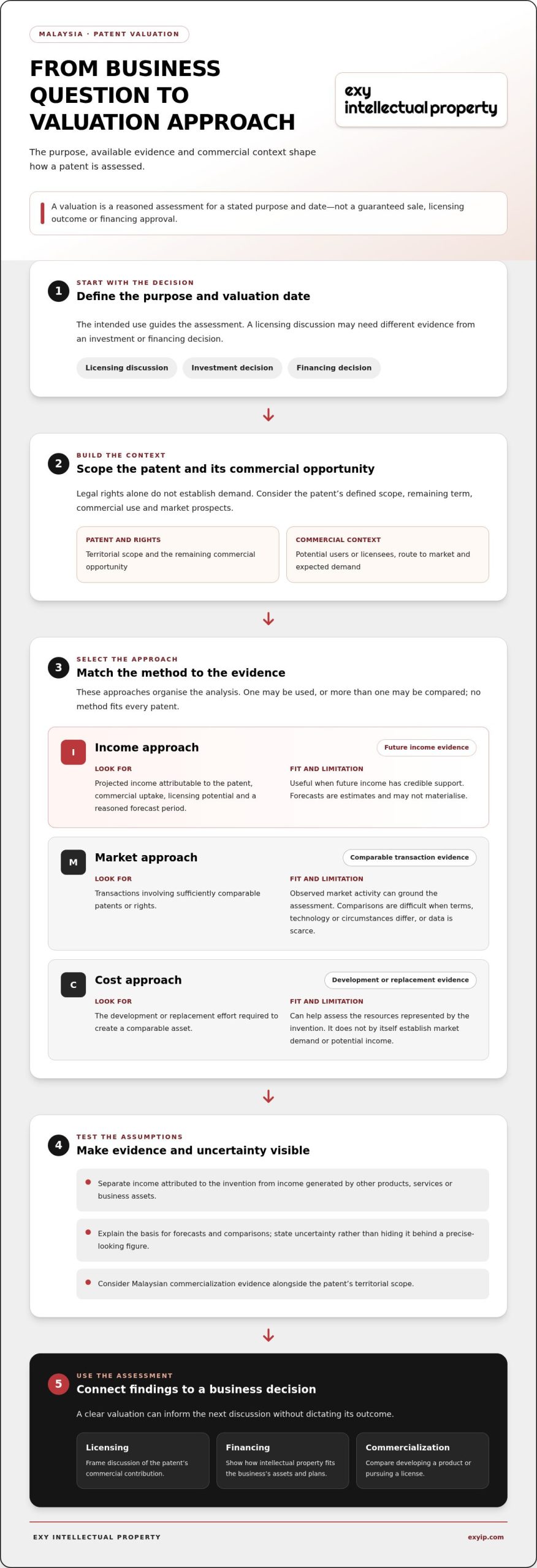
Three common frameworks are the income, market and cost approaches. They organise the analysis; they aren’t automatic formulas, and no method suits every patent. For patent valuation Malaysia, select an approach based on the intended decision, the evidence available and the invention’s commercial context. An assessment may use one approach or compare more than one, explaining why each is relevant and where its limits lie.
This comparison shows the kind of evidence each approach relies on:
- Income approach: Evidence may include projected income attributable to the patent, commercial uptake, licensing potential and the forecast period. This approach can be useful when future income is supported by credible assumptions. Its key limitation is that forecasts may not materialise.
- Market approach: Evidence may include transactions involving sufficiently comparable patents or rights. This approach can ground an assessment in observed market activity, but comparisons are difficult when transaction terms, technology or commercial circumstances differ, or relevant data is scarce.
- Cost approach: Evidence may include the development or replacement effort required to create a comparable asset. This approach can help assess the resources represented by the invention, but those resources alone don’t establish market demand or the income the patent could generate.
When might an income-based approach be relevant?
An income approach may be useful when a business can explain how the patent could contribute to future earnings, directly or through a license. Relevant evidence might include commercial uptake, discussions indicating licensing potential and a reasoned forecast period. The assumptions should distinguish income attributed to the patented invention from income generated by other products, services or business assets. Forecasts are estimates, not assured returns, so uncertainty should be visible in the analysis.
How do market and cost approaches differ?
A market approach looks to relevant transactions, while a cost approach examines the effort required to develop or replace the asset. Market evidence is most informative when comparisons are genuinely similar and transaction details are available. Cost evidence can help when comparable deals are hard to find, but recreating an invention doesn’t prove customers will want it. Scarce or dissimilar information can limit either approach, so record the rationale and evidence gaps.
For Malaysian work, don’t assume that a particular approach is legally required or accepted for every purpose. If the valuation is for a specific transaction or reporting purpose, identify that context at the outset and explain how it affects the method and evidence. A sound method choice shows why the evidence fits the decision and what remains uncertain. Businesses assessing their options can explore Exy’s patent valuation support as part of planning a licensing, financing or commercialization decision.
What Malaysian context and evidence can affect patent valuation?
A patent’s value depends partly on where its rights apply and where the business expects to commercialize the invention. A Malaysian patent is relevant to activity within its territorial scope; plans to sell or license in other markets may also require consideration of rights and commercial evidence in those territories. Local evidence, such as Malaysian customer interest, product plans, supply arrangements or licensing discussions, can help show whether there is a credible route from the protected invention to commercial use.
National intellectual property administration in Malaysia oversees the registration system, while organizations such as WIPO and the ASEAN IP Valuation Toolkit can provide broader reference material on intellectual property valuation. However, these resources should not be presented as a mandatory method for every Malaysian patent assessment. The valuation should fit the business decision and the evidence available. Evidence quality and clearly stated assumptions shape confidence in a patent valuation; an unsupported estimate cannot become reliable through precise presentation alone.
Which patent and market records should be considered?
Build an evidence file around the specific patent and the decision at hand. Include the patent documents and available records of ownership, status, prosecution history and licensing activity. Then add market and technical evidence that connects the invention to its potential use:
- Patent and ownership records: Identify the relevant patent, its current status, ownership documentation and remaining protection period. Include prosecution or licensing information where it helps explain the asset or its commercial history.
- Market evidence: Gather product plans, customer enquiries or orders, competitor solutions and information about the market the invention is intended to serve. Separate documented interest from general expectations.
- Technical readiness: Use testing, prototypes or development records where they help show how close the invention is to practical use. If Technology Readiness Level (TRL) is used, define it as a framework for describing a technology’s maturity and explain the evidence supporting the assigned level.
- Territorial and commercialization evidence: Match market evidence to the relevant patent territory. A Malaysian sales opportunity, for example, supports a different geographic claim from a plan that depends on overseas rights.
How should uncertainty and missing data be handled?
Label what is known and what is assumed. Patent records, signed agreements and completed sales are documented evidence; future demand, forecast income and expected adoption are estimates. This distinction helps decision-makers understand where professional judgement enters the analysis.
Comparable transactions or detailed financial records may be limited. If so, explain how the gap affects the conclusion rather than treating an approximate comparison as exact. Sensitivity analysis can help: vary key assumptions, such as the pace of uptake or forecast period, and show how the result changes. This makes uncertainty visible and gives the business a clearer basis for deciding what evidence to strengthen before licensing, financing or commercialization discussions.
How can you prepare for and assess a patent valuation?
A clear brief makes a patent valuation more useful. State the decision the assessment must support, such as considering a license, preparing for financing discussions or planning commercialization. That purpose helps define which patent rights to include, what evidence matters and what questions the findings need to answer.
Use this process to prepare and review the work:
- Define the decision. Explain how the valuation will be used, who will rely on it and when the decision is expected. Record the key questions, such as whether the patent supports a proposed licensing strategy or a wider business plan.
- Scope the patent. Identify the relevant patent rights, territories and related assets included in the assessment. Gather patent and ownership documents, and clarify whether the analysis concerns one patent or a group of connected assets.
- Assemble the evidence. Provide available records on development, commercialization, licensing activity, revenue and market interest. Label the source and date of important information so the basis for the assessment is clear.
- Assess assumptions. Separate documented facts from estimates and forecasts. Consider whether assumptions about demand, adoption, future income or development needs have a reasonable basis, and identify where information is incomplete.
- Review the findings. Check that the report addresses the original business question and explains its method, evidence, assumptions and limitations. Note any follow-up information that could improve a future assessment.
What information should a patent owner prepare?
Bring together the records that define the asset and its commercial context. These may include patent documents, ownership records and relevant prosecution or licensing information, alongside available product plans, development records, customer evidence and financial information. Explain which information relates directly to the patented invention and which relates to the wider business.
Also state the intended use, decision timeline and questions the valuation should answer. If the assessment is for a potential license, for example, share relevant licensing discussions and the planned use of the invention. A focused brief keeps evidence collection proportionate to the decision.
What should you look for in the valuation findings?
Read a valuation report together with its assumptions and purpose. Check the valuation date and scope first, then see whether the selected approach is explained in light of the evidence. Review which sources support key conclusions, what limitations apply and how the report describes uncertainty. Check that forecasts are clearly distinguished from recorded results.
The findings should answer the original business question, not imply a guaranteed transaction or outcome. If a material assumption changes, consider whether that affects the decision and whether more evidence is needed before acting. For support preparing or reviewing a business-focused assessment, explore Exy’s patent valuation service.
How can Exy support patent valuation and next steps in Malaysia?
A useful valuation starts with the decision it needs to inform. Exy’s patent valuation service assesses a patent against a defined purpose and the available evidence, rather than treating one figure as suitable for every situation. The scope can be tailored to the patent portfolio and intended use, whether the business is considering a license, preparing for financing discussions or planning commercialization.
This focus connects the assessment to action. A business may need to understand how a patent fits into a product plan, what information could support licensing discussions, or how intellectual property relates to a broader financing proposal. Exy’s advisory support connects valuation with related licensing, intellectual property financing and commercialization strategy services, while keeping the assessment distinct from any final transaction decision.
How does valuation connect with commercialization and financing?
Valuation findings can help a business compare possible routes to market. For example, an owner exploring a license may use the assessment to consider the patent’s commercial role and prepare for discussions about permission to use the invention. A business planning to commercialize the technology itself can consider valuation insights alongside product development, market and operational information when shaping its strategy.
For intellectual property financing discussions, a valuation can help explain the patent’s potential contribution to the business. It is one element of a wider assessment, not a substitute for other relevant business, financial and commercial information. A valuation alone doesn’t secure financing, investment or a licensing agreement. Its value lies in making the asset and the reasoning behind the assessment clearer for the decision at hand.
What is a practical next step for a Malaysian business?
Start with a short, clear brief. Identify the decision the assessment should support, the patent or portfolio in scope and when the findings will be needed. Then organize the supporting information so the valuation can be grounded in relevant records, not assumptions that are difficult to test.
- Patent information: Gather patent documents, ownership records, current status information and details of the territories relevant to the decision.
- Technical evidence: Prepare development records, testing information and product details that help explain the invention’s stage and intended use.
- Commercial evidence: Collect available market research, customer or licensing discussions, commercialization plans and relevant revenue information.
- Decision context: Note whether the assessment will inform licensing, financing or commercialization, and list the questions the findings should answer.
This preparation gives Exy a practical starting point for defining the valuation scope and evidence base. If your business is considering patent valuation Malaysia as part of an intellectual property strategy, discuss patent valuation with Exy and consider how an assessment may inform your next decision.
Turn your patent questions into a clear next step
A valuation is most useful when it helps move a business decision forward. Before acting on an assessment, identify what you still need to understand: which commercial route merits attention, what evidence would strengthen your position, or how the patent fits your wider intellectual property strategy. That focus keeps discussions practical and ensures the valuation serves a real business purpose.
For businesses considering patent valuation Malaysia, begin with the decision in front of you and the information already available. A focused conversation can help define the scope of an assessment and how its findings could support your plans, without assuming a particular commercial outcome.
Exy can help you consider how patent valuation relates to your business objectives and potential next steps. Discuss your patent valuation needs with Exy and take a considered step toward putting your intellectual property to work.
Frequently Asked Questions
How is a patent valuation conducted in Malaysia?
Patent valuation Malaysia typically starts by defining the business question, identifying the rights in scope, reviewing relevant records and choosing an approach that fits the evidence. The assessor then documents the reasoning, assumptions and limitations in findings tied to a valuation date. To begin, explain whether the assessment is intended to inform a proposed license, a financing discussion or an internal commercialization choice, since each decision may call for a different emphasis.
What factors affect the value of a patent?
A patent’s assessed value can be affected by its status and scope, the time remaining in its protection period, technical readiness and evidence of market demand. The availability of alternative solutions matters too: a patent may face different commercial prospects if customers can readily meet the same need another way. Also consider whether the owner has a credible route to market, such as product development or licensing, and what further work may be needed before the invention can be used commercially.
Which patent valuation method is most suitable for my business?
The suitable method depends on your decision and the evidence you can support. An income approach may be relevant if forecasts have a clear basis; a market approach may help if there are genuinely comparable transactions; a cost approach may offer insight into development or replacement effort. For example, a business with an early-stage invention and no relevant transaction evidence may need to explain why forecasts are uncertain before relying on an income-based result.
Can a patent valuation help with licensing or financing?
Yes. It can provide a structured reference for discussing how a patent might contribute to a proposed license or financing plan. For example, a company considering licensing may use the assessment to explain the invention’s role in a product and the evidence behind its commercial prospects. A financing party may also review it alongside business and financial information. The assessment informs those discussions, but the parties make their own decisions about any transaction.
Who can carry out an intellectual property valuation in Malaysia?
Businesses can engage a specialist in intellectual property valuation to assess a patent for a defined purpose. Exy Intellectual Property provides patent and intellectual property valuation services. For a useful assessment, the work should explain the chosen approach, evidence considered and assumptions made, so the business can understand how the findings relate to its decision. The reported figure should be read in light of the scope and context described in the assessment.
Does a patent valuation guarantee a sale or licensing income?
No. A valuation is an assessment, not a promise that a buyer or licensee will agree to a transaction or that licensing income will follow. Commercial outcomes depend on matters such as the parties’ interests, negotiations and the evidence each considers relevant. A business can still use the findings to prepare for discussions, identify questions that need answers and assess whether its commercial plans are supported, without assuming that an agreement or income will result.
What information should I prepare for a patent valuation?
Prepare the patent and ownership records relevant to the assessment, together with a short note describing the decision you need to make. Add available technical and commercial materials, such as development records, product plans, customer feedback, licensing discussions and relevant revenue information. Keep dates and sources with each item. This makes it easier to distinguish recorded results from forecasts and helps the assessor identify gaps that may affect the conclusions.