


A defensible IP portfolio is built around business goals, not a growing pile of registrations. Building a defensible IP portfolio means choosing markets with commercial potential, identifying assets worth protecting, assessing freedom to operate and reviewing the portfolio as the business changes. Because IP rights are territorial, protection in one market does not automatically cover another.
Registrations can protect valuable intellectual property, but filing alone will not keep a portfolio aligned with your plans. Clear records and useful portfolio data help you see which assets support a product, brand or expansion plan, where protection needs attention and what to prioritize next.
This article explains how to manage an IP portfolio through market selection, freedom-to-operate analysis, asset identification and data-informed planning. It also covers how patents, trademarks, copyright and trade secrets serve different business needs, and how a practical review process can connect those rights to commercialization, licensing and growth in Malaysia and other markets.
Key Takeaways
- Connect each intellectual property asset to a business goal, such as product development, investment planning or licensing.
- Choose filing markets based on where you plan to operate, grow and commercialize, rather than seeking protection everywhere.
- Assess freedom to operate by reviewing your planned activities alongside relevant competitor patent landscapes.
- Identify which parts of your innovation, brand and creative work may suit patents, trademarks, copyright or trade secrets.
- Use portfolio data to track assets, spot gaps and guide regular reviews as your business and markets evolve.
1. What is IP portfolio management?
A defensible IP portfolio is a managed set of intellectual property rights and related assets that supports a company’s business and protects its valuable work. Patents, trademarks, copyright and trade secrets can help prevent copying, strengthen competitive position and support action against infringement. Building a defensible IP portfolio means connecting each asset to a commercial purpose, not simply collecting registrations.
Start with the business strategy. Map each asset to a product, brand, research programme or planned market. For example, a software company developing warehouse automation might identify a technical method for patent review, its product name for trademark protection and confidential operating data for trade secret safeguards. This map helps teams decide what to protect, what to keep confidential and what could support commercialization or licensing.
Investment plans should shape these decisions, too. Before fundraising, prepare a clear record of granted rights, pending applications, ownership documents and assets tied to the company’s product roadmap. Investors may conduct IP due diligence before committing capital. A founder who can explain how a patent application supports a planned product, or how a trademark protects a launch brand, gives investors a clearer view of the company’s intangible assets.
Use regular portfolio audits to test whether each right still serves a business goal. Review its scope, validity, ownership and commercial potential, then compare the findings with current product plans and market priorities. An audit can flag an application that no longer fits the roadmap, an important asset without clear ownership records or a valuable right that needs maintenance. Prioritize high-impact assets rather than treating every filing as equally important.
Common portfolio risks include unclear ownership, incomplete transfer records, missed maintenance steps and rights that no longer match company plans. Due diligence should compare granted and pending rights with ownership documents, then assess each asset’s status and commercial relevance. For patent expiry reviews, the United States Patent and Trademark Office identifies filing and grant dates, term adjustments or extensions, terminal disclaimers and timely maintenance-fee payments as relevant factors.
For takeover defence, sound records and a clear account of strategic assets can strengthen a company’s negotiating position. Keep ownership documents, licences and asset valuations organized, and identify which patents, trademarks or confidential processes underpin the business. Intellectual property alone cannot prevent a takeover, but a well-managed portfolio helps leaders explain what the company owns, how those assets support operations and where its independent commercial value lies.
2. Choosing international markets for IP protection
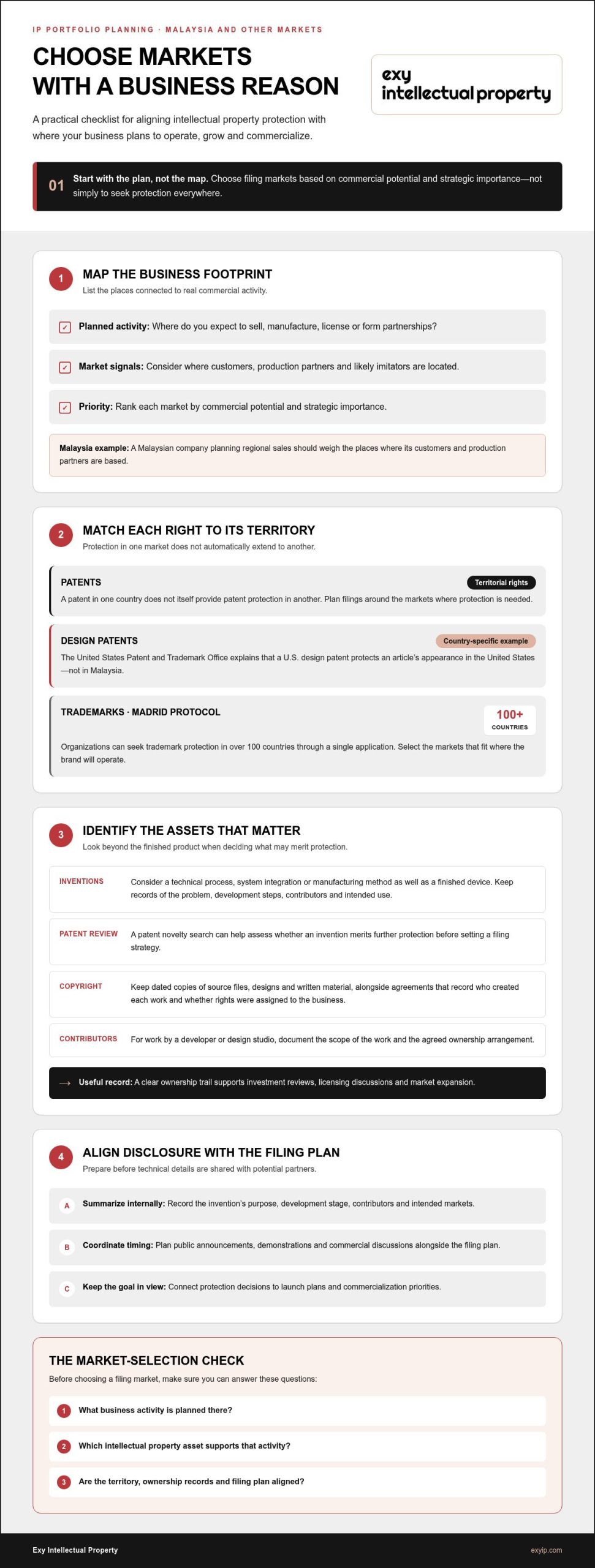
Choose filing markets by matching each right to a real business plan. List where you expect to sell, manufacture, license or form partnerships, then rank markets by commercial potential and strategic importance. A Malaysian company planning regional sales should consider where its customers, production partners and likely imitators are located. Filing everywhere can spread attention across markets that may not support commercialization.
Prioritize inventions that contribute to the company’s position, not only visible products or code. A technical process, system integration or manufacturing method may matter as much as a finished device. Keep invention records that explain the problem, development steps, contributors and intended use. A patent novelty search can help assess whether an invention merits further protection before you set a filing strategy.
Patent rights are territorial. A patent in one country does not itself provide patent protection in another, so planned markets need their own filing strategy. The United States Patent and Trademark Office explains that a U.S. design patent protects an article’s appearance only in the United States, not in Malaysia. For trademarks, the Madrid Protocol lets organizations seek protection in over 100 countries through a single application, but the selected markets should still reflect where the brand will operate.
Copyright planning also requires clear ownership records. Keep dated copies of source files, designs and written material, along with agreements documenting who created each work and whether rights were assigned to the business. If a developer or design studio contributes to a product, record the scope of the work and the agreed ownership arrangement. These records help establish a clear chain of title during investment reviews, licensing discussions or market expansion.
Before sharing technical details with potential partners, prepare a concise internal summary of the invention. Record its purpose, development stage, contributors and intended markets. Then coordinate public announcements, demonstrations and commercial discussions with the filing plan. This helps the business present its innovation to collaborators while keeping protection decisions aligned with launch and commercialization priorities.
In Malaysia, registration timing depends on the right, application scope, filing route, examination and any objections. There is no single timeline for every patent, trademark, design or copyright-related process. Before planning a filing, identify the asset, intended markets and ownership records. Then assess filing and enforcement decisions under the rules relevant to each right. Documenting ownership, use and possible infringement supports decisions about licensing or legal action.
3. Freedom-to-operate analysis and competitor patent landscapes
Freedom-to-operate analysis asks whether a planned product or activity may conflict with another party’s intellectual property rights. It is different from asking whether your own invention qualifies for a patent. A company may own a patent and still face restrictions on making, using, selling or importing its product. Before a Malaysian business commits to production or distribution for a new product launch, it should assess the activities and markets involved.
Start with the product as it will actually reach customers. Break it into components, technical functions, software processes and manufacturing steps. For example, a warehouse robotics company could map its navigation system, routing logic and automated picking workflow separately. This makes searches more focused than relying on a broad product label and helps identify which parts need closer review against relevant patent rights.
Next, examine patent landscapes for the markets where the company plans to operate. Search relevant patent documents, then compare their claims with the product’s features and planned activities. A landscape can reveal active areas of competitor research, crowded technical fields and potential gaps for innovation. Record each relevant document, its owner, status and connection to the product so technical and business teams can prioritize further analysis.
Review the findings before investment, launch or a major design change. A potential conflict may call for a technical redesign, a different market sequence, a licence discussion or further legal analysis. These are possible decision paths, not automatic conclusions: the patent’s claims and status matter, as do the product features and intended activities. Document the reasoning so investors and decision-makers can see how risks informed the plan.
Competitor monitoring should continue after the initial review. Assign someone to track patent filings and product announcements by companies active in the same technical space. If a competitor launches a feature resembling your protected invention, compare public product evidence with the relevant patent claims. Keep dated records of product pages, demonstrations and technical changes. These records provide a more useful basis for deciding whether further investigation or enforcement action is appropriate.
Also assess what competitors could copy with limited effort. Identify product features that are visible to customers, easy to reverse engineer or central to commercial appeal. A distinctive automated workflow may need different safeguards from confidential manufacturing settings. Match each concern to an appropriate response, such as patent protection, confidentiality controls or ongoing monitoring. An organized record of rights, market plans and competitor activity makes freedom-to-operate review a continuing business process, not a one-time search.
4. Identifying patents, trademarks, copyrights and trade secrets
Prioritize intellectual property by asking what creates commercial value, what competitors could copy and how each asset supports planned products. A company developing a medical device, for example, might assess its technical mechanism for patent protection, product name for trademark protection, instruction manual for copyright and confidential manufacturing settings as trade secrets. This comparison helps direct attention to the rights most closely connected to business goals.
Patents can protect inventions with technical features that may be disclosed and claimed. A patent portfolio can combine broad claims covering a core concept with narrower claims for specific implementations. This layered approach can address different versions of a product, while the claims must still fit the invention and its development. Patent landscape analysis can show how existing filings cluster around a technology and help identify areas for further investigation.
Trademarks protect signs that distinguish a business or its products, such as a brand name or logo. Copyright protects original expression, including written materials, software code and visual designs. For a product launch, connect the proposed brand to its goods or services and keep dated copies of creative works. Agreements with employees, contractors and collaborators should document ownership and permitted use of their contributions.
Trade secrets may suit valuable information that remains confidential, such as a manufacturing formula, customer process or internal method. Protection depends on keeping the information secret, so document each secret’s subject, business purpose, access permissions and sharing history. Use confidentiality terms in relevant agreements, limit access to people who need the information and keep controlled records of changes. Publicly presenting a formula, for example, could undermine secrecy.
Rank IP assets by their contribution to revenue, product differentiation, market access and future commercialization. Then consider the risk of copying, the value of preserving secrecy and the markets where protection matters. A distinctive brand may warrant trademark filings before launch, while a technical feature may need patent review before public disclosure. These decisions help ensure that filings support the company’s commercial position rather than simply increasing portfolio size.
Patent professionals can help translate an invention into a filing strategy suited to its technology, markets and development roadmap. Before a discussion, prepare invention records, diagrams, contributor details, current product plans and relevant competitor filings. For example, an engineering team can separate a device’s core function from optional components, providing clearer material for evaluating broad and narrowly tailored claims. Review the resulting portfolio as products change, and update ownership records when new work or agreements alter the asset base.
5. Data analytics and technology tools for portfolio planning
Portfolio analytics turn scattered intellectual property records into useful decisions. Start with a central register that connects each patent, trademark, copyright and confidential asset to a product, business unit and market. For example, a Malaysian manufacturer could link a production method to its equipment line, brand and planned export markets. This view helps leadership see which assets support revenue and which need further review.
Keep the register useful by recording consistent fields: asset type, title, owner, application or registration status, relevant markets, associated product, key documents and upcoming review dates. Link each record to ownership agreements and licensing terms where relevant. Assign a named team member to update the record after a new filing, acquisition, product launch or agreement. Reliable inputs matter; outdated ownership or status data can distort reports and decisions.
Build a dashboard around business questions, not vanity counts. Compare assets by product line, market, commercial use and strategic priority. Flag rights that support a planned launch, assets with unclear ownership and filings that no longer match the product roadmap. Then ask the responsible teams to explain gaps and propose actions. A patent count alone says little about whether a portfolio protects the company’s competitive position.
Combine internal records with patent landscape information to guide research and investment choices. Track relevant competitors, technical themes, filing activity and markets connected to planned products. If a company sees repeated activity around a specific automation function, its engineering team can assess whether its roadmap needs a technical change or further protection review. Keep the source documents behind each insight so decision-makers can distinguish evidence from assumptions.
Analytics can also inform commercialization. Link licensing agreements, product use and business-unit reports to the intellectual property assets involved. This can reveal assets suited to licensing, collaboration or sale, and help identify rights that contribute to revenue indirectly by supporting a product or partnership. A valuation review can then examine an asset’s commercial role, ownership position, market relevance and potential uses rather than treating registration as value in itself.
Make portfolio planning a repeatable process: update records after business changes, review dashboard findings with technical and commercial teams, and document each decision. If you’re assessing how intellectual property contributes to commercial value, explore intellectual property valuation as part of your planning.
Exy Intellectual Property: Trademark Registration
Exy Intellectual Property helps businesses turn portfolio priorities into practical protection steps. Its Trademark Registration service can protect a brand name or logo as your business prepares to enter or grow in a market. For technical inventions or product appearance, Patent Filing and Industrial Design Registration may suit the asset. Copyright Voluntary Notification can address eligible creative works.
Prepare a clear description of the asset, its current ownership and the markets where you plan to use it. These details help connect the protection process to your commercial plans and wider portfolio. Contact Exy Intellectual Property to discuss the next step for your intellectual property.
Make Your Next IP Decision Deliberate
Your portfolio should keep pace with the business it protects. As products, partnerships and expansion plans shift, set a clear time to review whether each asset still supports the company’s direction. This habit makes building a defensible IP portfolio an ongoing business practice, not a one-time filing exercise.
When you know the next step, Exy Intellectual Property can help with Trademark Registration, Patent Filing or Industrial Design Registration. The right option depends on the asset you are preparing to protect and its role in your plans. A focused conversation can help turn portfolio priorities into practical action.
Contact Exy Intellectual Property to discuss your next step. Build with clarity, and let your protection strategy grow alongside your business.
Frequently Asked Questions
How Can Companies Ensure Effective IP Portfolio Maintenance?
Make portfolio upkeep part of ordinary business controls, with a named owner and a process for reporting changes. For example, procurement can flag a supplier change that affects product components, while product teams record when a feature is retired. A shared action log can capture the decision, responsible person and follow-up date. This helps keep important portfolio decisions visible across legal, technical and commercial teams.
What Is an IP Moat?
An IP moat is a set of intellectual property assets that makes a business harder to copy. Its strength can come from complementary advantages, such as a recognizable brand alongside specialist know-how and a product’s technical features. A competitor may reproduce one element yet still struggle to match the combined customer experience and business model. Consider how each asset contributes to differentiation rather than treating a single right as the whole moat.
What is IP portfolio management?
IP portfolio management is the process of making and coordinating decisions about a company’s intellectual property. In practice, it requires clear decision rights: technical teams explain how an invention works, commercial teams identify its role in the market and leadership sets priorities. A short review record should state the decision, its business reason and who owns the next action. This creates accountability without turning every portfolio discussion into a major project.
Why Start on Day One?
Starting on day one gives founders a chance to build sound habits before urgent launches and investor discussions compete for attention. Add an intellectual property check to product planning and major marketing approvals. Before a pitch deck or public demonstration, decide which technical details can be shared and which need restricted handling. Early routines make it easier to coordinate protection decisions with development, communications and commercial planning as the business grows.
How do you audit and identify a company’s intellectual property assets?
Use a structured discovery exercise that asks each department what it creates, commissions, receives or relies on. Review working materials such as product specifications, campaign files, software repositories, supplier deliverables and collaboration records. Then classify each item by creator, business use, confidentiality and current status. This can reveal assets outside the formal filing system, including internal materials that teams rely on but have not discussed in planning.
What are the steps to secure IP ownership from founders, employees, and contractors?
Trace each asset from creation to the business, noting its contributors and the documents governing their work. Compare the records with the company’s current ownership position, and identify any missing signature, unclear scope or conflicting term. Resolve gaps through properly documented agreements, then keep final versions with the asset record. For collaborative work, record each party’s contribution and the agreed permissions before adapting or distributing the result.
How do you assess patentability and freedom to operate before investing in a product?
Set a decision gate before substantial product investment. Define the invention’s technical contribution and the exact product version under review, then have the relevant technical material assessed for patent potential. Separately, assess whether planned product activities raise concerns about third-party rights. Record assumptions, such as which features will be included at launch, because a later design change can make earlier analysis less relevant. Use the findings to inform investment decisions.
How do you build a patent filing strategy across markets and jurisdictions?
Turn market priorities into a filing calendar linked to product milestones and planned disclosures. Record the invention under consideration, the business purpose of protection, target markets and the internal decision owner. Revisit the calendar when commercial plans change, such as a shift in manufacturing arrangements or launch order. This approach helps teams coordinate technical development, disclosure planning and jurisdiction choices without treating every invention or market as equally urgent.