


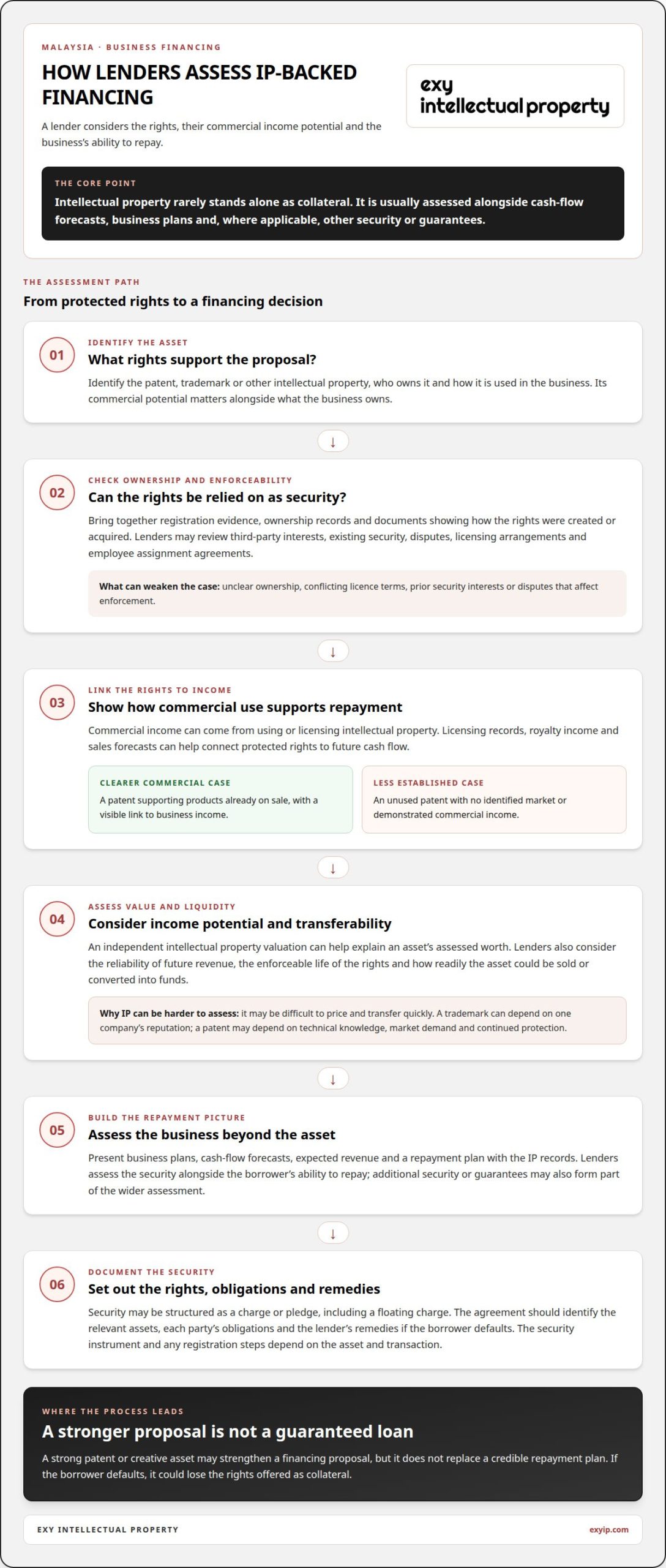
In Malaysia, leveraging IP assets for business loans can support a financing proposal, but intellectual property rarely stands alone as collateral. Lenders typically assess it alongside cash-flow forecasts, business plans and, where applicable, other security or guarantees. The financing potential depends not only on what you own, but also on its commercial income potential and the strength of your rights.
That distinction matters when a patent, trademark or other IP asset has real business value but does not fit the usual picture of loan security. Clear records of ownership and protection, together with evidence of income from commercial use, help explain how the asset supports the business and its ability to repay.
This article explains what lenders may assess, how commercial income and valuation approaches affect an IP asset’s financing potential, and why enforceable rights matter. It also compares IP-backed borrowing with other financing structures, helping you weigh the opportunity against its risks.
Key Takeaways
- Assess how your intellectual property generates or supports identifiable income, since commercial prospects shape its usefulness in a financing discussion.
- Understand why Malaysian lenders may weigh IP alongside the wider business case rather than treating it as standalone security.
- Compare income-based, market-based and other valuation approaches to see what can influence an asset’s assessed worth.
- Organize ownership records, registration evidence and details of existing rights or disputes to help demonstrate that the IP is enforceable.
- Consider how patents, trademarks and brands can support financing, while weighing the risks attached to pledging rights or assigning future income.
How can IP assets assist with securing financing?
Intellectual property can support business financing when it has clear ownership, enforceable rights and commercial potential. In Malaysia, lenders commonly assess it alongside cash-flow forecasts, business plans and, where applicable, additional security or guarantees.
Using Intellectual Property as Loan Collateral
Using intellectual property as loan collateral means offering rights, such as a patent or trademark, as security for repayment. This can provide another basis for financing while allowing the business to retain ownership, provided it meets the loan terms.
A lender will want to know who owns the rights, whether another party has an interest in them, and whether disputes could affect enforcement. Security may be structured as a charge or pledge, including a floating charge. If the borrower defaults, it could lose the rights offered as collateral.
Comparing IP-Backed and Other Financing
Conventional secured business loans typically rely on tangible assets or other security, while IP financing adds intellectual property to the assessment. Government financing schemes have their own eligibility and assessment conditions, so offering IP as collateral does not by itself establish access to a scheme.
For Malaysian businesses, IP is rarely accepted as standalone collateral. Lenders generally assess it alongside expected revenue, business plans and repayment capacity. A strong patent or creative asset may strengthen a financing proposal, but it does not replace a credible repayment plan.
Registering and Enforcing IP Security Interests
Creating an IP security interest involves documenting the rights offered and the lender’s security over them. The agreement should identify the relevant assets and set out each party’s obligations, as well as the lender’s remedies if the borrower defaults.
Due diligence matters before any pledge. Ownership records, existing security arrangements and disputes can affect whether rights are enforceable. The security instrument and any applicable registration steps depend on the asset and transaction. The arrangement should explain how the lender can enforce its rights, including the possibility that the borrower could lose the IP after default.
A loan application generally involves identifying the IP and its owner, providing records of the rights, explaining their commercial use, and presenting financial forecasts and a repayment plan. These materials help the lender assess both the security and the business’s ability to repay.
Loan Terms for IP-Backed Financing
Loan size, interest rate and repayment period depend on the assessed value of the IP, its income potential, the borrower’s cash flow and the wider security package. There is no single standard offer for every Malaysian IP-backed loan.
A valuation can help explain an asset’s worth, but does not determine the final terms on its own. Lenders also consider the reliability of future revenue, the enforceable life of the rights and the borrower’s repayment plan. Together, these factors shape the financing structure offered to the business.
Commercial income and lender assessments
In Malaysia, lenders assess whether intellectual property supports identifiable income and a credible repayment plan. For businesses using IP assets to support loan applications, evidence of commercial use connects protected rights to the cash flow available for repayment.
Commercial Income in Lender Assessments
Commercial income is revenue generated through the use or licensing of intellectual property. It matters because lenders assess whether that income can support repayments, rather than relying on the asset’s existence alone.
For example, a patent supporting products already on sale gives a lender a clearer commercial case than an unused patent with no identified market. Licensing records, royalty income and sales forecasts can show the link between protected rights and future cash flow. This connection helps lenders assess the business case alongside its financial forecasts.
Lender Reluctance and IP Liquidity
IP liquidity describes how readily an intellectual property asset can be sold or converted into funds. Unlike publicly traded shares, IP can be difficult to price and transfer quickly, which may make lenders cautious.
A trademark closely tied to one company’s reputation may have limited value to another buyer. A patent may also depend on technical knowledge, market demand and continued protection. Lenders may view IP as riskier collateral, especially if they lack internal expertise to assess it. That can affect whether they accept the rights and how much weight they give them.
Lender Due Diligence
Lender due diligence reviews ownership, protection, commercial use and barriers to enforcing the rights offered. It matters because unclear ownership or an existing pledge can weaken an asset’s value as security.
A useful application file brings together registration evidence, ownership records and documents showing how the IP was created or acquired. Lenders may also review licensing arrangements, employee assignment agreements, disputes and prior security interests. For example, conflicting licence terms could make income forecasts less reliable. A clear audit trail helps show who controls the rights and whether they can support financing.
Businesses can present business plans and cash-flow forecasts with their IP records. An independent intellectual property valuation can help explain an asset’s assessed worth during financing discussions.
Eligibility and Loan Documentation
Eligibility depends on the lender’s assessment of the borrower, the rights and the repayment case. The borrower needs to own the relevant IP and have authority to offer it as security.
Useful documents include ownership and registration records, evidence of creation, relevant licence or assignment agreements, and details of existing pledges or disputes. Include a business plan, cash-flow forecasts and information showing how the IP supports revenue. Together, these materials address both collateral quality and repayment capacity.
Risks include losing pledged rights after default, disputes that impair enforcement, and lapses in protection that reduce an asset’s usefulness. Unregistered rights can also be harder for lenders to verify. A careful plan for using IP assets for business loans weighs these risks against the proposed capital and how the business intends to use it.
Access to credit for smaller businesses
Smaller businesses may have valuable innovation before building the tangible asset base lenders often assess. A software company, for example, may own copyright and trade secrets while its competitive advantage rests on code, product knowledge and customer relationships. Intellectual property can provide another basis for seeking credit, but lenders still need a credible account of how the business will repay.
For an IP-backed proposal, connect each asset to a commercial activity. A patent might protect a product sold to customers; a trademark might identify a brand that generates repeat sales; a licence might produce royalty income. This connection shows how the rights support the business and its future cash flow. A list of registrations without commercial context tells a lender less about the business’s ability to service financing.
Smaller firms can also consider financing structures beyond a conventional loan. Royalty financing provides upfront capital in exchange for a share of future income related to intellectual property, typically royalties. It may suit a business with licensing revenue but limited conventional security. However, assigning part of future income to financing affects the funds available to the business, so account for that commitment before allocating money to product development or expansion.
Licensing offers another way to turn protected innovation into income. For example, a company could license technology to another business while retaining ownership, then use expected royalties to support its financing case. The agreement’s scope, payment terms and duration help explain how the revenue arises. Unclear terms can make income harder to assess, while a documented licence gives the lender a clearer view of the commercial relationship.
Some alternative lenders may accept intellectual property as loan collateral, broadening the potential financing options for IP-rich businesses. That does not remove the need to demonstrate ownership, commercial use and repayment capacity. A smaller firm can strengthen its proposal with IP records, sales history, licensing documents, cash-flow forecasts and a defined use for the capital, such as research and development or expansion.
Trade secrets need particular care because they are confidential information, not public registration records. A business whose competitive edge depends on a formula, process or customer data should document how it controls access and protects confidentiality. Its business plan can describe those safeguards without unnecessarily disclosing sensitive details. This helps explain the asset’s role in the business and the steps taken to protect it.
There is no universal system for IP valuation or IP-backed lending, so smaller businesses should frame a proposal around the specific asset, income model and financing structure. Intellectual property can support access to credit, but works best as part of a clear commercial case, not as a substitute for one.
IP valuation approaches
Intellectual property valuation estimates the economic worth of a right, such as a patent, trademark or copyright. For financing, it helps explain why an asset may support a borrowing proposal, but its assessed value is not automatically the amount a lender will advance. A startup’s patent, for example, may have strong technical potential but uncertain future income, making its valuation sensitive to commercial assumptions.
The income approach estimates value from income attributable to the intellectual property. A valuator may examine royalties from a licence, sales linked to a patented product, or forecast revenue from a protected brand. The assessment depends on how reliably those earnings can continue. If a business expects future licensing income, the forecast should show its commercial basis rather than rely only on projected demand.
A market approach compares the asset with similar intellectual property or transactions. A trademark with a licensing history may offer useful comparison points, while a unique patent can be harder to match. Differences in industry, territory, protection status and commercial use affect whether comparisons are meaningful. Because an asset’s value may vary between markets, the relevant market context matters to the estimate.
A cost approach considers the expenditure associated with creating or replacing an asset, such as developing software or documenting a design. That figure does not necessarily reflect what a buyer would pay or what income the asset can generate. For example, substantial development effort alone cannot establish the value of a copyright if the work has limited commercial demand.
Goodwill can also influence the value of IP, especially a trademark associated with reputation and consumer loyalty. A valuator may consider customer recognition and income linked to the brand, rather than treating registration as the entire asset. For a business with a well-known mark, evidence of repeat sales or licensing activity can help explain how reputation contributes to commercial value.
Before an assessment, clarify its purpose, the specific rights being valued and the available ownership records. A patent portfolio, for instance, should be distinguished from products or know-how that depend on it. An independent valuator can assess fair value using the asset’s income potential and relevant comparisons. This provides a reasoned basis for discussing the IP’s value with a lender.
No single method suits every asset. A software copyright may depend on licensing revenue, while a trademark may derive value from reputation and customer loyalty. For businesses including IP in a financing proposal, a strong valuation explains its assumptions, market context and the link between rights and income. Those details help lenders interpret the estimate alongside the wider business case.
Patents, trademarks, and brands as business assets
Patents, trademarks, industrial designs, copyright and certain confidential business information can form part of an IP financing proposal in Malaysia. A business may present these intangible assets alongside tangible assets, such as equipment, to explain its commercial position. Lenders assess the rights, their ownership and their connection to revenue. The asset category alone does not establish its financing value.
A patent can protect an invention that supports a product or process. For example, a manufacturer may show how a patented feature distinguishes its product and contributes to sales. The financing case should connect the patent to its business use rather than treat registration as an isolated document. The patent’s enforceable period also matters because the rights need to remain useful during the financing arrangement.
Trademarks and brands can support a different commercial case. A trademark identifies the source of goods or services, while brand value may reflect reputation and customer loyalty. A business could show how a recognized mark supports repeat purchases, licensing or expansion. These connections explain why the mark matters to the company’s operations and potential income, beyond its formal registration.
Industrial designs may matter when a product’s appearance distinguishes it in the market. Copyright can support financing discussions when original works, such as software or creative content, contribute to a product or generate licensing income. Trade secrets may also hold commercial value, but confidentiality and ownership records help explain the asset while protecting sensitive details. Each example needs evidence connecting the right to the business.
For investors and lenders, a documented IP portfolio can show that a company’s business proposition rests on identifiable rights. Keep registration evidence, ownership documents, licensing records and information about protection periods together. This helps distinguish assets owned by the business from rights held by founders, employees or others. It also gives a clearer picture of which assets support the company’s strategy.
IP as collateral is not equivalent to a building or machinery. Intellectual property can be harder to transfer or sell, and its commercial value may depend on the business that developed it. In Malaysia, lenders rarely accept it as standalone security, so businesses should present it alongside cash-flow forecasts and a clear commercial plan. The key takeaway is that patents, trademarks and other rights can strengthen a financing case when their ownership, protection and contribution to the business are documented.
To connect an IP portfolio with financing options, explore intellectual property financing for your business assets.
Exy Intellectual Property
Exy Intellectual Property helps businesses strengthen the IP records that can support financing discussions. Clear ownership and protection documents make it easier to explain which rights belong to the business and how they support its commercial activities.
Turn to the firm when a trademark, invention, industrial design or original work needs formal protection or clearer documentation. Trademark Registration, Patent Filing and Industrial Design Registration can help protect eligible business assets, while Copyright Voluntary Notification provides a way to record copyright information. These steps can help organize an IP portfolio, although lenders still assess the wider business and repayment case.
For businesses preparing to present IP assets to lenders, strengthening the underlying rights is a practical place to start. Contact Exy Intellectual Property to discuss your intellectual property needs.
Prepare your next financing conversation
Before approaching a lender, decide what role your intellectual property should play in your business’s growth plans. Consider which rights support the products, services or income streams you want to develop, and how clearly you can explain that connection. A focused financing proposal gives the discussion practical direction, whether your priority is expansion, product development or a new commercial partnership.
This preparation can also reveal where your IP position needs attention. You may need clearer ownership records, stronger protection or a more defined commercial plan before presenting an asset as part of your financing case. Treat these decisions as part of your wider business strategy, not simply as paperwork for a loan application.
For guidance on leveraging IP assets for business loans, speak with a specialist who can help align your rights with your commercial objectives. Contact Exy Intellectual Property to discuss a considered next step for your business.
Frequently Asked Questions
Can You Bank on Your IP?
Yes, intellectual property can support a business financing proposal in Malaysia, but it is rarely sufficient on its own. A lender will consider how the rights contribute to the business, whether ownership is clear, and how repayment will be supported. For example, a company with a trademark and ongoing licensing income can explain both the asset and its commercial role. The lender will still assess the wider business position.
What Is IP Financing?
IP financing uses intellectual property, or income generated from it, to help obtain capital. A business might offer a patent as security or arrange financing linked to royalty income from a licence. The structure matters: pledging rights can put them at risk if the borrower defaults, while assigning a share of future royalties affects the income available to the business.
Which Malaysian banks or lenders offer IP-backed business loans?
IP-backed lending is not widespread among Malaysian banks, and there is no standard list of lenders that routinely accept intellectual property as standalone collateral. Some lenders may consider IP as part of a broader financing package, assessing cash flow, business plans and other security alongside it. Frame a proposal around the asset’s commercial role and the repayment case rather than relying on the rights alone.
How do Malaysian lenders value patents, trademarks, copyrights, and other IP assets?
Valuation depends on the asset and the evidence supporting its commercial worth. For a patent, an assessment may consider income attributable to products using the invention; for a trademark, reputation and customer loyalty can inform its goodwill. Copyright may be assessed through related licensing or commercial income. Comparisons with similar IP can also help, but differing markets and uncertain future earnings affect how useful they are.
What loan amounts, interest rates, fees, and repayment terms are available for IP-backed loans in Malaysia?
Loan size, interest rate and repayment period depend on the IP’s assessed value and income potential, the borrower’s cash flow and the wider security package.