


An IP valuation is an informed estimate, not a guarantee of what a buyer will pay. Knowing how to value intellectual property for sale means considering the resources needed to recreate it, the economic benefits it may generate and evidence from comparable transactions. The eventual transaction reflects negotiations between the buyer and seller.
A single figure may seem like a straightforward way to express what a trademark, patent, copyright or other IP asset is worth. In practice, the estimate depends on the rights it protects, its contribution to the business, its potential to generate future income and whether comparable deals provide a useful benchmark.
This article explains how the cost, income and market methods work, when each may be useful and why an estimated value can differ from the eventual transaction outcome. It also outlines the information that helps make an assessment relevant to a Malaysian business, so you can approach a sale with a clearer view of the asset and the commercial factors behind its value.
Key Takeaways
- Separate an IP valuation from the agreed transaction terms: an estimate informs negotiations, while the parties agree on the terms.
- Choose a method that fits the asset: the income approach considers expected economic benefits, and the market approach considers comparable transactions.
- Assess how the IP contributes to revenue or improves operational efficiency, alongside its legal strength, market potential, competition and useful economic life.
- Treat comparable deals carefully because transaction details may be confidential and differences in rights, territory and deal terms can affect comparisons.
- Use the valuation to support a clearer sale strategy, while recognising that the method and assumptions shape the estimate.
Difference between IP value and transaction price
An intellectual property valuation estimates an asset’s economic worth for a defined purpose and set of assumptions. The transaction price is the amount the buyer and seller agree on when rights are sold or transferred. A valuation can inform negotiation, but it does not determine the final terms.
For example, a Malaysian business might value a trademark based on its contribution to product sales, customer recognition and licensing potential. A buyer may assess those benefits differently, taking competitors, market demand and the rights included in the deal into account. Negotiation brings these different assessments together in agreed terms.
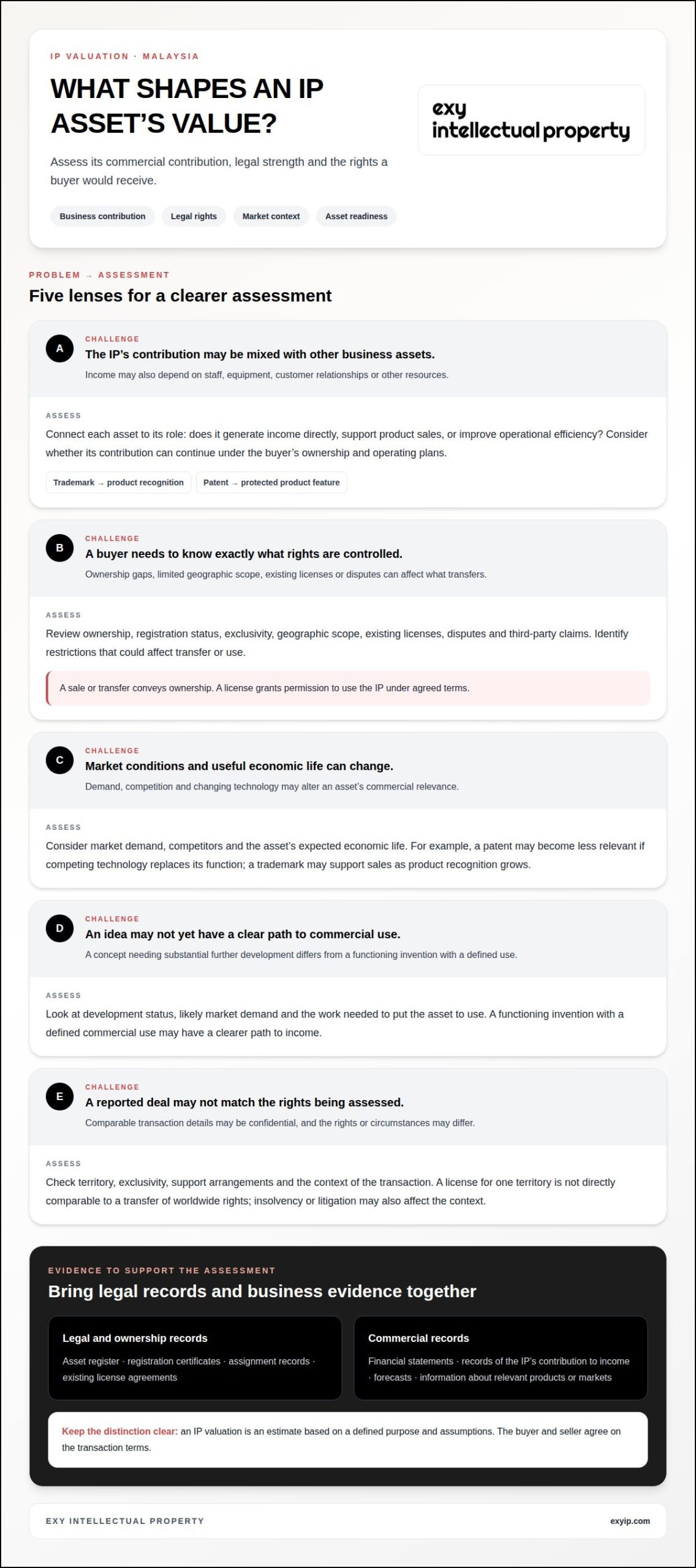
The distinction matters in an acquisition, where the buyer may acquire an entire business rather than a single IP asset. A trademark, patent or copyright may support income alongside staff, equipment and customer relationships. Before valuing it separately, determine whether its income stream can be distinguished from those other business assets.
A sale or transfer can convey ownership of an IP right, while a license grants permission to use it under agreed terms. A business might transfer a patent outright or retain ownership while licensing its use in a specific market. The structure determines what the buyer receives and which future income, if any, remains with the seller.
In Malaysia, an agreement should state whether ownership is transferred or use is licensed, and specify the rights covered. Assess tax treatment in light of the actual transaction and applicable Malaysian tax rules. The distinction between an assignment and a license is relevant to both the contract and the transaction’s financial analysis.
Comparable transactions can help test a valuation, but useful evidence may be difficult to find. Details of IP deals are often limited because parties keep their terms confidential. A reported sale may not disclose the asset’s territory, exclusivity, payment structure or support arrangements.
These differences matter. A license covering one territory is not directly comparable to a transfer of worldwide rights. A transaction connected with insolvency or litigation may also reflect circumstances unlike a negotiated business sale. Adjust comparisons for the rights and context involved rather than treating a reported figure as a direct benchmark.
For an IP valuation, assemble an asset register, registration certificates, assignment records and existing license agreements. Add financial statements, records showing the IP’s contribution to income, forecasts and information about relevant products or markets. Together, these documents link the legal asset to its commercial role.
Due diligence should examine ownership, registration status, geographic scope, existing licenses, disputes and third-party claims. Buyers and sellers should also identify restrictions that could affect transfer or use. A gap in the ownership chain, for example, may make it harder for a buyer to obtain the rights expected.
A clear valuation distinguishes the asset’s estimated worth from the negotiated terms. It gives both parties a structured basis for discussing rights, future income and commercial advantage, without assuming that one estimate determines the outcome.
How is intellectual property valued when selling a business?
Valuing IP in a business sale means assessing its legal strength and commercial contribution alongside other assets. The estimate should explain what the rights protect, how they support the business and what benefits a buyer may expect.
Factors Influencing IP Value
An IP asset’s value reflects how it supports income, protects a commercial advantage or helps distinguish a business in its market. A trademark may contribute by identifying products, while a patent’s value depends partly on its technical scope and practical use. These factors help investors understand the asset’s contribution beyond equipment, staff and other business resources.
Legal strength also affects the assessment. Clear ownership, meaningful exclusivity and relevant geographic scope can shape what a buyer can control after acquisition. When considering how to value intellectual property for sale, assess legal risks, the asset’s expected lifespan and whether its commercial contribution can be separated from other operations.
Factors That Change IP Value
Market demand, competition and changes in an asset’s expected economic life can alter its estimated value. A trademark may support stronger sales as a product gains recognition, while a patent may become less commercially relevant if competing technology replaces its function. These developments affect the assumptions used to value IP during a business sale.
Development status matters as well. A functioning invention with a defined commercial use may have a clearer path to income than a concept requiring substantial further development. Valuing intellectual property for sale therefore involves considering readiness, likely market demand and the work needed to put the asset to use.
Start by connecting each IP asset to its role in the business. A trademark might help maintain customer demand, while a patent could protect a feature that distinguishes a product from competitors. Assess the income attributable to the rights and whether that contribution could continue under the buyer’s ownership and operating plans.
Useful questions include:
- Does the asset generate income directly or support sales of another product?
- Can it function independently, or does it rely on other business assets?
- How do its legal strength, exclusivity and geographic scope affect its use?
- What market conditions, competition or expected lifespan could change future benefits?
These questions connect the valuation to the transaction. A patent supporting one product may serve a different role from a trademark used across several product lines. The buyer’s intended use can also shape expected benefits, so the valuation should state its assumptions rather than treat the asset as having one universal worth.
Different methods can help test the estimate. An income approach suits rights with identifiable actual or projected revenue, while a market approach relies on comparable transactions. The asset’s development stage and commercial use help determine which approach is most relevant.
For sellers, a clear account of IP assets can explain their contribution to business performance. For buyers, it can show which rights may support income or strengthen market position. This context helps both parties assess the IP as part of the wider business.
Cost method
The cost method estimates an IP asset’s value based on the resources used to create or protect it. It can help when a Malaysian business needs to value an early-stage asset or one without useful comparable transactions. The method offers a structured starting point, but does not capture every source of commercial value.
For a patent, the assessment may consider the research, materials and specialist work involved in creating the invention. For a trademark, it may examine the work involved in developing the sign and related materials. The valuation basis matters: the resources used to create an asset may differ from those used to protect it.
To apply the method, identify the asset and define what is included in the valuation. Then gather records of development activity and the resources used to create or protect it. Separate relevant work from unrelated business activity. This creates a traceable basis for assessing the asset.
For example, a company developing a software tool might review design records, development documentation and work by external specialists. The assessment should distinguish the effort that produced the IP from ordinary operating activity. Time spent on unsuccessful versions does not necessarily add value to the asset that exists today.
The cost method’s main limitation is that it focuses on inputs rather than economic results. It does not account for future profits or directly reflect current market demand. A product may have required extensive development but attract little interest. Conversely, a modestly developed asset may support strong income because customers value its commercial role.
For that reason, use the method as one perspective, not as a substitute for examining cash flow or market evidence. It can help establish a baseline when an asset has limited commercial history. For a functioning product with identifiable income, an income-based approach may better reflect expected economic benefits. Valuing an asset for sale may therefore involve comparing its cost basis with its commercial prospects.
In Malaysia, the scope and timing of a valuation depend on factors such as the asset type, number of rights, available records and analysis required. The work is easier to structure when development documents, ownership records and financial information are organised by asset. These materials help link the resources used to create the IP with its present condition.
The method also requires clarity about what is being valued. A patent may depend on technical documentation, while a trademark may rely on evidence of its use in the business. If an asset cannot be separated from other business operations, the estimate may not represent its standalone value.
Use the cost method when the resources used to create or protect an asset offer a meaningful reference point. Then test whether that reference reflects the asset’s current function, legal position and ability to contribute to the business. This grounds the estimate in development inputs without treating past investment as proof of future value.
Future economic benefits of IP
The income method values intellectual property by estimating the economic benefits it can generate and expressing expected income in present-day terms. It suits assets with identifiable revenue streams, such as a patent supporting product sales or a trademark generating licensing income.
The central task is to connect income to the specific IP right. A product may also depend on tangible assets, staff, distribution and other intangible assets. The valuation separates the IP’s contribution from those supporting resources. For example, if a patented feature helps distinguish a product, the analysis considers income linked to that feature rather than attributing every product sale to the patent.
Expected benefits may arise through several routes:
- Product income: IP rights incorporated into a product may support sales or protect its market position.
- Royalty income: A business may license its rights, receiving payments from another party’s use.
- Reduced outgoings: Owning a trademark or patent may avoid payments that would otherwise be required to use equivalent rights.
- Commercial protection: An exclusive right may help reduce competition from substitutes or limit competitors’ access.
For example, a Malaysian company could grant another business permission to use a trademark in an agreed territory. The valuation would consider expected royalty income, the rights granted and the agreement’s commercial limits. Licensing the same IP rights in different regions may create separate income streams, provided each use is supported by the rights and agreements.
Forecasts need a defined period. The IP’s useful economic life, expected market demand and strength of legal protection affect how long income may continue. A patent tied to a product affected by changing technology may have a different outlook from a trademark supporting an established product line. Competition and economic conditions also affect the forecast.
Future income is uncertain, so the income method accounts for risk and financial factors when estimating present value. A valuation should make its assumptions clear, including projected sales or royalties, related income-generating expenses and the asset’s expected life. Changing an assumption can change the estimated value, which makes the reasoning as important as the final figure.
An income-based IP valuation is most useful when the asset’s contribution can be identified and supported by business information. If a right plays no role in creating, maintaining or increasing cash flow, it may have little financial value to that business. The assessment should distinguish current performance from projected benefits, then test whether those benefits depend on the IP itself or on other business assets.
This approach helps a seller explain how IP supports future income and helps a buyer assess the basis for that projection. It does not make a forecast certain. Instead, it provides a structured estimate grounded in the asset’s economic role, legal scope and expected commercial life.
Market comparisons and comparable IP transactions
The market method estimates an intangible asset’s value by comparing it with similar IP transferred in comparable circumstances. It uses evidence from sales or licensing transactions as a benchmark. The comparison is useful only when the rights, commercial setting and deal terms are sufficiently alike.
Relevant evidence can be difficult to find. Parties often keep transaction details confidential, and public announcements may identify an asset without explaining the agreement. A headline about a trademark acquisition, for example, may omit the territory, exclusivity, payment structure and support included in the deal.
Start by defining the asset and transaction being assessed. A trademark used for one product line may not be comparable to a brand covering several markets. A patent’s technical scope, remaining useful life and commercial application also affect whether another patent offers a meaningful comparison. The closer the rights and uses, the more informative the benchmark.
Next, examine what the comparable transaction actually transferred. A sale of ownership differs from a license granting limited use. A deal may also include technical support, other IP assets or rights in several territories. These features can influence the transaction terms, so an apparent match may need careful adjustment before it informs a valuation.
Context matters too. Transactions connected with insolvency or litigation may reflect pressures absent from a planned business sale. A buyer comparing such a deal with a voluntary transfer should account for the different circumstances. Economic conditions and market demand at the time of the transaction can also affect how well it represents present value.
A patent can be especially difficult to value through market comparisons because its novelty may leave few close equivalents. For instance, a patent for a specialised manufacturing process may have no recent transfer with the same technical scope and commercial use. Broader transactions may provide context, but they are not direct substitutes.
A practical comparison can be organised around these questions:
- Do the transactions concern the same type of IP, such as a patent or trademark?
- Are the rights similar in territory, exclusivity and duration?
- Did the deal transfer ownership, or grant licensing rights?
- Did it include support, related assets or unusual commercial conditions?
- Did the parties transact in comparable market and economic conditions?
For example, a Malaysian seller assessing a trademark might compare licensing deals involving similar goods and territories. If one transaction granted exclusive rights while another allowed several licensees, their terms should not be treated as equivalent. The differences show why transaction evidence supports judgment rather than providing an automatic answer.
Use comparable transactions to test an estimate, not to copy a reported result. For an assessment of a patent, trademark or other IP asset, request an intellectual property valuation that considers the rights and transaction context.
Exy Intellectual Property
Exy Intellectual Property helps Malaysian businesses clarify and protect the rights behind their intellectual property assets. For a potential sale, knowing which rights are registered, filed or documented can provide a clearer picture of what may be transferred or licensed.
Its services include Trademark Registration, Patent Filing, Industrial Design Registration and Copyright Voluntary Notification. These services address protection and documentation needs for trademarks, inventions, product designs and creative works. The right next step depends on the type of IP and its current position, so consider these services when strengthening the groundwork around an asset before commercial discussions.
For support with intellectual property protection in Malaysia, contact Exy Intellectual Property.
Put Your IP Position to Work
Connect your valuation to the decision ahead. Before entering sale discussions, define what you want the transaction to achieve: a full transfer, continued use through a licence or a clearer basis for considering offers. That commercial objective can guide how you present the asset and assess proposed terms.
A practical approach to how to value intellectual property for sale starts with a clearly defined asset and a clear account of its role in the business. If protection or documentation needs attention, Exy Intellectual Property provides Trademark Registration, Patent Filing and Industrial Design Registration. These services can help address the rights connected with the assets under consideration.
For support with your intellectual property priorities, contact Exy Intellectual Property. A considered next step can help you move into negotiations with a clearer commercial position.
Frequently Asked Questions
How do I measure my IP’s value?
Start by defining the asset and the purpose of the estimate. A valuation for a proposed sale may need a different scope from one prepared for financing or a licensing discussion. Separate the IP from other business assets, then identify how it contributes to products, services or operating income. Available financial records, legal documents and market evidence help determine which valuation approach fits that purpose.
What may cause the value of IP to spike or drop?
An asset’s value may rise when it gains commercial use, attracts licensing interest or strengthens a product’s position against substitutes. It may fall if legal challenges weaken the rights, competing technology reduces demand or the asset approaches the end of its useful economic life. For example, a patent’s prospects may change if a new development makes its protected feature less relevant to customers.
What other business processes may rely on the IP valuation process?
An IP valuation can inform licensing negotiations, financing decisions and the allocation of value during a merger or acquisition. In a joint venture, it can help clarify each party’s contribution. Businesses may also use valuation work in tax filings or disputes involving alleged infringement. The purpose shapes the assumptions: a financing assessment, for example, considers whether the asset can support the proposed arrangement.
Why conduct an IP valuation?
Conduct an IP valuation when a business decision depends on understanding an asset’s contribution or negotiating position. A seller can use it to support discussions about an asset transfer; a licensor can use it to evaluate proposed royalties. It can also help management identify which rights support products and future plans. A valuation is most useful when its purpose and assumptions are clear.
Why should I value my IP assets?
Valuing IP assets can help a business understand what underpins its products, brand and commercial plans. For example, an asset review may reveal that a product depends on a patent, a trademark and licensed material together. Understanding these connections can inform portfolio management, investor discussions and decisions about further development. It also helps distinguish registered rights from other business resources.
What methods are used to value intellectual property for sale?
Common approaches include income and market methods, with the choice guided by the asset and available evidence. Other techniques include relief-from-royalty, excess profits, capitalised earnings and real-options analysis. A relief-from-royalty approach estimates the payments avoided by owning the right. A specialist may combine or compare methods when no single approach reflects the asset’s commercial position.
How do you value a patent using the income and market approaches?
For the income approach, estimate future benefits attributable to the patent and account for relevant risks and financial factors. The market approach looks for transfers of patents with comparable technical scope and deal conditions, though close comparisons can be scarce. Patent novelty, development stage and commercial use shape the analysis.
How do you value a trademark or brand for sale?
Assess the trademark’s legal scope and its role in generating or supporting business income. An income analysis may estimate royalties a business would otherwise pay to use the mark. Market evidence can provide context if similar trademark transactions exist. Brand recognition alone does not establish value; the assessment should connect the mark to its rights, use and commercial contribution.