


An NDA should protect sensitive information without bringing a business discussion to a halt. An NDA can set out what information is confidential and how the receiving party may use or disclose it. In Malaysia, NDAs must comply with the Contracts Act 1950.
It’s sensible to focus on what must stay confidential, but the agreement also needs to account for people who may need access to move the discussion forward. Professional advisers, for example, may be permitted to receive information if the NDA sets clear conditions for that disclosure.
This guide explains what a non-disclosure agreement for a Malaysian business can protect, how it limits the use of information, who may receive disclosures, and what a breach may lead to. It also covers exclusions, duration, security, return or destruction of information, and the consequences of unauthorised use or disclosure.
Key Takeaways
- Define confidential information clearly across written, oral and electronic disclosures, and identify the exclusions that apply.
- Set a specific business purpose for using shared information, with clear limits on onward disclosure.
- Allow professional advisers access only under confidentiality conditions that protect the information.
- Clarify how long confidentiality duties last and what happens to information when discussions end.
- Keep records of disclosures; clear evidence can matter when responding to suspected misuse or unauthorised sharing.
Defining confidential information
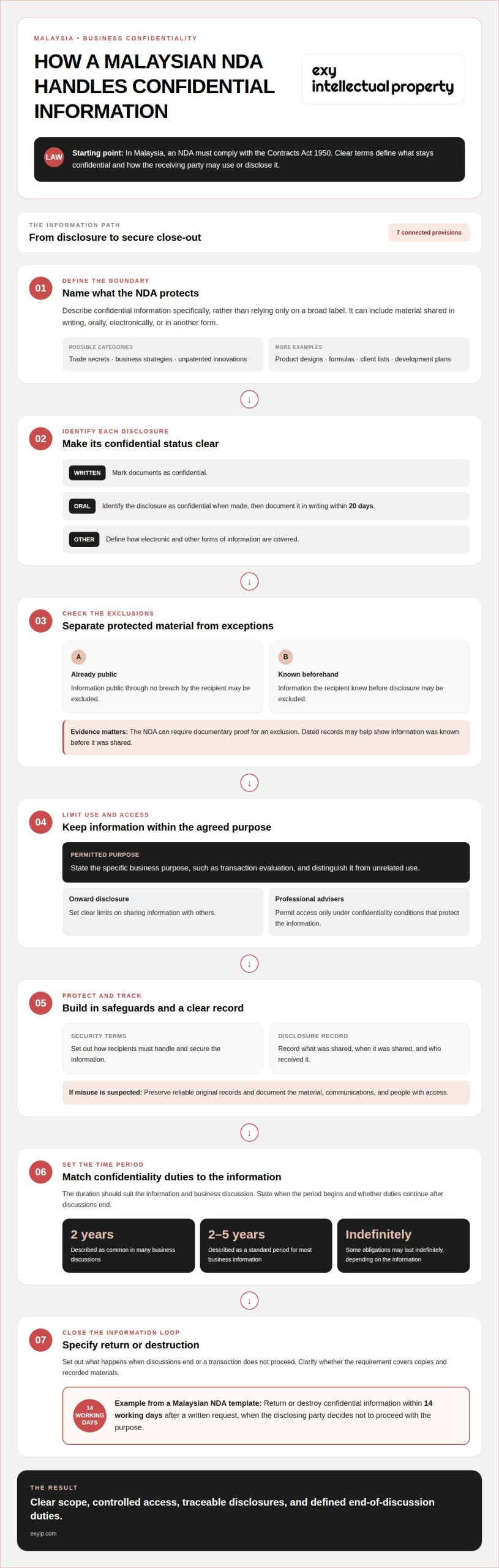
For a Malaysian business, an NDA should define the information it protects and how the parties may handle it. Include terms on scope, exclusions, permitted use, recipients, security, duration, and return or destruction. Clear provisions help both parties understand their confidentiality duties during business discussions.
Scope of Protected Information
Confidential information is business material that the NDA identifies as protected, whether shared in writing, orally, electronically, or in another form. A specific definition helps both parties recognise which disclosures carry confidentiality duties. It may cover trade secrets, business strategies, unpatented innovations, product designs, formulas, client lists, pricing structures, and development plans. Naming relevant categories is more useful than relying only on a broad label.
Set out how each format is identified. For example, documents can be marked confidential, while an oral disclosure can be identified as confidential when made and documented in writing within twenty (20) days. This gives the parties a record of what was shared and its status. The NDA should also state the permitted purpose, so recipients can distinguish transaction evaluation from unrelated use.
Mergers and acquisitions create particular information risks because potential buyers may receive detailed financial, customer, or development material. In a professionally managed M&A process, detailed information is shared only after an NDA is signed. A defined scope helps the parties identify which materials may be included in due diligence and which fall outside the transaction discussion.
Exclusions from Confidentiality Obligations
Exclusions identify information that is not covered by the NDA’s confidentiality duties. Common examples include material that is already public through no breach by the recipient, and information the recipient knew before disclosure. These exceptions prevent the agreement from claiming control over information that was independently available. Clear wording also helps the parties assess whether a particular item is protected.
The agreement can require the recipient to provide documentary evidence when relying on an exclusion. Dated records, for example, may help show that information was known before the disclosing party provided it. The NDA should distinguish such evidence from material obtained through an unauthorised disclosure. A defined process gives both parties a clearer basis for resolving disputes about an exclusion.
The duration should suit the type of information and the business discussion. Two years is common in many business discussions, while two to five years is described as a standard period for most business information. Some obligations may last indefinitely, depending on the information. Specify when the period begins and whether duties continue after discussions end. A defined term helps parties plan access, retention, and future use.
Return or destruction terms address what happens when a transaction does not proceed. One Malaysian NDA template requires the recipient to return or destroy confidential information within fourteen (14) working days after a written request, when the disclosing party decides not to proceed with the purpose. Specify whether the requirement covers copies and recorded materials. This gives parties a clear closing step for confidential files after discussions stop.
Consequences of NDA breaches
A Malaysian business can enforce an NDA through court action, including in the High Court of Malaya. To establish a breach, it must show that the information was confidential, disclosed in confidence, and used or disclosed without authorisation.
Responding to a Breach
A prompt response starts with preserving reliable evidence and identifying how information left the agreed safeguards. Record the disclosure, the material involved, relevant communications, and who had access. An email showing an unauthorised onward disclosure, for example, may help establish the sequence of events. Avoid altering original records, as their integrity may matter in later proceedings.
Notify the relevant parties in writing and document the suspected misuse. A Malaysian NDA template requires the receiving party to notify the disclosing party immediately in writing after learning of a loss of confidentiality, unauthorised disclosure, misappropriation, or misuse. The contract’s reporting clause can guide the response and help limit further access.
Remedies for Breach
Remedies are legal measures that may address unauthorised use or disclosure and its effects. An NDA may allow the disclosing party to seek injunctive relief, to the extent permitted by Malaysian law, without giving up other remedies. An injunction may be relevant if continued disclosure could spread sensitive material, such as a product design shared beyond the agreed transaction team.
Financial damages may not fully address harm that is difficult to measure, such as lost commercial advantage from exposed development plans. The outcome depends on the evidence, contract terms, and loss shown. The agreement should not imply that a stated remedy is automatic. It sets out potential consequences, while a court determines relief in a dispute.
Enforcing an NDA and Proving a Breach
Enforcement depends on linking the NDA’s obligations to the information and the alleged conduct. The business must establish that the information was confidential, disclosed in confidence, and used or disclosed without authorisation. A signed agreement, a marked document, and records identifying its recipients can help support that account.
Keep a disclosure record identifying what was shared, when it was shared, and with whom. Compare those records with evidence of the suspected use, such as a later disclosure to an unauthorised recipient. The contract should clearly identify the parties and permitted purpose. These details help distinguish a breach from lawful access or an applicable exclusion.
If the evidence supports a claim, the innocent party may initiate court action, including in the High Court of Malaya. Act swiftly to preserve records and establish who was responsible. Legal counsel can help assess whether to seek an injunction or another equitable remedy, particularly where continued use could cause harm that monetary damages may not fully compensate.
Meaning and purpose of NDAs in Malaysia
An NDA is a contract that protects specified information shared between parties during business discussions. In Malaysia, its purpose and limits should reflect the relationship, whether it involves employees, suppliers, contractors, or business partners.
Purpose of NDAs in Business
A non-disclosure agreement sets confidentiality duties for information shared for a defined business purpose. Malaysian businesses use NDAs during proposals, consultancy work, product development, employment, and partnership discussions. For example, a company presenting an unpatented innovation can restrict the recipient from using its details beyond the evaluation. NDAs help preserve competitive information while parties consider whether to work together.
Employees, contractors, suppliers, and business partners can be bound by a valid agreement covering their relationship and the information involved. The contract should clearly identify the parties, protected information, permitted purpose, and obligations.
Unilateral and Mutual Agreements
A unilateral NDA places confidentiality duties on the recipient, while a mutual NDA places duties on each party when both disclose information. An employer sharing internal plans with an employee may use a unilateral structure. A mutual NDA may suit a collaboration in which both businesses reveal commercial information. Choosing a form that matches each party’s role helps avoid gaps or unnecessary obligations.
Employee NDAs and Restraint of Trade
An employee NDA protects confidential material received through employment, but it should not operate as an overbroad restriction on future work. Malaysian NDA terms in employment contracts must comply with the Employment Act 1955. Section 28 of the Contracts Act 1950 may render overly restrictive employment clauses void as restraints of trade. Perpetual confidentiality duties may also be refused by Malaysian courts when they effectively restrain trade.
Define the protected business information and its permitted use rather than restricting an employee from working in a field. This distinction separates confidentiality duties from a broad restriction on competition.
Malaysian Laws Relevant to NDAs
The Contracts Act 1950 is a key legal framework for Malaysian NDAs. Enforceability depends on offer, acceptance, consideration, intention to create legal relations, and certainty of terms. Overly broad or unfair provisions can create enforceability risks, especially when employment clauses function as restraints of trade. A template may offer a starting structure, but parties should tailor its terms to their information and transaction.
To prepare and manage an NDA, identify the parties and purpose, define the duties, and sign before sharing sensitive material. Store the signed agreement with records showing who received disclosures. The contract’s scope, intended use, and recipient obligations should reflect the actual business relationship.
Limiting information use to transaction evaluation
An NDA should tie access to confidential information to a defined transaction purpose. For a Malaysian business considering a joint venture, that purpose might be assessing commercial viability, not copying a proposed product or independently approaching customers. Clear limits let the parties exchange information while separating evaluation from implementation or other business activity.
Define the purpose in practical terms. “Assessing a proposed acquisition” is clearer than “business discussions” because it identifies what the receiving party may do. The NDA template’s approach is that confidential information may be used only for the stated purpose and must be kept secure against unauthorised third-party access. A specific purpose helps show whether a later use falls within the agreed scope.
For a potential sale, detailed information should be shared only after an NDA is signed. A seller might then provide financial, customer, or development material for a prospective buyer’s evaluation. The agreement can distinguish reviewing those records from using customer details to compete or contacting staff outside the process. This keeps disclosure tied to the transaction under consideration.
Written consent creates a clear boundary for other uses. Under a sample Malaysian NDA, recipients may not use or disclose confidential information without the disclosing party’s prior written consent, except as anticipated between the parties. For example, a potential investor who wants to use a disclosed product design in another project cannot rely on the original evaluation purpose to authorise that use. Written permission can document any agreed change.
Access should also match the purpose. A recipient may need to involve employees or advisers to assess a transaction, but unnecessary circulation increases exposure. The NDA can identify who may receive information and require those recipients to follow confidentiality obligations. In a proposed acquisition, for instance, a finance team may need relevant financial records, while unrelated teams have no role in the evaluation.
Set out how the recipient must protect materials during the review. The Malaysian NDA template requires confidential information to be secured against unauthorised access. In practice, the parties can specify approved storage locations and whether people with system access, such as IT support staff, may encounter the information. Clear handling terms address access risks without expanding the permitted purpose.
Evaluation may generate new materials, such as comparison tables, forecasts, or board presentations that reflect the information received. The NDA can clarify whether these analyses are confidential and restrict their use to assessing the proposed transaction. For example, a buyer’s internal comparison of a target’s product plans should not become a roadmap for an unrelated launch. Defining this boundary keeps evaluation work within the agreed purpose.
Permitted disclosure to professional advisers
Professional advisers may need access to proprietary information to help assess a transaction. An NDA can permit disclosure to advisers who need the material, while requiring them to be bound by confidentiality obligations.
In a merger or acquisition, advisers may help prepare an Information Memorandum before formal due diligence begins. A financial adviser might need business figures, while a lawyer may review contracts. The NDA should link each disclosure to the transaction purpose. This lets the business share valuable details for analysis without treating adviser access as permission for unrelated use.
Define permitted advisers clearly. The agreement can name categories such as legal, financial, or technical advisers, then require each recipient to keep the information confidential. It may also make the receiving party responsible for breaches by permitted recipients. This helps avoid an unclear chain of access in which the business cannot identify who received a document or what confidentiality duty applied.
Use a need-to-know approach. A technical adviser evaluating a product, for example, may need design documents but not customer pricing files. A transaction team can receive materials relevant to its task rather than every file in a data room. Limiting access by role reduces unnecessary exposure and makes disclosures easier to track.
Set practical handling rules alongside the permission. The NDA can specify where advisers may store confidential material and whether support personnel with system access may encounter it. If an adviser uses an electronic workspace, the parties can define approved access and copying conditions. Clear terms matter because otherwise a recipient may share information more widely than the transaction requires.
Permission to disclose does not transfer ownership or grant rights to the information. A sample Malaysian NDA states that disclosure does not give the recipient rights or a license to confidential information. For instance, an adviser reviewing a trademark portfolio cannot treat access as permission to use the marks. Keep the purpose, adviser access, and limits on use distinct in the agreement.
Before sharing, identify the adviser, the task, and the information needed. Record what was disclosed and to whom, then apply the same access limits when documents move between the business and its advisers. If a transaction ends, align adviser access with the NDA’s return or destruction terms. These steps create a practical record of permitted disclosures.
Plan controlled information sharing before advisers receive proprietary transaction materials.
Exy Intellectual Property: Licensing Agreements
Exy Intellectual Property can help when confidential discussions lead to a decision to license intellectual property. An NDA controls how information is used during evaluation, but does not itself grant permission to use the protected material. A licensing agreement can set out the permission and terms for commercial use, giving both parties a clearer framework for moving from discussions to an arrangement.
This is a relevant next step when a business has assessed a proposed collaboration and is ready to define how a trademark, patent, or industrial design may be used. Exy Intellectual Property also provides trademark registration, patent filing, and industrial design registration where those protections suit the business need.
For guidance on a licensing agreement, contact Exy Intellectual Property.
Shape the next stage of your business relationship
A non-disclosure agreement for a Malaysian business can support early discussions, while the next stage may call for a broader plan for managing intellectual property. Consider how information shared during negotiations connects to future business decisions, including who may use it and under what terms. Aligning these decisions can help the parties move from discussion toward a clear commercial direction.
Exy Intellectual Property can help businesses consider how intellectual property fits their plans as opportunities develop. The right next step depends on the intended use and the needs of the relationship.
If you’re ready to discuss your plans, contact Exy Intellectual Property. Move forward with clarity and confidence.
Frequently Asked Questions
What is Non Disclosure Agreement in Malaysia?
In Malaysia, the written terms determine how an NDA applies to the parties’ dealings. It may be a standalone document or a clause within a broader contract, such as a service agreement. Some Malaysian NDA templates specify Malaysian law and the jurisdiction of Malaysian courts. Check that the chosen document identifies the correct parties and fits the transaction rather than relying on its title alone.
What Is a Confidentiality Agreement?
A confidentiality agreement is a common label for an agreement that sets confidentiality duties. Its title alone does not show what information or conduct the parties have agreed to cover. For example, a supplier contract may include a confidentiality clause, while a separate document may address a proposed collaboration. Read the operative terms to understand who is bound and which activities the agreement covers.
What Should You Do If Your NDA Has Been Breached?
Start by preserving material that may show what happened, such as relevant messages, access records, and copies of disclosed files. Make a timeline linking each disclosure to its recipients and any suspected unauthorised use. If the receiving party learns of a loss of confidentiality, a Malaysian NDA template calls for immediate written notice to the disclosing party. Prompt record-keeping can help clarify the issue.
What is an NDA?
NDA stands for non-disclosure agreement. Its practical role is to set contractual rules for handling specified information, not to require the parties to complete a proposed deal. A Malaysian NDA template states that signing does not oblige either party to proceed with the transaction. This lets businesses assess an opportunity while keeping the decision to continue separate from their confidentiality commitments.
What is a non-disclosure agreement (NDA) in Malaysia, and when should a business use one?
A Malaysian business can put an NDA in place before providing sensitive material for a proposal, collaboration, or transaction assessment. Signing first records the terms that apply before the recipient sees the information. For a developing discussion, the agreement can also state that neither party is required to complete the transaction. This separates permission to assess an opportunity from any later decision to proceed.
What Malaysian laws govern confidentiality and NDAs, including the Contracts Act 1950 and trade secret protections?
The Contracts Act 1950 is a key framework for contracts, including NDAs, in Malaysia. If the information includes personal data, the NDA should also address applicable obligations under the Personal Data Protection Act 2010. A confidentiality clause does not replace attention to those requirements. The agreement’s wording should fit the information being shared and the parties’ relationship, including employment or a commercial transaction.
Should a Malaysian business use a unilateral or mutual NDA, and how do they differ?
Choose the structure by mapping who expects to disclose information during the relationship. A one-way disclosure may call for duties focused on the recipient; a collaboration involving disclosures from both sides calls for terms covering each party’s information. For example, if discussions change and both businesses begin sharing material, the agreement should reflect that exchange rather than leave one party’s disclosures unprotected.
How should an NDA define confidential information, exclusions, and permitted disclosures?
Use practical categories and procedures that make the terms workable for the people exchanging information. The NDA can explain how documents are marked, how oral disclosures are identified and recorded, and which adviser roles may receive access. It can also require documentary evidence when a recipient relies on an exclusion. These details help the parties trace a disclosure and assess whether the stated conditions were followed.