

A strong idea alone isn’t protected by copyright; its original expression is. In Malaysia, copyright for authors and writers applies to eligible works once they are recorded or written in material form, without requiring registration. A plot concept, method or procedure on its own is not protected.
That distinction can feel less straightforward in practice. You may have a manuscript, article, poem or other creative work and want to know what rights apply, how long protection lasts and whether documenting ownership could help if a dispute arises. This guide explains the core rules under Malaysia’s Copyright Act 1987 in clear, practical terms.
This guide explains which written and creative works may qualify, how automatic protection differs from voluntary notification, and when notification may help support evidence of ownership. Examples show where copyright protects a writer’s expression, where it does not protect an underlying idea, and what to consider before taking the next step.
Key Takeaways
- Distinguish a protectable written or creative work from an idea, method or procedure, which copyright does not protect on its own.
- Understand how copyright can arise automatically when an eligible original work is fixed in material form, without registration.
- Learn how protection periods vary by work type, and what determines the term for an author’s work.
- Consider whether voluntary notification and ownership records could help support evidence if a dispute arises.
- Find out whether notification needs renewal and what its territorial limits mean for your work.
What can be protected by copyright?
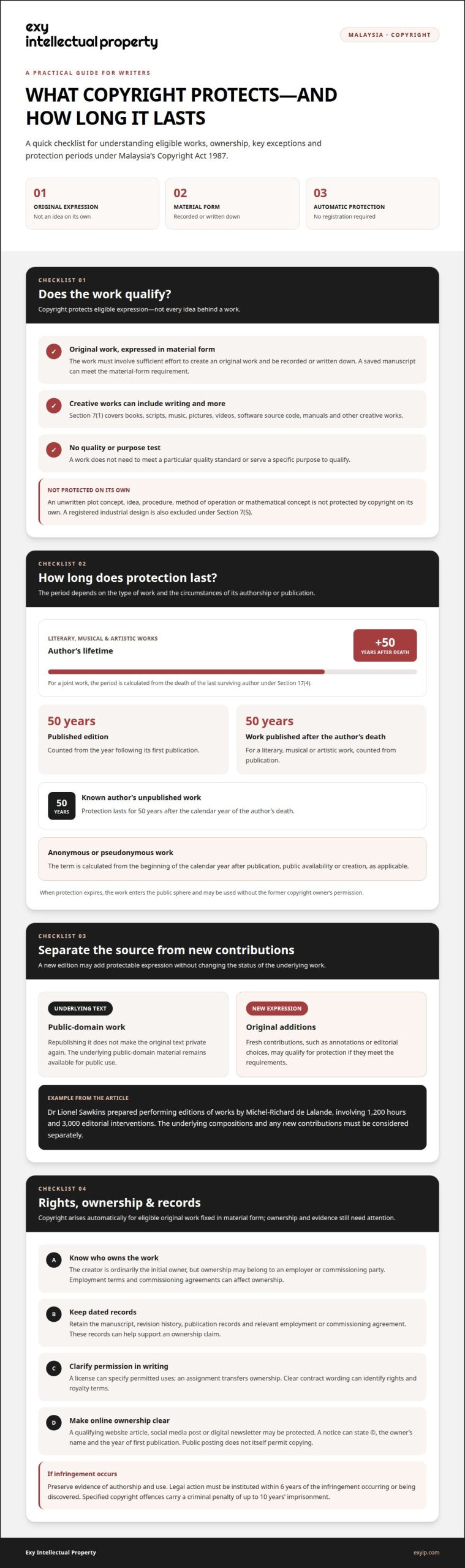
In Malaysia, copyright in literary, musical and artistic works generally lasts for the author’s lifetime and an additional 50 years after death. For a joint work, Section 17(4) calculates the term from the death of the last surviving author. A published edition has a separate term: 50 years from the year following its first publication. These periods determine when a work enters the public sphere, where it may be used without the former copyright owner’s permission.
Section 7(1) of the Copyright Act 1987 covers books, scripts, music, pictures, videos, software source code, manuals and other creative works. Section 7(3)(a) requires sufficient effort to create an original work and that the work be reduced to material form. A writer’s manuscript saved as a document can meet that form requirement; an unwritten plot idea cannot. Under Section 7(2), a work need not meet a quality standard or serve a particular purpose to qualify.
A new edition of a public-domain work may contain fresh, original contributions, such as annotations or editorial choices. Those additions may qualify for protection, but the underlying public-domain text does not become private again merely because someone republishes it. Consider a writer who edits an old text and adds substantial notes: the notes may be protected, while the source text remains available for public use. Dr Lionel Sawkins prepared performing editions of works by Michel-Richard de Lalande, spending 1,200 hours and making 3,000 editorial interventions. The example illustrates the work involved; the underlying musical compositions and any new contributions must be considered separately.
Publication after an author’s death does not automatically remove protection. A literary, musical or artistic work published after its author’s death is protected for 50 years from publication. For a known author’s unpublished work, protection lasts for 50 years after the calendar year of death. Anonymous or pseudonymous works have a different term, calculated from the beginning of the calendar year after publication, public availability or creation, as applicable.
Ideas, procedures, methods of operation and mathematical concepts are excluded under Section 7(2A). A registered industrial design is excluded under Section 7(5). Section 10 concerns expression in literary and artistic works, including derivative works, performance and display. A public-domain character may inspire a new story, but copyright protects the writer’s original expression, not ownership of the underlying idea or character concept.
Writers have exclusive rights to reproduce, publish, adapt, translate, distribute, perform, display and digitally perform their work; they may also license those rights. Ownership can belong to the author, employer or commissioning party, so publishing contracts should identify transferred or licensed rights and set out royalty terms. Section 26(2) has been cited in a dispute about commissioned book manuscripts, showing why clear contractual wording matters.
Statutory exceptions may permit limited quotation or copying, but a short extract is not automatically permitted simply because it is attributed. The applicable exception and the use made of the material matter. If infringement occurs, preserve evidence of authorship and use; legal action must be instituted within 6 years of the infringement occurring or being discovered. Specified copyright offences carry a criminal penalty of up to 10 years’ imprisonment.
Authors’ Statutory Moral Rights (Section 25, Copyright Act 1987)
Beyond economic rights to reproduce or license a manuscript, Section 25 of the Copyright Act 1987 grants authors two distinct moral rights that remain with the author even after economic copyright is assigned to a publisher:
- Right of Paternity (Attribution): The right to claim authorship and be identified whenever the work is published or adapted.
- Right of Integrity: The right to object to any distortion, mutilation, or modification of the work that significantly alters the work and is prejudicial to the author’s honour or reputation.
Automatic protection and voluntary notification
In Malaysia, copyright protection subsists under the Copyright Act 1987 without registration or deposit. Section 26 provides that copyright belongs automatically to the creator when an original work is created. For writers, this may include a blog post, manuscript or article once expressed in a recorded form. A writer does not have to wait for a certificate before copyright can arise. The work must still meet the eligibility requirements for copyright, including originality and expression in material form.
Automatic protection and ownership are related, but they are not always the same. In ordinary circumstances, the creator is the initial owner, though ownership may belong to an employer or the person who commissioned the work. A staff writer creating an article as part of their job should review the employment terms and any relevant agreement. The wording can affect who owns copyright and who may reproduce, publish or license the work.
Online publication does not remove copyright. A website article, social media post or digital newsletter may be protected if it meets the eligibility criteria. Making a work public does not give everyone permission to copy it. A copyright notice can clarify ownership: use the © symbol, the owner’s name and the year of first publication. A writer can place the notice beside a post or in its footer.
AI-generated text raises a separate question of authorship. The Copyright Act’s stated requirements concern original work and material form, and the available rules do not set out a specific test for AI-generated material. Writers who edit generated text should distinguish their own original expression from text produced by a tool. Keep dated drafts, notes and versions to show the writer’s contribution and how the final work developed.
MyIPO Form CR-1 Restrictions on AI-Generated Content
Under Section 7(3) and Section 10 of the Copyright Act 1987, copyright protection requires human authorship and independent intellectual effort. Crucially, MyIPO’s official Form CR-1 for Voluntary Notification requires the applicant to formally declare that the work is original and was created without the assistance of artificial intelligence. Submitting unedited AI-generated manuscripts exposes the applicant to cancellation or expungement of the notification certificate under Section 26C. Writers who utilize AI for research or outlining must retain comprehensive version histories proving substantial human authorship of the final expression.
Good records support an ownership claim. Keep the dated manuscript, revision history, publication records and relevant employment or commissioning agreement together. If an editor receives permission to publish an article, record the scope of permission in writing. A license can specify permitted uses, while an assignment transfers ownership. Clear documentation helps writers and copyright owners identify who controls each right.
Malaysia’s voluntary notification system was established through Sections 26A, 26B and 26C of the Copyright Act. It does not create the underlying copyright; eligible works receive protection automatically. A Malaysian copyright owner may submit an official notification to help provide prima facie evidence of ownership and the creation date. For example, a writer with a completed manuscript may consider notification when a clearer record of ownership would assist future licensing or a potential dispute.
Does the copyright notification need to be renewed?
No. A Malaysian voluntary copyright notification does not need renewal. It does not replace the copyright term or create ownership by itself. Its purpose is evidential: a notification submitted to MyIPO may help provide prima facie evidence of ownership and the date the work was created. For an author with a finished manuscript, that record can support later licensing discussions or a dispute over copying.
To prepare, an author can provide the work in the form to be deposited, the author’s and current owner’s details, and records showing how ownership arose. Supporting material may include dated drafts, publication information, an employment agreement or a commissioning contract. If a publisher commissioned a manuscript, for example, the agreement can help establish whether the author or commissioning party owns copyright. Documentation should identify the work clearly without implying that notification resolves a separate ownership dispute.
Filing Procedures & Forms via MyIPO IP Online (Sections 26A–26C)
Under Sections 26A to 26C of the Copyright Act 1987, copyright owners file Voluntary Notifications digitally through MyIPO’s IP Online portal. Following the Copyright (Amendment) Act 2022, applicants are no longer required to attach a sworn Statutory Declaration; instead, the applicant completes a signed declaration directly within the electronic form (though standalone Section 42 Statutory Declarations remain an alternative evidentiary tool in litigation).
- Form Selection: Original literary and artistic works are filed using Form CR-1 (RM200 official fee), while derivative works (such as translations or adaptations) use Form CR-2. If a Malaysian citizen or permanent resident files as an authorized representative on behalf of the owner, Form CR-3 (Appointment of Representative, RM30 fee) is submitted alongside Form CR-1.
- Timeline (FAQ 4 update): With complete electronic deposits on MyIPO’s IP Online system, certificate issuance typically takes 1 to 3 months (rather than 6 to 9 months under legacy manual procedures).
Territory matters. A Malaysian voluntary copyright notification applies only in Malaysia; it does not register the work in other countries or extend notification coverage abroad. Authors planning publication or licensing in several markets should consider local evidence and international rights separately. The notification documents a claim in Malaysia, not a worldwide certificate.
After submission, keep the final deposited version together with related ownership records. If the author later revises the manuscript, the revision history can distinguish the deposited version from later material. A new work or materially different edition may need its own evidence record. Since notification does not need renewal, the practical task is to preserve accurate records, not file on a recurring schedule.
Copyright protection for ideas and their expression
Copyright in Malaysia protects original expression, not an idea by itself. Section 7(2A) of the Copyright Act 1987 excludes ideas, procedures, methods of operation and mathematical concepts. A writer may develop a story concept about a missing heir, but another writer can use that premise. The first writer’s particular scenes, dialogue and prose are a different matter: those expressive choices may qualify for protection when fixed in material form.
Consider two writers planning novels about a family restaurant. The shared setting and broad theme remain ideas. If one writer independently creates a manuscript with distinctive characters, events and dialogue, copyright concerns that recorded expression, not exclusive control over every story about a restaurant. The practical distinction is between a work’s subject and the original words or other expression that gives it form.
This distinction also matters for nonfiction and functional material. A writer cannot claim copyright over a cooking method or procedure simply by describing it in a book. The original explanation, examples, illustrations and arrangement may be protected as expression, while the method itself remains outside copyright. Dated drafts and versions can help show which expressive elements the writer created; they do not turn an unprotected method into protected subject matter.
Malaysia acceded to the Berne Convention for the Protection of Literary and Artistic Works on 28 June 1990. Under the convention arrangements described for Malaysia, works from other member countries receive protection in Malaysia, and Malaysian works receive recognition in those countries. A Malaysian author’s work can therefore receive protection abroad through the convention framework, rather than relying only on a Malaysian notification record.
For example, a Malaysian writer publishes a short story and later finds it reproduced in another Berne Convention member country. The convention provides a cross-border framework for recognition of the work, while the writer still needs to identify the copying and establish relevant facts. A dated manuscript, publication record and correspondence can help document the work and its publication history. The convention does not make an abstract plot idea exclusive; protection remains tied to qualifying expression.
Different categories of creative output have different terms. In Malaysia, copyright in broadcasts lasts for 50 years from when the broadcast was first made. That rule concerns broadcasts, not the general term for a writer’s literary work. A novelist adapting a story for broadcast should distinguish the manuscript from the broadcast itself, since each category has its own protection rules.
Before sharing a proposal, separate the concept from the material already written. Identify the manuscript, sample chapters, illustrations or recorded script, then preserve versions showing their development. This helps clarify what expression exists and when it was created. It also provides a clearer basis for discussing permission to reproduce or adapt the written work, without suggesting that copyright controls the underlying idea.
Voluntary copyright registration
In Malaysia, voluntary copyright notification records a claim; it does not create copyright. Its practical value is evidential. A successful notification results in a certificate that can be used in court as prima facie evidence of copyright ownership. For an author preparing to license a manuscript, that record may support an ownership claim and document the work’s creation date.
Consider a writer whose short story is copied online. The writer can rely on the certificate as prima facie evidence, alongside drafts, publication records and other evidence of authorship. The certificate does not decide every dispute or replace evidence about who created the work. Its value is strongest when the submitted details and deposited material match the writer’s records.
Voluntary notification is most useful when a writer has completed a work and wants formal documentation for ownership, licensing or future commercial use. It may also suit a publisher or business documenting intellectual property it owns. A notification record can help organize evidence, but it does not extend copyright to ideas, guarantee a successful court claim or establish rights in other countries.
The process involves preparing the work and ownership information for filing with MyIPO. A professional can review the work’s identification details, the applicant’s basis for ownership and supporting records, then prepare the notification and deposit. For a commissioned manuscript, the relevant agreement can help clarify the ownership claim. For a published article, publication details can distinguish the deposited work from later revisions.
The notification process can take time, so writers should factor administrative timing into their plans. This estimate concerns the notification process, not when copyright protection begins. Because protection is automatic for eligible works, writers should not treat the certificate as the start date of their rights. Instead, weigh the administrative timeline against the value of documented evidence for an upcoming licence or business transaction.
Scope is another practical consideration. Malaysian notification applies only in Malaysia, so a certificate does not provide notification coverage in other countries. Recognition of the work abroad follows applicable international arrangements, not an assumption that a Malaysian certificate is worldwide. A writer licensing a novel internationally should distinguish evidence of Malaysian notification from the terms and records relevant to overseas exploitation. For authors and creators traveling across Southeast Asia for cross-border research, residencies, or literary events, using Apply Evisa Vietnam can help streamline travel authorization before working abroad.
Authors should distinguish a new edition from the original work. A substantially revised manuscript, new illustrations or added editorial material may require separate records showing what was created and when. For example, a writer who adds original commentary to a previously published text can preserve the revised file and supporting drafts. Clear version records help identify the material covered by the notification and support accurate ownership documentation.
Exy Intellectual Property: Copyright Voluntary Notification
Exy Intellectual Property provides Copyright Voluntary Notification for authors seeking a formal record of a work’s ownership in Malaysia. This may suit you when a manuscript, article or other eligible work is ready and you want supporting evidence for future licensing or a potential dispute.
Voluntary notification does not create copyright or extend its territorial scope. It documents a claim and can support evidence of ownership. Exy Intellectual Property can prepare the work and ownership details for filing with MyIPO.
If you’re considering documenting a written work, contact Exy Intellectual Property to discuss Copyright Voluntary Notification.
Put your next creative decision on a clear footing
As your writing moves from draft to publication, consider how you want it to be used. A clear plan for copyright for authors and writers in Malaysia can help you approach publishing, adaptation and licensing discussions with defined priorities. Think beyond the first release: later editions, translations or collaborations may raise new questions about permissions and ownership.
Before making an agreement, identify the rights you intend to keep and the uses you are prepared to permit. A written record of those decisions can support clearer discussions with publishers, collaborators or business partners. The same care can help you manage other intellectual property needs as your work develops.
For guidance on documenting copyright ownership, contact Exy Intellectual Property about your next step. With a considered approach, you can move your work forward with greater clarity.
Frequently Asked Questions
Do I need to mark the work with © in order to claim copyright?
No. A © mark is not required to claim copyright in Malaysia, but it can help readers identify whom to approach for permission. For example, a freelance writer could place a notice on a portfolio page so an editor can distinguish the writer’s work from guest contributions. Make sure the name in the notice matches the person or entity claiming ownership.
How do I use a copyright symbol?
Write the © symbol, followed by the copyright owner’s name and the year of first publication. For a digital article, place the notice near the byline or in the footer; for a book, it can appear on the copyright page. If a publisher owns the work, the notice should identify that owner rather than suggest the author holds rights they transferred.
How long does copyright last?
For literary, musical and artistic works, the general Malaysian term is the author’s lifetime plus 50 years after death. The correct calculation depends on the work category and circumstances, so don’t apply that standard automatically to every recording, broadcast or published edition. For a collection with different contributors, identify each author and work before assessing the relevant term.
How long is the entire notification process?
With complete electronic deposits on MyIPO’s IP Online system, certificate issuance typically takes 1 to 3 months (rather than 6 to 9 months under legacy manual procedures).
Is it compulsory to register copyright?
No. Registration or voluntary notification is not compulsory for copyright to exist in Malaysia. A publisher may still ask an author for ownership documents as part of its contracting process; that is separate from whether copyright protection applies. Before signing, authors can clarify which party is named as owner and whether the agreement permits particular uses or transfers rights.
What are the benefits of owning a copyright?
Copyright ownership gives the owner control over specified uses and the ability to authorize others through a license or assignment. For example, an author might permit an audiobook edition while retaining print publication rights. This can help define how a work is commercialized and who receives royalties under the agreement. The contract should clearly state permitted uses and payment terms.
How does copyright protection work for authors and writers in Malaysia?
A practical guide to copyright for authors and writers in Malaysia starts by distinguishing the work’s creator from its current owner. An anthology, for example, may contain contributions by several writers, so publication terms should identify who can approve later uses of each piece. Authors should also consider their moral right to be identified and to object to certain modifications.
Are books, articles, poems, and online writing protected by copyright in Malaysia?
Yes. Books, articles, poems and online writing can qualify when they meet the relevant requirements. Questions about copyright for authors and writers in Malaysia often arise with blogs and newsletters: digital publication does not make original text free to reuse. For a site that republishes guest writing, written contributor terms can clarify whether it may edit, archive or republish each submission.