

Your e-commerce store’s most valuable assets may be the ones customers never see. Intellectual property for e-commerce businesses can include a brand name and logo, website content, software, product designs, and other original work or innovations that support online sales.
It’s easy to focus on the products you sell and overlook the assets that make your business recognisable. Identifying them early helps you decide what to protect, document ownership, and respond if someone uses them without permission.
This guide explains what intellectual property covers in Malaysia and how to identify valuable assets across your brand, website, and digital operations. It also outlines ways to spot possible infringement, respond to misuse, monitor your rights, and choose an enforcement approach suited to your business goals.
Key Takeaways
- Recognise how a trademark distinguishes your business’s goods or services and supports a consistent identity online.
- Learn how to spot possible misuse of your brand or content and choose a response suited to the type of infringement.
- Understand why preserving evidence and monitoring online platforms can support enforcement of your rights.
- Identify which parts of your website, software, databases and digital content may hold intellectual property value.
- See when registration or copyright notification may help formalise protection for key business assets.
What is Intellectual Property?
For an online seller, intellectual property includes valuable creations and identifiers, from a product name to original listing photographs. Trademarks distinguish goods and services, while copyright can protect creative expression such as product descriptions and images.
Trademarks and Digital Brands
A trademark is a sign which distinguishes a business or its products from others, such as a shop name or logo. For a Malaysian e-commerce business, this helps customers connect a marketplace listing, website, and social media profile with the same source. A digital brand can therefore depend on more than its domain name: the wording and visual identity used across sales channels also matter.
In Malaysia, brand names and logos may function as trademarks when they identify the source of goods or services. Marketplace listings can also contain copyright material, such as original photographs and product descriptions, but a listing does not automatically establish ownership of every element it displays.
To register a trademark in Malaysia, identify the sign and the goods or services it will distinguish, then submit an application through the national trademark registration process. Processing time depends on the application and examination, so allow for these stages when planning a brand launch.
Before settling on a name, search for similar marks used for related goods or services, including spelling and visual variations. For example, a seller planning to use “Luma Home” should compare it with similar marks before investing in packaging and marketplace listings.
Trade Secrets and Confidential Information
Trade secrets are commercially valuable information kept confidential, such as supplier terms, a pricing method, or an unreleased product plan. For an online store, practical protection depends on controlling access: a shared spreadsheet containing supplier details should not be treated like public product copy. Written confidentiality terms can clarify how employees or business partners may handle sensitive information.
Trademark Ownership and Counterfeit Goods
Trademark ownership concerns who holds the rights to a sign that distinguishes goods or services, while counterfeit goods may misuse a brand to make products appear genuine. A registered mark can provide a clear record of the sign and its owner, supporting action when a marketplace listing uses a confusingly similar brand. Keep application and ownership records together to support a complaint.
For Malaysian sellers, trademark protection is tied to the jurisdiction where the mark is registered. Businesses selling across borders should consider protection in each target market and align applications with where their goods or services will be offered.
Methods for detecting and countering infringement
For Malaysian online sellers, infringement can involve copied product images, lookalike listings, unauthorised software use, or counterfeit goods. A consistent monitoring and response process helps distinguish a genuine concern from a resemblance that does not affect protected rights.
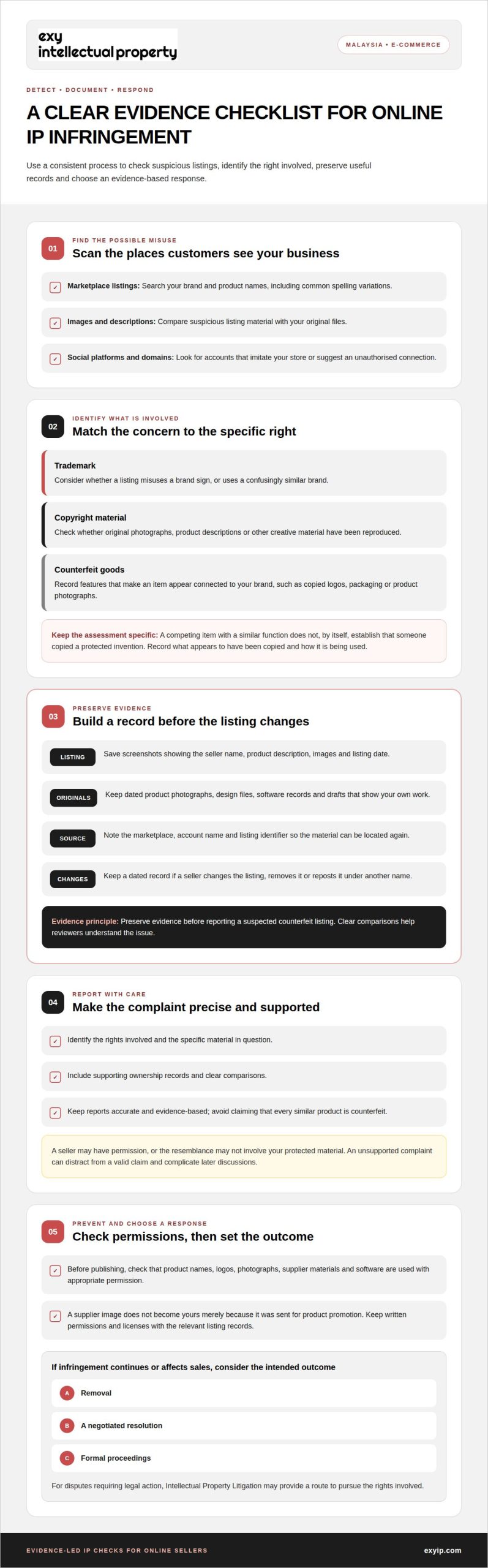
Start with practical checks across the channels where customers encounter your business. Search marketplace listings for your brand and product names, including common spelling variations. Compare suspicious photographs and descriptions with your original files. Search social platforms and domain names for accounts that imitate your store or suggest an unauthorised connection.
Assess possible infringement against the specific right involved. A listing may misuse a trademark, reproduce copyright material, or offer a counterfeit product. A competing item with a similar function does not, by itself, establish that someone copied a protected invention. The evidence depends on the claim, so record what appears to have been copied and how it is being used.
- Save the listing: retain screenshots showing the seller name, product description, images and listing date.
- Compare original materials: keep dated product photographs, design files, software records and drafts that show your own work.
- Record the source: note the marketplace, account name and listing identifier so the material can be located again.
- Track changes: keep a dated record if a seller changes the listing, removes it or reposts it under another name.
For counterfeit products, document the features that make the item appear connected to your brand, such as copied logos, packaging, or product photographs. Preserve evidence before reporting the listing. A platform complaint should identify the rights involved, the material in question, and supporting ownership records. Clear comparisons help reviewers understand the issue without broad accusations.
Marketplace reporting can address online listings, but reports should be accurate and evidence-based. Avoid claiming that every similar product is counterfeit. A seller may have permission, or the resemblance may not involve your protected material. An unsupported complaint can distract from a valid claim and complicate later discussions.
Statutory Online Takedowns (Part VIB, Copyright Act 1987) & .my Domain Recovery
For unauthorized reproduction of product photography, lifestyle videos, or listing descriptions, Part VIB (Sections 43B–43I) of the Copyright Act 1987 provides a statutory mechanism to issue formal takedown notices to network service providers and digital intermediaries, compelling prompt removal of infringing content. Additionally, where bad-faith actors register lookalike .my or .com.my domains to divert traffic, brand owners can pursue expedited domain transfer through the MYNIC Domain Name Dispute Resolution Policy (MYDRP) via the Asian International Arbitration Centre (AIAC), avoiding protracted High Court litigation.
Prevention also means reviewing your own listings before publication. Check that your product name, logo, photographs, supplier materials, and software are used with appropriate permission. For example, a supplier image does not become yours merely because it was sent for product promotion. Keep written permissions and licenses with the relevant listing records.
Parallel Imports vs. Counterfeits & Groundless Threat Liability (Sections 55 & 62, Trademarks Act 2019)
Before submitting an Intellectual Property Protection (IPP) takedown notice on marketplaces such as Shopee, Lazada, or TikTok Shop, brand owners must verify whether the seller is offering counterfeit goods or genuine parallel imports. Under Section 55 of the Trademarks Act 2019 (international exhaustion of rights), a registered proprietor cannot use trademark infringement to block third parties from reselling authentic goods already placed on the market by the proprietor or with its consent (unless the condition of the goods has been changed or impaired). Submitting an unfounded infringement report against a legitimate reseller exposes the complainant to platform penalties and civil counterclaims for groundless threats of infringement proceedings under Section 62 of the Act.
When infringement continues or affects sales, assess the desired outcome before choosing a response: removal, a negotiated resolution or formal proceedings. For disputes requiring legal action, Intellectual Property Litigation may provide a route to pursue the rights involved.
Monitoring and enforcing intellectual property rights
Monitoring makes ownership records useful for identifying possible misuse across marketplaces, domains, and social accounts. In Malaysia, an enforcement plan should connect each suspected use to the specific right and business outcome involved.
Enforcement Strategies and Expert Assistance
An enforcement strategy sets out the evidence, response, and desired result for suspected infringement. It matters because a copied logo, product photograph, and technical invention involve different rights and supporting records. Before acting, organise ownership documents, dated original files, and examples of the disputed use. Expert assistance can help assess whether the evidence supports a claim and whether the response fits your business objective.
Include intellectual property audits in business reviews. An audit compares the rights your business holds with the assets it uses, such as a marketplace brand, product packaging, website images, or software. It can also reveal gaps: for example, final logo files may exist, while business records do not clearly show who owns them.
For each asset, record its source, owner, current use, and supporting evidence. Separate registered rights from materials protected through other forms of intellectual property, then note where each is used. A Malaysian seller with a local trademark and listings on several platforms can map those listings against the mark and its approved use. This makes unfamiliar sellers or altered logos easier to spot during routine reviews.
- Keep ownership records: organise registration documents, assignments, licenses and relevant agreements.
- Preserve original evidence: retain dated design files, product photographs, software records and publication drafts.
- Log suspected misuse: record the platform, account, listing and date, then preserve screenshots or copies.
- Review changes: revisit previously reported material to see whether it was removed, altered or reposted.
Choosing Enforcement Measures
Choose enforcement measures by matching the response to the right, evidence, and desired result. A platform report may suit a copied product image or misleading listing; a continuing dispute may call for formal legal action. The response should address the specific infringement, rather than treating every resemblance as proof of wrongdoing.
Consider how widely the material is used, whether the use is ongoing, the strength of ownership records, and the impact on customers or sales. If a seller uses an identical logo on counterfeit goods, preserving the listing and product evidence can support a focused complaint. If the issue concerns software or technical material, the evidence and analysis may differ.
Plan for follow-through. Assign responsibility for monitoring reported listings, recording platform decisions, and preserving new evidence. If a marketplace removes a copied listing but the seller reposts it under another account, the new record can inform your next response. A measured process protects your business interests while tying each enforcement step to identifiable intellectual property rights.
Protection of websites, software, databases and digital content
A Malaysian online store may hold intellectual property in its software, product designs, database structure, photographs, and written content. The applicable right depends on the asset: a functional invention, an industrial design, and a product image are not protected in the same way.
For product designs, inventions, and packaging, identify the valuable feature before choosing a protection route. An industrial design concerns an article’s ornamental or aesthetic aspect, including two-dimensional or three-dimensional features. A distinctive package shape or surface pattern may therefore merit assessment as a design asset. Patent protection addresses inventions, while copyright can protect original creative works such as photographs and written descriptions.
Patent rights can protect an invention and give its owner control over how others use it. Invention patents are protected for 20 years. Patent documents also make technical information about inventions publicly available. For an online seller, this means protection and disclosure are linked: the application describes the invention, while the resulting right concerns the protected invention, not every similar product or business idea.
Software and databases need an asset-by-asset review. Copyright covers computer programs, databases, and advertisements, so preserve source files, drafts, and records showing how the material was created. A database may receive copyright protection, while some jurisdictions also recognise sui generis database laws. This distinction matters for a store operating across borders because protection can differ by country.
Protecting your digital assets also requires clear ownership records. Keep contracts and written permissions for developers, designers, photographers, and other contributors. For example, retain the terms covering a commissioned checkout feature alongside its code and design files. Use copyright notices or watermarks on original content where appropriate, and keep original, dated files as evidence of creation.
Statutory Ownership of Commissioned E-Commerce Assets (Section 26, Copyright Act 1987)
Under Section 26(2) of the Copyright Act 1987, copyright in a commissioned product photograph taken for valuable consideration vests automatically in the commissioning online merchant (unless agreed otherwise). However, this automatic rule does not cover custom checkout software, mobile apps, website UI graphics, or copywriting—where default copyright stays with the external agency or freelancer even after invoices are paid. Merchants must execute written IP Assignment Deeds for all non-photographic creative and technical deliverables.
International sales require a country-by-country approach. Intellectual property rights are territorial, and e-commerce activity may bring a business under the laws of the countries where it sells. Identify target markets, the assets exposed in each market, and the rights relevant there. A Malaysian registration does not automatically provide protection everywhere; align protection and monitoring with the territories where customers can buy.
E-commerce platforms often request registration certificates and novelty evaluation reports when reviewing claims involving industrial designs or utility rights. In Malaysia, incremental functional product improvements are protected via a Certificate for a Utility Innovation under Section 17A of the Patents Act 1983 (rather than "utility model patents"), valid for an initial 10-year term and extendable up to 20 years.
Protecting digital assets is an ongoing business process. Review product pages, software releases, and packaging changes against ownership documents before launch. This routine helps identify valuable assets early and keeps evidence connected to the specific invention, design, or content at issue.
Identifying valuable e-commerce intellectual property
A useful IP audit starts with assets customers recognise, rely on, or cannot easily replace. For a Malaysian online retailer, these might include its store name, product designs, website content, software, and confidential supplier information.
Build an inventory around how each asset supports the business. A signature product name may help customers distinguish your goods, while a checkout feature may improve the buying process. A product photograph can attract buyers, and original packaging can make an item recognisable. Record each asset, its source, its owner, and where it appears.
Then assess commercial importance and exposure. Ask whether an asset helps generate sales, sets the business apart, or supports growth plans. A logo used on marketplace listings, packaging, and social accounts has broader exposure than an internal draft. A product design used for one item may deserve a different priority from a design used across an entire range.
- Brand assets: list shop names, logos, product names and slogans customers see on listings.
- Creative assets: record original photographs, product descriptions, graphics and website text.
- Technical assets: identify software, checkout features and technical inventions that support online sales.
- Confidential assets: note supplier terms, pricing methods and business processes restricted to authorised people.
- Product appearance: capture packaging and product features with ornamental or aesthetic value.
Ownership records turn that inventory into action. For each logo, photograph, or software component, record who created it and retain relevant agreements, source files, and dated drafts. If a freelance designer created a product graphic, the project file and written terms help clarify its origin and ownership. Keep these records with the relevant asset rather than in separate, unlabelled folders.
Next, map each valuable asset to suitable protection. A brand identifier points toward trademark protection; original written or visual material may involve copyright; an invention or ornamental product appearance needs a different assessment. Protection also has a national dimension. A Malaysian business selling internationally should map important assets to each target market rather than assume one national application covers every country.
Finally, rank assets by business impact, clarity of ownership, exposure, and intended markets. A name used across every sales channel may need attention before a draft slogan that has not reached customers. Review the inventory when launching a product, changing a brand, or entering a new market. This keeps protection decisions aligned with the assets your business actually uses.
For a clearer view of which assets carry commercial value, assess your intellectual property portfolio as part of your business planning.
Exy Intellectual Property
Exy Intellectual Property helps Malaysian e-commerce businesses assess and protect rights connected to their brands, products, and digital content. Turn to the firm when you need to formalise ownership, assess protection for a product design or invention, or document copyright in original material.
Its services include Trademark Registration, Patent Filing, Industrial Design Registration, and Copyright Voluntary Notification. The right next step depends on the asset: a brand identifier, technical invention, product appearance, or original creative work each calls for a different approach. A clear assessment can connect your business priorities with suitable protection and supporting records.
If you are planning a launch, expanding into new markets, or responding to suspected misuse, contact Exy Intellectual Property to discuss your intellectual property needs.
Make intellectual property part of your next growth decision
A new product launch, refreshed brand, or move into another market can change which business assets matter most. Revisit your priorities regularly so decisions about intellectual property for e-commerce businesses stay connected to your commercial plans. Clear ownership records and a considered protection strategy can support future launches and partnerships.
Exy Intellectual Property supports Malaysian businesses with Trademark Registration, Patent Filing, and Industrial Design Registration. These services address different assets, from brand identifiers to inventions and product appearance. Where to begin depends on what your business is developing, how it plans to use that asset, and where it intends to operate.
When you’re ready to discuss the right next step, contact Exy Intellectual Property. A considered approach can help your business move forward with greater clarity.
Frequently Asked Questions
What is covered by copyright?
Copyright can cover original creative works, including written copy, photographs, graphics, advertisements, computer programs, and databases. For an online shop, this may include a product photograph or custom-written product guide. Copyright protects creative expression, not simply the underlying idea or product concept. Keep original files and dated drafts, and record permissions for material supplied by photographers, designers, or other contributors.
What should a business patent?
Consider patent protection for a technical invention, such as a new product mechanism or process used to fulfil online orders. The key question is whether the asset is an invention, rather than only a brand name, product photograph or general business idea. Record how the invention works and what technical problem it addresses. A patent novelty search can help assess existing inventions before deciding whether to prepare an application.
Why is early registration of intellectual property important?
Early registration can create a clearer record of the claimed owner and asset before a product launch or marketplace dispute. This matters when a growing business adds sales channels, hires contributors, or prepares to license a brand. For example, recording a mark before using it across packaging and online listings can help keep business records aligned. Preserve application documents and ownership agreements together for future enforcement or commercial discussions.
What types of intellectual property should Malaysian e-commerce businesses protect?
Prioritise assets that distinguish products, attract customers, or support store operations. A Malaysian seller might consider trademarks for its brand, copyright for original photographs and descriptions, patents for technical inventions, and industrial design protection for product appearance. Confidential supplier terms or pricing methods may also be valuable. Map each asset to its owner, business use, and target markets, then set priorities based on launch plans and commercial importance.
How can an online business protect website content, product photos and software with copyright in Malaysia?
Keep original files, working drafts, and records showing when content was created and who made it. Use written agreements to clarify ownership or permitted use when freelancers create photographs, website copy, or software. A copyright notice can identify the claimed owner, while a watermark may help signal that an image is protected. Copyright Voluntary Notification is another way to document copyright material. Retain evidence alongside the relevant files.
What should a Malaysian online seller do if a competitor copies its products, photos or branding?
Before contacting the marketplace, preserve the suspected copy: save the listing, seller details, images, and date. Compare it with your original files and identify whether the concern involves a brand sign, creative work, product appearance, or invention. Gather ownership records and relevant permissions, then make a focused platform report explaining the alleged misuse. Keep a record of the report and any changes to the listing or seller account.
What intellectual property clauses should e-commerce businesses include in supplier, freelancer and influencer contracts?
Use written terms to define who owns commissioned work and what the business may use. Specify permitted channels, territory, duration, and whether the material can be edited or sublicensed. For suppliers, address permission to use product images, designs, and brand assets. Freelancer agreements can cover delivery of source files and ownership of commissioned work. Influencer terms should clarify use of posts and likenesses, confidentiality, and how campaign content may be reused.
What are the risks and penalties for selling counterfeit or trademark-infringing goods in Malaysia?
Selling goods that misuse another business’s trademark can lead to complaints, marketplace action, and legal disputes. Counterfeit listings can also confuse customers, damage trust, and disrupt sales channels. Consequences depend on the conduct, the rights involved, and the evidence available; the same penalty should not be assumed in every case. A seller facing an allegation should preserve purchase and supplier records, pause disputed claims, and obtain advice on the specific facts.