


Can AI Be a Designer? Why Design Law Might Succeed Where Copyright Fails
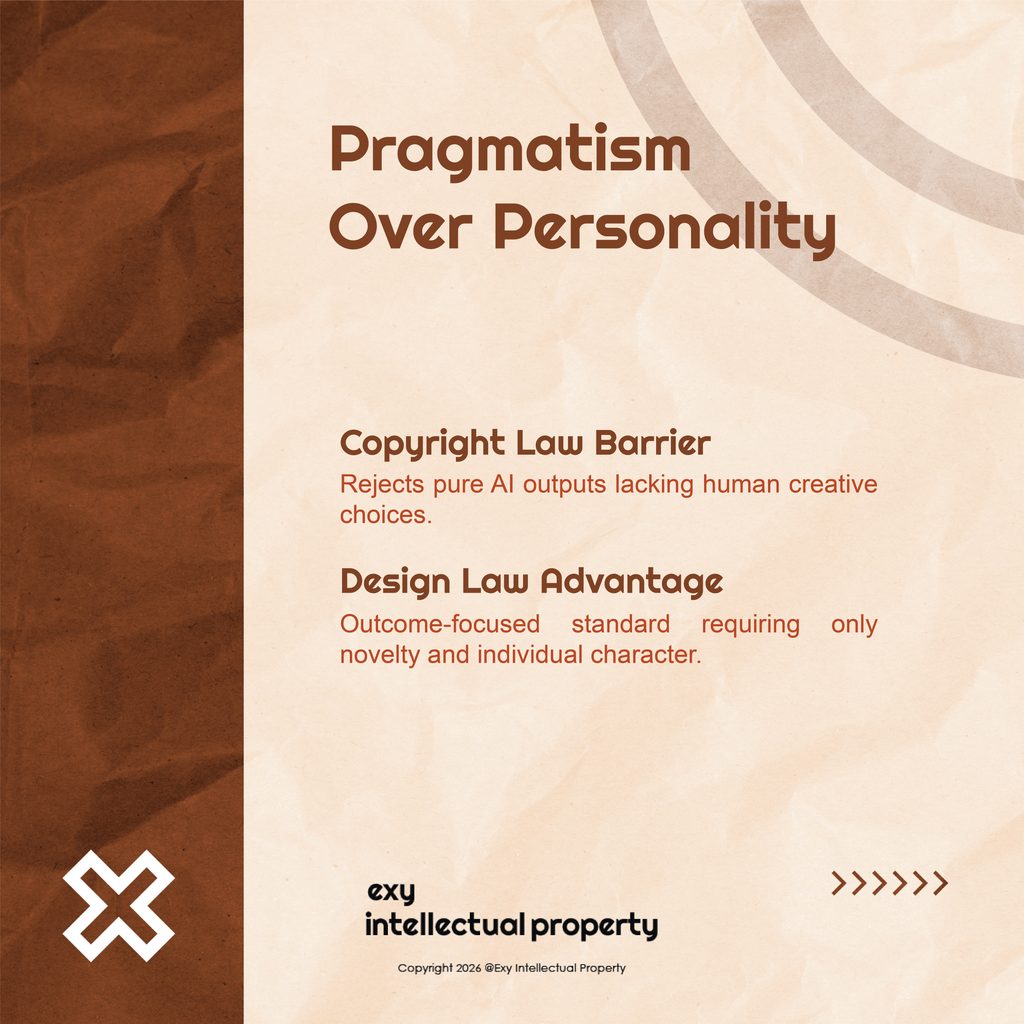
If you’ve been following the non-stop legal battles surrounding generative AI, you already know the default script: AI creates an image, someone tries to register it, and copyright offices around the world instantly shut it down. Continental Europe’s copyright system is deeply romantic and human-centered. It’s built on personality theory, the idea that art is an extension of the human soul. Because an algorithm doesn’t have a soul or personal creative intent, pure AI output gets a flat zero when it comes to copyright protection.
But what if we’re looking at this through the wrong legal lens?
We need to stop obsessing over copyright and start looking at the law itself. It turns out that design law carries far less philosophical baggage, making it a much better match for the realities of AI-assisted creation.
The Core Difference: Authors vs. Outcomes
The fundamental clash between AI and intellectual property comes down to an author-based approach vs. a design-based approach.
The human author is the center of the universe. To gain protection, a work must meet a strict standard of originality, reflecting the author’s personal, creative human choices. It is intensely pragmatic and focused almost entirely on the commercial outcome. To secure a design right, a product simply needs to fulfill two objective criteria: novelty and individual character. The law is so outcome-focused that the individual designer has very little legal weight compared to an author.
Think about it this way:
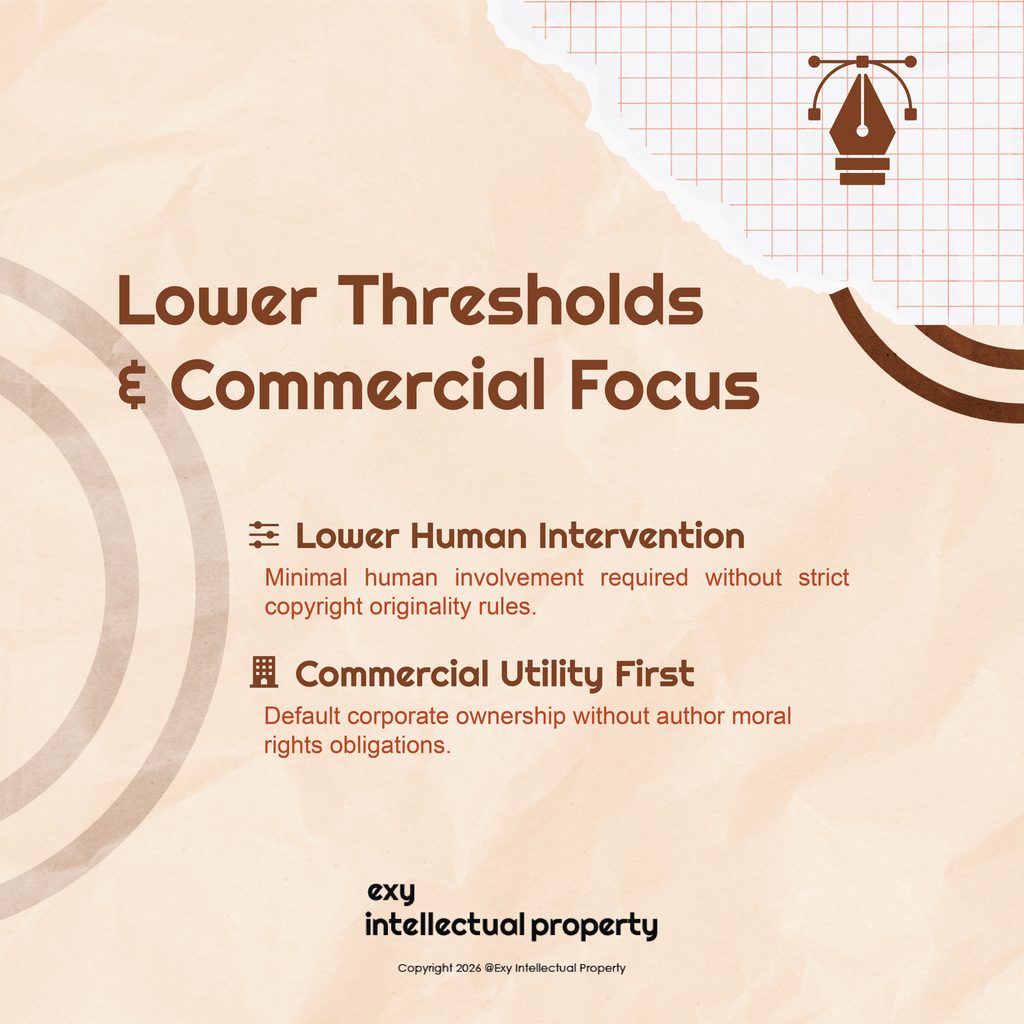
- Design law regularly awards default ownership to corporate employers rather than individual creators.
- It completely lacks moral rights, meaning there is no inalienable “right to be credited” like you see in art and literature.
- The law doesn’t even use the word “create”; instead, it notes that designers develop designs.
Because the link between a designer and their final design is so structurally weak, design law is inherently flexible. This low level of human-centrism opens a massive legal door for protecting non-human “creativity”.
The Legality of the Prompt: What Counts as “Development”?
Can you just type a prompt into Ai download a geometric pattern for a fashion line, and claim a monopoly over that shape?
Not quite. The law lacks a clear definition of a “designer” , recent legal scholarship and historical frameworks—like the original 1991 Green Paper, suggest that a design right must still originate from some form of human intervention. A machine cannot independently hold rights.
However, the threshold for human intervention in design law is significantly lower than the standard for copyright originality. The real debate hinges on the act of design development.
If we look at how designers actually use AI today, the process usually falls into two categories:
- The Curator Approach: A designer enters a prompt, lets the AI spit out dozens of variations, and simply selects the best option. Whether merely “curating” an AI output qualifies as design development is still a gray area, but outcome-oriented case law suggests that proving deep artistic intent isn’t strictly necessary to get a design right.
- The Hybrid Approach: A designer uses an AI prompt to generate a foundational concept, then manually tweaks, edits, and refines the file using traditional software. This is the safest bet. Even though the human input is minimal, it satisfies the requirement of intellectual contribution to the development process, making the final product fully protection-worthy.
The Danger of a “Patent Troll” Economy for Shapes. If design law is flexible enough to protect AI-assisted outputs, it solves a massive commercial problem for industries like fashion, furniture, and digital tech that rely on these tools to speed up their pipelines. But it also introduces a terrifying side effect, flooded public domain.
AI algorithms can generate tens of thousands of unique, highly complex geometric shapes, product configurations, and digital assets in a matter of minutes. If a company can register every single one of those iterations as a protected design, they gain an aggressive legal monopoly over those visual forms.
This creates a serious risk of “design trolling”. Human designers could easily find themselves sued for infringement simply because an automated corporate AI engine generated and registered a similar clothing silhouette or product shape three months prior
Well, the bottonline is, when it comes to the legal realities of the design field, the normative justification for protecting purely AI-generated work just isn’t there. However, if the market decides that protecting AI-assisted design is economically desirable, design law is a far more effective tool than copyright.
It carries less historical baggage, focuses entirely on commercial utility, and care less about whether a human or a prompt wheel did the heavy lifting. The tools are already there, now the industry just has to decide exactly how much space it wants to give the machines.
#ExyIntellectualProperty #DesignLaw #IndustrialDesign #AIDesign #IPLaw #Innovation