


A business model can be valuable without being patentable. Whether you can patent a business model in Malaysia depends on what the patent application claims. A commercial idea alone is unlikely to qualify, while a specific technical invention behind how the model operates may warrant closer assessment.
It is understandable to want protection for a model that sets your business apart. But patent eligibility depends on the substance of the invention, not just its commercial potential. The U.S. Bilski decision illustrates why abstract business methods face scrutiny, but it should not be mistaken for Malaysia’s patent test.
This article explains how technical features affect eligibility, what the Bilski test says, and how the scope and complexity of a patent application can shape the work involved. You’ll also see where professional patent drafting and filing fit, so you can assess the idea with a clearer view of its protection prospects.
Key Takeaways
- A commercial idea or operating model is different from a technical invention; what the patent claims is central to assessing eligibility.
- The Bilski machine-or-transformation test comes from U.S. case law and is not the only test used there to assess process claims.
- Software does not become patentable simply because it runs on a computer; the technical contribution and the specific claims matter.
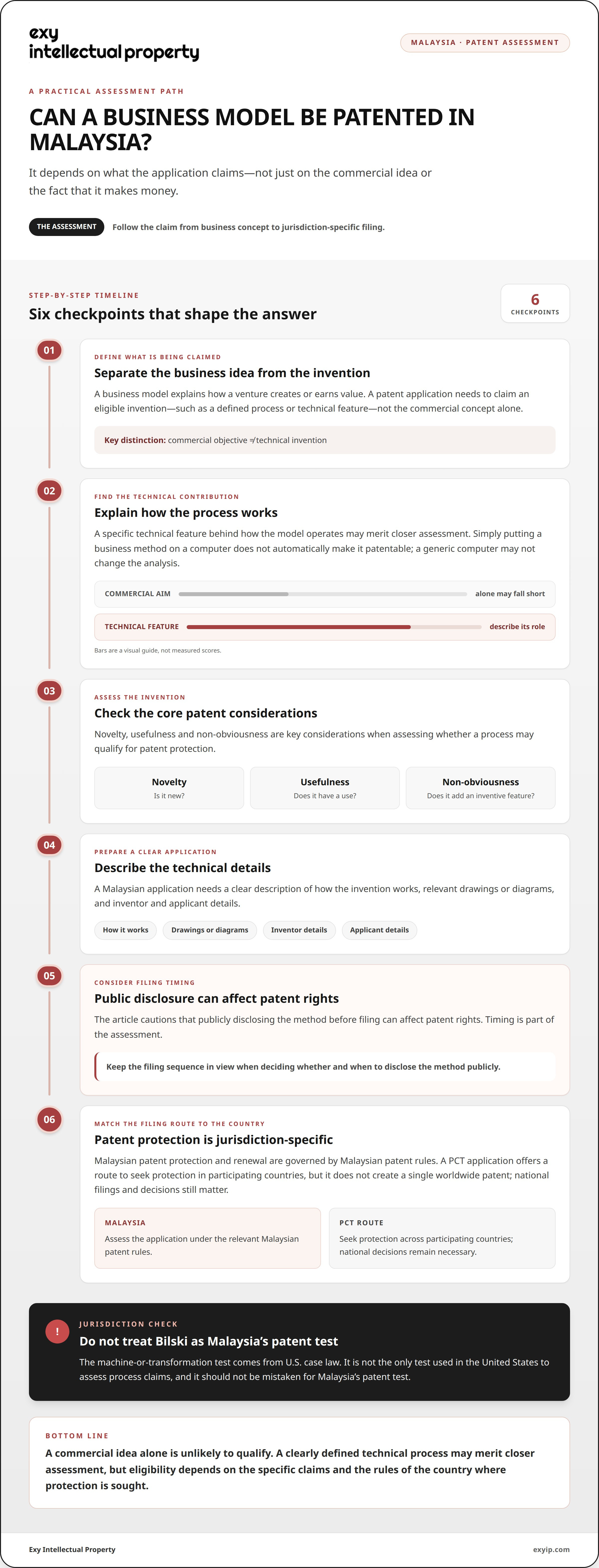
- Novelty, usefulness and non-obviousness are key considerations when assessing whether a process may qualify for patent protection.
- A patent novelty search and carefully prepared drafting can help assess an invention and clearly describe its technical features.
Can You Patent a Business Model?
Sometimes, but not simply because a model makes money. A business model describes how a venture creates or earns value; a business idea may be only a concept. A patent application must claim an eligible invention, such as a defined process or technical feature, rather than the commercial concept itself.
A business method describes a way of doing business, such as matching buyers and sellers. In the United States, utility patents can cover processes, but abstract ideas face eligibility limits. In Bilski v. Kappos, decided in 2010, the U.S. Supreme Court held that a commodity-trading risk-hedging method was an abstract idea. The decision did not make every business method ineligible.
Rules differ by jurisdiction. Article 52 of the European Patent Convention excludes business methods “as such” from its definition of inventions. China revised its examination guidelines in April 2017 to allow business method patents when methods have technical features. These examples show why filing strategy must reflect the country where protection is sought.
Software does not automatically change the analysis. Adding a generic computer to a business method may not make the claimed invention eligible: in Alice Corp. v. CLS Bank, decided in 2014, the U.S. Supreme Court rejected that reasoning for a computerized settlement-risk method. A specific technical contribution may matter more than the fact that software implements the commercial process.
In Malaysia, patent protection and renewal are governed by Malaysian patent rules, so do not assume the U.S. patent term applies. A PCT application offers a route to seek protection in participating countries, but it does not create a single worldwide patent. National filings and decisions still matter. A Malaysian application needs a clear description of how the invention works, relevant drawings or diagrams, and inventor and applicant details. Publicly disclosing the method before filing can affect patent rights, so timing matters.
Malaysian Statutory Rules: Section 13(1)(c) and the Technical Effect Test
In Malaysia, patent eligibility is governed by the Patents Act 1983 (Act 291), not U.S. case law. Under Section 13(1)(c), "schemes, rules or methods for doing business, performing purely mental acts or playing games" are expressly excluded from patentability when claimed as such. Under MyIPO’s Patent Examination Guidelines, a software-implemented business model or fintech workflow crosses from an excluded business method into a patentable invention under Section 12 only when it solves a technical problem using technical means and produces a further technical effect beyond standard computer execution—such as a novel cryptographic security protocol, distributed ledger consensus optimization, or automated server load-balancing architecture. Even where technical character is established, the claims must satisfy worldwide novelty (Section 14), inventive step (Section 15), and industrial applicability (Section 16) to receive a 20-year patent term from the filing date (subject to Section 35 annual renewal fees).
Malaysian Statutory Framework: Section 13(1)(c) & Technical Contribution (Patents Act 1983)
In Malaysia, patent eligibility is governed by the Patents Act 1983 (Act 291), not U.S. Section 101 case law. Specifically:
- Statutory Exclusion of Business Methods (Section 13(1)(c)): Schemes, rules, or methods for doing business, performing purely mental acts, or playing games are expressly excluded from patentability when claimed as such.
- The "Technical Effect" Requirement: Under MyIPO’s Patent Examination Guidelines, a software-implemented business model or fintech platform crosses from an excluded business method into a patentable invention under Section 12 only when the claimed system solves a technical problem using technical means—such as a novel cryptographic authentication protocol, a distributed ledger consensus optimization, or an automated server load-balancing architecture—rather than merely automating a commercial pricing, loyalty, or marketplace rule on standard computing hardware.
- Core Patentability Thresholds (Sections 14–16): Even where technical character is established, the claims must satisfy worldwide novelty (Section 14), inventive step (Section 15), and industrial applicability (Section 16), conferring protection for 20 years from the filing date (subject to annual renewal fees under Section 35).
There is no single application timeline. The technical detail, drafting and examination process affect how long it takes. A business method without a technical invention may be rejected, while a carefully defined technical process may merit closer assessment.
Patent examination and eligibility guidance
In the United States, patent eligibility begins with 35 USC 101, which names four statutory categories: process, manufacture, composition of matter and machine. A business method patent usually claims a process. The United States Patent and Trademark Office (USPTO) examines whether the claimed subject fits a category, but category alone does not establish eligibility.
Eligibility is only one part of examination. The application must also describe an invention that is useful, novel and non-obvious. A claim to a familiar sales workflow may fall short if it adds no inventive feature. An application describing a specific technical solution should explain what it does and how its claimed features differ from existing knowledge.
The USPTO evaluates the claims in the application, not just the title or the business benefit. Its guidance on 35 U.S.C. § 101 addresses how examiners assess subject matter. Under MPEP §1004, final authority to determine patentability rests with the Primary Examiner, subject to an exception for a Junior Examiner with partial signatory authority. An applicant may respond to a rejection by addressing the examiner’s stated grounds.
U.S. eligibility standards remain subject to ongoing legislative debate, but proposed U.S. reforms do not alter examination rules unless enacted—nor do they govern patent applications examined in Malaysia.
That distinction matters for international filing. U.S. eligibility guidance does not determine whether an invention qualifies for patent protection in Malaysia or another jurisdiction. A trademark protects a sign that distinguishes goods or services, while a patent application concerns an invention. Before filing, patent professionals assess the technical contribution, prior disclosures and claim wording against the relevant jurisdiction’s rules.
For a business method patent, the central question is whether the claims define more than an abstract commercial objective. A method that simply says “sell products through an online platform” describes a business aim. An application specifying a technical process for handling data raises a different eligibility question. Clear claims help the examiner assess the invention itself, rather than broad business language.
The Bilski machine-or-transformation test
The Bilski machine-or-transformation test comes from United States patent law. In Bilski v. Kappos, decided on June 28, 2010, the U.S. Supreme Court said the test was not the sole way to decide whether a process is patent-eligible. It remains a useful clue when assessing process claims, but passing it does not automatically mean a patent will be granted.
The U.S. test asks whether a claimed process is tied to a particular machine or transforms an article into a different state or thing. Merely connecting it to a generic computer may not be enough. For example, a method for calculating sales commission may remain an abstract business rule if it adds no meaningful technical operation. The specific steps and practical effect of the claim matter.
Bilski concerned a method for hedging risk in commodities trading. The Court treated it as an abstract idea, not an eligible invention. The case therefore illustrates the distinction between a commercial objective and a process with meaningful technical character. A business purpose alone cannot establish patent eligibility.
The later Alice Corp. v. CLS Bank decision, issued in 2014, applied a two-step abstract-idea analysis. First, the examiner or court considers whether the claim is directed to an abstract idea. If it is, the second step looks at the claim’s elements, separately and in combination, to see whether they add an inventive concept. Merely performing an abstract method on a generic computer does not supply that concept.
Consider software that records transactions to reduce settlement risk. Under Alice, computerizing that commercial goal did not, by itself, make the method patentable. A claim focused on a specific technical improvement to how a computer processes transactions raises a different question. The distinction lies in what the claimed system changes, not simply in its business result.
These decisions interpret U.S. eligibility rules, not Malaysian law. They help explain why patent claims must define more than an abstract idea, but they do not decide Malaysian applications. Copyright may protect original written explanations of a process, while the method itself raises a separate intellectual property question. In Malaysia, eligibility depends on the applicable local requirements.
Utility patents for business processes
In the United States, a utility patent may cover a new and useful process, machine, article of manufacture, composition of matter, or improvement. A business process may fall within the process category, but commercial value alone does not establish eligibility. The claims must define the invention and what it does.
Three requirements shape the U.S. assessment: novelty, usefulness and non-obviousness. Novelty asks whether the claimed invention is new. Usefulness concerns whether it has a practical application. Non-obviousness asks whether the difference from existing knowledge would have been obvious. For example, changing a familiar order-taking sequence may not be enough if the change adds no inventive feature.
Claims set the legal boundaries described in the application. They should identify the process’s steps and explain how those steps work together. The application must also describe the invention clearly enough for a person skilled in the relevant area to make and use it. A patent professional helps align the written description with the scope the claims seek to protect.
Priceline’s reverse auction method is an example of a patented business method. It illustrates that a process may be considered for protection when an application defines a particular method, rather than claiming the broad idea of selling online. It does not mean every auction model qualifies. Novelty, usefulness and non-obviousness still matter.
A utility patent is distinct from a U.S. design patent. Utility protection concerns how an invention works or is used; design protection concerns ornamental appearance. A U.S. utility patent generally lasts 20 years from the application date. A U.S. design patent lasts 15 years from its grant date. These U.S. terms should not be treated as Malaysian patent rules.
In Malaysia, the term "utility patent" is not used. Technical inventions are protected either as standard Patents (valid for 20 years from the filing date, requiring novelty, inventive step, and industrial applicability) or—for incremental single-claim technical improvements—as Certificates for Utility Innovations under Section 17A of the Patents Act 1983 (valid for an initial 10-year term and extendable up to 20 years, requiring novelty and industrial applicability without an inventive-step threshold). Product appearance is protected separately under the Industrial Designs Act 1996.
For a Malaysian business, the key is to identify the protectable invention behind the process. A workflow may involve software, devices or data handling, but the claims and written description need meaningful detail about those components. A patent novelty search can help identify relevant earlier inventions before drafting. The technical account, not just the business objective, gives the examiner material to assess.
Business models versus technical inventions
A business model explains how a company creates, delivers or earns value. An invention describes a solution with defined features. The distinction matters because a commercial plan, such as charging a subscription, may express an aim rather than a technical contribution. Patent assessment focuses on the nature and features of the claimed invention, not just its commercial appeal.
Consider a meal-delivery business that charges customers monthly. That pricing model describes how revenue is collected. A separate system that changes how a device routes orders or processes data may raise a technical question. The details matter: what problem does the system solve, what steps does it perform, and what changes physically or technically?
The European Patent Office applies the COMVIK approach, associated with decision T 641/00. It counts only features that contribute to technical character when assessing inventive step. In practical terms, a claim combining commercial rules with technical features must distinguish the features that contribute technically. A business objective alone does not supply that contribution.
Protecting Non-Patentable Business Models in Malaysia
Where a business model relies on commercial workflows rather than a patentable technical mechanism, Malaysian businesses secure competitive defensibility through complementary IP and contract tools:
- Copyright (Copyright Act 1987): Protects original software source code, mobile app interfaces, standard operating procedure (SOP) manuals, and training guides automatically upon fixation in material form (though the underlying business procedure itself remains excluded under Section 7(2A)).
- Trade Secrets (Breach of Confidence & Contracts Act 1950): Protects backend pricing algorithms, supplier margins, and customer analytics through role-based access controls and tailored NDAs.
- Trademarks (Trademarks Act 2019): Protects the customer-facing brand name, logo, and service marks (such as Class 35 retail/marketplace services or Class 42 SaaS platforms) that build market recognition.
Patent and trademark protection cover different subject matter. A patent concerns a qualifying invention; a trademark distinguishes a business or its products from others. For example, a restaurant’s ordering process and its name raise separate intellectual property questions. Copyright may protect a written manual describing the process, but that is distinct from protection for the method itself.
For a Malaysian venture, start by distinguishing the commercial arrangement from the mechanism that makes it work. A franchise model may set out operating standards and brand use. A technical system supporting inventory or order processing is a different subject for patent assessment. The application should describe the mechanism, not merely the commercial plan.
This distinction helps match protection to the right asset. If the value lies in a name, trademark protection may fit. If it lies in original written materials, copyright may be relevant. If a technical invention underpins the business process, patent eligibility depends on its claimed features and the jurisdiction’s rules. Separating these elements gives the assessment a clearer focus.
Exy Intellectual Property
Exy Intellectual Property helps businesses assess how intellectual property protection may fit a proposed business model. The central task is to distinguish the commercial concept from any technical invention that supports it. This can clarify whether patent filing is relevant or another form of protection better suits the asset.
For a process with technical features, a patent novelty search can identify earlier inventions relevant to the proposed claims. Patent drafting then describes the invention and defines the protection sought. Clear technical descriptions matter: a broad claim to a way of earning revenue differs from a claim explaining how a particular system performs a technical function. Patent filing supports the application process once its subject and claims are developed.
Not every valuable part of a business model is a patent candidate. A business name or logo may call for trademark registration because a trademark distinguishes a business or its products. A product’s visual appearance may raise an industrial design question. Original written materials, such as a training manual explaining a franchise process, may call for copyright protection. Each right addresses a different type of asset.
This distinction is useful when preparing to disclose a model to investors, partners or potential franchisees. A review can separate information describing a technical invention from information identifying the brand or expressing original written material. That helps shape a protection strategy around the actual assets, rather than treating the entire business model as one patentable item.
Exy Intellectual Property provides patent novelty searches, drafting, filing and registration. These services are relevant when a business has a defined technical process and needs support assessing and preparing an application. If the core value lies instead in a name, appearance or written materials, trademark, industrial design or copyright protection may be more suitable. The right route depends on the asset and the applicable requirements.
A focused assessment can clarify the next step before a business invests further in development or commercialization. It can also distinguish a technical contribution that may merit patent protection from business rules that need a different strategy. Contact Exy Intellectual Property to discuss your business model and its potential intellectual property protection.
Frequently Asked Questions
Business Model Patents – Are They Important or Not?
Patents may matter when a business has a genuinely protectable invention behind its operating model. Patent protection may support commercialization or licensing, but it does not secure every pricing structure, customer journey or revenue strategy. A distinctive subscription offer, for example, may be commercially valuable without being a patentable invention. The key question is whether the value lies in a technical solution that can be clearly defined and protected.
How else can I protect a business idea?
Protect different assets with rights suited to them. A trademark can distinguish your business name or product; copyright can apply to original written materials, software code or training content. Confidentiality arrangements can help manage access to information shared with staff, suppliers or potential partners. A franchise agreement or licensing agreement can set terms for using a business model or intellectual property. These approaches protect distinct interests, not the underlying idea in every form.
What did the Supreme Court decide in Alice?
In Alice Corp. v. CLS Bank, the U.S. Supreme Court held in 2014 that a computerized method for reducing settlement risk was abstract. Using a generic computer did not make that method patentable. The decision introduced a two-step eligibility analysis in the United States: assess whether the claim is directed to an abstract idea, then consider whether its elements add an inventive concept.
What is “prior art” and why is a search important?
Prior art is existing material relevant to whether an invention is new or inventive, such as earlier patent documents or public technical disclosures. A search can reveal similar systems before an application is drafted. For example, a fintech team may find an earlier transaction-processing method with comparable features. That information helps a patent professional assess which technical differences matter and shape claims around the invention’s actual contribution.
What qualifies as a patentable business idea?
A business idea needs more than commercial appeal: it must be developed into a specific invention that meets the relevant patent requirements. A plan to offer same-day delivery is a commercial objective; a defined technical system for coordinating routes raises a separate patent question. The application must explain how the invention works and identify its features. A novelty search can help assess earlier disclosures before claims are prepared.
Can a business model be patented in Malaysia?
Sometimes, if the application concerns a qualifying invention rather than the commercial model in the abstract. A company’s subscription structure, for example, differs from a technical process for securely handling transactions. Malaysian protection depends on the invention and the claims presented under the applicable requirements. An assessment should focus on the technical features, how they operate together and the protection sought in Malaysia.
Are business methods or abstract ideas excluded from patent protection in Malaysia?
Do not assume a business method or abstract idea qualifies just because it supports a successful venture. The question is what the application claims and whether it describes an invention that meets Malaysian patent requirements. A broad instruction such as “match buyers with sellers” differs from a defined technical system for processing their transactions. The substance of the claim, not its commercial label, is central to the assessment.
Can software-based business models or fintech methods be patented in Malaysia?
Software or fintech involvement does not, by itself, settle patent eligibility in Malaysia. The application needs to describe the specific technical contribution, such as how a system processes or secures transaction data, rather than only the commercial service it enables. A digital lending model, for example, is not the same as a technical method for verifying transaction information. The claims and supporting description determine what is presented as the invention.