


What if the only thing standing between your brand’s security and a rejected application is a single, incorrectly numbered form? It’s a common anxiety for many Malaysian entrepreneurs. You’ve worked hard to innovate, yet the administrative maze of myipo forms and fees can feel like it’s designed to trip you up. Filing the wrong document isn’t just a clerical error; it’s a forfeited investment that can stall your market entry.
We understand that navigating these complexities requires precision. You want to protect your assets without overspending or falling victim to hidden costs. This guide simplifies the 2026 landscape by providing a comprehensive reference for the latest filing requirements. We’ll show you exactly which forms to use, how to calculate your registration costs, and how to verify if you qualify for small business fee reductions.
Strategic. Reliable. Clear. We’ve mapped out the current financial and procedural requirements for trademarks, patents, and industrial designs. This ensures your intellectual property strategy remains both robust and cost-effective as you grow your venture in Malaysia’s competitive market.
Key Takeaways
- Identify the specific documents required for trademarks and patents; this ensures your application meets statutory requirements from the start.
- Master the 2026 schedule for myipo forms and fees to accurately budget for your intellectual property lifecycle without hidden surprises.
- Determine your eligibility for significant fee reductions by verifying if your business falls below the RM500,000 annual sales turnover threshold.
- Discover how strategic filing choices, such as using pre-approved goods lists, can lower your initial registration costs.
- Prevent costly re-submissions by understanding the critical distinction between statutory government fees and professional advisory services.
Navigating the MyIPO Fee Schedule and Official Forms
The Intellectual Property Corporation of Malaysia, commonly known as MyIPO, serves as the central guardian for all intangible assets in the country. It’s the agency responsible for administering the legal frameworks that protect your brand, inventions, and creative works. To interact with this system, you must follow a structured path defined by specific myipo forms and fees. This structure isn’t arbitrary; it’s governed by the Trademarks Act 2019 and the Trademark Regulations 2019. These laws ensure that every application is handled with consistency and legal rigour.
Understanding the difference between statutory fees and professional service fees is your first step toward a realistic budget. Statutory fees are the mandatory costs paid directly to the government to process your application. In contrast, professional fees are paid to specialists who manage the strategic drafting and filing of your documents. While you might feel tempted to handle filings alone, the sequence in which you submit forms is critical. A single mistake in the filing order can jeopardize your priority date, which is the legal stake in the ground that proves you were the first to claim a specific right.
The Purpose of Statutory IP Fees
Fees. They’re a necessary part of the protection lifecycle. MyIPO categorizes these costs into application, examination, and maintenance fees. Application fees initiate the process, while examination fees cover the intensive legal and technical review of your submission. Once granted, maintenance fees ensure your rights remain active over the years. These payments fund the national IP infrastructure, supporting enforcement and the continued modernization of the legal system. For businesses planning their 2026 roadmap, staying updated on the current fee schedule is essential for accurate financial forecasting. This legal ecosystem also aligns with broader frameworks, such as Malaysian copyright law, which provides the foundation for protecting original literary and artistic expressions alongside industrial rights.
Official MyIPO Forms: An Overview
Forms are the language of the registration process. MyIPO uses a prefix system to categorize different types of protection. You’ll primarily encounter TMA prefixes for trademarks and PF for patents. As Malaysia moves through the MyIPO NextGen transformation plan, most of these submissions have transitioned from paper-based filings to a sophisticated digital system. This shift improves speed but increases the need for technical accuracy. A common pitfall for many businesses is selecting a form that doesn’t match their specific commercial intent, leading to costly delays or the need for entirely new submissions. Professional guidance ensures you select the correct sequence of myipo forms and fees from day one, securing your assets without unnecessary administrative friction.
Essential Trademark Forms and Registration Costs
Precision is the cornerstone of a successful trademark strategy. When you begin the registration process, your primary interaction with the registry involves specific myipo forms and fees that dictate the scope of your protection. The Trademarks Act 2019 revolutionized this process by introducing multi-class filings. This allows you to protect your brand across various product categories under a single application, streamlining your administrative burden. However, choosing between a single-class or multi-class approach requires a clear understanding of your long-term commercial goals. It’s not just about the initial cost; it’s about building a defensible asset that grows with your business.
Form TMA2 and the Application Phase
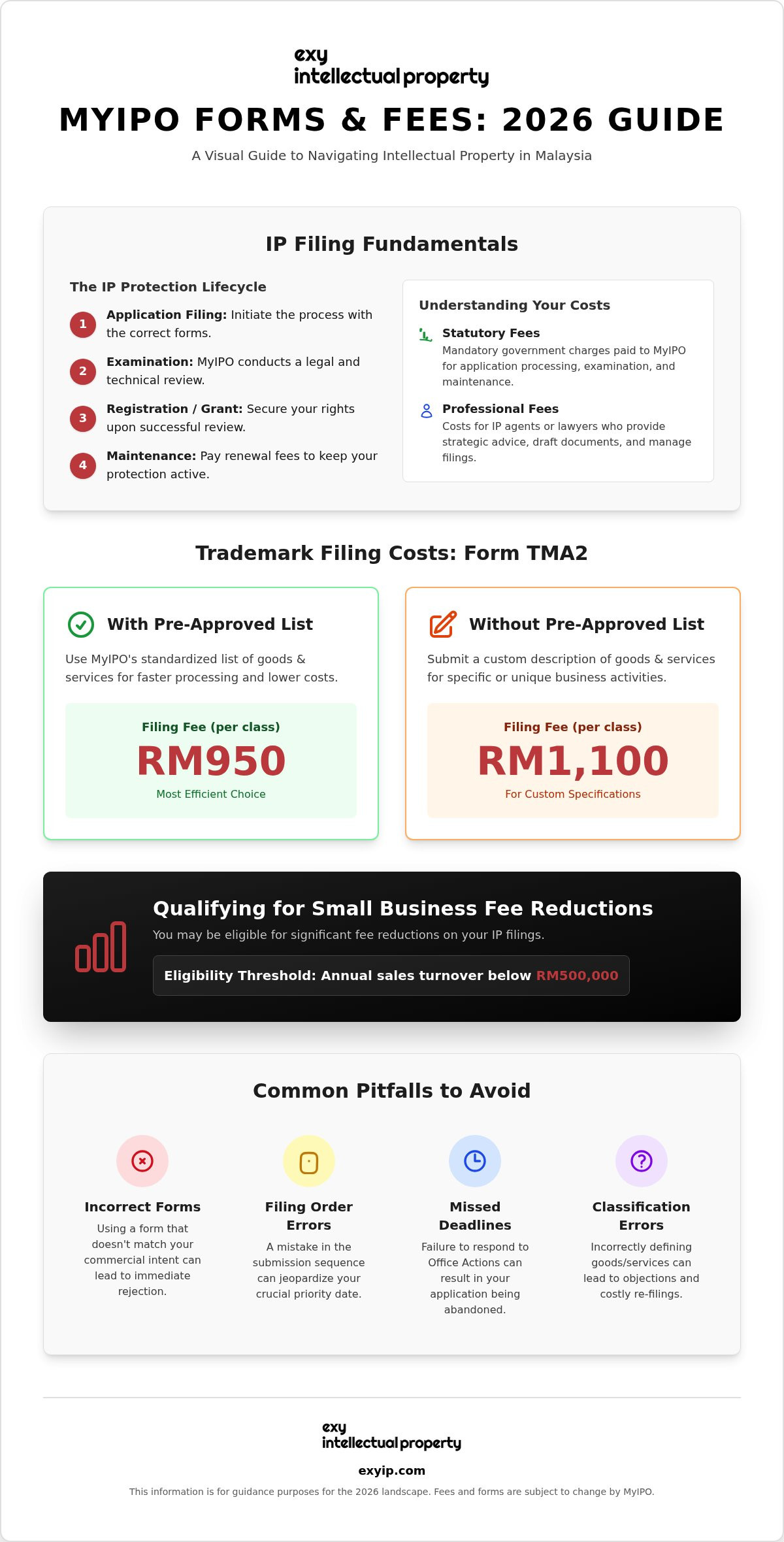
Form TMA2 is the standard vehicle for most modern trademark applications in Malaysia. If you utilize the pre-approved list of goods and services through the online portal, the filing fee starts at RM950 per class. Opting for a non-pre-approved list increases this to RM1,100 per class. This price gap highlights the efficiency of the digital system. To avoid errors in classification that could lead to a rejected application, many businesses engage a trademark agent in Malaysia to handle the technical nuances of the submission. If you’re unsure about your brand’s classification, a professional trademark filing strategy can prevent costly re-filings later.
Beyond the initial filing, you must be prepared for the possibility of an "Office Action." This occurs when the registrar raises an objection or requires clarification. Responding to these notices often requires additional forms and, in some cases, legal submissions. Failure to respond within the tight procedural timelines introduced in the 2026 guidelines can result in your application being deemed abandoned. This would mean losing your filing fees and your priority date. Following the U.S. Guide to Protecting IP in Malaysia, businesses are encouraged to treat these administrative steps as vital components of their market entry strategy.
Maintenance and Renewal Fees
Brand protection is a marathon, not a sprint. Once your trademark is registered, it remains valid for 10 years. To maintain this protection, you must file Form TMA8 for renewal. The standard fee for this renewal is RM1,000 per class, provided it’s filed within six months before the expiry date. If you miss this window, you enter a grace period where a late renewal (Form TME2) is required. This incurs a RM1,200 fee per class, which includes a RM200 surcharge. Budgeting for these recurring costs ensures your brand remains secure without the risk of a third party claiming your expired mark. Consistency in managing these filings is what separates a vulnerable brand from a market leader.
Patent and Industrial Design Filing Fees: A Comparative Overview
While trademarks protect your brand identity, patents and industrial designs secure the technical and aesthetic core of your innovation. Choosing the right path requires a clear understanding of myipo forms and fees, as the financial commitment varies significantly depending on the level of protection you seek. A patent guards how an invention works, while an industrial design protects its unique appearance. Balancing these two can be the difference between a protected market lead and a vulnerable product launch. Each path has its own set of statutory requirements and long-term maintenance costs that you must factor into your R&D budget.
Patents: From Filing to Grant
The patent journey starts with Form PF1, the Request for Grant of Patent. For online submissions, the filing fee typically starts at RM 500. If your invention is a functional improvement but lacks a high degree of "inventive step," you might opt for a Utility Innovation using Form PF14, which has a lower filing fee of RM 200. However, the initial filing is only the beginning. A critical, often overlooked cost is the Request for Substantive Examination (Form PF5), which carries a RM 1,000 fee. This is where MyIPO conducts a deep dive into your invention’s novelty.
Wasting these fees on an invention that isn’t actually new is a common mistake. Conducting a patent novelty search before you file ensures you aren’t paying to examine something that already exists in the public domain. Once granted, you’ll face annual maintenance fees, known as annuities. These start at RM 120 for the second year and escalate as the patent matures toward its 20-year limit. It’s a structure designed to ensure only commercially viable inventions maintain their monopoly over time.
Industrial Designs: Protecting Aesthetics
If your competitive edge lies in the "look and feel" of a product, Form ID1 is your primary tool. The filing fee for an industrial design starts at approximately RM300. Unlike patents, industrial designs don’t undergo a substantive examination of novelty in the same way, making the process faster and generally more affordable. One strategic way to optimize your budget is by registering a "set" of designs. If you have multiple embodiments of the same design concept, filing them together can be more cost-effective than individual submissions.
Protection for designs is granted in five-year blocks. While the initial fee covers the first period, you’ll need to pay extension fees for the second, third, fourth, and fifth periods to reach the maximum 25-year lifespan. This modular approach allows you to drop protection for designs that are no longer trendy or commercially relevant. By aligning your myipo forms and fees with your product lifecycle, you ensure your budget supports the designs that actually drive your revenue.
Qualifying for Fee Waivers and Small Business Reductions
Protecting your intellectual property shouldn’t drain your startup capital. For many Malaysian entrepreneurs, the financial barrier to entry is lowered by specific government initiatives designed to support the local business ecosystem. Understanding how to navigate the 2026 myipo forms and fees landscape includes knowing when you don’t have to pay the standard rate. If your venture meets certain criteria, you can access significant cost savings that make comprehensive protection much more attainable.
The RM500,000 annual sales turnover threshold is the primary benchmark for these benefits. If your business earns less than this amount, you’re likely eligible for a reduction in filing costs. For example, previous initiatives have seen trademark filing fees reduced by RM300, bringing the cost down from RM950 to RM650 per application. This isn’t an automatic discount; it requires a proactive submission using the "Application for Waiver or Modification of Fee" form. Securing this reduction is a strategic move that allows you to reinvest saved capital into other areas of your business growth. To further optimize your operations, engaging a partner like LBCO Advisory Sdn Bhd can help manage the accounting and tax complexities that often accompany such expansion.
The SME Fee Reduction Criteria
Eligibility is strictly defined. To qualify as a Small or Medium Enterprise (SME) under the current MyIPO standards, you must provide concrete evidence of your financial status. This typically involves submitting audit reports, recent tax filings, or statutory declarations that verify your annual turnover stays below the RM500,000 limit. These documents are essential because they provide the legal basis for the registrar to modify the standard fee schedule. Successfully claiming these waivers can drastically reduce the total investment required for trademark registration in Malaysia, making it easier for micro-businesses to defend their brands against infringement.
Common Mistakes in Waiver Applications
Timing is everything. One of the most frequent errors is attempting to apply for a fee reduction after the application has already been filed and paid for. You must submit your waiver request at the exact point of filing. If you pay the full statutory fee first, MyIPO generally won’t issue a refund for the difference. Another common pitfall is using the wrong documentation. If your evidence of turnover is outdated or doesn’t meet the specific evidentiary standards of the Trademarks Act, your request will be rejected. Accuracy matters. A rejected waiver application doesn’t just cost you money; it can also delay your filing date, leaving your brand temporarily unprotected. Ensuring you use the correct myipo forms and fees from the start is the only way to guarantee your budget remains optimized. If you’re ready to secure your brand while maximizing your budget, our team can provide expert trademark filing assistance to ensure you qualify for every available discount.
Optimizing Your IP Budget with Professional Advisory
Strategic investment. It’s not just about paying the government; it’s about making sure that payment counts. Many businesses view myipo forms and fees as a hurdle. We see them as the foundation of your commercial moat. Professional advisory ensures your filing is correct the first time. This prevents the cycle of re-submissions and forfeited fees that plagues DIY applications. When you get the paperwork right, you protect your priority date and your capital. Mistakes are expensive. A single classification error can lead to an Office Action that costs more to resolve than the original filing.
The Exy Intellectual Property Advantage
Precision matters. We provide end-to-end management of your MyIPO filings. This ensures accuracy and speed. Our team doesn’t just fill out forms; we optimize your entire portfolio to minimize maintenance costs over time. We help you decide which assets are worth the long-term investment and which can be retired. By leveraging intellectual property valuation, we help you justify every ringgit spent on registration. You’ll see your IP not as an administrative expense, but as a tangible balance sheet asset that can attract investors and secure financing. We bridge the gap between legal necessity and commercial growth.
Beyond protection lies profit. Registering a trademark in Malaysia is the first step toward licensing and franchising. These strategies turn your registration costs into recurring revenue streams. We assist you in drafting robust licensing agreements that unlock the economic value of your brand. It’s about turning a legal right into a commercial engine. This proactive approach ensures your business stays ahead of the competition while maintaining full compliance with the latest 2026 regulations. We move your strategy from defense to offense.
Next Steps for Your Business
Don’t rush into filing without a clear plan. Start with a preliminary trademark check in Malaysia. This simple step identifies potential conflicts before you commit to myipo forms and fees. For inventors, a novelty search is non-negotiable. It secures your invention’s future by confirming its uniqueness before you trigger the examination phase. Consult with a Business-Savvy Guardian, and with a qualified IP Specialist today. We’ll map out an IP roadmap that aligns your legal protection with your long-term commercial goals. Your success is our priority. Let’s build something that lasts together.
Securing Your Commercial Legacy in Malaysia
Innovation is the heartbeat of your business. Safeguarding that innovation requires a precise understanding of myipo forms and fees to ensure every ringgit spent builds a lasting competitive advantage. We’ve explored how selecting the right forms, such as the TMA2 for trademarks or PF1 for patents, dictates the strength of your legal protection. By leveraging the RM500,000 turnover threshold, small businesses can access significant cost reductions, making world-class protection an achievable reality.
Exy Intellectual Property stands as your proactive advisor in this complex landscape. Our expertise in Trademarks Act 2019 compliance and dedicated SME fee reduction advisory ensures you don’t miss an opportunity for savings or security. We go beyond mere filing by providing comprehensive IP valuation and strategy to unlock the true economic potential of your assets. Secure your intellectual property with Exy Intellectual Property’s expert filing services today.
Your journey toward market leadership begins with a single, correctly filed document. Let’s ensure your professional interests are in safe, capable hands as you scale your venture with confidence. Your success is the ultimate return on investment.
Frequently Asked Questions
How much does it cost to register a trademark in Malaysia in 2026?
Registration costs depend on your filing method and classification strategy. For online submissions using the pre-approved goods list, the statutory fee starts at RM950 per class. If you opt for a non-pre-approved list, the fee increases to RM1,100 per class. These 2026 rates apply to the initial application phase. You should also budget RM50 for the certificate of registration for each trademark class under the current schedule.
Can I get a refund on MyIPO fees if my application is rejected?
No, MyIPO doesn’t issue refunds for rejected or withdrawn applications. Statutory fees cover the administrative cost of examining your submission regardless of the final outcome. This makes it vital to conduct thorough searches before filing to ensure your brand or invention meets the necessary legal standards. Investing in professional drafting helps you avoid forfeited payments by ensuring your myipo forms and fees are correctly managed from the start.
What is the difference between Form TMA2 and TMA2A?
Form TMA2 is the standard application used for a single trademark in one or more classes. In contrast, Form TMA2A is used specifically for registering a series of trademarks. A series consists of marks that resemble each other in material particulars but differ in non-distinctive features like color or size. Choosing the correct form ensures your application is processed without delays. Using the wrong prefix can lead to technical objections.
Are MyIPO fees different for foreign applicants?
Statutory government fees remain the same for both local and foreign applicants. However, foreign businesses without a local place of business must appoint a registered Malaysian trademark or patent agent to handle their filings. This requirement adds an agent service fee to the total cost of ownership. Foreign entities should also consider international treaties like the Madrid Protocol, which allows for streamlined trademark protection across multiple jurisdictions including Malaysia. For entrepreneurs looking to expand into South Asia, DigiFiling can help you check trademark status and manage filings in the Indian market.
How often do I need to pay maintenance fees for a patent in Malaysia?
Patent maintenance fees, also known as annuities, are payable every year starting from the second year of the patent’s term. These fees follow an escalating scale, meaning the cost increases as the patent ages toward its 20-year maximum lifespan. For a utility innovation, the protection lasts for a total of 20 years subject to these annual payments. Keeping track of these deadlines is essential to prevent your intellectual property rights from lapsing prematurely.
Does MyIPO offer discounts for individual inventors or students?
Yes, MyIPO frequently introduces initiatives to support individual inventors and students. While specific student discounts vary, individuals and micro-enterprises with an annual sales turnover of less than RM500,000 often qualify for reduced registration fees. For instance, temporary reductions have previously lowered trademark registration costs by RM300 for eligible applicants. You must submit a specific waiver form along with proof of your financial status at the time of filing to benefit from these savings.
What happens if I use the wrong form for my IP filing?
Using the wrong form usually results in a formality objection or an outright rejection of your application. If the error is caught early, the registry might allow a correction, but this often requires paying additional amendment fees. In more severe cases, you may lose your filing fee and, more importantly, your priority date. Ensuring you select the correct myipo forms and fees is the only way to safeguard your legal claim against potential competitors.
Can I pay MyIPO fees online through their official portal?
Yes, you can pay all statutory fees online through the MyIPO NextGen digital portal. This system supports various payment methods, including credit cards and online banking transfers. Digital filing is actually encouraged through a lower fee structure compared to manual counter submissions. For example, online patent filing starts at RM500 while manual filing costs RM700. This modernization aims to improve efficiency and speed up the overall processing time for Malaysian businesses.