


What if your brand’s most valuable asset was legally unprotected simply because you viewed a filing as a chore rather than a strategy? Many entrepreneurs realize too late that their logo and name are vulnerable to copycats without a formal legal title. To truly own your market position, you must register trademark malaysia protections through the proper channels. This isn’t just about filing paperwork. It’s about building a defensive wall around your business’s future.
We understand the confusion surrounding MyIPO technicalities and the lingering fear that your investment might not yield a clear return. You’ve worked hard to build trust with your customers, and the thought of someone else profiting from your reputation is unsettling. This 2026 strategic guide provides a clear roadmap to secure your exclusive legal rights and unlock the commercial potential of your intellectual property. We will examine the step-by-step registration process, analyze the cost-to-value ratio, and show you how to transform your brand into a scalable asset ready for franchising or professional valuation.
Key Takeaways
- Transform your brand identity into a defensible commercial asset by understanding the strategic steps to register trademark malaysia protections under the Trademarks Act 2019.
- Identify the specific distinctiveness criteria required by MyIPO to ensure your brand name or logo is legally registrable and strong enough to withstand challenges.
- Navigate the complexities of the filing process to avoid the “simple filing” trap where a mere receipt is mistaken for a granted trademark.
- Secure the long-term value of your business by mastering the 10-year renewal cycle and proactive enforcement strategies against copycats.
- Unlock new revenue streams by learning how a registered mark serves as the foundation for franchising, licensing, and professional IP valuation.
Understanding Trademark Registration in Malaysia as a Strategic Asset
A trademark is a recognizable sign, design, or expression that identifies products or services of a particular source. Think of it as your brand’s unique fingerprint. In Malaysia, the legal landscape for these assets underwent a massive transformation with the Trademarks Act 2019. This legislation modernized our local standards to meet global expectations, allowing for more robust protection and easier international expansion. For any business owner, the decision to register trademark malaysia rights is the first step in moving from a local operation to a recognized corporate entity. It’s the foundation of your commercial identity.
Many founders mistakenly believe that registering a business name with the Companies Commission of Malaysia (SSM) provides brand protection. It doesn’t. An SSM registration simply grants you the right to conduct business under a specific name. It doesn’t prevent a competitor from using a similar logo or brand name for their products. Only a registered trademark provides the exclusive legal right to use that mark and the power to stop others from infringing upon it. Without this protection, you’re essentially building your house on rented land.
The Economic Value of Your Mark
Your trademark is more than a logo; it’s an intangible asset with measurable financial weight. On a company balance sheet, a registered mark represents goodwill and market presence. In the Malaysian market, having a registered trademark is a strict prerequisite for any business looking to enter the franchising industry. Under the Franchise Act 1998, you cannot register a franchise without first securing your intellectual property. Additionally, as your brand grows, professional trademark valuation can unlock new doors. These marks can be used as leverage for business financing or to increase the overall valuation of your company during an acquisition or exit.
TM vs. ®: Knowing the Difference
The symbols you see next to brand names carry specific legal weights. The ™ symbol is used to notify the public that you’re claiming ownership of a mark, even if it isn’t officially registered yet. It acts as a placeholder of intent. Conversely, the ® symbol is reserved exclusively for marks that have successfully completed the full registration process with MyIPO. You shouldn’t use the ® symbol until you have the physical registration certificate in your possession. Using it prematurely isn’t just misleading; it’s a legal offense in Malaysia that can result in fines. Protecting your brand requires patience and a clear understanding of these milestones.
Determining What Qualifies for Trademark Protection
To successfully register trademark malaysia protections, your brand must pass a series of technical hurdles set by MyIPO. Not every name or logo qualifies for a certificate. The law requires that a mark be distinctive, non-descriptive, and legally compliant. This means your sign must be capable of distinguishing your goods or services from those of your competitors without misleading the public or using prohibited symbols. MyIPO will reject any mark that is scandalous, deceptive, or uses protected national emblems like the Malaysian crest.
The spectrum of distinctiveness is the primary tool used to measure a mark’s strength. At the top are "Fanciful" marks, which are entirely invented words with no prior meaning. These are the easiest to protect. "Arbitrary" marks use common words in unrelated contexts, while "Suggestive" marks hint at a product’s nature without explicitly naming it. "Generic" terms are at the bottom; they are unprotectable because no single business should own a common word used to describe an entire category of products.
Beyond the name itself, you must navigate the Nice Classification system. This is an international standard that categorizes goods and services into 45 distinct classes. Selecting the correct class is vital. If you register in the wrong category, your protection might be useless when you try to enforce it against a copycat in your actual field of trade. Precise classification ensures your legal shield covers the specific commercial activities that generate your revenue.
Registering Logos, Sounds, and Scents
The 2019 Act expanded the definition of a mark to include non-traditional identifiers. It’s now possible to protect a specific sound, a scent, or even a unique color, provided they function as a clear source identifier. However, representing these to MyIPO requires precise technical descriptions, such as musical notations for sounds. While a wordmark protects your brand name in any font, a logo registration secures the specific visual arrangement of your identity. Most successful businesses choose to file both to ensure the most robust process to register trademark malaysia assets that are actually enforceable.
Common Pitfalls in Choosing a Brand Name
Many entrepreneurs fall into the "descriptive" trap. They choose names that simply state what they sell, hoping for immediate consumer recognition. This often leads to a MyIPO rejection. Geographical names also pose a risk; using "Penang" or "Malaysia" in your brand name can lead to objections unless the mark has acquired a massive reputation over many years. A name like "Best Coffee Malaysia" cannot be trademarked because it is purely descriptive and lacks inherent distinctiveness, whereas a unique, invented brand name provides the legal strength needed for registration. Seeking a Trademark Filing strategy early in your journey ensures your brand is built on a solid legal foundation.
The Risks of DIY Filing vs. The Strategic Professional Approach
A receipt is not a certificate. This is the most critical lesson for any business owner looking to register trademark malaysia protections. Many entrepreneurs submit their own applications through the MyIPO portal, receive an acknowledgment of filing, and mistakenly believe their brand is now legally secure. In reality, that receipt only confirms that MyIPO has received your documents and fees. It does not grant you any exclusive rights. The true challenge begins during the examination phase, where a high percentage of DIY applications face "Provisional Refusals" due to technical errors or conflicts with existing marks.
Managing these office actions requires more than just filling out forms; it requires a sophisticated understanding of case law and administrative procedures. When MyIPO issues a refusal, you’re often given a strict deadline to submit a legal response. If your arguments fail to meet the registrar’s standards, your application is abandoned, and your filing fees are forfeited. Professional agents act as your Legal Advisory team, crafting strategic responses that address the examiner’s concerns and increase the likelihood of a successful grant. We don’t just file papers. We defend your brand’s right to exist in the marketplace.
Why Search Before You File?
Risk mitigation starts long before the first form is submitted. A basic name search on a public database often misses "confusingly similar" marks that could block your application. A professional novelty search is a deep dive into phonetic similarities, translated meanings, and visual overlaps. Identifying these conflicts early allows for a strategic pivot. It’s far more cost-effective to adjust your brand name now than to face a rebranding crisis after you’ve already invested RM50,000 in signage and marketing. A strategic pre-filing search focuses on identifying these hurdles early so you can move forward with confidence.
The Role of an IP Agent in Malaysia
Navigating the Trademark Filing process involves managing complex legal deadlines and the critical two-month opposition period. During this time, any third party can challenge your application. An experienced trademark agent malaysia monitors these windows and provides the necessary Intellectual Property Litigation support if a dispute arises. Furthermore, we ensure your registration isn’t just a snapshot of your business today. We structure your classes to cover future expansion, ensuring that as you scale from a single shop to a national franchise, your legal protection grows with you. This proactive guardianship is what separates a mere filing from a long-term business asset.
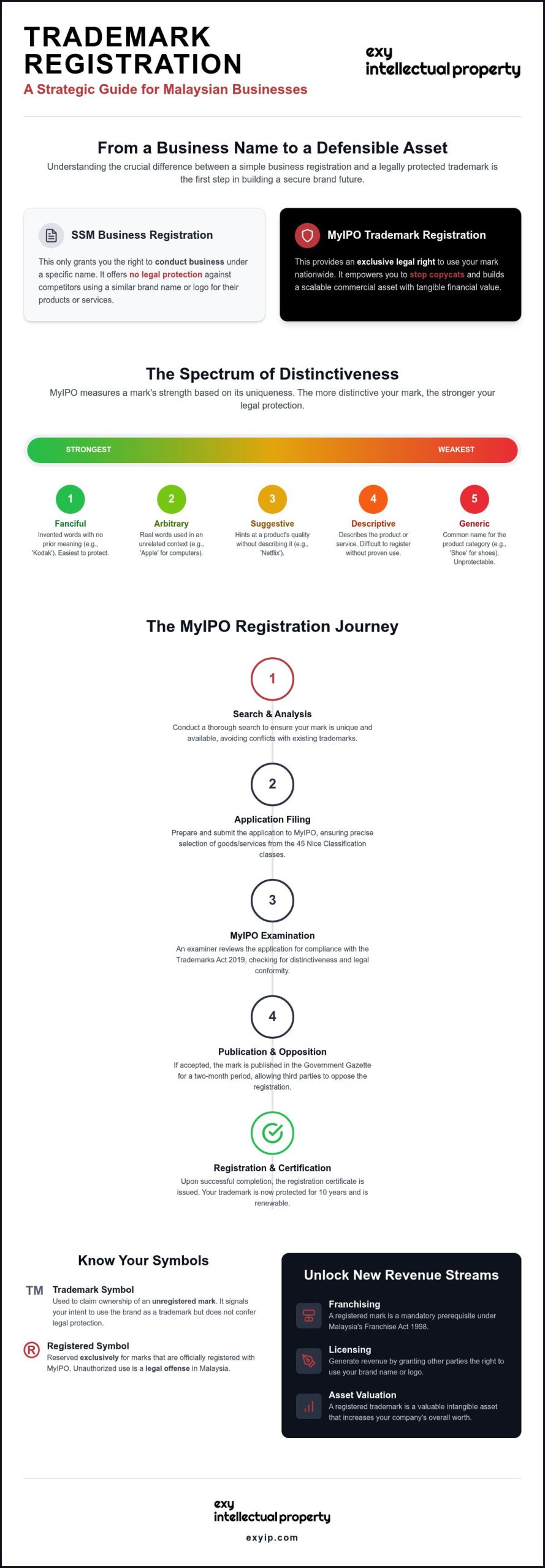
Step-by-Step: The Malaysia Trademark Registration Process (MyIPO)
Success starts with a strategic foundation. To register trademark malaysia protections effectively, you must navigate a multi-phase journey through the Intellectual Property Corporation of Malaysia (MyIPO). Unlike the simplified overviews found elsewhere, the real process demands meticulous attention to Phase 1: the pre-filing search and strategic classification. This stage isn’t just a box to tick. It is your primary defense against future Intellectual Property Litigation. By identifying potential conflicts before they reach a registrar’s desk, you ensure your application is built on solid ground.
- Phase 1: Pre-Filing Search & Classification: A deep-dive analysis into existing registers to prevent "confusing similarity" rejections and categorize your goods/services.
- Phase 2: Formal Application: Submitting required MyIPO forms and official filing fees.
- Phase 3: Substantive Examination: The Registrar reviews the mark for inherent distinctiveness and compliance with the Trademarks Act 2019.
- Phase 4: Journal Publication: Your mark is published in the IP Journal for a mandatory two-month opposition window.
- Phase 5: Certificate Issuance: If no oppositions are filed, MyIPO issues your official Certificate of Registration.
Timeline and Expectations in 2026
Patience is a requirement in the world of IP. The typical duration from the initial filing to the issuance of a certificate currently averages between 12 and 18 months. However, MyIPO offers expedited examination options for businesses that need to secure their rights quickly for commercial reasons, such as an upcoming product launch or a licensing deal. The date of filing is the priority date for your rights, establishing your legal seniority over any similar marks filed after you. This date is the anchor for your brand’s protection in Malaysia.
Handling Objections and Oppositions
The path to registration isn’t always linear. If the Registrar identifies an issue, they will issue a "Notice of Provisional Refusal," requiring a formal legal response. Similarly, during the publication phase, a third party might file an opposition if they believe your mark infringes on their existing rights. These are high-stakes legal hurdles. Our team provides the necessary Legal Advisory to navigate these disputes, ensuring that a single objection doesn’t derail your entire brand strategy. If you are ready to secure your brand’s future, our experts can guide you through a professional Trademark Registration process today.
Beyond the Certificate: Commercializing and Protecting Your Registered Mark
A certificate is a tool. Not a trophy. Establishing your rights to register trademark malaysia marks is the foundation, but the true value lies in how you utilize that asset. Unlike a physical office, a trademark requires active maintenance to remain valid. In Malaysia, marks are protected for a 10-year cycle. You must file for renewal before this period ends to prevent your exclusive rights from lapsing. Proactive guardianship also means monitoring the market for infringers. When copycats emerge, your registration provides the legal teeth needed for Intellectual Property Litigation or cease-and-desist actions. You aren’t just defending a name; you’re protecting your market share.
Licensing acts as a powerful engine for passive revenue. By granting third parties the right to use your mark in exchange for royalties, you can expand your brand’s reach without the overhead of direct operations. Additionally, your registered trademark can be used as collateral for Intellectual Property Financing. This allows your brand’s reputation to fund your next stage of growth, turning your legal protection into a tangible financial instrument. We help you transition from simply owning a name to managing a high-value Commercialization Strategy.
Franchising and Global Expansion
IP Valuation: Knowing What Your Brand is Worth
Determining the financial weight of your brand is essential during mergers, acquisitions, or investment rounds. Professional Trademark Valuation uses income-based or market-based methodologies to calculate exactly what your reputation is worth in Ringgit. This data is vital for internal auditing or when negotiating with potential partners. It’s time to view your IP as a strategic business asset rather than a legal cost. Unlock the true value of your brand with strategic IP advisory.
Building a Future-Proof Brand Identity
Your brand is more than just a name; it’s the commercial heartbeat of your company. Choosing to register trademark malaysia protections correctly ensures that your hard-earned reputation remains yours alone. We’ve explored how a strategic approach to MyIPO filings moves you beyond simple compliance and into the realm of asset creation. By avoiding the pitfalls of DIY applications and focusing on long-term distinctiveness, you set the stage for successful franchising and professional valuation.
As your business-savvy IP guardians, we bring specialized expertise in IP valuation and franchising to the table. Our comprehensive global protection networks are designed to support your growth from a local startup to an international powerhouse. Don’t leave your brand’s security to chance or technical guesswork. Secure your identity today and transform your intellectual property into a scalable engine for business success. We’re ready to help you navigate every step of this journey with confidence and clarity.
Secure Your Brand with a Strategic Trademark Consultation
Frequently Asked Questions
How much does it cost to register a trademark in Malaysia in 2026?
MyIPO fees are structured per class of goods or services under the Nice Classification system. The total cost depends on how many categories your business operates in. While the official filing fee is a fixed government cost, you should also account for potential response costs if the Registrar issues an objection. Strategic budgeting ensures you can defend your application throughout the entire 18-month process.
How long does a trademark registration last before I need to renew it?
A trademark registration in Malaysia is valid for 10 years from the date of filing. This date is crucial as it establishes your legal priority. You can renew your protection every 10 years indefinitely, provided you submit the renewal application and pay the required fees before the expiry date. Timely maintenance is essential to prevent your brand assets from lapsing and losing their commercial value.
Can I register a trademark myself, or do I need an agent?
You can legally file an application yourself, but engaging a registered agent is highly recommended for strategic protection. Professionals provide a novelty search and legal advisory that DIY filings often lack. This significantly reduces the risk of provisional refusals and ensures your application is robust enough to withstand third-party oppositions during the publication period. Working with an expert trademark agent malaysia ensures your IP is a scalable business asset.
What is the difference between a trademark and a copyright in Malaysia?
Trademarks protect brand identifiers like names, logos, and slogans that distinguish your products in the marketplace. Copyright, conversely, protects original creative works such as books, music, and software code. For organizations in the performing arts sector looking to scale their operations, you can explore Xperios for Music Services to see how specialized management software complements your brand protection strategy. While a logo can sometimes be protected by both, the registration processes and legal rights granted under the Trademarks Act 2019 and the Copyright Act 1987 serve different commercial purposes. One protects reputation; the other protects expression.
Can I register my logo and brand name together in one application?
You can file a combined mark that includes both your brand name and logo in a single application. This is often cost-effective but limits your protection to that specific visual arrangement. Filing them separately provides broader rights, allowing you to use the name independently of the logo or update your visual branding without losing your trademark seniority. Most established brands choose separate filings for maximum strategic flexibility.
What happens if my trademark application is rejected by MyIPO?
If MyIPO rejects your application, they will issue a Notice of Provisional Refusal outlining their objections. You typically have a set period to submit a formal legal response or attend a hearing to argue your case. This is a critical stage where professional legal advisory is vital to overcome technical hurdles and secure your brand’s right to register trademark malaysia protections.
How do I check if my brand name is already taken in Malaysia?
You can perform a preliminary search on the MyIPO online database to see if an identical name is already registered. However, a basic search may miss "confusingly similar" marks that could still block your application. A professional novelty search provides a much deeper analysis, including phonetic similarities and translations, to ensure your proposed brand name is truly available for registration and won’t trigger future litigation.
Does a Malaysian trademark protect my brand in other countries?
A Malaysian trademark only provides legal protection within Malaysia’s borders. To protect your brand internationally, you must file separate applications in each country or use the Madrid Protocol. This international system allows you to register trademark malaysia rights as a base and then extend that protection to over 130 member countries through a single, streamlined application process.