


Who owns a creative work when an employee creates it, a contractor is paid to produce it, or another business wants to use it? Copyright law in Malaysia can protect original creative work, but it does not automatically resolve questions about ownership, permission or proof if a dispute arises.
Before sharing content, commissioning work or responding to unauthorised use, it helps to know what the law protects and what records to keep. This guide explains the Malaysian copyright framework in practical terms, including protected work categories, how ownership can depend on the circumstances, and what to check before using someone else’s work. It also explains Copyright Voluntary Notification, which is not a condition for copyright to exist.
You’ll also find guidance on permissions and licensing, plus a note on proposed amendments to the Copyright Act 1987 that remain proposals as of October 2026. The aim is to help you spot potential issues early and understand when tailored intellectual property advice may support your business.
Key Takeaways
- Learn what copyright law in malaysia protects and why the specific expression of an idea matters.
- Check who owns work created by employees or contractors before using, sharing or licensing it.
- Keep clear records of your work and permissions, and understand that voluntary notification is separate from copyright protection.
- Assess whether you need permission to use a work or whether a statutory exception may apply.
- See how clear ownership can support business licensing and commercialization, and when tailored intellectual property advice may help.
What Does Copyright Law in Malaysia Protect?
Copyright protects original expression, not ownership of an idea. It can give the copyright owner control over certain uses of a qualifying work. The Copyright Act 1987 is Malaysia’s principal copyright legislation. It sets out protected work categories and legal requirements, subject to the Act’s provisions and applicable amendments. Proposed reforms announced in July 2026 were proposals, not enacted law, as of October 2026. For historical and structural context, see Copyright law of Malaysia.
Which creative works may receive copyright protection?
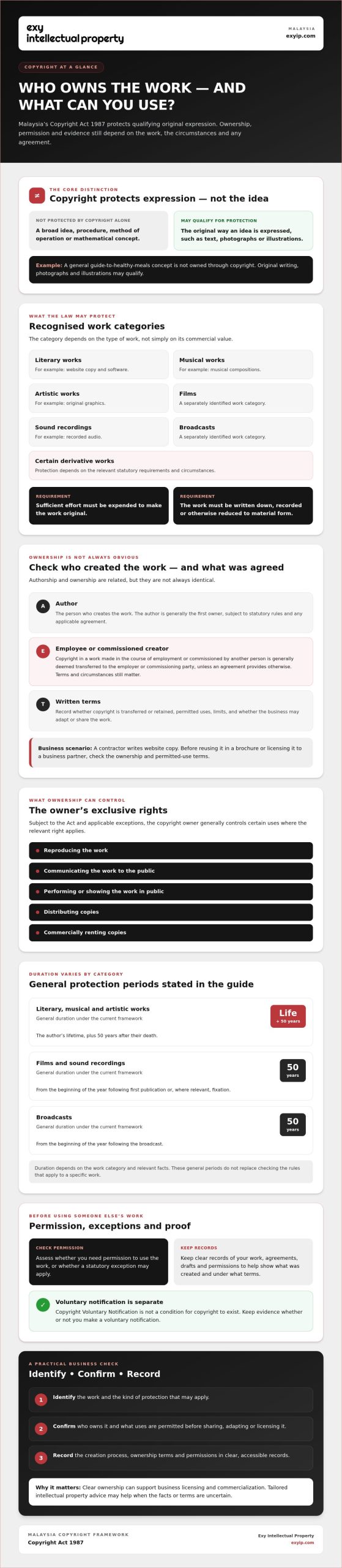
The Act identifies literary, musical and artistic works, films, sound recordings and broadcasts, as well as certain derivative works. Business examples include website copy, original graphics, musical compositions, software and recorded audio or video. The category depends on the type of work, not simply on its commercial value.
A work must meet the relevant statutory requirements. In general, sufficient effort must be expended to make it original, and it must be written down, recorded or otherwise reduced to material form. An unrecorded thought alone is not protected, and the Act excludes certain subject matter, including ideas, procedures, methods of operation and mathematical concepts. Whether a specific work qualifies depends on its nature and circumstances.
Does copyright protect an idea or its expression?
Copyright protects the particular form in which an idea is expressed, not the underlying idea. For example, a general concept for a guide to healthy meals is not owned through copyright, but an author’s original text, photographs and illustrations may qualify for protection.
Another business could independently create a guide on the same broad topic without automatically infringing copyright. The key question is whether protected expression has been copied or otherwise used in a way restricted by law. Similar subject matter alone does not establish infringement.
This distinction separates copyright from other forms of intellectual property. A patent may protect a qualifying invention, while an industrial design registration concerns a product’s visual design. A trademark identifies and distinguishes a business or its goods and services. Each right has a different legal test and protects a different interest. Before sharing or commercializing a business asset, first identify what it is and what kind of protection may apply.
How Malaysian Copyright Law Treats Ownership, Rights and Duration
Copyright ownership determines who can control certain uses of a protected work. Under the Copyright Act 1987, the copyright owner generally has the exclusive right to control acts such as reproducing the work, communicating it to the public, performing or showing it in public, distributing copies, and commercially renting copies, where the relevant right applies. These rights are subject to the Act, including any applicable exceptions.
Authorship and ownership are related, but they are not always identical. The author is the person who creates the work; the first owner is generally the author, subject to statutory rules and any applicable agreement. In particular, the Act provides that copyright in a work made in the course of employment or commissioned by another person is generally deemed transferred to the employer or commissioning party, unless an agreement provides otherwise. The terms and circumstances still matter.
Who owns work created by employees or contractors?
If an employee creates a design as part of their work, or a contractor is commissioned to produce a business video, check the ownership terms rather than assume who owns the copyright or what the business may do with the work. Statutory rules and contract terms can affect ownership. Before work begins, document whether copyright is to be transferred or retained, the permitted uses, any limits, and whether the business may adapt or share the work.
For example, a company may pay a contractor to write website copy and later want to reuse it in a brochure or license it to a business partner. A clear written agreement can record the intended ownership and permitted uses. Keep the agreement and drafts together so there is evidence of what was created and under what terms.
How long does copyright last in Malaysia?
Duration depends on the work category and relevant facts. Under the current framework, literary, musical and artistic works generally receive protection for the author’s lifetime plus 50 years after their death. Films and sound recordings generally receive protection for 50 years from the beginning of the year following their first publication or, where relevant, fixation. Broadcasts generally receive protection for 50 years from the beginning of the year following the broadcast. Other categories and circumstances may have different rules, so do not apply one duration to every work.
Before relying on an ownership or expiry date, confirm the work’s category, creator, creation or publication history, and any employment or commissioning agreement. These details can affect whether you may reproduce, adapt, share or license a work. If the position is unclear, intellectual property legal advice can help clarify ownership and permitted use under copyright law in malaysia.
Copyright Infringement, Exceptions and Lawful Use in Malaysia
Using protected material without permission can infringe copyright if the use involves an act controlled by the copyright owner, such as reproducing or communicating the work to the public. The outcome depends on the work, the use and the applicable law. Under copyright law in malaysia, finding content online, crediting its creator or using it for a non-commercial purpose does not, by itself, establish that reuse is lawful.
When should a business seek permission or a license?
Pause before copying a photograph into an advertisement, sharing a report with customers, adapting artwork for packaging or publishing music in a promotional video. A license grants permission for specified uses, so check that its terms cover the use you plan rather than assuming general permission is enough.
Confirm who controls the relevant rights and what the permission covers. Check permitted uses, platforms, territory, duration and any limits on editing, distribution or sublicensing. If a supplier or employee provided the material, review your agreement with them too. They may not control every element incorporated into the work.
What copyright exceptions may apply?
The Copyright Act 1987 provides for certain uses without permission, including fair dealing for purposes such as research, private study, criticism, review and reporting current events. Whether an exception applies depends on its statutory conditions and the circumstances. Naming a purpose alone does not make a use lawful.
The comparison below is a starting point, not a ruling on any particular use:
| Use route | What to check |
|---|---|
| Permission-based use | Obtain permission from the rights holder and follow the license terms. |
| Possible statutory exception | Check whether the purpose and the way the work is used meet the Act’s conditions. |
For example, quoting a passage to review a publication may raise different issues from reproducing the same passage in marketing material. The amount used, purpose and context can matter. Attribution may be required in some situations, but credit alone does not replace permission when permission is needed. Likewise, material that is freely accessible is not automatically free to copy.
For planned commercial use, substantial copying or a disputed claim, check the current statutory wording and the specific facts before proceeding. Tailored intellectual property advice or a licensing agreement can help clarify rights and permitted use.
How to Protect Copyright in Malaysia: Evidence, Notification and Response
Practical protection starts with clear records, not paperwork alone. Under copyright law in malaysia, copyright generally arises automatically when an original work is created in material form. Voluntary notification is a separate administrative option, not a prerequisite for the right to exist.
Use this sequence to organise your business’s approach:
- Identify the work: Record what it is, such as a software file, marketing graphic or video.
- Confirm ownership: Check who created it and review any employment, contractor or assignment agreements.
- Preserve records: Keep material that helps show when and how the work was developed.
- Set permissions: Document who may use the work, for what purpose and under what terms.
What records can help establish authorship and ownership?
Keep dated drafts, source files, working versions, contracts, publication records and correspondence about permissions. For commissioned work, link the agreement to the specific deliverables and record any agreed transfer or limits on use. Store these documents with the asset or in a place the relevant team can easily find.
These records may help explain a work’s development and ownership history, but no single file guarantees the outcome of a dispute. A consistent record trail is more useful than relying on memory or a copyright notice alone.
Is copyright registration required in Malaysia?
No. Copyright protection and Copyright Voluntary Notification are separate: notification is not a prerequisite for copyright to exist. Malaysia’s notification system provides an administrative route that may give prima facie evidence of ownership, but it does not by itself settle a contested ownership question. The process is for a copyright owner or assignee. Check current official guidance for filing requirements and procedures.
If you suspect unauthorised use, save copies of the material and relevant web pages, note where and when you found them, and compare the use with your own work and any permission granted. Consider a measured first response, such as asking the user to explain their basis for use or requesting removal. Seek tailored advice before escalating a disputed or commercially significant matter, and avoid public accusations until the facts and rights are clear.
For help reviewing ownership records or considering a notification, learn about copyright voluntary notification with an intellectual property adviser.
Using Malaysian Copyright Strategically in Your Business
Copyright can be a business asset as well as a safeguard. Clear ownership records help a company decide who can publish, adapt, license or commercialize creative material, and reduce uncertainty when content is used in marketing, products or partnerships. A practical first step is to maintain an asset list that links each work to its creator, ownership evidence and any permissions or restrictions.
How can businesses manage copyright assets and permissions?
For each asset, record:
- Its title, type and creator, with the relevant creation or publication details.
- Who owns it, and where the supporting contract or other evidence is stored.
- Any license received or granted, including permitted uses and limits.
- Whether the work may be adapted, shared with partners or used in a new campaign.
This record supports day-to-day decisions. A marketing team can check permission before reusing a photograph in a new campaign; a product team can confirm rights before incorporating graphics into packaging; and a business can review its terms before sharing content with a collaborator. Keep permissions linked to the relevant asset so teams can verify them before use.
Some business outputs may involve more than one type of intellectual property. Copyright may protect original creative expression, while a patent concerns a qualifying invention and an industrial design registration may protect a product’s visual appearance if the legal requirements are met. These rights have distinct tests and are not interchangeable. For product appearance, see this guide to industrial design protection in Malaysia. For a separate overview of invention protection, read the Malaysia patent filing guide.
When should a business seek copyright advice?
Consider tailored advice if ownership is unclear, a use is disputed, a proposed license covers complex uses, or the business plans to commercialize creative work. These issues can affect what the business may publish or permit others to use. Exy Intellectual Property offers Copyright Voluntary Notification, licensing agreements and legal advisory. Voluntary notification is an administrative option, not a guarantee of ownership or a substitute for reviewing the underlying rights.
Before making a high-impact use or responding to a claim, organise your asset list, agreements and permission records, then identify any unresolved questions. Explore Exy’s intellectual property services for support assessing a complex copyright issue under copyright law in malaysia.
Put Your Copyright Knowledge to Work
Understanding copyright law in malaysia helps you make better decisions about creative work, but clear ownership and permissions turn that knowledge into practical business protection. Copyright applies to qualifying expression, while rights and duration depend on the work and relevant facts. Do not assume a contractor’s deliverable or employee-created asset is automatically owned or cleared for every use without checking the agreement.
Build good habits: keep creation and ownership records together, confirm permission before reusing another party’s work, and check whether an exception genuinely applies before relying on it. Copyright Voluntary Notification is an optional administrative route, not a requirement for copyright to exist. It may support evidence of ownership, but it does not settle every dispute.
Where ownership is unclear, a use is disputed, or a licensing or commercialization decision has wider business implications, tailored guidance can help you assess the next step. Exy Intellectual Property offers Copyright Voluntary Notification, intellectual property legal advisory and licensing support. Discuss your copyright and intellectual property needs with Exy Intellectual Property to clarify your options.
Frequently Asked Questions
Who owns copyright in work created by an employee in Malaysia?
There isn’t one answer for every employee-created work. Ownership can depend on the nature of the working relationship, the Copyright Act 1987 and the terms of the employment agreement. Review the relevant documents and keep records showing who created the work and in what circumstances. If the work is commercially valuable or ownership is disputed, seek advice based on the facts and current law before relying on an assumption.
Can I use an image or article I found online in Malaysia?
Finding an image or article online does not automatically give you permission to copy, adapt or publish it. Check who controls the relevant rights and read any license terms to confirm they allow your planned use. Attribution alone may not be enough. A statutory exception may apply in some circumstances, but its conditions matter. For commercially significant use, seek permission or tailored advice before publishing.
What should I do if someone uses my copyrighted work without permission?
First, preserve examples of the use, dates, ownership records and relevant communications. Then assess what rights may be involved, whether permission was granted and what outcome you want. The appropriate response depends on those facts and the law, so there is not one remedy for every situation. If the use is commercially material or disputed, seek specialist advice before escalating or making public allegations.
What is copyright voluntary notification in Malaysia?
Copyright Voluntary Notification is an administrative process separate from the creation of copyright itself. It may give an owner or assignee a record and prima facie evidence of ownership, but it does not replace contracts, creation records or other evidence, and it will not automatically resolve a dispute. Check current official guidance for eligibility, required documents and filing steps before applying.