

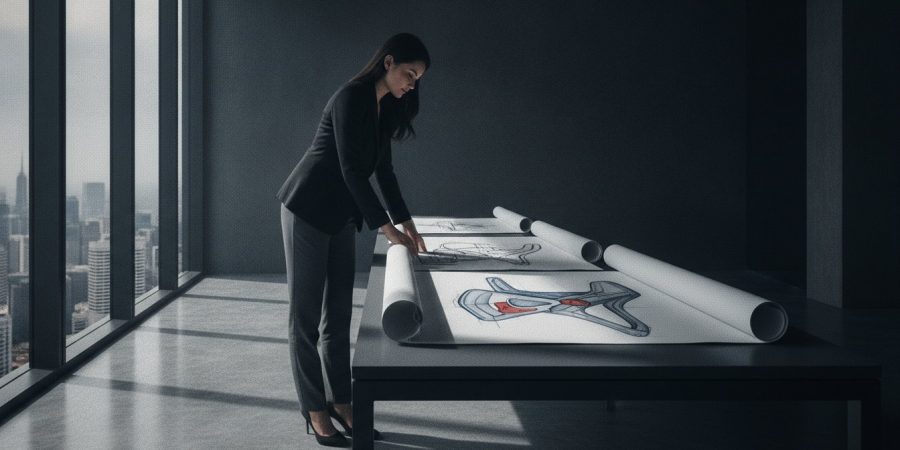
What if your most successful product design is currently being sold under a competitor’s name, and you lack the legal power to stop them? It’s a heavy thought. Most business owners understand that a product’s visual appeal is often its strongest selling point. However, the fear of seeing your unique aesthetics copied is real and justified. When you’ve invested months into perfecting a shape or pattern, protecting that investment against industrial design infringement Malaysia becomes a commercial necessity. You deserve the security of knowing your creative work is an enforceable asset, not just a target for imitation.
We recognize that the lines between patents, copyrights, and design rights often feel blurred. This guide provides the clarity you need to move forward with confidence. You’ll master the essentials of securing your product’s visual identity and navigating the legal landscape of the Malaysian market in 2026. We’ll provide a clear roadmap for MyIPO registration and a strategic approach to identify and halt unauthorized copying. By the end of this article, you’ll know exactly how to transform your designs into protected commercial assets that safeguard your business’s future.
Key Takeaways
- Understand the legal boundaries of industrial design and how the worldwide novelty standard affects your registration eligibility in 2026.
- Follow a structured roadmap for MyIPO registration; it’s essential to focus on high-quality representations that meet strict “individual character” requirements.
- Learn how to apply the “Informed User” test to identify and legally address industrial design infringement Malaysia within the five-year limitation period.
- Transform your visual identity into a commercial asset by integrating design protection into a broader strategy for licensing and franchising.
- Secure your market exclusivity for up to 25 years through proactive renewals and professional novelty searches that ensure you don’t face avoidable litigation.
Understanding Industrial Design Protection in Malaysia
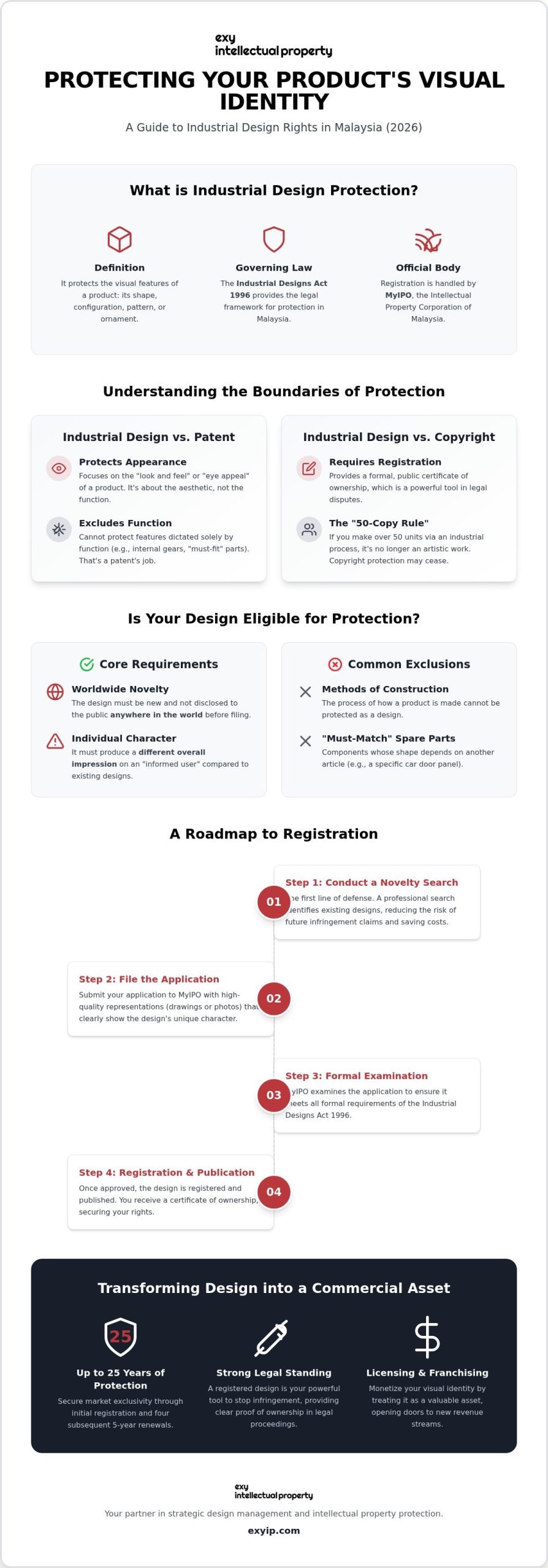
Protection begins with the Industrial Designs Act 1996. This legislation defines an industrial design as the features of shape, configuration, pattern, or ornament applied to an article by any industrial process. In the sophisticated consumer landscape of 2026, visual identity is often the primary driver of purchasing decisions. It’s the reason customers choose one smartphone or furniture piece over another. While patents safeguard technical functions and trademarks protect brand names, industrial design rights focus on the "look and feel." MyIPO, the Intellectual Property Corporation of Malaysia, acts as the official registry. Visuals drive market value. Securing a grant from MyIPO is the first step in building a defense against industrial design infringement Malaysia. If you don’t register, your product’s aesthetic value remains vulnerable to competitors who prioritize imitation over innovation.
The Aesthetic vs. Functional Debate
Design protection is strictly about appearance. It covers the external "eye appeal" of a product, which must be judged solely by the human eye. If a feature is dictated solely by the function the article has to perform, it’s excluded from protection. This includes "must-fit" parts, such as a replacement component that must be a specific shape to connect to another product. For example, the internal gear of a watch is functional; the unique, curved geometry of the watch face is aesthetic. Functionality belongs to patents. By Understanding Industrial Design Protection, you can identify which elements of your product are commercially valuable assets. It’s about securing the visual soul of your product while leaving the technical mechanics to patent law.
Industrial Design vs. Copyright
Creators often assume copyright is an automatic safety net. In Malaysia, the relationship between these two rights is complex. The law prevents dual protection; once you register an industrial design, copyright protection typically ceases to apply to that specific aesthetic. The "50-copy rule" is a critical threshold. If you produce more than 50 units of an item using an industrial process, the design is no longer viewed as a simple artistic work. Registration ensures legal clarity. Relying on copyright for mass-manufactured goods often leaves you with a weak legal hand. For a comprehensive understanding of how copyright infringement Malaysia rules interact with your design rights, business leaders should review the full scope of the Copyright Act 1987. Formal registration provides a clear, public certificate of ownership. This certificate is your most powerful tool when you need to stop industrial design infringement Malaysia in a court of law. Businesses that want to strengthen their ownership evidence beyond registration should also explore the copyright voluntary notification process in Malaysia, which provides prima facie proof of ownership through MyIPO’s formal submission system.
Eligibility Criteria: What Qualifies for Registration?
To qualify for protection, a design must be new. Malaysia adheres to a worldwide novelty standard. This means your design hasn’t been disclosed to the public anywhere in the world before your priority date. It isn’t enough for it to be new in Malaysia; it must be globally unique. If a similar design exists in a database in Europe or is sold on an e-commerce platform in China, your application could face rejection. Beyond novelty, the design must possess "individual character." It needs to produce a different overall impression on an informed user compared to existing designs. If it looks like a minor tweak of a common household item, it won’t pass the test.
Not everything is registrable. Methods of construction are excluded from protection. "Must-match" spare parts are also out. These are components whose shape is dependent on the appearance of another article, such as a specific car door panel or a printer cartridge. These exclusions prevent companies from monopolizing the secondary repair market. Public disclosure remains the biggest risk for entrepreneurs. Under Section 12(3) of the Industrial Designs Act 1996, Malaysia applies a strict worldwide novelty standard. Disclosing your design on social media or commercial websites before filing generally destroys novelty. The narrow six-month grace period strictly covers disclosures made at officially recognized international exhibitions or unlawful disclosures resulting from a breach of confidence. Filing first is the only way to ensure you can later stop industrial design infringement Malaysia.
The Importance of a Novelty Search
A professional search is your first line of defense. It identifies existing designs that could block your path. At Exy IP, we conduct thorough searches to ensure your design is truly unique. This proactive step significantly reduces the risk of facing an industrial design infringement Malaysia claim from a third party later. It’s much cheaper to pivot a design now than to fight a legal battle after production. You can start this process by exploring our Patent Novelty Search and registration services. We help you identify potential roadblocks before you commit to manufacturing.
Excluded Designs and Public Policy
Some designs are prohibited by law. Anything contrary to public order or morality is unregistrable. You also cannot include official emblems, state flags, or royal regalia in your design. Finally, remember the functional exclusion. If a product’s shape is dictated solely by its technical function, it belongs in the patent office. Design law protects how it looks; it doesn’t protect how it works. If your design is purely a result of engineering requirements, it won’t qualify for industrial design registration.
The Registration Process: From Filing to Grant
Securing a design grant requires more than just a creative idea. It demands a methodical approach to documentation and filing. Precision matters. Your drawings are the legal DNA of your application. They define exactly what you own and what you can defend. The process begins with preparing high-quality representations that show every unique angle of your product. Once these are ready, you file the application with MyIPO and pay the prescribed fees. Electronic filing has streamlined this stage, making it faster to establish your priority date. This date is your shield; it proves you were first in line.
Once the application is submitted, it undergoes a formal examination. MyIPO officials check for compliance with the Industrial Designs Act 1996. They ensure the application is complete and the design isn’t excluded from protection by public policy. If the application passes, it’s registered and a certificate is issued. This certificate is a powerful commercial tool. A registered right allows you to take swift action against industrial design infringement Malaysia. Your protection lasts for an initial five years. You can extend this for four subsequent five-year terms, providing a total of 25 years of market exclusivity. Consistent renewal is the only way to maintain this strategic advantage.
Indexing via Locarno Classification
Applications submitted to MyIPO must specify the appropriate class and sub-class under the Locarno Classification, an international classification system for industrial designs. Proper classification ensures your product is correctly indexed in the registry, avoiding formality objections and ensuring clear scope across market categories.
Preparing Your Application for Success
Clear visual representations are the most critical part of your filing. If your drawings are vague, the scope of your protection becomes uncertain. This uncertainty often leads to office actions or, worse, successful challenges from competitors. Common mistakes include inconsistent line weights or missing views that leave gaps in your ownership. For a deeper look at how to structure these filings effectively, consider our guide on design patent registration MY. Precision in your initial filing is the best way to prevent industrial design infringement Malaysia from becoming a recurring headache later.
Optimizing Legal Monopoly via Line Drawings
While MyIPO accepts high-resolution photographs, submitting clean black-and-white line drawings is generally preferred by IP specialists. Color photographs limit your legal monopoly strictly to the specific color scheme and surface finish shown. In contrast, line drawings secure protection over the underlying shape and configuration regardless of future color or material variations, providing a broader shield against copycats.
Going Global: The Hague Agreement in 2026
Malaysian businesses are no longer limited by geographic borders. Through the Hague Agreement, you can protect your designs in over 90 countries with a single international application. This centralized system eliminates the need to hire separate lawyers in every jurisdiction. It significantly reduces costs for exporters. You manage your entire global design portfolio through one point of contact. This streamlined approach ensures your visual identity is secured in every market where you do business. It transforms a local design into a global commercial asset with minimal administrative friction.
Managing Industrial Design Infringement in Malaysia
Discovery of a copycat product is a critical moment for any business. It isn’t just a legal issue; it’s a direct threat to your market share and brand reputation. To prove industrial design infringement Malaysia, courts apply the "Informed User" test. This hypothetical person is someone familiar with the specific product category, such as furniture or consumer electronics. They aren’t a casual shopper, but they aren’t a technical expert either. If the copycat product creates the same "overall impression" on this informed user as your registered design, you likely have a case for infringement.
Evidence is king. Act quickly. Delay can weaken your position. First, gather evidence by purchasing the suspected infringing product and keeping all receipts and packaging. Second, verify that your MyIPO registration is active and the renewal fees are paid. A well-drafted cease and desist letter is often the most efficient way to resolve these disputes. It serves as a formal warning, often prompting the infringer to pull the product from the market without the need for a full trial.
Remedies provide restitution. If the matter goes to court, several paths are available:
- Injunctions: A court order to immediately stop the sale and manufacture of infringing goods.
- Damages: Financial compensation for the loss your business suffered.
- Account of Profits: Requiring the infringer to hand over the revenue they generated from your design.
These legal tools are essential to address industrial design infringement Malaysia effectively.
The Legal Framework for Enforcement
The Industrial Designs Act 1996 provides the foundation for these rights. While civil litigation is the primary enforcement path, you can involve the Enforcement Division of the Ministry of Domestic Trade and Cost of Living (KPDN) for administrative and criminal enforcement against large-scale commercial counterfeiting. This is especially useful for large-scale counterfeiting. Establishing a strong case requires a documented history of your design’s evolution. For a deeper dive into these strategies, read our guide on intellectual property protection for designers. If you’re facing an immediate threat, our Intellectual Property Litigation team can help you evaluate your options.
Defending Against Infringement Allegations
Defending against allegations is equally critical. If you’re accused of infringement, don’t panic. Common defenses include challenging the validity of the registered design itself. If the design wasn’t actually new or original at the time of filing, it shouldn’t have been registered. "Prior use" is another powerful shield. If you can prove you were using the design before the other party filed their application, you may have a right to continue. Professional legal advisory ensures you don’t accidentally step on a competitor’s rights during the development phase.
Strategic Design Management with Exy Intellectual Property
Registration is just the beginning. True value lies in how you manage that protected asset over its 25-year lifespan. In the competitive market of 2026, a static registration isn’t enough. You need a strategy that integrates your product’s look into your overall business growth. Proactive monitoring is essential. By staying ahead of market copycats, you can address industrial design infringement Malaysia before it erodes your profit margins. We don’t just file papers; we build commercial fortresses. Our role is to ensure your visual identity remains a unique selling point that competitors cannot legally touch.
Understanding the economic worth of your design is a game-changer. IP valuation provides a clear picture of how your product’s visual identity contributes to your company’s bottom line. This data is vital for attracting investors or securing better terms during a merger. A design that’s both registered and valued becomes a tangible asset on your balance sheet. It transforms from a creative concept into a financial instrument that can drive your firm’s long-term health.
Turning Design into Revenue
Licensing is a powerful path to growth. By allowing third parties to use your registered design in exchange for royalties, you create a new income stream without the overhead of manufacturing. We help you structure these agreements to ensure your brand’s integrity remains intact. Often, a design’s success is tied to its brand name. Integrating your design strategy with trademark registration Malaysia creates a layered defense. This holistic approach ensures that both the look of your product and the name behind it are fully protected. Design assets can even be used to secure intellectual property financing, providing the capital needed for your next big innovation. For businesses seeking to maximize the financial leverage of their registered designs, applying a structured intellectual property valuation methodology can unlock access to funding and strengthen your position in M&A negotiations. If you’re considering scaling your business model beyond licensing, working with a franchise consultancy Malaysia partner can help you build a strategic fortress around your IP while expanding nationally.
The Exy IP Advantage
We act as your "Business-Savvy Guardian." Our team views intellectual property through the lens of a practical entrepreneur. We understand the commercial stakes of your work. Protecting a product often requires more than one type of right. Our expertise in patent filing services Malaysia ensures that your technical breakthroughs and aesthetic triumphs are equally secured. We don’t wait for problems to arise. We actively look for ways to add value to your portfolio. Securing your market exclusivity is our priority. Booking a consultation is the first step toward turning your creative vision into a protected, profitable reality that stands strong against industrial design infringement Malaysia.
Securing Your Design Legacy in 2026
Your product’s visual identity is its most powerful market differentiator. By securing a formal MyIPO registration, you transform creative effort into a 25-year strategic asset. This legal foundation is essential to identify and stop industrial design infringement Malaysia before it impacts your revenue or brand reputation. Whether you’re navigating the Hague Agreement for global export or resolving a local copycat dispute, clarity and speed are your best allies. Protecting the look of your innovation is a commercial necessity in a crowded marketplace.
At Exy IP, we act as your dedicated partner in this journey. Our specialized IP litigation experts and national Malaysian coverage ensure your professional interests are always in safe hands. We provide a comprehensive commercialization strategy that turns your designs into engines for long-term growth. Don’t leave your product’s aesthetic future to chance. It’s time to build a defense that is as robust as your design is unique. Protect your product’s visual DNA—contact Exy IP today. Your innovation deserves a guardian that understands the commercial stakes as well as you do.
Frequently Asked Questions
What is the difference between a design patent and an industrial design in Malaysia?
In Malaysia, the term "design patent" isn’t used legally; instead, we refer to industrial designs. An industrial design protects the visual features of shape, configuration, or pattern applied to an article. Conversely, a patent protects the functional and technical aspects of how a product works. If your innovation has both a unique look and a new technical mechanism, you might need both types of protection to secure your intellectual property fully and avoid future disputes.
How long does industrial design protection last in Malaysia?
Registered industrial design protection in Malaysia lasts for a maximum of 25 years. This term is divided into five-year periods. You receive an initial five years of protection from the filing date, which you can then extend for four subsequent five-year terms. It’s vital to track these renewal deadlines. Failing to pay the renewal fees to MyIPO results in the design entering the public domain, where it can no longer be protected against copycats.
Can I register a design that I have already started selling?
Generally, you cannot register a design that has already been disclosed or sold to the public. Malaysia follows a strict worldwide novelty standard. This means any public disclosure anywhere in the world before your filing date can disqualify your application. If you’ve already launched your product, your design is likely no longer "new" in the eyes of the law. Always file your application with MyIPO before your first marketing campaign or sales launch.
What constitutes industrial design infringement in Malaysia?
Industrial design infringement Malaysia occurs when a third party makes, sells, or imports an article that carries your registered design without consent. The legal test focuses on whether the competing product is "not substantially different" from yours. Courts use the "Informed User" perspective to determine if the overall visual impression is too similar. If the average savvy consumer would confuse the two designs, you likely have a strong case for legal action and restitution.
Do I need to register my design in every country I sell in?
Yes, industrial design rights are territorial. A registration in Malaysia only protects you within Malaysian borders. If you export your products, you should seek protection in those specific markets. Fortunately, the Hague Agreement allows Malaysian businesses to file a single international application covering over 90 countries. This centralized system is a cost-effective way to manage a global portfolio and prevent infringement on an international scale through one point of contact.
Can a 3D shape be protected as an industrial design?
A three-dimensional shape can certainly be protected as an industrial design. The Industrial Designs Act 1996 specifically includes "shape" and "configuration" in its definition. Whether it’s a unique furniture silhouette or a distinctive bottle design, the 3D form is registrable if it appeals to the eye. However, the shape cannot be dictated solely by the product’s technical function. If the shape is required for the product to work, it may require a patent instead.
What is the cost of industrial design registration with MyIPO?
The total cost of registration involves both MyIPO official filing fees and professional fees for drafting and strategic advice. Official fees vary depending on whether you’re filing a single application or a multiple-design application. While we don’t quote specific government fees here, it’s important to view these costs as a strategic investment. A registered design is an enforceable asset. It increases your company’s valuation and provides a clear path to licensing or franchising revenue.
How do I prove that someone has infringed on my design?
Proving industrial design infringement Malaysia requires a side-by-side comparison between your registered representations and the suspected copycat. You must demonstrate that the infringing article creates the same overall visual impression on an informed user. Evidence such as purchase receipts, marketing materials, and physical samples of the infringing goods are essential. Documenting the date you first discovered the copy is also critical; there is a five-year limitation period for taking legal action from the infringing act.