


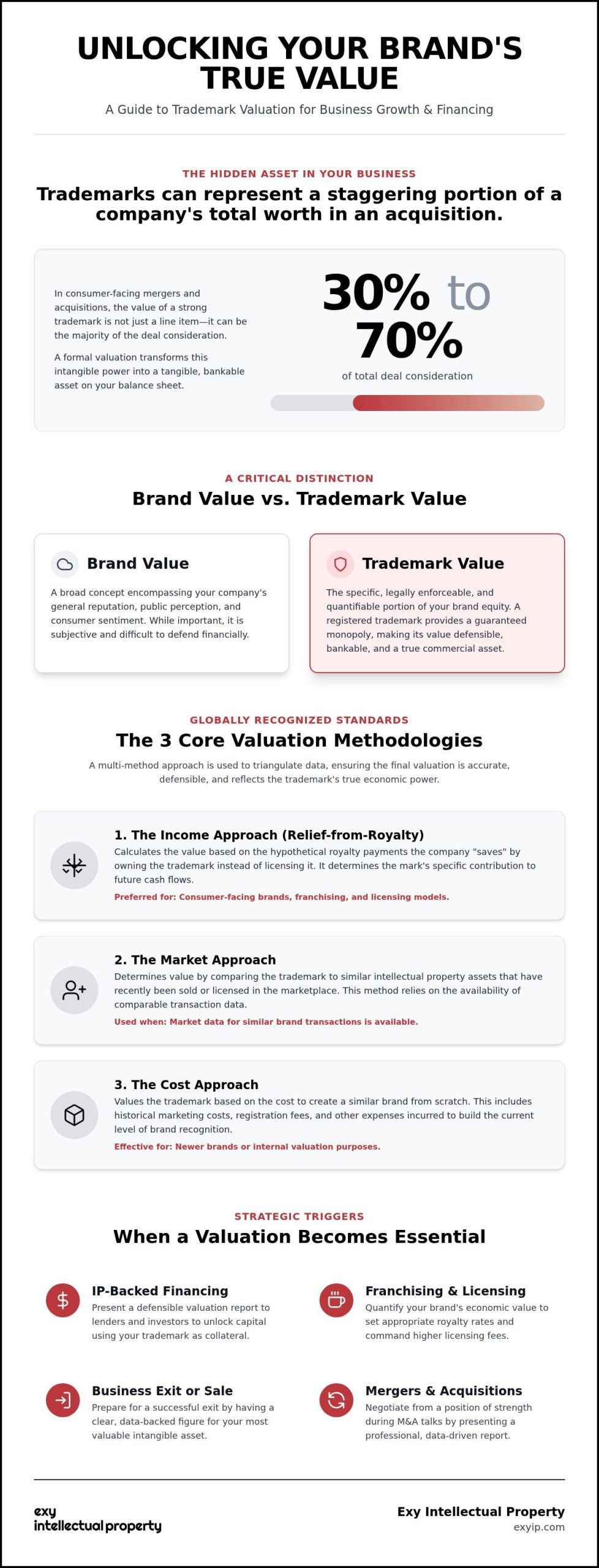
Value. In consumer-facing acquisitions, trademarks can represent 30% to 70% of the total deal consideration. This isn’t just a vanity metric; it’s the bedrock of your company’s market power. You’ve likely felt the frustration of having your hard-earned equity undervalued during negotiations or ignored by traditional lenders. Securing a formal trademark valuation for business is the critical step to ensure your intellectual property is treated with the commercial respect it deserves. It’s a common hurdle for Malaysian entrepreneurs who know their brand has immense potential but lack the technical data to prove its worth on a balance sheet.
Protection. This guide will show you how to quantify your brand’s economic value to secure IP-backed financing, command higher licensing fees, and prepare for a successful business exit. We’ll break down the Relief-from-Royalty method, discuss the 2026 landscape for strategic growth, and show you how a defensible valuation report becomes your strongest tool in franchising talks. Your brand is more than a logo; it’s your most valuable capital. We’re here to help you unlock it.
Key Takeaways
- Understand the three globally recognized methodologies—Cost, Market, and Income—used to determine the precise economic worth of your intellectual property.
- Learn why securing a formal trademark valuation for business is a mandatory prerequisite for companies looking to access IP-backed financing or scale through franchising.
- Discover the specific documentation required for a successful valuation audit, including registration certificates and historical marketing expenditure data.
- Gain the leverage needed to negotiate from a position of strength during mergers and acquisitions by presenting a defensible, professional valuation report.
- Explore how to transition your brand from a legal protection expense into a strategic commercial asset that drives long-term business growth.
What is Trademark Valuation and Why Does it Matter in 2026?
Growth. In the 2026 business landscape, trademarks are no longer viewed as static legal expenses; they are dynamic economic engines. Trademark valuation for business is the process of determining the total economic value of a brand’s protected marks. Historically, many companies only sought these figures during litigation or bankruptcy proceedings. Today, savvy entrepreneurs use valuation as a proactive commercial strategy to unlock capital and scale operations. It’s the difference between owning a name and owning a bankable asset.
Accuracy. Traditional book value often fails to capture the true power of a trademark. Accounting standards typically record intangible assets at their historical cost of registration, which might be a negligible amount on a balance sheet. However, the fair market value of that same mark could be worth millions based on its revenue-generating potential. Trademark valuation for business is the formal financial assessment of a company’s registered brand identifiers to determine their specific contribution to the organization’s total market value.
The Difference Between Brand Value and Trademark Value
Distinction. It’s easy to confuse these two concepts, but the difference is vital for your commercial strategy. Brand value is a broad term covering the general reputation and consumer sentiment surrounding your business. Trademark value is the specific, legally enforceable portion of that equity. Registered trademarks carry significantly higher weight in a valuation report than unregistered ones because they offer a guaranteed monopoly over a specific name or logo. This legal certainty is why trademark registration Malaysia is the essential first step for any business owner looking to quantify their worth. Without registration, your brand’s economic value remains vulnerable and difficult to defend in a boardroom.
Economic Drivers of Trademark Worth
Leverage. Several commercial factors influence the final valuation of your intellectual property. Market share and consumer recognition are the primary drivers; a brand that consistently wins the "mental shelf space" of a customer is naturally more valuable. Geographic reach also plays a role. A trademark with national-level protection in Malaysia provides a solid foundation, but global enforceability expands the potential revenue streams through international licensing and franchising opportunities.
Strength. The legal robustness of your mark is equally important to its financial standing. Evaluators look at how unique the mark is and how effectively it has been defended against infringement. By applying standardized Intellectual property valuation methodologies, experts can determine if your brand’s economic influence is sustainable over the long term. This data provides the leverage you need when talking to investors, securing financing, or negotiating a high-stakes franchise agreement. If your business also holds patents alongside trademarks, exploring dedicated patent valuation services can further strengthen your overall IP portfolio’s bankable worth.
Establishing Base Protection via MyIPO
Because statutory registration is the prerequisite for valuation, local SMEs should leverage MyIPO’s fee assistance programs. Qualifying businesses with an annual sales turnover below RM 500,000 can access fee reductions on government e-filing charges (lowering base class filing fees by RM 300), making initial brand capitalization accessible to early-stage enterprises.
The 3 Core Methodologies of Intellectual Property Valuation
Strategy. Selecting the appropriate framework for trademark valuation for business requires a balance of financial rigor and commercial insight. While several technical variations exist, the industry relies on three globally recognized standards to quantify intangible worth. A professional firm won’t just rely on a single calculation; they use a multi-method approach to ensure the final report is defensible during high-stakes negotiations or audits. This triangulation of data provides a more accurate reflection of a brand’s true economic power. For a deeper dive into these technical frameworks, you can explore our comprehensive guide on intellectual property valuation methodology.
The Income Approach (Relief-from-Royalty)
Efficiency. The Income Approach is the preferred standard for consumer-facing brands, specifically through the Relief-from-Royalty method. It operates on a logical premise: how much would your company have to pay in licensing fees if you didn’t already own the trademark? By calculating these hypothetical "saved" royalty payments over a projected period, experts can determine the trademark’s specific contribution to future cash flows. This method is particularly effective for franchising and licensing because it directly mirrors the revenue-generating mechanics of those business models. Recent research on the value of trademarks suggests that strong brand identifiers significantly reduce capital costs and improve long-term profitability, making this income-based perspective vital for growth-oriented companies.
The Market and Cost Approaches
Comparison. The Market Approach is highly intuitive but depends on data transparency. It involves comparing your trademark to recent sales or licensing deals of similar brands within your specific industry. While this provides a "real-world" benchmark, it can be challenging if recent transaction data is kept private. The Cost Approach, by contrast, looks backward. It calculates the total investment required to recreate the trademark from scratch, including design, legal registration fees, and historical marketing expenditure over the last three to five years.
Validation. Most professional reports use the Cost or Market methods as secondary validation points to support the primary Income Approach. This layered analysis ensures your trademark valuation for business stands up to the scrutiny of banks, investors, and potential buyers. If you’re preparing for a significant corporate deal, our team can help you identify which approach aligns best with your commercial goals through a professional Intellectual Property Valuation assessment.
Adherence to International Valuation Standards (IVS 210)
For a trademark valuation report to stand up during bank due diligence or M&A audits, it must comply with IVS 210 (Intangible Assets). Adhering to these global standards ensures that cash flow projections, discount rate builds (WACC plus asset-specific risk premiums), and Tax Amortization Benefits (TAB) meet the strict compliance requirements of financial institutions and Big 4 auditors.
Strategic Triggers: When Does Your Business Need a Valuation?
Opportunity. While many founders view valuation as a reactive measure, the most successful 2026 enterprises use it as a proactive catalyst for expansion. Identifying the right strategic triggers ensures you aren’t just protecting your IP but actively leveraging it. Whether you’re entering a merger or seeking growth capital, a formal trademark valuation for business provides the empirical data needed to back up your commercial claims. It moves the conversation from abstract brand strength to concrete financial performance.
Capital. Securing IP-backed financing is a major driver in the current market. Traditional lenders often struggle to quantify intangible assets, but a defensible report allows you to use your trademark as collateral for significant growth funding. Similarly, in Mergers and Acquisitions, a precise valuation prevents you from leaving money on the table. Without it, your brand’s equity is often lumped into a vague "goodwill" category, potentially costing you millions in deal consideration. You wouldn’t sell a factory without an appraisal; your brand deserves the same level of financial scrutiny. Businesses with innovation-driven portfolios should also consider how professional patent valuation services can complement their trademark strategy to present a complete picture of IP-backed collateral to lenders.
Compliance. Beyond external deals, internal licensing and litigation require financial clarity. Corporate groups often use valuation to set fair market royalty rates for internal IP transfers, which helps in optimizing tax structures across different jurisdictions. In cases of infringement, having a pre-established value is essential for quantifying damages and securing a favorable settlement. The International Trademark Association emphasizes the importance of the Valuation of Trademarks for these exact scenarios, ensuring that legal rights translate into measurable financial recovery.
Scaling Through Franchising and Licensing
Expansion. If you plan to scale, valuation is your baseline. It determines the royalty rates you can realistically charge in franchise agreements. A professional report doesn’t just satisfy your accountants; it serves as a powerful recruitment tool. High-quality franchisees are more likely to invest in a brand that can demonstrate its economic worth through a structured audit. By engaging a specialist in franchise consultancy Malaysia, you ensure your expansion strategy is built on a foundation of bankable data rather than guesswork.
Preparation for Business Exit or IPO
Liquidity. Investors demand transparency during due diligence. When preparing for an IPO or a total business exit, a clear trademark valuation for business maximizes the "goodwill" component of your sale. We’ve seen tech firms in the Malaysian market significantly increase their exit price simply by moving their IP from an undervalued line item to a strategically appraised asset. It turns a "maybe" from a buyer into a "must-have" by proving the brand’s long-term revenue potential and market defensibility. Tech founders preparing for a Seed or Series A round can gain a significant advantage by understanding the full scope of ip valuation for tech startups to ensure their intangible assets are fully quantified before investor negotiations.
How to Prepare Your Business for a Trademark Valuation Audit
Preparation. A successful audit depends on the quality of the data you provide. Before an expert can calculate the economic worth of your brand, they need a comprehensive view of its historical performance and legal standing. Organizing your records early doesn’t just speed up the process; it ensures the final report is robust enough to withstand scrutiny from tax authorities, investors, or potential buyers. Preparing for a trademark valuation for business requires a methodical approach to data collection across several key areas of your operation.
- Legal Proof: Gather all registration certificates and proof of recent renewals to establish clear ownership and validity.
- Investment History: Compile marketing and advertising spend data over the last 3-5 years to demonstrate the capital invested in building brand recognition.
- Financial Performance: Document historical revenue and profit margins specifically linked to branded products or services to prove direct economic contribution.
- Risk Assessment: Identify any current or past legal challenges, oppositions, or infringement cases involving the mark, as these affect its perceived strength and risk profile.
The Role of the ‘Business-Savvy Guardian’
Reliability. While internal estimates are useful for planning, banks, courts, and regulatory bodies require an independent, third-party report to verify your claims. There is a significant difference between a rough estimate and a certified valuation report; the latter follows strict professional standards and carries the weight of legal authority. Our team acts as your strategic partner, ensuring your data is organized to minimize valuation time and cost. By providing a clear, defensible document, we help you transition from claiming value to proving it in a commercial setting.
Assessing the Competitive Landscape
Context. Your trademark doesn’t exist in a vacuum. To determine its true worth, we must identify your closest market competitors and analyze their brand positioning relative to yours. This involves studying industry-standard royalty rates for similar trademarks to ensure your valuation is grounded in current market trends. A thorough analysis of the competitive environment ensures that the final valuation conclusion is anchored in market reality rather than theoretical projections. If you’re ready to quantify your brand’s standing, our specialists can provide a comprehensive Intellectual Property Valuation to support your next strategic move.
Maximizing Your Brand Value with Exy Intellectual Property
Partnership. At Exy Intellectual Property, we don’t view your brand as a static file; we see it as a dynamic engine for growth. Our role is to bridge the gap between technical legal protection and the high-level commercial growth your business deserves. In the 2026 Malaysian market, simply holding a registration certificate isn’t enough to secure a competitive edge. You need to understand the precise economic weight of that certificate to unlock its true potential. A formal trademark valuation for business provides the transparency required to turn an intangible asset into a bankable reality.
Integration. Moving from protection to profit requires a cohesive commercialization strategy that views every mark as a revenue driver. We guide you through the entire lifecycle of your intellectual property, from the initial registration to securing IP-backed financing and beyond. By integrating professional valuation into your long-term planning, you ensure that your brand is always positioned for maximum leverage, whether you’re negotiating a local partnership or expanding into international markets. Our commitment is to the long-term health of national business growth through meticulous and professional IP management.
Beyond the Numbers: Strategic Advisory
Execution. A valuation report is only as powerful as the strategy that follows it. We use your trademark valuation for business as a tool to negotiate better licensing deals and more favorable franchise agreements. Our advisory services focus on ongoing asset management to ensure your trademark’s value increases over time. We help you identify underutilized aspects of your brand and develop plans to strengthen its market position. For businesses seeking international legal support during these strategic transitions, check out Matthew Fornaro, P.A. for specialized business law counsel. 2026 is the year to stop treating your IP as a secondary administrative task and start treating it as your primary revenue driver.
Get Started with a Strategic IP Consultation
Clarity. Every business journey is unique. During your initial valuation discovery session, we’ll analyze your current portfolio, identify key value drivers, and discuss your specific goals for growth or exit. We provide customized solutions tailored to the needs of agile startups looking for their first round of funding, as well as established franchises preparing for a national rollout. Our methodical process ensures that every detail of your brand equity is captured and quantified. It’s time to stop guessing what your brand is worth and start knowing. Secure your brand’s future with a professional trademark valuation and take the first step toward unlocking your strategic worth.
Securing the Future of Your Brand Equity
Transformation. Your brand is no longer just a name on a registration certificate; it’s a measurable financial asset that dictates your company’s market power. We’ve explored how a professional trademark valuation for business moves your intellectual property from the legal department to the boardroom. By quantifying your brand’s economic worth, you gain the leverage needed to secure IP-backed financing, negotiate superior licensing terms, and command a higher price during a business exit. It’s the foundation of a modern commercialization strategy.
Growth. Exy Intellectual Property is an established leader in Malaysian IP strategy, specializing in commercialization and franchising consultancy. We provide the defensible valuation reports required to satisfy banks, investors, and M&A partners. Our team ensures your professional interests are in safe hands, helping you navigate the complexities of 2026’s regulatory landscape with confidence. Don’t let your brand’s true value remain hidden on your balance sheet. Unlock the economic value of your brand with Exy IP’s valuation services. Your journey toward a more bankable future starts with a single, strategic assessment.
Frequently Asked Questions
How much does a professional trademark valuation cost?
Professional fees for a trademark valuation for business vary based on the scope of the project and the complexity of your intellectual property portfolio. Factors such as the number of classes, geographic reach, and the intended use of the report influence the final cost. Because each business has a unique market position, we provide customized quotes after an initial discovery session to ensure the fee reflects the technical depth required for a defensible report.
Can I value a trademark that hasn’t been registered yet?
You can value an unregistered mark, but the resulting figure is often substantially lower than that of a registered trademark. Registered marks provide a legal monopoly that is much easier to defend in court or present to investors. Unregistered marks rely on common law rights, which require extensive proof of use and reputation. Securing a formal registration is the most effective way to stabilize and increase the bankable worth of your brand before an audit.
How long is a trademark valuation report valid for?
Most trademark valuation reports remain valid for six to twelve months, depending on the volatility of your industry. Market dynamics, consumer sentiment, and competitive entries can shift the economic landscape quickly. If you’re using the report for a specific transaction like a business exit or a financing application, lenders usually require the data to be as current as possible. Regular updates ensure your commercialization strategy is always based on accurate, real-time figures.
What is the most common method for valuing a business trademark?
The Relief-from-Royalty method is the most widely accepted technique for a trademark valuation for business. This approach falls under the Income Approach and calculates the hypothetical royalty payments you save by owning the mark instead of licensing it from a third party. It’s particularly favored by financial institutions and courts because it uses market-based royalty rates to provide a concrete, logical link between the trademark and the company’s actual cash flow.
Will a trademark valuation help me get a bank loan in Malaysia?
A professional valuation is a critical prerequisite for securing intellectual property financing in Malaysia. While traditional banks historically focused on physical assets like property, the 2026 financial landscape increasingly recognizes intangible assets as valid collateral. A defensible valuation report provides the empirical evidence a lender needs to quantify the risk and worth of your brand. This transparency allows you to unlock growth capital without diluting your equity through venture capital or private investors.
How does trademark infringement affect my brand’s value?
Infringement can significantly diminish your brand’s value by diluting its market exclusivity and creating consumer confusion. When a competitor uses a similar mark, it weakens your brand’s mental shelf space and potentially redirects your revenue streams. A valuation audit considers these risks by analyzing the enforceability factor. If your mark has a history of successful defense through intellectual property litigation, its value remains robust; however, unresolved infringement can lead to a lower final appraisal.
What documents do I need to provide for a valuation audit?
You’ll need to provide several key documents to ensure a thorough and accurate audit of your brand’s worth. This includes all registration certificates, proof of renewals, and a breakdown of marketing and advertising expenditure over the last three to five years. Financial statements specifically highlighting revenue and profit margins for branded products are also essential. Finally, you should document any past or current legal challenges to the mark to help the evaluator assess the overall risk profile.
Is brand valuation the same as trademark valuation?
These terms are often used interchangeably, but they represent different commercial concepts. Brand valuation is a broad assessment of a company’s total reputation, consumer sentiment, and market influence. Trademark valuation is a narrower, more technical process that focuses specifically on the legally protected marks and logos. While a brand’s reputation drives value, the trademark is the legal vessel that allows you to capture, defend, and monetize that value in a professional contract or business deal.