


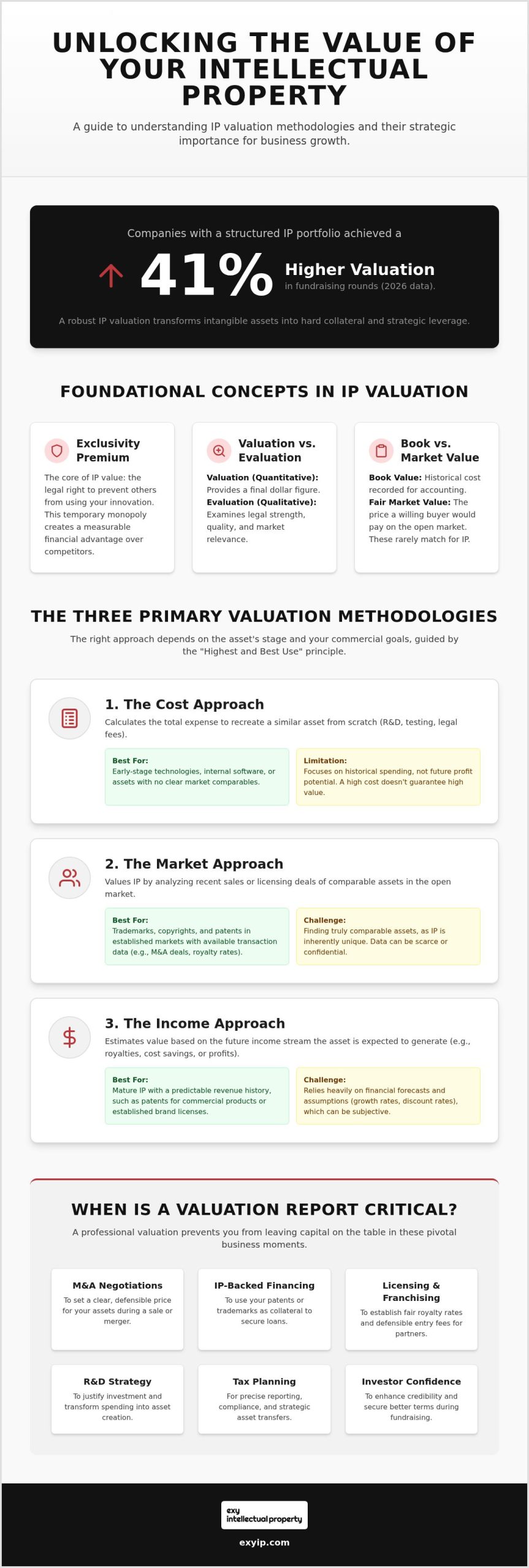
Did you know that companies with a structured IP portfolio raised funds at a 41% higher valuation in 2026 compared to those without? It’s a staggering gap. For many business owners, intellectual property represents their greatest source of untapped wealth, yet it remains frustratingly difficult to quantify without a robust intellectual property valuation methodology. You might find yourself struggling to secure a loan using your intangible assets or feeling uncertain during high-stakes M&A negotiations because you can’t clearly articulate what your brand is worth. It’s a common challenge that often leaves significant capital on the table.
We understand that your innovations are the heartbeat of your enterprise. This guide provides the clarity you need to transform your intangible ideas into hard collateral and strategic leverage. We’ll show you how to master the core frameworks used to calculate the economic value of your assets to unlock financing and drive growth. We’ll explore the specific tools for assessment, prepare you for IP-backed lending, and position your brand for more lucrative licensing deals. Your assets deserve to be recognized; let’s ensure they’re valued correctly.
Key Takeaways
- Understand how the transition toward intangible assets makes precise valuation a critical tool for modern business growth and security.
- Master the “Big Three” globally recognized approaches to determine which intellectual property valuation methodology best aligns with your specific asset type.
- Learn how legal robustness and a well-drafted patent act as primary value drivers to enhance investor confidence and secure better terms.
- Identify the pivotal moments, such as M&A negotiations or IP-backed financing, where a professional valuation report prevents you from leaving capital on the table.
- Discover how a strategic blend of legal expertise and commercial analysis builds the foundation for successful licensing and franchising deals.
What is Intellectual Property Valuation and Why Does it Matter?
Intellectual Property Valuation is the formal process of determining the monetary worth of assets that lack a physical form. These include patents, trademarks, industrial designs, and trade secrets. In 2026, the global business environment has shifted decisively. Intangible assets now dominate corporate balance sheets. The global IP valuation services market is estimated at USD 14.16 billion in 2026, reflecting a reality where your brand identity or proprietary tech often holds more value than physical equipment. Selecting the correct intellectual property valuation methodology is the first step in unlocking this hidden capital.
Value arises from the "Exclusivity Premium." This is the legal right to stop others from using your innovation. If you own a patent, you have a temporary monopoly. This right to exclude creates a measurable financial advantage. It’s the difference between a generic product and a market-leading solution. Strategic owners must also distinguish between book value and fair market value. Book value is an accounting figure based on historical cost. Fair market value is what a willing buyer would pay in an open market. In the IP context, these numbers rarely match. A trademark might have a low book value but be worth millions in a licensing deal.
The Role of IP in Modern Corporate Strategy
Strategic leaders use valuation to justify heavy R&D spending to shareholders. It transforms "spending" into "asset creation." Valuation also supports a franchise consultancy Malaysia strategy by setting clear, defensible entry fees for new partners. Beyond growth, it’s essential for internal asset management and precise tax planning. Knowing the value of your assets helps you allocate resources where they’ll generate the highest return. It provides a roadmap for where to invest and which assets to prune.
Valuation vs. Evaluation: Understanding the Difference
Don’t confuse valuation with evaluation. Quantitative valuation provides the final dollar figure. Qualitative evaluation examines the asset’s actual quality, legal strength, and market relevance. You can’t achieve an accurate figure without a technical novelty search. This search confirms your asset is unique and enforceable. Without this foundation, any intellectual property valuation methodology is just guesswork. If the underlying patent is weak, the valuation figure will collapse under scrutiny. Ultimately, IP valuation is a sophisticated blend of legal protection and economic forecasting.
The Three Primary Intellectual Property Valuation Methodologies
Selecting the right intellectual property valuation methodology is a strategic decision that depends on your asset’s development stage and your specific commercial goals. Valuation experts typically rely on the "Big Three" globally recognized approaches. To find the most accurate figure, we often look at the "Highest and Best Use" (HBU). This principle ensures the asset is valued based on its most profitable, legally permissible, and physically possible application. When you utilize professional patent filing services Malaysia, you create the high quality documentation required to support these sophisticated models.
The Cost Approach: Replacement and Reproduction
Precision starts with understanding what it would take to build the asset again. The Cost Approach calculates the total expense of recreating a similar asset from scratch. This includes R&D hours, testing, and legal fees. It is particularly useful for early stage technologies or internal software where no clear market comparables exist. However, this method has a significant limitation. It focuses on historical spending rather than future profit potential. Just because a patent cost $50,000 to develop doesn’t mean it will generate millions in revenue.
The Market Approach: Comparative Transaction Analysis
This method values your IP by looking at what similar assets have sold for in the open market. It relies on real world data from recent M&A deals and established royalty rates. For example, software royalty rates in May 2026 typically range between 8% and 12% of net sales. The primary challenge here is "uniqueness." Because intellectual property is by definition one of a kind, finding a perfect match is difficult. We solve this by adjusting for factors like market share and geographic reach to find a fair comparative value.
The Income Approach: Future Economic Benefits
The Income Approach is the most common intellectual property valuation methodology for established brands and patents. It uses Discounted Cash Flow (DCF) analysis to forecast the future revenue specifically attributable to the asset. A key component is the Relief from Royalty method. This specific technique calculates the value of an IP asset by determining the hypothetical royalty payments you would save by owning the asset rather than licensing it from someone else. By isolating the cash flow generated solely by the IP, we can provide a clear picture of its long term economic contribution to your business. If you’re preparing for a licensing deal, ensuring your portfolio is professionally appraised can significantly strengthen your negotiating position. For patent-heavy businesses, engaging professional patent valuation services transforms these technical assets into measurable financial instruments that support licensing negotiations and IP-backed financing. For brand-heavy businesses, understanding trademark valuation for business is especially critical, as trademarks can represent 30% to 70% of total deal consideration in consumer-facing acquisitions.
Qualitative Factors: What Drives the Value Up or Down?
While a quantitative intellectual property valuation methodology produces a preliminary dollar figure, the actual commercial worth is refined by qualitative "strength" factors. These variables act as multipliers or discounts. Precision matters. A weak claim can sink a valuation. Beyond the numbers, we look at the "Freedom to Operate" (FTO). This factor assesses whether your asset can be commercialized without infringing on third-party rights. High FTO reduces legal risk, which in turn increases the risk-adjusted value for investors and lenders. If an asset is shadowed by potential litigation, its value drops regardless of its revenue potential.
Market position is the ultimate test of an asset’s worth. In 2026, sophisticated investors prioritize defensibility over simple growth rates. They often ask a critical question: Could a competitor replicate this IP for $5 million within 18 months? If the answer is no, your competitive moat is deep. This defensibility directly inflates the valuation because it guarantees a longer period of market dominance. We also analyze the remaining economic life of an asset. While a patent may have a legal life of 20 years, we must account for the rapid pace of technological obsolescence. An asset that will be technologically irrelevant in five years cannot be valued based on a twenty-year horizon.
The Impact of Registration Quality
Registration quality is the bedrock of value. A successful trademark registration Malaysia process provides the legal baseline for any brand-heavy valuation. However, value increases significantly when the registration is strategically broad. In patent drafting, broad claim coverage creates a wider "competitive moat" that’s harder for rivals to bypass. Similarly, robust Industrial Design Protection prevents copycats from eroding your market share by mimicking your product’s unique aesthetic. High-quality registration ensures that the legal protection is as robust as the technology itself, protecting the asset from value erosion. For businesses with international ambitions, a Madrid Protocol trademark filing extends this legal foundation across multiple markets simultaneously, directly enhancing the geographic scope and therefore the assessed value of your brand assets.
Surviving Post-Grant Challenges
In 2026, valuation accuracy depends heavily on whether a patent can survive third-party challenges post-grant. Under Sections 55A and 56A of the Patents (Amendment) Act 2022, competitors have a strict six-month window from grant publication in the IP Official Journal (IPOJ) to initiate post-grant administrative oppositions at MyIPO. Patents with multi-layered dependent claims retain a higher risk-adjusted valuation because they are significantly harder for competitors to invalidate.
Commercialisation and Portfolio Synergy
Value peaks through portfolio synergy. We often see "IP Bundles" where trademarks, patents, and designs work in unison. This creates a multi-layered barrier to entry that is far more valuable than any single asset. Scalability is another vital driver. Can the IP be licensed across borders easily? Assets that are ready for global expansion command higher premiums because they represent a "plug-and-play" growth opportunity for partners. Finally, we consider brand reputation. This is often captured as "Goodwill" in financial statements. A trusted brand name attached to a patented technology makes the entire package more attractive to M&A partners and justifies a higher royalty rate.
Practical Scenarios: When Your Business Needs a Valuation Report
Precision. That is what a valuation report delivers to a modern enterprise. It transforms your intangible assets into a documented financial instrument. In 2026, relying on guesswork during a transaction is a significant risk. You need a formal intellectual property valuation methodology to provide the transparency that partners and lenders demand. Without it, you risk underselling years of research or losing leverage in a high stakes negotiation.
Mergers and acquisitions (M&A) represent the most common scenario for these reports. Sellers use them to defend their asking price, while buyers use them to ensure they aren’t overpaying for "blue sky" potential. Similarly, in licensing and franchising, a report sets defensible royalty rates. For example, in the 2026 market, SaaS and pharmaceutical royalty rates often reach 15% or higher. Having a report that justifies these figures based on market benchmarks makes the negotiation process smoother and more professional.
Securing Investment and Financing
IP-backed lending has become a mainstream financial strategy in 2026. Financial institutions now increasingly accept intellectual property as collateral for non-dilutive loans. Venture capitalists also look for a formal intellectual property valuation methodology during their due diligence. They want to see that your portfolio is defensible. Statistics show that companies with a structured IP portfolio raised funds at a 41% higher valuation gap compared to those without. A valuation report speeds up this process by providing an "investor ready" view of your assets. It serves as a bridge between your technical innovation and the bank’s credit committee, making your business a more attractive candidate for capital. Startups seeking to leverage their innovations should consider dedicated patent valuation services to produce the credible, independent reports that satisfy lender and investor due diligence requirements.
Navigating Local IP-Backed Financing Frameworks
In Malaysia, leveraging patents or trademarks as loan collateral relies on the legal recognition of IP as personal movable property under statutory amendments (such as Section 58 of the Patents Act 1983). Banks require valuation reports prepared by certified, independent valuation specialists that adhere to International Valuation Standards (IVS 210 for Intangible Assets) to satisfy internal risk management committees.
Litigation and Dispute Resolution
Valuation reports are critical tools in the courtroom. When infringement occurs, you must prove the actual economic damage to your business. This involves calculating lost profits or determining what a "reasonable royalty" would have been. In 2026, the strategic use of valuation is particularly vital in industrial design infringement Malaysia cases. A report helps settle disputes quickly by providing a clear, objective dollar figure that both parties can use as a basis for mediation. It moves the conversation from emotional grievances to commercial realities. If you are ready to unlock the financing potential of your portfolio, consider our specialized Intellectual Property Valuation solutions to secure your growth.
Executing a Strategic IP Valuation with Exy Intellectual Property
Exy Intellectual Property bridges the gap between legal protection and commercial success. We don’t view valuation as a static accounting exercise. Instead, we utilize a dynamic intellectual property valuation methodology that integrates technical legal depth with real world market intelligence. This dual approach ensures that your report stands up to the scrutiny of banks, investors, and potential acquisition partners. We transform your intangible assets into verifiable business leverage.
Our process begins with the foundation. A technical novelty search is essential. It confirms the uniqueness of your innovation, providing the necessary evidence to support a premium valuation. From this foundation, we develop customized valuation reports tailored to your specific objectives. Whether you’re seeking IP-backed financing or negotiating a complex licensing agreement, our reports provide the clarity you need. We also provide ongoing IP asset management. This proactive service ensures your portfolio continues to grow in value as your business scales and market conditions evolve.
The Exy IP Advantage: Business-Centric Guardianship
Expertise meets partnership. We act as your "Business-Savvy Guardian," which means we look at your IP through the eyes of an entrepreneur. We prioritize your long term interests, ensuring that every legal decision supports your broader commercial roadmap. You gain access to our national network of specialists who understand the specific nuances of the Malaysian market in 2026. By integrating valuation into your strategy, we help you transform legal costs into profit centers. Our goal is your sustained commercial growth.
Next Steps for Your IP Portfolio
Progress starts with an audit. An initial IP audit helps identify hidden assets that may not be on your current registry but hold significant economic potential. Once these are identified, you should prepare all relevant technical and financial documentation. This preparation streamlines the professional valuation engagement and ensures the highest degree of accuracy. Documentation is the key to defensibility. If you are ready to discover the true economic worth of your innovation, contact Exy Intellectual Property. We provide the strategic consultation needed to turn your intangible ideas into tangible growth.
Unlocking the Economic Potential of Your Innovations
Your intellectual property is more than a legal certificate; it is a powerful commercial tool. Throughout this guide, we’ve explored how mastering a robust intellectual property valuation methodology allows you to quantify the true worth of your innovation. By balancing quantitative formulas with qualitative factors like legal robustness and market defensibility, you move beyond simple protection toward active commercialization. Whether you are preparing for a high stakes M&A negotiation or seeking non-dilutive financing, having a professional valuation report ensures you never leave capital on the table.
Exy Intellectual Property stands ready to help you navigate this transition. We provide specialised IP valuation and financing solutions backed by comprehensive legal advisory and expertise in strategic commercialisation. Our team ensures your assets are not just registered but actively working to support your long term business health. Secure your business future—consult Exy IP for a strategic valuation today. Your innovations represent the future of your enterprise. Let’s work together to ensure that future is as valuable as it can be.
Frequently Asked Questions
What is the most accurate IP valuation methodology for a tech startup?
The Income Approach is widely considered the most accurate intellectual property valuation methodology for tech startups. It focuses on the net present value of future cash flows the asset is expected to generate. This is more useful than the Cost Approach because a startup’s value lies in its future potential rather than historical R&D spending. Investors prioritize this forward looking data during due diligence rounds to justify their capital injection and assess scalability.
How often should a business update its intellectual property valuation?
You should update your valuation every 12 to 18 months or whenever a significant business milestone occurs. Major triggers include entering new geographic markets, launching a new product line, or preparing for a funding round. Because market conditions and technology lifecycles change rapidly in 2026, an outdated report may lead to undervalued assets during critical negotiations. Regular updates ensure your balance sheet reflects the current commercial strength of your portfolio.
Can I use my IP valuation report to get a bank loan in Malaysia?
Yes, you can use a professional valuation report to facilitate intellectual property financing in Malaysia. Financial institutions are increasingly accepting patents and trademarks as collateral for loans to support business expansion. A formal report provides the objective evidence banks require to assess the risk and value of your intangible assets. This allows you to access non dilutive capital without giving up equity, helping you maintain control of your company.
What is the difference between IP valuation and an IP audit?
An IP audit is a systematic review to identify and catalog your assets, while a valuation determines their specific monetary worth. The audit focuses on legal ownership, registration status, and potential risks or gaps in your protection. Valuation follows the audit by applying a specific intellectual property valuation methodology to translate those protected assets into a dollar figure. Both are essential for a comprehensive commercialization strategy and long term portfolio management.
Does a trademark registration automatically increase my company’s value?
Trademark registration provides the essential legal foundation that makes your brand value defensible, but it doesn’t automatically create a specific dollar amount. The actual value comes from how you commercialize that brand and the market share you capture. However, without registration, your brand has almost no transferable value. You don’t own the exclusive right to exclude competitors, which makes the asset high risk for any potential buyer or investor. To fully understand how your brand contributes to your company’s worth, a dedicated trademark valuation for business assessment provides the commercial evidence needed to command higher licensing fees and secure IP-backed financing.
How long does a professional IP valuation process typically take?
A professional valuation typically takes between two and four weeks to complete. This timeframe allows for a thorough review of your financial data, market comparables, and the technical strength of your legal registrations. Complex portfolios with multiple international patents may require additional time for deep market analysis. Starting the process early ensures you have a defensible report ready before you enter high stakes M&A or licensing negotiations with global partners.
What documents are required to start an IP valuation?
You will need to provide your IP registration certificates, historical financial statements, and any existing licensing or franchise agreements. Additionally, documentation regarding R&D expenditures and market research helps the valuer understand the asset’s competitive position. Providing a clear roadmap of your commercialization strategy is also vital. This data allows the expert to build a more accurate and defensible forecast of the asset’s future economic benefits and risk profile.
Can I value my IP myself or do I need a professional firm?
While you can perform internal estimates, you need a professional firm to produce a report that is defensible to third parties. Banks, venture capitalists, and tax authorities require an independent, objective assessment conducted by specialists. A professional firm like Exy IP provides the necessary technical depth and market credibility. This ensures your valuation stands up to scrutiny during due diligence and helps you secure the best possible terms for your growth.