


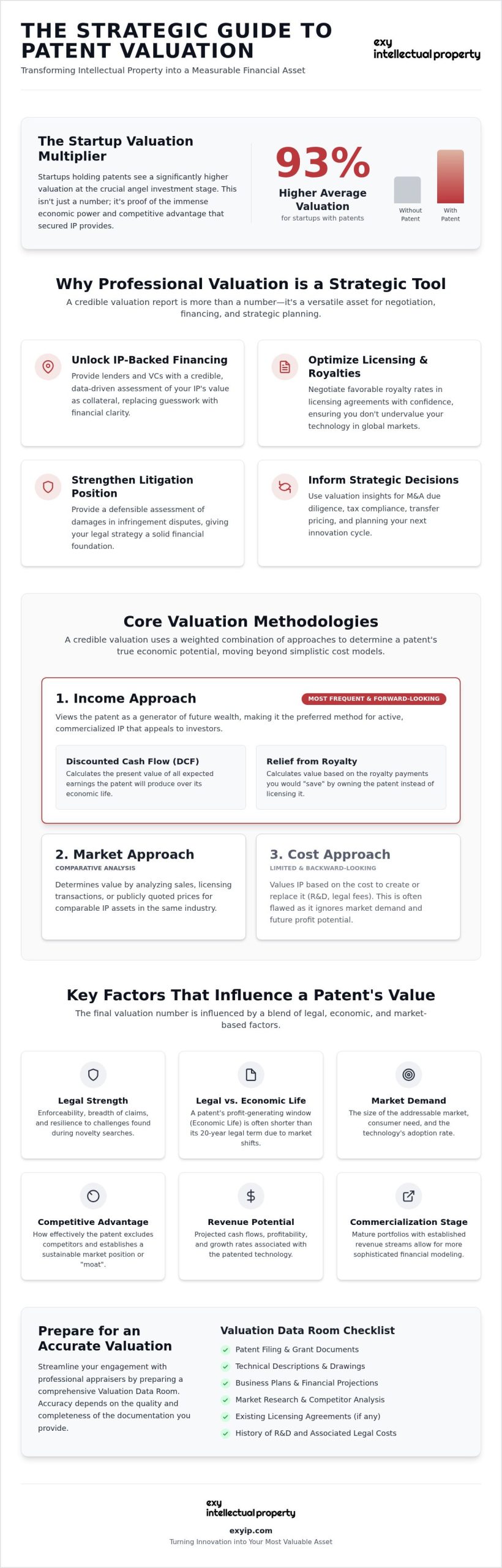
Startups with patents see a 93% higher average valuation at the angel stage compared to those without. Numbers like these aren’t just statistics; they’re proof of the immense economic power sitting in your filing cabinet. It’s natural to feel uncertain about the fair price of your innovation. You don’t want to leave money on the table during licensing talks, and you certainly don’t want to miss out on IP-backed financing because you lack a credible report.
We see your patents as the foundation of your commercial security. By utilizing expert patent valuation services, you can transform these intangible ideas into measurable financial assets that fuel your expansion. This guide provides a clear path to securing better leverage in negotiations and satisfying stakeholder requirements. We’ll examine the primary valuation methodologies for 2026 and show you how to turn your intellectual property into a strategic growth engine.
Key Takeaways
- Professional patent valuation services translate technical innovation into a clear financial language that resonates with investors and commercial partners.
- Moving beyond simple cost-based models is essential. Learn how a weighted combination of market and income approaches reveals the true economic potential of your IP.
- Legal strength is a primary value driver. A comprehensive novelty search ensures your patent stands up to the scrutiny of a rigorous valuation audit.
- Preparation is key to accuracy. Discover the specific documentation required for a Valuation Data Room to streamline your engagement with professional appraisers.
- Use your valuation report as a strategic tool to secure IP-backed financing or negotiate favorable royalty rates in global licensing agreements.
The Strategic Importance of Professional Patent Valuation Services
Professional patent valuation is the systematic process of determining the economic worth of an invention. It bridges the gap between a technical filing and a tangible balance sheet asset. Many businesses mistakenly rely on a cost-based approach, assuming a patent’s value equals the total spent on research, development, and legal fees. This logic is flawed. It fails to capture market demand, competitive advantage, or future revenue potential. A patent’s true value lies in its ability to exclude competitors and generate profit, not in what it cost to create.
Securing intellectual property financing requires this level of financial clarity. Lenders aren’t interested in your passion; they’re interested in collateral. By engaging professional patent valuation services, you provide a credible, third-party assessment that banks and venture capitalists can trust. This transparency is vital during due diligence, as it replaces guesswork with data-driven projections that highlight the longevity and strength of your intellectual property.
Beyond M&A: Why Growing Businesses Value Patents
Valuation isn’t just for selling a company. It’s a daily operational tool. For instance, it facilitates the setting of accurate royalty rates in licensing agreements, ensuring you don’t undervalue your technology. It also supports tax reporting and transfer pricing compliance for international operations, which is critical for avoiding regulatory penalties. If you’re involved in a dispute, a professional report strengthens your position in patent litigation by providing a defensible assessment of damages based on established patent valuation methodologies.
Identifying the Economic Life of Your Innovation
There’s a significant difference between a patent’s legal life and its economic utility. While a patent typically lasts for 20 years from the filing date, its ability to generate money often expires much sooner. Market saturation, the arrival of newer technology, and changing consumer habits all impact this timeline. Professional patent valuation services help you identify this window of opportunity. Economic life is the specific period during which a patent generates a distinct competitive advantage for its owner. Understanding this timeframe allows you to maximize returns and plan your next innovation cycle before your current assets become obsolete.
Core Methodologies Used in Patent Valuation Services
Precision is the hallmark of a credible valuation. Professional firms don’t rely on a single calculation to determine an asset’s worth. Instead, they typically apply a weighted combination of three globally recognized approaches. This multi-layered strategy ensures that the final valuation isn’t skewed by temporary market fluctuations or overly optimistic revenue projections. Selecting an intellectual property valuation methodology that aligns with your specific business goals, such as securing a loan or preparing for an exit, is critical for stakeholder trust.
The choice of methodology often shifts as a patent matures. Early-stage innovations, which lack a sales history, might depend more on development costs or market comparisons. Mature portfolios with established revenue streams allow for more sophisticated financial modeling. If you’re ready to quantify your technical edge, our team provides tailored patent valuation services to guide your commercial journey. For founders navigating a Seed or Series A round, understanding ip valuation for tech startups is especially critical to avoid leaving equity on the table.
Adherence to IVS 210 (Intangible Assets)
For a patent valuation report to be accepted by institutional lenders, Big 4 auditors, or cross-border tax authorities, it must adhere to International Valuation Standards (IVS 210). Compliance with IVS 210 ensures that risk-adjusted discount rates (WACC plus technological obsolescence factors) and Tax Amortization Benefits (TAB) satisfy institutional due diligence requirements.
The Income Approach: Forecasting Future Cash Flows
The Income Approach is the most frequent choice for active, commercialized IP. It views the patent as a generator of future wealth. One primary tool is the Discounted Cash Flow (DCF) analysis, which calculates the present value of all expected earnings the patent will produce over its remaining economic life. It’s a forward-looking perspective that appeals to investors and lenders alike.
A specialized variation is the Relief from Royalty method. This approach calculates value based on the royalty payments you would have to pay a third party to license the technology if you didn’t already own it. By owning the patent, you "save" these costs, which directly translates into asset value. For emerging technologies, appraisers apply risk-adjusted growth rates to account for market volatility and adoption hurdles, ensuring the final figure remains commercially grounded.
Market and Cost Approaches: Comparative and Replacement Metrics
The Market Approach functions much like real estate appraisal. It looks for "comparable" patent transactions within the same industry to establish a baseline price. While finding public data on private IP deals can be challenging, this method provides a reality check against current market sentiment. The legal frameworks established by the U.S. Patent and Trademark Office often influence how these comparable assets are weighted in terms of their robustness and enforceability.
The Cost Approach looks backward. It calculates the total expense required to reproduce or replace the invention from scratch at today’s prices. While it doesn’t account for future profit potential, it’s an essential metric for internal accounting and R&D-heavy companies that need to justify historical spending on their balance sheets. It serves as a "floor" for valuation, ensuring that the sheer effort of innovation is recognized in the final report.
Key Factors That Influence Your Patent’s Market Value
Determining the price of an innovation isn’t just about the math. It’s about understanding the legal fortress surrounding the idea and how that fortress stands up to market pressure. Value isn’t static. It fluctuates based on legal certainty, market reach, and the remaining years of exclusivity. Expert patent valuation services look beyond the technical blueprint to see the commercial reality, ensuring your asset is positioned for maximum growth.
Legal robustness is the primary pillar of value. A patent with broad, defensible claims is an asset; a patent that is easily circumvented is merely a piece of paper. This is why a high-quality patent novelty search is so critical. It proves to stakeholders that the invention isn’t just a variation of existing technology, but a genuine leap forward. This level of proof reduces risk and increases the perceived value for potential investors or buyers.
Professional patent valuation services also analyze the "Freedom to Operate" (FTO) in target jurisdictions. If you can’t commercialize your product in key markets without infringing on others, your patent’s value drops. Similarly, the "Remaining Term" acts as a natural ceiling. A patent with 18 years of exclusivity left offers a much longer runway for ROI than one nearing its 20-year expiration. Time is money, and in the patent world, the clock is always ticking.
Legal Strength and Enforceability
The quality of the initial filing is paramount. Specialized patent drafting services ensure that claims are structured to withstand "Invalidity Challenges" from competitors. A clean litigation history is another major value driver. If a patent has never been successfully challenged in court, it carries an aura of reliability that commands a premium price. We help you assess these risks to ensure your portfolio remains a credible deterrent to infringement.
Surviving Post-Grant Opposition Windows
Valuation model risk factors must account for post-grant validity challenges. Under Sections 55A and 56A of Malaysia’s Patents (Amendment) Act 2022, third parties have a strict six-month window post-grant publication in the IP Official Journal (IPOJ) to file administrative oppositions directly with MyIPO. Patents that include multi-layered dependent claims retain higher valuations because they present significantly lower invalidation risk during this window.
Technological Relevance and Market Adoption
Market adoption dictates the pace of returns. We look at whether a technology is "Essential" to industry standards, which can lead to consistent, high-yield royalty streams. We also evaluate "Complementary Assets." If a patent needs specific software or hardware IP to be useful, its value is intrinsically linked to the availability of those other assets. Aligning your innovation with current market trends ensures long-term utility and secures your position as an industry leader.
Preparing Your Business for a Patent Valuation Audit
Preparation is the foundation of a defensible report. When you engage patent valuation services, the speed and accuracy of the results depend heavily on your internal readiness. An organized approach reduces the billable hours required by appraisers and ensures that no hidden value is overlooked. Before the formal process begins, you should conduct a thorough internal IP audit to identify all intangible assets that support your patent, such as associated trade secrets or industrial designs. This clarity allows the appraiser to see the full scope of your innovation’s market power. A structured approach to intellectual property asset management ensures your portfolio is audit-ready and that no valuable rights are overlooked before the appraisal begins.
Aligning this data with your broader commercialization strategy is essential. A valuation doesn’t exist in a vacuum; it must reflect how you actually intend to use the asset to drive growth. If you’re preparing for a significant transaction, reviewing our IP valuation guide can help you understand the specific metrics stakeholders will scrutinize. Being proactive ensures your business is positioned as a sophisticated, investment-ready entity.
Organizing Technical and Financial Documentation
The first step is building a "Valuation Data Room." This is a secure repository of every document related to your innovation. You’ll need to gather filing documents, office actions, and maintenance fee receipts to prove the patent’s current legal standing. On the financial side, you must isolate specific revenue streams. If your patent is used in three different product lines, you need to show the sales data for those specific items rather than general company revenue. This granular detail is what gives a valuation report its credibility.
- R&D History: Document the total investment into the technology, including staff hours and laboratory costs.
- Legal Correspondence: Include any freedom-to-operate opinions or previous novelty search results.
- Current Licenses: Provide copies of existing licensing agreements to establish a baseline for royalty expectations.
Assessing the Competitive Landscape
Appraisers need to know where your invention sits in the broader market. You should identify direct competitors and track their patenting activity to determine if your claims provide a unique "moat" or if the sector is becoming crowded. Mapping potential licensees who could benefit from your technology also helps in forecasting future income. Perform a basic search for competitor patent filings in your industry before the audit begins to provide your appraiser with immediate context. This proactive step helps patent valuation services focus on the most relevant market comparisons, ultimately strengthening the final report’s authority.
Leveraging Valuation for IP Commercialization and Financing
A valuation report is more than a compliance document. It’s a strategic tool for commercial negotiations. By utilizing professional patent valuation services, you move beyond technical protection into the realm of economic leverage. This is where your innovation starts paying for its own development. At Exy Intellectual Property, we act as your "Business-Savvy Guardian," ensuring that every negotiation is backed by rigorous financial data that protects your long-term interests and fuels your company’s expansion.
Unlocking Capital Through IP-Backed Financing
Traditional lending often overlooks intangible assets. However, in 2026, the Malaysian financial landscape has evolved to recognize the inherent value of intellectual property. Banks and private lenders now view a certified patent valuation report as a legitimate basis for collateral. This enables "IP-Backed Financing," which is a method of securing capital or credit lines without diluting your company’s equity. It’s a powerful way to fuel expansion while maintaining full control over your venture. As the national market matures, these reports are becoming essential for startups looking to scale without constant rounds of venture capital. Tech founders can explore our dedicated ip valuation for tech startups strategic guide to understand how to leverage these reports when approaching Seed or Series A investors.
Maximizing Royalty Rates in Licensing
Setting the right price for your technology is a delicate balance. If you’re entering into licensing agreements, a third-party valuation provides the authority needed to justify high-yield royalty rates. By using the data generated through the Income Approach discussed earlier, you can demonstrate the specific profit margins your technology enables for the licensee. This transparency allows you to negotiate from a position of strength, moving away from industry averages toward a price that reflects your patent’s unique utility.
- Tiered Royalty Systems: Use valuation data to structure fees that increase as the licensee hits specific market performance milestones.
- Minimum Guarantees: Justify higher upfront payments by proving the replacement cost and market demand for your IP.
- Cross-Licensing Leverage: Use your valuation to balance the scales when trading technology rights with competitors.
For tech-heavy business models, valuation is also a cornerstone of franchise consultancy. It allows you to quantify the value of the technical "system" you’re selling to franchisees, ensuring that your technical IP is properly monetized as you scale. Reliable patent valuation services transform your ideas into a scalable currency for growth, providing the security you need to navigate complex commercial waters with confidence.
Securing Your Intellectual Future
Your patents are the silent engines of your company’s growth. We’ve explored how professional patent valuation services transform these technical filings into measurable financial power. By mastering globally recognized methodologies and preparing your business for a rigorous audit, you gain the leverage needed for high-yield licensing and strategic expansion. Reliability is paramount in commercial negotiations. It’s the difference between a speculative idea and a bankable asset.
Whether you’re seeking specialized IP financing solutions or require professional legal advisory for IP litigation, a credible valuation report is your most potent tool. It bridges the gap between technical innovation and commercial reality. At Exy IP, we provide the expertise in strategic commercialization required to navigate the complexities of the 2026 market with confidence. We act as your guardian, ensuring that your intangible assets are recognized for their true market potential.
Unlock the true value of your innovations with Exy IP’s expert valuation services. Your journey from a protected invention to a market-leading asset starts with a clear understanding of your worth. We look forward to helping you secure the long-term health of your venture.
Frequently Asked Questions
How much do patent valuation services typically cost in 2026?
Pricing for these services depends on the complexity of the technology, the number of jurisdictions involved, and the intended use of the final report. A valuation for internal accounting purposes differs significantly from one required for high-stakes litigation or a global licensing deal. We recommend a strategic consultation to assess your portfolio’s specific needs and provide a tailored quote that reflects the depth of the audit required for your business goals.
How long does the patent valuation process take from start to finish?
A standard, audit-ready patent valuation typically takes between two and six weeks to complete. This timeline depends on the availability of your technical and financial documentation, such as R&D investment records and revenue data. If your "Valuation Data Room" is well-organized, the process moves faster. More complex portfolios involving global filings or emerging technologies may require additional time for thorough market analysis and risk assessment.
Can I perform a patent valuation myself using online tools?
While online calculators provide a rough estimate, they lack the legal and commercial depth required by banks, investors, or courts. Professional patent valuation services involve a rigorous analysis of legal robustness, market adoption, and competitive moats that automated tools cannot replicate. A self-generated report often fails to meet the strict due diligence standards of venture capitalists or the compliance requirements for IP-backed financing in Malaysia.
What is the difference between patent valuation and trademark valuation?
Patent valuation focuses on the economic worth of a specific technical invention and its ability to provide a competitive advantage. It often relies on the Income Approach to forecast future cash flows. Trademark valuation measures the financial value of brand recognition, reputation, and consumer loyalty. While both are intangible assets, patents are valued based on technical utility and exclusivity, whereas trademarks are assessed on their market presence and brand equity.
How often should a business update its patent valuation report?
Businesses should generally update their reports every 12 to 24 months or whenever a significant "trigger event" occurs. These events include entering new international markets, the arrival of a major competitor, or preparing for a new funding round. Because market conditions and technological relevance shift rapidly, an outdated report can lead to undervalued licensing deals or missed opportunities in securing IP-backed financing for your company’s expansion.
Is a patent valuation report legally required for IP-backed financing?
Lenders in the Malaysian market typically require a certified third-party valuation report to prove the income potential and durability of the patent used as collateral. This report provides the financial institution with a credible assessment of the asset’s liquidation value and its ability to generate revenue. Without a professional valuation, banks cannot accurately assess risk, making it nearly impossible to secure non-dilutive capital against your intellectual property portfolio.
What happens if my patent valuation is lower than expected?
A lower valuation is often a strategic signal to refine your commercialization strategy or strengthen your legal claims. It might indicate that your patent is easily circumvented or that the market isn’t yet ready for the technology. We use these findings to advise on better patent drafting or novelty searches for future filings. Understanding the "why" behind a lower figure allows you to make informed decisions before entering high-stakes licensing negotiations.
Can a patent valuation help in a divorce or corporate dissolution?
Professional patent valuation services are essential for the equitable distribution of assets during a divorce or the winding up of a company. Intellectual property is often the most valuable asset in a tech-driven venture, and a formal report ensures that its worth is accurately represented on the settlement table. This transparency prevents one party from being disadvantaged and provides a clear, defensible figure that can be used in legal proceedings or mediation.