


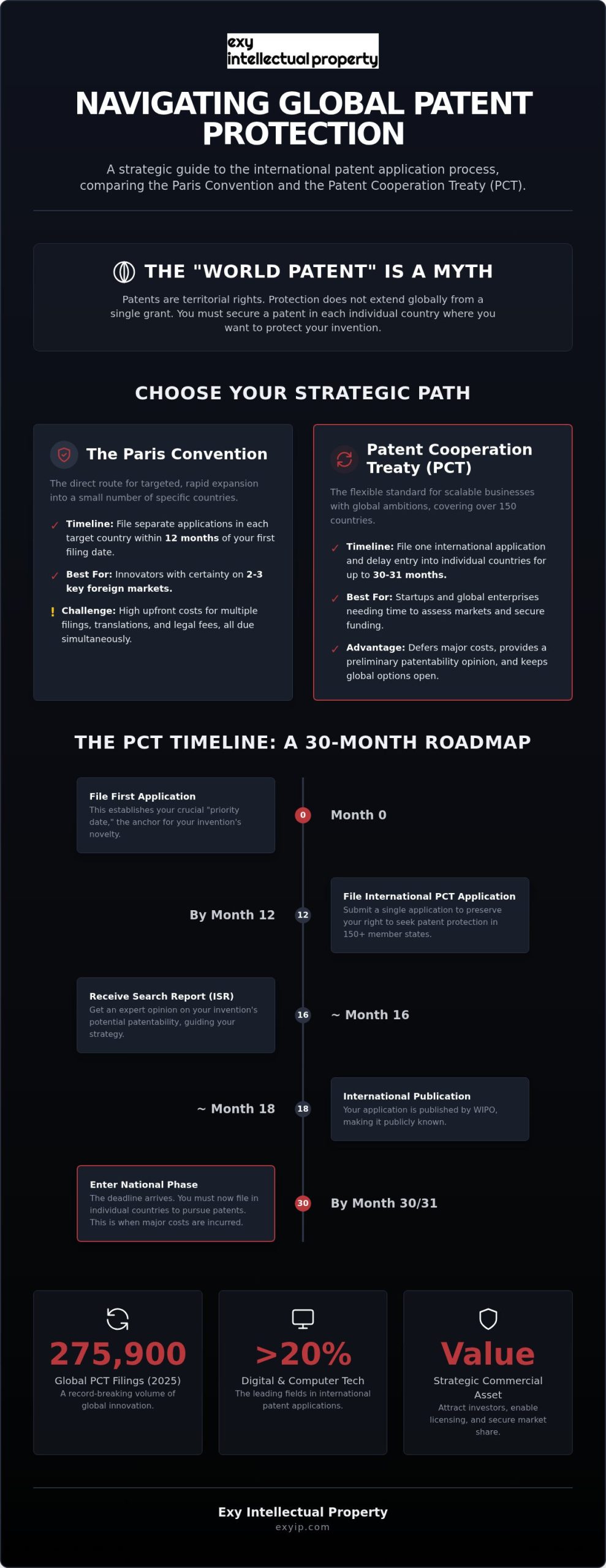
In 2025, global PCT filings reached a staggering 275,900 applications. This represents a record-breaking volume of innovation, highlighting a world where ideas move faster than ever. For many creators, the international patent application process feels like a high-stakes race against a ticking clock. It’s natural to worry about the high costs of individual foreign filings or the risk of missing a critical deadline. You want to safeguard your hard work without draining your capital before you’ve even tested the market.
Your invention is more than a technical achievement; it’s a vital commercial asset. We’ll help you master the complexities of global patenting to ensure your intellectual property remains secure across borders. This guide provides a clear roadmap of the PCT timeline, showing you how to defer significant costs while you validate international demand. We clarify the differences between the Paris Convention and the PCT so you can maintain global priority effectively. You’ll gain a structured plan to manage global protection with the confidence of a seasoned strategist.
Key Takeaways
- Clarity. Understand why a “world patent” doesn’t exist and how the WIPO framework actually functions to protect your intellectual property.
- Strategy. Learn to distinguish between the Paris Convention and the PCT to choose the path that’s most cost-effective for your market goals.
- Precision. Master the international patent application process by managing the critical 12-month priority window and interpreting your International Search Report.
- Flexibility. Discover how to use the 30-month PCT window to defer significant filing fees while you’re assessing the commercial potential of foreign markets.
- Security. Secure your global priority by partnering with experts who manage strict WIPO deadlines and provide professional drafting for international success.
Understanding the International Patent Application Landscape
The idea of a “world patent” is a persistent myth in the business community. Patents are strictly territorial. This means a patent granted in one jurisdiction doesn’t automatically offer protection in another. To secure your rights globally, you must engage with the legal systems of each individual nation where you intend to operate. This is where the World Intellectual Property Organization (WIPO) provides essential structure. WIPO doesn’t grant patents itself; instead, it manages the international framework that allows you to seek protection in multiple countries simultaneously.
The most critical element in the international patent application process is your priority date. This is the date you file your first application. It acts as a legal anchor, establishing your invention’s novelty against any similar ideas that appear later. Missing the window to claim this date in other countries can leave your invention vulnerable to competitors who might “invent around” your product in foreign markets.
The Two Main Paths to Global Protection
Innovators typically choose between two primary routes: the Paris Convention or the Patent Cooperation Treaty (PCT). The Paris Convention is often the right choice if you’re targeting only two or three specific countries. It requires you to file individual applications in each nation within 12 months of your priority date. It’s fast, but the upfront legal and translation costs can be heavy.
The PCT route is the strategic gold standard for startups and growing enterprises. It provides a unified filing system that extends your deadline to enter most foreign markets to 30 or 31 months. This extra time is invaluable. It lets you test market demand and secure funding before committing to the high costs of national filings. In 2025, digital communication and computer technology led the way in PCT filings, representing over 20% of the 275,900 international applications processed.
The Strategic Value of International Filing
Securing global priority isn’t just a legal hurdle; it’s a commercial strategy. When you initiate the international patent application process, you’re signaling to the market that your innovation has global value. Investors are far more likely to back a venture that has a clear roadmap for international protection. It demonstrates that you’ve considered the long-term health of the business and have taken steps to prevent unauthorized copycats.
Additionally, an international filing establishes the foundation for global licensing and franchising. By treating your IP as a transferable asset, you can generate revenue through royalty agreements in markets where you don’t have a physical presence. This proactive approach ensures your intellectual property remains a driver of growth rather than a source of legal risk.
The PCT vs. Paris Convention: Choosing Your Strategic Path
The 12-month rule is the critical pivot point for your intellectual property. After your initial filing, the clock starts. You have precisely one year to claim priority in other jurisdictions. This decision isn’t just about legal compliance; it’s a fundamental choice in how you allocate your company’s capital. Choosing the wrong path early can lead to unnecessary expenses or, worse, the loss of rights in key markets.
The Paris Convention: For Targeted Expansion
Speed. Directness. Focus. The Paris Convention is the preferred route when you have a clear, limited list of target markets. If your business strategy only requires protection in one or two specific foreign countries, filing directly is often the most efficient path. You move straight to the national offices, which can lead to faster grant times in those specific regions. However, this approach demands significant upfront investment. You must handle multiple translations, pay various national filing fees, and engage local agents in every country simultaneously. For a startup, this immediate drain on resources can be a barrier to entry.
The PCT Path: For Scalable Innovation
Strategy. Flexibility. Protection. The Patent Cooperation Treaty (PCT) serves as the strategic gold standard for businesses with global ambitions. By utilizing WIPO’s International Patent System, you submit a single application in one language. This action effectively “parks” your invention in over 150 member states. The most significant advantage is the time it buys you. While the Paris Convention requires action at 12 months, the PCT extends your deadline to enter the national phase to 30 or 31 months from your priority date.
These 18 extra months are a commercial lifeline. You can use this period to refine your product, secure international investors, or validate market demand before committing to heavy national phase expenses. The international patent application process under the PCT also provides you with an International Search Report. This document gives you an early, authoritative look at your patent’s chances of success, allowing you to pivot your strategy if needed. Managing these timelines requires precision. If you’re looking to turn your innovation into a protected commercial asset, our team provides the strategic legal advisory needed to navigate these complex windows. Deferring costs while maintaining global priority isn’t just a legal convenience; it’s a smart business move that preserves your runway while you scale.
Step-by-Step: The International Patent Application Process
The transition from a local filing to a global strategy is a high-stakes move. You must file your international application within exactly 12 months of your original priority date. Missing this deadline is often fatal to your international rights. This stage isn’t just a paperwork exercise; it’s the moment your invention begins its journey through the global regulatory framework. By following a structured international patent application process, you transform a technical idea into a defensible commercial asset.
Preparing Your Application for Success
Quality matters from day one. A poorly drafted application can lead to “claim narrowing,” where your protection is so specific it becomes easy for competitors to bypass. We recommend utilizing professional patent drafting services Malaysia to ensure your technical descriptions are robust enough for international scrutiny. Before you even file, conducting a thorough patent novelty search is essential. This search identifies existing “prior art” that could block your application. It allows you to refine your claims early, saving time and capital during the more expensive international phases.
Precision in translation is equally vital. If you’re filing in multiple languages, even a small technical error can change the scope of your protection. Clear, accurate drafting ensures your invention is understood exactly as intended by examiners across different jurisdictions.
Navigating the International Search Report (ISR)
The International Search Report (ISR) is your first objective look at your patent’s viability. Approximately 16 months after your priority date, an International Searching Authority (ISA) will issue this report along with a written opinion. As detailed by the USPTO on the PCT, this report identifies the most relevant prior art documents that might affect your invention’s patentability.
When reviewing your ISR, pay close attention to the citations. An “X” citation suggests your invention lacks novelty on its own. A “Y” citation indicates your idea might be considered obvious when combined with other documents. These aren’t necessarily roadblocks. You can use Article 19 amendments to modify your claims and strengthen your legal position before the application is published. This is a critical decision point. If the ISR is unfavorable, you may choose to withdraw the application to keep your invention as a trade secret instead of allowing it to become public record through international publication at the 18-month mark.
For those seeking even more certainty, you can request a Supplementary International Search or an International Preliminary Examination. These optional steps provide a deeper analysis of your claims. They help you enter the national phase with a highly refined application, reducing the risk of rejection in individual countries.
The National Phase: Entering Specific Foreign Markets
The 30 or 31-month deadline marks the definitive shift from international potential to national reality. This is the point of no return for your global protection strategy. Up until this moment, your application has existed as a centralized placeholder. Now, you must decide exactly where your invention needs a legal shield. This phase of the international patent application process is the most capital-intensive. It requires a precise selection of jurisdictions to maximize your return on investment.
Strategic Country Selection
Don’t try to protect your invention everywhere. It’s rarely cost-effective. Focus instead on your primary manufacturing hubs and your largest consumer markets. If you’re planning a broad expansion, regional hubs offer a streamlined entry point. The European Patent Office (EPO) allows you to target multiple European nations through a single grant process. Similarly, organizations like ARIPO in Africa or the GCC in the Gulf provide centralized routes. If your growth strategy involves a franchise consultancy Malaysia expansion, your patent filings should mirror your target territories. This ensures your franchisees are protected from local copycats from day one.
Valuation and Financing for National Entry
Justifying the high costs of national phase entry requires a commercial perspective. You shouldn’t view these as mere legal fees. They’re investments in your company’s future valuation. By applying a rigorous intellectual property valuation methodology, you can demonstrate to stakeholders exactly how much value these foreign rights add to your balance sheet. This clarity often helps in securing Intellectual Property Financing to cover the costs of global expansion. A robust international portfolio doesn’t just protect sales. It significantly increases your company’s exit value during an acquisition or IPO.
In each country, you’ll need a local patent agent to navigate the specific procedural requirements of that national office. These experts manage the local examination process and ensure your claims meet national standards. This is where the complexity peaks. Managing a dozen different agents across different time zones and legal systems requires a centralized partner who understands the big picture. If you’re ready to secure your innovations across international borders, our team provides the expert patent registration support you need to succeed.
Maximizing Global Success with Strategic IP Advisory
Attempting a DIY approach to the international patent application process is a high-risk gamble. The global IP framework is governed by strict, unforgiving deadlines. A single missed filing window at the 12 or 30-month mark can lead to an irrevocable loss of rights. Managing these complexities requires more than just technical knowledge; it demands a commercial mindset that views legal protection through the lens of business growth. Without expert guidance, you risk spending significant capital on a portfolio that lacks the teeth to stop competitors.
Exy Intellectual Property acts as your proactive guardian in this complex landscape. We don’t just file paperwork. We manage the delicate balance between legal authority and approachable partnership. By integrating your patent strategy with a comprehensive Global Trademark Registration plan, we ensure your brand identity and your technology are equally secure as you enter new territories. This holistic approach builds a fortress around your innovation, making it a far more attractive prospect for investors and partners.
Beyond Filing: Commercializing Your Global Assets
Your patents should be active revenue drivers. Once your international rights are secured, they become valuable assets that can be leveraged for licensing agreements and steady royalty streams. This transforms your intellectual property from a necessary expense into a profit generator. We help you identify these opportunities, ensuring your IP serves your long-term commercial health. Protecting against global infringement also requires specialized legal advisory. We monitor your interests and act swiftly to address unauthorized use. As your business scales, regular portfolio audits become essential. These audits help you prune underperforming assets and double down on the high-value innovations that drive your competitive advantage.
Next Steps for Your Innovation
Moving forward requires a methodical, logical plan. Success in the global market isn’t about luck; it’s about preparation. Don’t wait for a deadline to arrive before you start thinking about your international strategy. Take these concrete steps to secure your future:
- Audit your current priority dates to identify upcoming filing windows and avoid missing critical 12-month deadlines.
- Consult with an international patent expert to align your IP filings with your specific market expansion and manufacturing goals.
- Develop a 30-month roadmap for national phase funding to ensure you have the capital ready for the most intensive part of the process.
By taking these steps, you move from a reactive posture to a strategic one. You’ll enter the global market with the quiet confidence of a specialist who knows their interests are in safe, capable hands.
Secure Your Global Competitive Advantage
Success in the global market requires more than just a brilliant invention; it demands a disciplined approach to intellectual property. By mastering the international patent application process, you transform a local innovation into a protected global asset. You’ve learned how the PCT route provides a strategic 30-month window to validate your market and manage capital effectively. You also understand that the International Search Report serves as a vital compass, guiding your claim amendments before you enter the expensive national phase.
Managing these moving parts requires a partner who views legal protection through the lens of a practical entrepreneur. Exy IP offers specialized expertise in global patent registration and IP valuation services to ensure your portfolio remains a driver of commercial growth. We provide the strategic commercialization advisory needed to turn your technical achievements into long-term financial security. Secure your global innovation with Exy IP’s strategic patent services. Your journey from a local creator to a global leader is a significant milestone, and we’re here to ensure your interests are in safe, capable hands.
Frequently Asked Questions
What is the difference between a PCT and a national patent application?
A PCT application acts as a centralized placeholder for over 150 countries, providing a unified filing system. It simplifies the initial stages but never results in a granted patent on its own. A national application is filed directly with a specific country’s patent office. While the PCT delays costs and provides an international search, you must still enter the national phase in each jurisdiction to gain enforceable rights.
How much does the international patent application process cost?
Total costs depend on your chosen countries and technical complexity. Mandatory fees include the international filing fee, which was 1,330 CHF as of August 2026, and search fees that vary by authority. The most significant expenses occur during the national phase. These include translation costs, national filing fees, and local agent fees. Using the international patent application process allows you to defer these larger investments for up to 30 months.
Can I add new information to my patent during the international phase?
You cannot add “new matter” or technical information that wasn’t in your original priority application. The technical disclosure must remain consistent throughout the process. However, you can amend your claims under Article 19 to better define the scope of protection based on the International Search Report. If you have significant new technical developments, you typically need to file a separate application, though this results in a later priority date.
What happens if I miss the 12-month priority deadline for international filing?
Missing the 12-month window is a critical error that usually prevents you from claiming your original priority date. Consequently, any public disclosure of your invention after the first filing, including your own application, becomes “prior art” that can block your international rights. While some jurisdictions offer limited “restoration of rights” for accidental misses, these are difficult to obtain. It’s vital to track this deadline with the help of a professional advisor.
Do I need a different patent agent for every country I enter?
Most national patent offices require a local agent registered in their jurisdiction to handle the examination process. While you need these specialists for each country, you don’t have to manage them individually. A centralized partner like Exy IP coordinates the international patent application process on your behalf. We act as your single point of contact, managing the network of local agents and ensuring all global deadlines and technical requirements are met.
How long does the entire international patent process take from start to finish?
The journey from first filing to a granted patent usually spans 3 to 5 years. The international phase takes about 18 months, concluding at the 30 or 31-month mark when you enter the national phase. After this, individual national offices conduct their own examinations, which can take an additional 1 to 3 years. Factors like the technology field and the specific backlogs of chosen patent offices influence the final timeline.
Is my patent protected in every country once I file a PCT application?
Filing a PCT application does not grant automatic protection. It’s a procedural tool that preserves your right to file in member countries while establishing a global priority date. Enforceable patent rights are only secured once you successfully complete the national phase in each specific country. Until a national office grants your patent, you cannot legally enforce your rights against infringers in that specific jurisdiction or claim damages for unauthorized use.
What is the “National Phase” and when does it begin?
The national phase is the final stage where you seek actual patent grants in specific countries. It typically begins at the 30 or 31-month mark from your initial priority date. During this stage, you must submit translations and pay national fees to each local patent office. This transition is the most critical part of the international patent application process, as it turns your global placeholder into individual, enforceable legal assets.