


The total value of Southeast Asia’s top 30 brands reached US$165 billion in 2026, a 26% increase since 2024. High stakes. Protecting your identity in a market this valuable is no longer optional. Many leaders struggle with the reality of fragmented IP laws across ten different nations and the slow enforcement timelines that often follow. Establishing a robust brand protection strategy Southeast Asia means shifting from reactive defense to a proactive, regional roadmap.
We’ll show you how to navigate the ASEAN IP landscape with a strategic framework designed for security and long-term growth. This article explores the essential 2026 trends you need to understand, from Vietnam’s new proactive e-commerce screening laws to Malaysia’s proposed reforms for AI and digital copyright. We also examine how to utilize international protocols to keep your filing costs manageable while ensuring your enforcement actions actually yield results. By the end of this guide, you’ll have a clear roadmap for transforming a fragmented legal burden into a unified regional asset.
Key Takeaways
- Develop a proactive brand protection strategy Southeast Asia by transitioning from isolated country filings to a unified regional roadmap that aligns with the 2026 ASEAN IPR Action Plan.
- Learn how to leverage AI-driven monitoring tools to stay ahead of evolving digital piracy and new proactive e-commerce screening requirements across the region.
- Understand the strategic benefits of using Malaysia as a hub for regional IP management, focusing on specialized litigation support and efficient customs recordal processes.
- Discover the essential role of intellectual property valuation and franchising consultancy in turning secured trademarks into scalable, investor-ready commercial assets.
- Master a structured five-step approach to auditing and prioritizing your IP portfolio to ensure cost-effective enforcement where your revenue risks are highest.
The Shifting Landscape of Brand Protection in Southeast Asia (2026)
ASEAN is a financial powerhouse. The top 30 regional brands hit a combined value of US$165 billion in 2026, marking a 26% increase in just two years. This growth is a double-edged sword. While it creates immense opportunity, it also invites sophisticated brand squatters who look for gaps in your regional coverage. Developing a successful brand protection strategy Southeast Asia requires a shift in mindset. You aren’t just defending a name; you’re securing a commercial asset that drives your expansion. Building a brand protection strategy Southeast Asia is the foundation for scaling securely.
We view this as a "Business-Savvy Guardian" role. It’s about proactive advisory. Using a centralized hub like Malaysia offers a distinct advantage. Malaysia’s legal framework provides a stable base for managing regional portfolios, especially when navigating the diverse legal traditions found across the ten member states. This approach turns legal compliance into a competitive edge.
The Fragmentation Challenge: 10 Countries, 10 Systems
Diversity is the primary obstacle. Southeast Asia is split between common law systems, like Malaysia and Singapore, and civil law systems, such as Indonesia and Vietnam. This distinction matters for your filing priority. Most ASEAN nations follow a "First-to-File" rule. This means the first person to register a trademark owns it, regardless of who used it first. A brand protection overview reveals that failing to secure these rights early often leads to expensive litigation against local squatters who register your brand before you arrive. Proactive registration is your only real insurance policy.
Harmonization Trends to Watch in 2026
Change is coming. The ASEAN IPR Action Plan 2026-2030 is currently driving regional trademark consistency and digital integration. One major trend is the widespread adoption of the Madrid Protocol. This allows for cost-effective filing across multiple jurisdictions through a single application. Additionally, the ASEAN Patent Examination Co-operation (ASPEC) is speeding up patent sharing between offices. Digital transformation is also a priority. Most regional IP offices have moved to online-first processing in 2026. This shift is finally reducing the slow enforcement timelines that previously plagued the region. Faster processing means faster protection for your bottom line.
Core Components of a Modern ASEAN Brand Protection Strategy
A resilient brand protection strategy Southeast Asia is built on four pillars: registration, monitoring, enforcement, and commercialization. While many businesses view IP as a defensive cost, we see it as a growth engine. Effective protection ensures that your market share remains yours. It allows you to scale without the constant threat of dilution or revenue loss. In 2026, this requires more than just filing papers; it demands a proactive stance against increasingly sophisticated digital and physical threats.
Strategic Registration: Beyond the Trademark
Registration is your legal baseline. Without it, enforcement is nearly impossible in "First-to-File" jurisdictions like Indonesia or Vietnam. We recommend starting with trademark registration Malaysia to establish a strong regional hub. This provides a stable foundation for managing your broader ASEAN portfolio. However, a comprehensive brand protection strategy Southeast Asia must extend to industrial designs. Protecting the "look and feel" of your products prevents competitors from riding on your aesthetic appeal. For technical innovations, navigating the international patent application process ensures your inventions are secured across multiple borders simultaneously. This multi-layered approach creates a "protective moat" around your business assets.
Digital Brand Monitoring in the ASEAN E-commerce Era
The digital landscape has shifted. Vietnam’s Decree No. 248/2026/ND-CP, effective July 1, 2026, now requires e-commerce platforms to proactively screen for counterfeit goods. This is a game changer. Monitoring efforts must now focus on major regional platforms like Shopee, Lazada, and TikTok Shop. AI-driven tools are essential for tracking infringements in real time. These tools can identify suspicious listings before they gain traction. Beyond public marketplaces, we’re seeing a rise in "dark social" piracy on encrypted messaging apps. Takedown strategies must be swift and decisive. Relying on reactive litigation is often too slow and costly for the fast-paced digital world. Proactive monitoring identifies risks early, allowing for cost-effective interventions.
Compliance with E-Commerce Anti-Counterfeiting Mandates
In 2026, regional brand protection must adapt to proactive liability laws enacted across Southeast Asia (such as Vietnam’s updated e-commerce regulations under Decree No. 248/2026/ND-CP). Platforms operating across ASEAN are now required to maintain automated notice-and-takedown portals and perform proactive seller verification. Rights holders should register their marks directly with platform brand registries (e.g., Shopee Brand IP Portal, Lazada IP Protection Platform, and TikTok Shop IP Center) using official MyIPO or Madrid Protocol registration certificates to enable algorithmic counterfeit screening.
Enforcement also requires a physical presence. Customs recordals are a highly effective way to stop counterfeit goods at the border. By training customs officials to recognize your genuine products, you create a front-line defense that works while you sleep. Finally, remember that protection is the first step toward revenue. A secured brand is an investable brand. If you are looking to expand your footprint, our team can provide the legal advisory needed to turn your protected IP into a successful licensing or franchising model.
Comparing Regional Enforcement: Malaysia vs. The Greater ASEAN Region
Enforcement isn’t a one-size-fits-all process. While your brand protection strategy Southeast Asia begins with registration, it survives through active enforcement. Each jurisdiction offers different tools for rights holders. Some favor criminal raids for immediate market clearing, while others prioritize civil litigation to recover damages and establish legal precedents. Understanding these nuances is critical for any brand owner looking to minimize losses and maximize market control. A proactive approach here ensures that your legal rights translate into real-world business security.
Specialized intellectual property litigation Malaysia serves as a powerful deterrent. In many ASEAN nations, IP cases are heard in general courts. This often leads to longer timelines and inconsistent rulings. Malaysia stands out as a reliable hub. The presence of specialized IP judges ensures that complex technical arguments are adjudicated with precision. According to the 2026 International IP Index, Malaysia scored 51.85%, reflecting a stronger enforcement landscape than regional neighbors like the Philippines (40.64%) or Vietnam (38.91%). This reliability is why we position Malaysia as the strategic core of a regional protection program.
The Malaysian Advantage for Regional Brands
Specialized. Efficient. Accessible. Malaysia’s legal system provides a streamlined path for protecting your interests. Unlike more expensive hubs, enforcement here remains cost-effective for growing enterprises. There’s a natural synergy between your registration and your ability to act. Because the system is centralized, transitioning from a discovered infringement to a court-filed injunction is a logical, methodical process. This speed is vital. It protects your reputation before a counterfeit product can saturate the market. We view this as a primary commercial advantage for brands scaling across the region.
Cross-Border Enforcement Challenges
Complexity remains the standard. As we’ve noted, the fragmentation across ten different nations means that enforcing a judgment in one nation doesn’t automatically grant you rights in another. This requires working closely with local authorities for physical raids and customs recordals. Customs recordals are particularly effective. They act as a filter at the border, preventing infringing goods from even entering the local supply chain. To strengthen your position, we often recommend Copyright Voluntary Notification. In many jurisdictions, this serves as immediate, prima facie proof of ownership during a raid. It eliminates the need for lengthy documentation during high-pressure enforcement actions. These proactive steps ensure your brand protection strategy Southeast Asia remains effective across diverse borders.
Border Control via Customs Recordals
Preventing counterfeit goods from entering regional supply chains requires formal Customs Recordals. In countries like Malaysia (via the Royal Malaysian Customs Department under the Trademarks Act 2019), Thailand, and Vietnam, registered trademark owners can record their rights directly with customs authorities. This enables officers to ex-officio detain suspected shipments at ports of entry, seize physical goods before distribution, and request immediate verification from local legal representatives.
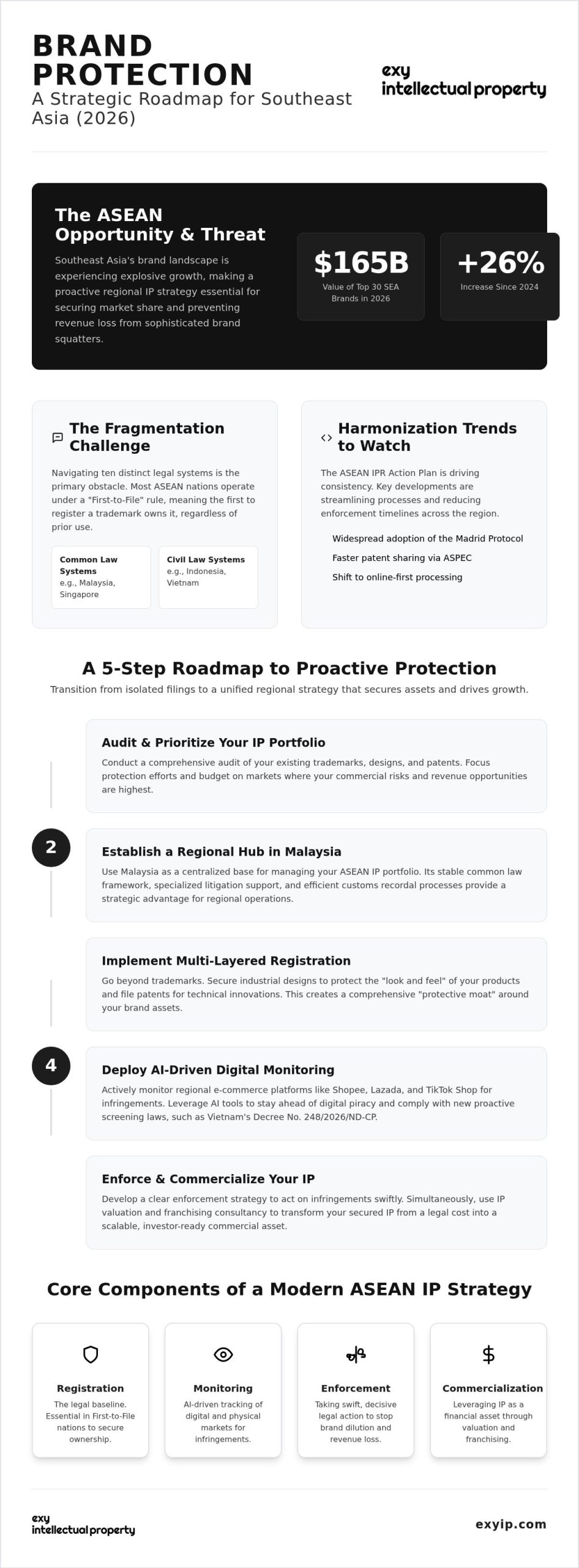
A 5-Step Roadmap for Protecting Your Brand in Southeast Asia
The 2026 market moves with incredible speed. You need a plan that is as agile as the competitors you face. A cohesive brand protection strategy Southeast Asia requires a structured approach to bridge the gap between legal theory and commercial reality. We’ve developed this five-step roadmap to help you navigate the region’s complexities efficiently and with total confidence. This process ensures that your legal efforts align perfectly with your business growth objectives without wasting resources on low-priority assets.
- Step 1: Conduct a regional IP audit to identify vulnerable assets across your entire portfolio.
- Step 2: Prioritize markets based on revenue potential and the specific risk level of each jurisdiction.
- Step 3: Execute a Madrid Protocol trademark filing to achieve cost-efficient scale across multiple borders.
- Step 4: Establish local customs recordals in key manufacturing and transit hubs to stop counterfeits at the source.
- Step 5: Implement a continuous monitoring and takedown program to address digital infringements in real time.
Auditing and Prioritizing Your IP Assets
Successful protection starts with clarity. You must distinguish between your core trademarks, such as your primary brand name, and secondary elements like seasonal slogans or specific product packaging. Not everything requires the same level of investment. For businesses in the tech sector, assessing the patentability of new innovations before market entry is vital. This prevents competitors from reverse-engineering your success while you’re still scaling. An IP audit is a comprehensive review of a business’s intellectual property assets and risks, serving as a mandatory prerequisite for regional scaling in 2026. This process ensures your budget is allocated where the risk to revenue is highest, providing a clear view of your intellectual property health.
Leveraging International Filing Systems
Administrative efficiency is a significant competitive advantage. The Madrid Protocol allows you to manage filings in multiple ASEAN nations through a single application. This approach significantly reduces time and administrative costs compared to filing individually in ten different countries. While this is ideal for broad regional coverage, there are moments when a direct national filing is the better choice. This is particularly true if you face specific local opposition or need faster domestic processing in a high-priority market. Navigating these technical choices requires professional guidance. A specialized IP agent can guide you through the specific requirements of national IP offices to ensure your applications are robust and defensible. If you’re ready to secure your assets, our team can help you initiate a trademark filing today.
Maximizing Value: IP Valuation and Commercialization in ASEAN
Brand protection is the starting line, not the finish. While securing your trademarks and patents prevents loss, commercialization is what generates gain. A robust brand protection strategy Southeast Asia creates the necessary legal certainty for investors and partners to commit capital to your venture. When your intellectual property is properly secured, it transforms from a legal requirement into a high-value business asset that can be leveraged for financing, expansion, and long-term revenue generation. We focus on helping you realize this economic potential through strategic advisory and professional management.
IP Valuation as a Growth Strategy
Quantifying the worth of your intangible assets is essential for modern business. Whether you are preparing for a merger, an acquisition, or seeking new financing, you must understand what your brand is actually worth in the current market. Using a professional intellectual property valuation methodology provides a data-backed foundation for these negotiations. In the ASEAN region, we typically distinguish between cost-based valuation, which looks at the historical expense of developing the asset, and market-based valuation, which compares your IP to similar regional transactions. IP valuation is critical for tech startups seeking Series A funding in 2026 because it provides a data-backed justification for equity pricing and investor confidence. This clarity allows you to negotiate from a position of strength, ensuring you don’t leave value on the table during critical growth phases.
Franchising and Licensing: The Path to Scale
Scaling across borders requires a model that balances growth with control. Licensing agreements allow you to turn your protection into a steady revenue stream by granting others the right to use your IP under specific conditions. This is a highly effective way to enter diverse markets without the capital intensity of direct ownership. If you are considering a more structured expansion, seeking franchise consultancy Malaysia ensures your business model is legally sound and ready for replication. Securing your brand is the mandatory first step before entering any such agreement. Without it, you risk losing control over your brand standards and quality. Exy Intellectual Property acts as your "Business-Savvy Guardian" throughout this journey. We provide the technical expertise in licensing agreements and commercialization strategy needed to manage your brand presence safely across multiple jurisdictions. Our goal is to ensure your brand protection strategy Southeast Asia serves as a launchpad for sustainable regional success.
Securing Your Brand’s Future in a Harmonized ASEAN Market
The landscape of 2026 demands a unified brand protection strategy Southeast Asia. You’ve seen how regional harmonization and digital transformation are reshaping the IP roadmap. Success now depends on moving from defensive filing to strategic asset growth. By prioritizing key markets and utilizing professional valuation, you turn your intellectual property into a powerful engine for regional scaling. It’s about more than legal compliance. It’s about building a defensible competitive advantage.
Exy Intellectual Property stands ready to be your proactive advisor. We provide specialized IP litigation and enforcement expertise to navigate complex jurisdictional challenges. Our team delivers comprehensive IP valuation for scaling businesses, ensuring your expansion is commercially grounded. With a proven track record in global trademark and patent filing, we handle the technical complexities so you can focus on your business. Your vision deserves a guardian that understands the entrepreneurial journey. Secure Your Regional Growth with Exy Intellectual Property Today and take the next step toward a protected, profitable future.
Frequently Asked Questions
What is the most cost-effective way to protect a brand in multiple ASEAN countries?
The most cost-effective approach is utilizing the Madrid Protocol for a unified brand protection strategy Southeast Asia. This system allows you to file a single application in one language and pay one set of fees to cover multiple member nations. It eliminates the need for separate local agents in every jurisdiction during the initial filing phase. This streamlined process significantly reduces administrative overhead while ensuring broad regional coverage for your trademarks.
How long does trademark registration typically take in Southeast Asia in 2026?
Trademark registration timelines in 2026 generally range from 6 to 18 months, depending on the specific jurisdiction. While digital transformation has accelerated processing in several regional hubs, other nations may still face backlogs due to rising application volumes. A brand protection strategy Southeast Asia should account for these variations. Early filing is essential to secure priority dates, especially as market competition continues to intensify across the region.
Can I enforce my trademark in Vietnam if it is only registered in Malaysia?
You cannot enforce a Malaysian trademark in Vietnam because intellectual property rights are strictly territorial. To protect your brand in Vietnam, you must obtain a local registration through the appropriate national IP office. Relying on a registration from a different country leaves you vulnerable to local infringers. Securing national rights in every market where you operate is the only way to ensure your enforcement actions are legally valid.
What is the Madrid Protocol and which Southeast Asian countries are members?
The Madrid Protocol is an international treaty that simplifies the process of registering trademarks in multiple countries simultaneously. Most Southeast Asian nations are members, including Malaysia, Singapore, Vietnam, Thailand, Indonesia, the Philippines, Brunei, Cambodia, and Laos. By using this system, you can manage your entire regional portfolio through a single centralized office. This provides a logical and highly structured way to expand your brand’s legal footprint across the ASEAN region.
How does the ASEAN Patent Examination Co-operation (ASPEC) speed up patent filings?
ASPEC speeds up patent filings by allowing member IP offices to share search and examination results. If a patent is cleared in one ASEAN country, the other offices can use that data to fast-track their own reviews. This work-sharing initiative reduces duplication of effort and shortens the time to grant. It’s an excellent tool for technical innovations that need rapid protection across diverse markets to maintain a competitive advantage.
Is it better to use a local IP agent or a global law firm for Southeast Asian brand protection?
A specialized regional advisor often provides more practical business value than a broad global firm. Local experts understand the specific procedural nuances and internal requirements of national IP offices within the region. They offer a collaborative, advisory relationship that focuses on your long-term commercial goals rather than just filing paperwork. This "Business-Savvy Guardian" approach ensures your protection strategy is both elite in skill and humble in service.
What happens if someone registers my brand name in Thailand before I do?
Thailand follows a "First-to-File" system, meaning the person who registers the trademark first generally owns the legal rights. If a squatter registers your brand before you, recovering it can be extremely difficult and expensive. You might have to prove bad faith or prior use, which isn’t always successful. Proactive registration is the only reliable way to prevent others from hijacking your brand’s identity as you scale.
How can I protect my brand from counterfeiters on e-commerce platforms like Lazada?
Effective e-commerce protection begins with a valid trademark registration in the target market. Platforms like Lazada and Shopee have specialized portals where rights holders can submit proof of ownership to initiate takedowns. Modern trends are shifting the burden to platforms to identify fakes through proactive screening. Combining these platform tools with a continuous monitoring program ensures your digital presence remains secure and free from infringing listings.