


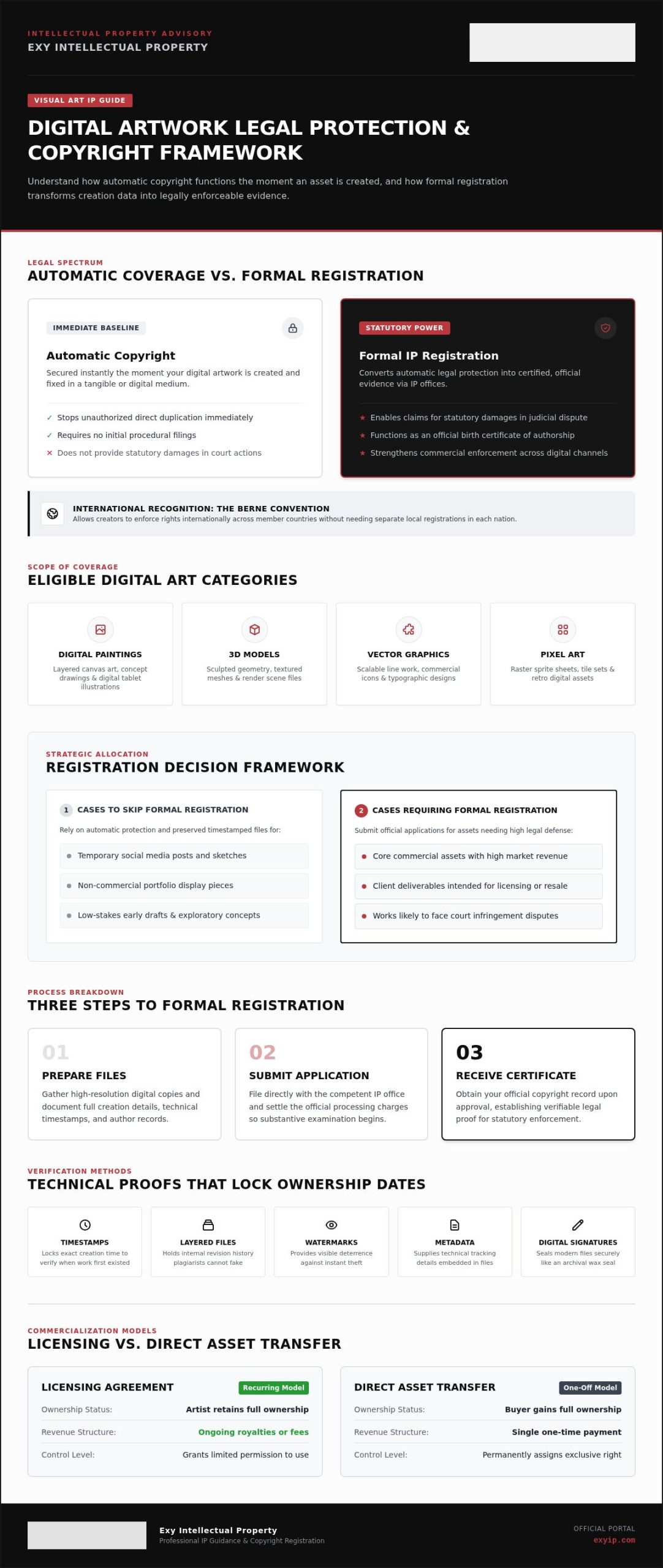
Digital artwork receives automatic legal protection (intellectual property) the moment it is created and fixed in a tangible or digital medium. Formal registration strengthens your legal position, allowing creators to claim statutory damages and prove ownership efficiently. Securing your creative assets early prevents unauthorized distribution across digital platforms.
Key Takeaways: You receive automatic copyright protection the moment you save your digital art file, though formal registration is required to claim statutory damages in court.
- Secure 100% automatic legal protection for your digital paintings, 3D models, and vector graphics upon creation.
- Skip formal registration when creating temporary social media sketches, non-commercial portfolio pieces, or low-stakes drafts.
- Register core commercial assets through official IP offices to transform automatic rights into enforceable evidence.
- The Berne Convention allows you to enforce your rights internationally across member countries without separate local registrations.
Automatic rights that fit how you create digital art
You secure legal protection the moment your creation is fixed in a digital file you can store and retrieve.
That immediate right stops others from copying your file without permission. How you act next depends on what the work is for:
- Temporary social posts or rough portfolio sketches: rely on automatic protection and keep timestamped source files.
- Client deliverables you still want to resell or license later: grant a permission to use (license) with clear limits, and keep ownership.
- Core commercial pieces you may need to enforce in court: add formal registration so you can prove ownership and pursue statutory damages efficiently.
Storing original project files with timestamped layers creates clear proof of creation. Registering your work supplies strong legal backing if a dispute reaches court. Granting a permission to use lets you sell artwork while keeping your exclusive right. Defining clear terms prevents clients from altering your designs or reselling them without payment, which protects your income.
Which visual works already receive copyright cover
Copyright safeguards original digital art as soon as you fix it in a medium you can store, copy, or display, including a saved digital file.
When you draw an illustration on a tablet and save it, legal protection secures your creative expression. Digital paintings, 3D models, vector graphics, and pixel art all qualify for this automatic coverage. Registration is optional, yet official proof helps when you enforce your exclusive right against online copying. You hold ownership right away; no complicated procedure is required to begin. Professional guidance from Exy Intellectual Property helps you manage full ownership rights. Applying a visible signature or digital watermark remains a practical deterrent against unauthorized copying.
Three steps that turn automatic rights into enforceable proof
Formal registration turns automatic legal protection into verifiable evidence you can use in enforcement.
Digital creators who need to defend work against unauthorized copying secure their exclusive right through official channels. Reviewing famous copyright cases shows how documentation shapes dispute outcomes.
Here is how you secure a formal registration:
- Prepare files: Gather high-resolution digital copies and document creation details.
- Submit application: File with the competent IP office and settle the official processing charges so examination can begin.
- Receive certificate: Obtain your official record upon approval.
An overlooked tactic is preserving original design files with time-stamped metadata to back up your application from day one. Registration functions as an official birth certificate for your artwork, which supports commercial enforcement when you need it.
Technical proofs that lock your ownership date in place
Timestamps lock your digital art creation dates so you can show when the work first existed.
Storing raw source files alongside embedded watermarks creates verifiable evidence against unauthorized copying. Digital signatures seal modern files in a way analogous to a wax seal on paper. Metadata supplies tracking details, and original project files hold internal revision history that casual plagiarists cannot fake easily. Watermarks deter instant theft.
Documented proof of creation supports strong legal protection. Metadata establishes technical timelines; formal legal registration strengthens your exclusive right in court. Obtaining official copyright registration confirms your authorship on the record. Archive initial sketch files immediately, and preserve layered documents as solid proof. Technical tools safeguard your files; proper legal filing makes ownership rights enforceable.
When licensing earns more than selling the file outright
Licensing your digital art keeps your legal protection while granting only limited rights to buyers; a direct asset transfer permanently assigns your exclusive right to someone else.
Retaining ownership supports long-term revenue. Selling the asset ends future control.
| Rights Model | Ownership Status | Revenue Type |
|---|---|---|
| Licensing Agreement | Artist retains ownership | Ongoing royalties or fees |
| Direct Asset Transfer | Buyer gains full ownership | Single one-time payment |
Your exclusive right lets you decide who may use the work commercially and on what terms. Giving permission to use is closer to renting access, whereas transferring assets hands over the whole property. Choosing licensing suits creators who want recurring creative income.
How to budget filing fees without overspending
Registration fees and timelines should match what you actually plan to enforce, so you avoid paying for filings you will not use.
Scheduling filings strategically lowers initial expenses and preserves priority dates in multiple countries. Overseas filings often add administrative expenses that push totals up quickly; planning early limits sudden financial stress. Ask for a custom cost estimate so you can map precise filing fees for your brand assets.
For longer-term security, formal registration anchors your exclusive right over the works you choose to protect. Managing international applications benefits from experienced guidance so you avoid costly procedural delays. Among Exy Intellectual Property’s Google reviews, Hong (5★) wrote:
Would like to praise YeongBoon and Wai Nee for their excellent service, will be engaging them again for further overseas trademark applications 👍🏻"
That path (overseas filing needs, specialist handling, repeat engagement) shows how skilled IP support keeps cross-border applications on track for your digital assets. Reach out when you want filing costs scoped to the works that justify protection.
Three cases where you can skip formal registration
Official registration is not mandatory for every creative piece you produce.
Automatic legal protection begins when you create original digital art in a fixed form. Skipping formal registration fits temporary social media sketches, non-commercial portfolio pieces, and quick client drafts. Paying for full registration on a disposable rough concept is poor fit when you only need to share an idea once. Registration adds little when the art has a short life or low commercial value. Saving time and money on low-stakes images lets you focus resources on core commercial assets. If you only share casual creative work online, automatic creator rights already cover basic protection. Advisers at the firm can help you identify which valuable creations justify full filing.
How treaties help you enforce rights across borders
Cross-border legal protection enforcement draws on international treaties such as the Berne Convention, which extends protection for your digital art across member countries without a separate local registration in each one.
Proving infringement in different jurisdictions depends on a clear paper trail: original creation dates, file metadata, and proof of public display. When AI models scrape your work without a permission to use, proving unauthorized training means showing substantial similarity between your output and the generated images. Enforcement costs vary by territory, so request a personalized quote from legal specialists before you start foreign actions. Exy Intellectual Property helps creators pursue global takedown notices; international copyright treaties give independent creators valid legal options worldwide when foreign misuse appears.
Frequently asked questions
What is digital art?
How is digital art protected by copyright?
Digital art receives legal protection automatically as soon as you record the file in a fixed medium. Your exclusive right covers copying, displaying, or modifying that original file. Specialists can assist you in asserting these rights against unauthorized parties.
What legal steps can artists take to strengthen protection?
You can register your artwork with official registries and add watermarks or metadata to your files. A written permission to use for clients sets clear limits on reuse. Structured agreements keep those limits enforceable.
What are the differences between digital art and crypto‑art?
Owning a token does not automatically grant you copyright ownership of the underlying image.
When does copyright protection begin for visual art?
Copyright begins the instant you create the artwork and fix it in a storable form. You do not need to register the file for that basic protection; it arises automatically.
Protecting Your Work
The same choices run through this guide: rely on automatic rights for low-stakes work, register the pieces you may need to enforce, and license when you want income without giving up ownership.
Early registration stops unauthorized copies on the works that matter commercially. A permission to use lets you monetize your portfolio while you keep the exclusive right over original designs. Strategic enforcement and clear rights management keep digital assets usable across online platforms. For guidance tailored to your portfolio, contact the advisers who help you defend those rights, and request a personalized quote when you are ready to secure the next set of creative work. IP protection Archives, ExyIp