


The first intellectual property right your startup pursues may not be the one that matters most. In Malaysia, the better question is what your business needs to protect next, and why. This intellectual property for startups guide helps founders move beyond collecting registrations and make decisions around business milestones.
Your ideas, brand, product design, software or creative content may hold value. The challenge is identifying which assets may qualify for protection, deciding what deserves attention while you build the business, and knowing what safeguards to consider before sharing an innovation with investors or partners.
This guide explains how to identify the intellectual property your startup may own or create, prioritise protection according to your goals and exposure, and understand how rights can support licensing, partnerships and commercialisation. It also introduces the main protection routes available in Malaysia, including trademarks, patents, industrial designs and copyright. The aim is a practical framework: protect what supports your next milestone, then build from there.
Key Takeaways
- Use this intellectual property for startups guide to map your brand, inventions, product appearance and creative work to possible protection options.
- Compare trademarks, patents, industrial designs and copyright by the type of asset and the business purpose it serves.
- Prioritise protection by assessing each asset’s business importance, exposure, intended markets and plans for disclosure or partnership.
- Before launch or collaboration, record who contributed to each asset, what permissions apply and how you intend to use it commercially.
- As your startup grows, consider how intellectual property may support licensing, partnerships and entry into new markets.
What Does Intellectual Property Mean for a Startup in Malaysia?
Intellectual property means legal rights that protect creations of the mind, such as inventions, designs and artistic works. For a founder, the key distinction is simple: an intangible asset is something your business creates or owns; intellectual property protection is a legal right that may apply to that asset. A brand name, technical solution, product appearance and original content are different assets, and each may raise different protection questions. One right does not cover everything.
This overview of intellectual property (IP) introduces the main categories. The right fit for your startup depends on the asset, your commercial plans and the rules that apply in Malaysia and any markets you intend to enter.
Which Startup Assets May Involve Intellectual Property?
Build an inventory before deciding what to protect. Include assets already in use and work still in development, such as:
- Business, product or service names, and logos
- Product concepts, technical solutions and inventions
- Product appearance, including visual features and design details
- Original materials such as software, website copy, graphics, photographs or other content
An early idea and a developed or recorded expression of it may raise different questions. Describe each asset in practical terms: what has been built, written, drawn or tested? Then check who contributed. Founders, employees, contractors and collaborators may all have a role. Third-party materials may also come with permissions or restrictions that need review.
Why Should Founders Consider Intellectual Property Early?
Early awareness helps you make informed choices before a launch, product development milestone or partnership. For example, a presentation or collaboration may involve sharing technical details, creative materials or a proposed brand identity. Knowing what you plan to disclose, to whom and for what purpose gives you a better basis for deciding what to review first.
Timing matters, but the answer depends on the asset and applicable rules. Before sharing an innovation publicly, check whether disclosure could affect the protection options available. Take similar care when setting up ownership arrangements or using third-party content. Don’t assume every startup needs every registration, or that registration alone prevents every dispute. A practical intellectual property for startups guide starts with the assets that matter to your business, then checks suitable protection against your plans and exposure.
How Do Trademarks, Patents, Designs, and Copyright Differ?
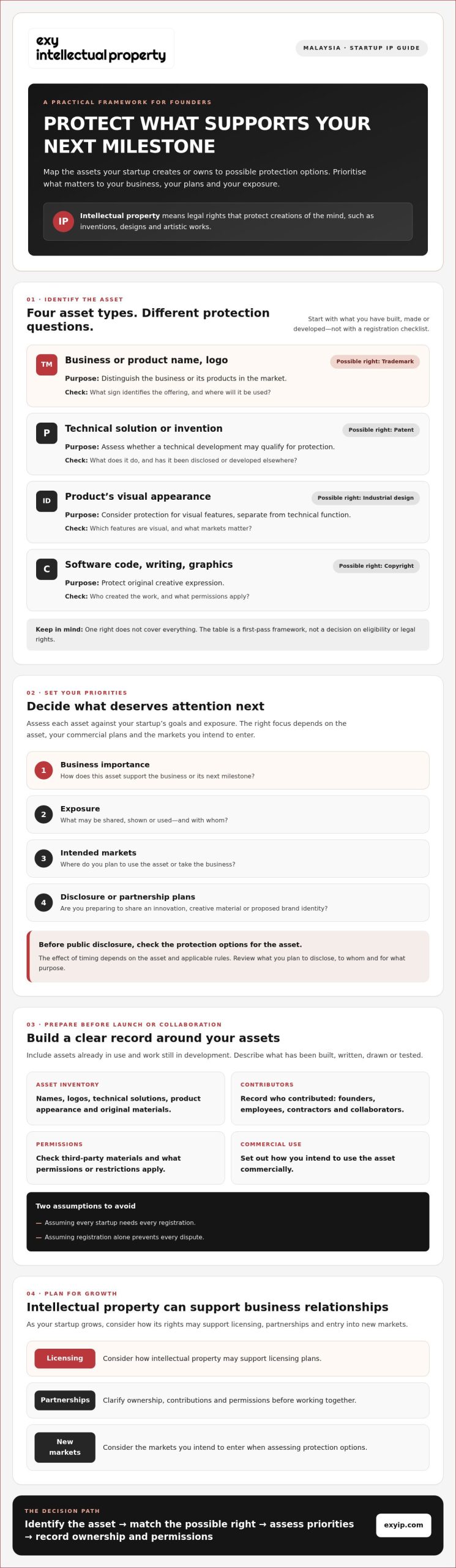
Start with the asset, then ask what business purpose protection could serve. A name, a technical solution, a product’s appearance and original content are not interchangeable, so they may call for different forms of intellectual property protection. The table provides a first-pass framework, not a decision on eligibility or legal rights.
| Asset | Possible right | Business purpose | Questions to check |
|---|---|---|---|
| Business or product name, logo | Trademark | Distinguish the business or its products in the market | What sign identifies the offering, and where will it be used? |
| Technical solution or invention | Patent | Assess whether a technical development may qualify for protection | What does it do, and has it been disclosed or developed elsewhere? |
| Product’s visual appearance | Industrial design | Consider protection for visual features, separate from technical function | Which features are visual, and what markets matter? |
| Software code, written content, graphics | Copyright | Protect original creative expression | Who created the work, and what permissions apply? |
Which Right May Relate to Your Startup’s Brand or Product?
A trademark is a sign that distinguishes a business or its products from others. Names and logos usually raise trademark questions, not questions about protecting an invention. For a Malaysia-focused overview, see Malaysia trademark registration guidance.
A technical solution may warrant patent assessment, subject to applicable requirements and professional review. Learn more in this strategic patent filing guide. A product’s visual appearance raises a different question: industrial design protection generally concerns appearance, not how the product works. See industrial design protection guidance for more detail.
MyIPO VA1-2026 Guidelines & SME Subsidies
In 2026, MyIPO enforced its updated Guidelines of Trademark 2019 (VA1-2026), raising examination scrutiny on non-distinctive or overly broad specifications. Startups should select Nice Classification classes with precision. Additionally, qualifying Malaysian tech startups and SMEs (with annual turnover under RM 500,000) can tap into SME Corp Malaysia IP filing subsidies to offset official MyIPO registration fees.
How Can Copyright and Confidential Information Fit In?
Copyright concerns the expression of an idea, not ownership of an abstract idea itself. Software code, written materials and graphics are examples of original creative work that may raise copyright questions. Confidential information is separate: it is a management concern, not a registered right. Consider who can access sensitive material and how it is shared. The U.S. Commercial Guide to IP in Malaysia offers country-specific background. Check how current rules apply to your circumstances.
This intellectual property for startups guide is a starting point, not a substitute for assessing your specific assets. If you need help matching an asset to a suitable route, Exy Intellectual Property’s advisory services may be a relevant next step.
How Should a Startup Prioritise Intellectual Property Protection?
Prioritise around business milestones, not a target number of registrations. A useful sequence is to inventory your assets, identify which ones matter most to the business, assess their exposure, then choose a next action. That action might be professional review, clarifying ownership, documenting the asset or exploring a suitable protection route.
Decision rule: Give first attention to assets that are both commercially important and exposed to loss, copying or uncertainty. An asset central to your product or brand, soon to be disclosed or needed for a planned partnership, may deserve earlier review than a less-used asset with no near-term commercial role. This is a prioritisation aid, not a legal test.
What Should Founders Assess Before Choosing a Protection Route?
Look at each asset through five business questions: What purpose does it serve? Which markets matter? Is disclosure planned? Is ownership clear? Could a future partner, investor or licensee need access to it?
Check who created the asset and review relevant agreements and ownership records. Is it central to the product, brand recognition or planned expansion? Note upcoming demonstrations, pitches, public launches and collaborations. These events can affect what you share and when, so flag them for timely professional review. The right response depends on the asset and applicable rules.
How Can You Compare Protection Options Without Guesswork?
Compare each option by its purpose and limits. Registration is not a universal solution, and not every asset needs immediate registration. A startup may have different priorities for a core product name, a technical development and supporting creative materials. Tie each choice to a specific business outcome rather than treating registration as a goal in itself.
Use a simple decision record for each asset:
- Importance: What product, brand recognition or growth plan depends on it?
- Exposure: Who will see or use it, and is disclosure approaching?
- Readiness: Who created it, what evidence exists, and are ownership records clear?
- Markets and partnerships: Where will the business operate, and could a collaborator need permission to use it?
- Open questions: What facts, eligibility points or filing choices need specialist review?
Mark each factor as high, medium or low to compare assets consistently, then revisit priorities as plans change. Record unanswered questions and the business decision each one affects. WIPO’s IP strategy for startups also connects intellectual property planning with investment and growth. This intellectual property for startups guide is a framework, not a substitute for advice where ownership, eligibility or filing strategy is uncertain. For tailored support, Exy Intellectual Property’s advisory services may help founders connect protection choices with business plans.
What IP Steps Can a Startup Take Before Launch or Collaboration?
Before a launch, pitch or partnership, make your intellectual property records useful to the people making business decisions. A clear inventory can show what the startup has created, who contributed, what may belong to someone else and what needs review before it is shared or commercialised.
What Should Be Recorded Before Sharing Work Externally?
Build a record for each significant asset and update it as the product, brand or content develops. A practical checklist includes:
- Asset description: Identify what it is, such as a product concept, technical work, software, logo, design or written material.
- Creation record: Note who contributed, when it was created and where relevant drafts, files or development records are stored.
- Ownership information: Gather relevant agreements, assignments or other records that help clarify who holds rights or responsibilities.
- Sharing history: Record what has already been shown or sent, to whom, when and under what documented terms.
- Third-party materials: Flag software, images, text, data or other materials from outside the startup, and check whether permission or further review may be needed.
- Planned commercial use: Describe how the startup expects to use, distribute, adapt or share the asset.
This record helps reveal gaps before external activity. A public launch, demonstration or pitch may involve disclosure, while a collaboration may give another party access to sensitive work. Timing and consequences depend on the asset and applicable rules, so seek qualified advice before sharing material if protection or ownership is uncertain.
How Can Founders Prepare for Hiring and Collaboration?
Internal development and externally contributed work can involve different people, records and expectations. Don’t assume the startup owns everything created for its project. Review relevant written agreements with employees, contractors, suppliers and collaborators. Ask a qualified adviser to clarify ownership questions when the documents or facts are unclear.
Before work begins or is shared, record who can access the material, confidentiality expectations, permitted uses and who approves external disclosure or changes. For a partner, also clarify how each party may use the work and what happens to shared materials when the project ends. These are issues to document and review, not assumptions about legal defaults.
Use this intellectual property for startups guide checklist as a preparation tool, then have uncertain ownership, permissions or disclosure plans reviewed before a significant launch or collaboration. Request an intellectual property priorities review to connect your records and next steps with your business plans.
How Can Intellectual Property Support a Startup as It Grows?
Intellectual property can inform business decisions beyond initial protection. As a startup develops, its rights and records may help shape partnership discussions, licensing opportunities, market entry plans and commercialisation. The value comes from connecting each asset to a clear business objective, not from collecting registrations without a purpose.
For example, a startup might explore allowing another business to use its brand in a defined market, or grant permission to use a technical solution as part of a commercial partnership. A licence grants permission to use intellectual property under agreed terms. It does not automatically transfer ownership. The agreement should reflect the parties’ intended uses and commercial objectives, with details reviewed for the specific arrangement.
When Might Licensing or Commercialisation Become Relevant?
Licensing may be worth considering when another business can help bring a product, technology, brand or creative asset to a market the startup cannot serve alone. Before discussions, identify what may be licensed, who may use it, for what purpose and in which markets. Clear permissions can help the parties assess fit and responsibilities. Commercialisation planning can also connect an asset to a wider route to market, such as a partnership or expansion plan.
Protection and commercial success are different things. Legal rights may support a business plan and help define what others are permitted to use, but they don’t guarantee demand, revenue or a successful partnership. Revisit the plan as the product, target customers and markets change.
Leveraging IP Assets for Bank Financing
Beyond equity fundraising, registered patents and trademarks can serve as collateral under Malaysia’s WIPO-MIDF IP Financing Pilot. To pledge IP as security for non-dilutive credit, startups must register a corporate charge with the Companies Commission of Malaysia (SSM) under Section 352 of the Companies Act 2016, alongside recording the security interest at MyIPO.
When Should a Founder Seek Specialist IP Advice?
Seek advice if ownership is unclear, a public disclosure is planned or a key asset could affect the startup’s growth. A specialist can help assess which protection route may fit, what information needs review and how a filing or licensing decision relates to business goals. Exy Intellectual Property supports businesses with trademark and patent registration, patent novelty searches and drafting, industrial design registration, licensing agreements and commercialisation strategy.
As investment, collaboration or market expansion approaches, founders may also want to understand how intellectual property fits into the business’s wider value. Explore intellectual property valuation guidance to consider how valuation can inform business planning.
This intellectual property for startups guide is a starting point for making choices around assets and growth. To discuss registration, strategy, licensing or valuation in the context of your business plans, speak with Exy Intellectual Property about your startup’s IP needs.
Apply This Intellectual Property for Startups Guide to Your Next Milestone
The practical lesson from this intellectual property for startups guide is to identify what your business creates, match each asset to a suitable protection route, and prioritise according to commercial importance, exposure and growth plans. Keep ownership records clear and review disclosure before launches or collaborations. Registration can support a business plan, but it doesn’t guarantee commercial success or prevent every dispute.
As your startup grows, intellectual property may also help shape licensing, partnerships and commercialisation. The right next step depends on your assets, intended markets and business objectives. Exy supports businesses with trademark, patent and industrial design registration, patent novelty searches and drafting, licensing, and intellectual property strategy.
Discuss your startup’s intellectual property priorities with Exy to consider how protection and commercial planning can work together. With a clear plan and the right advice, you can build your business while making informed decisions about the assets that support its future.
Frequently Asked Questions
What intellectual property should a startup protect first?
Start with assets that are important to your business and exposed to disclosure, copying or ownership uncertainty. A name central to customer recognition, a technical development central to the product, or content needed for a launch may deserve early review. This intellectual property for startups guide uses commercial importance and exposure as a starting point, not a fixed rule. Your priorities depend on your goals, records and intended markets.
Can a startup protect an idea before launching a product?
An idea alone may not qualify for the same protection as a developed invention or an expressed creative work. The options depend on what has been created and the applicable rules. Before pitching or publicly demonstrating a technical innovation, consider getting professional advice about disclosure and possible protection. Keep sensitive details confidential where appropriate, and distinguish the underlying concept from records, designs, code or other work already developed.
What is the difference between a trademark and a patent?
A trademark is a sign that distinguishes a business or its products from others, such as a business or product name. A patent concerns a technical invention and is subject to applicable requirements. In practical terms, a name identifies the source of an offering, while a patent assessment considers a technical solution. Protecting a name does not protect the product’s technical function, and patent rights do not automatically protect the brand.
Do startups need to register every form of intellectual property?
No. A startup doesn’t necessarily need to register every asset or pursue every available protection route. The appropriate steps depend on the asset, its commercial role, exposure, ownership and business plans. Some rights may operate differently from registered rights. For example, copyright protection in Malaysia is generally automatic for eligible works, while owners can make a voluntary notification. Consider specialist advice to confirm what applies to your specific work.
How can a startup protect intellectual property created by contractors?
Review the written agreement with each contractor and clarify ownership and permitted use rather than assuming the startup owns all project work. Record the deliverables, contributors, relevant third-party materials, access and any permissions required. Keep copies of agreements and development records with the asset inventory. If the contract is silent or unclear about rights, ask a qualified adviser to review it before relying on the work commercially or sharing it with partners.
Can intellectual property help a startup earn revenue?
Yes. A startup may license a brand, technical asset or creative work to another business under agreed terms, or include intellectual property in a broader commercialisation plan. A licence grants permission to use the asset; it doesn’t automatically transfer ownership. Licensing and partnerships can create commercial opportunities, but protection alone doesn’t guarantee revenue or market success. Define the intended use and business objective, then assess whether the arrangement fits your growth plan.
When should a startup speak with an intellectual property adviser?
Seek advice when ownership is unclear, a public disclosure or partnership is approaching, or an important asset could affect growth. An adviser can help assess registration options, patent searches and drafting, licensing or intellectual property strategy. Exy Intellectual Property provides these services for businesses in Malaysia and globally. Early review can help founders identify unanswered questions and align protection choices with business plans before committing to a course of action.