


What if the first result that resembles your idea isn’t the whole story? If you’re wondering how to check if an invention already exists, finding a similar patent can feel discouraging. But a resemblance alone doesn’t show whether a document describes the same technical features or affects your options for protection.
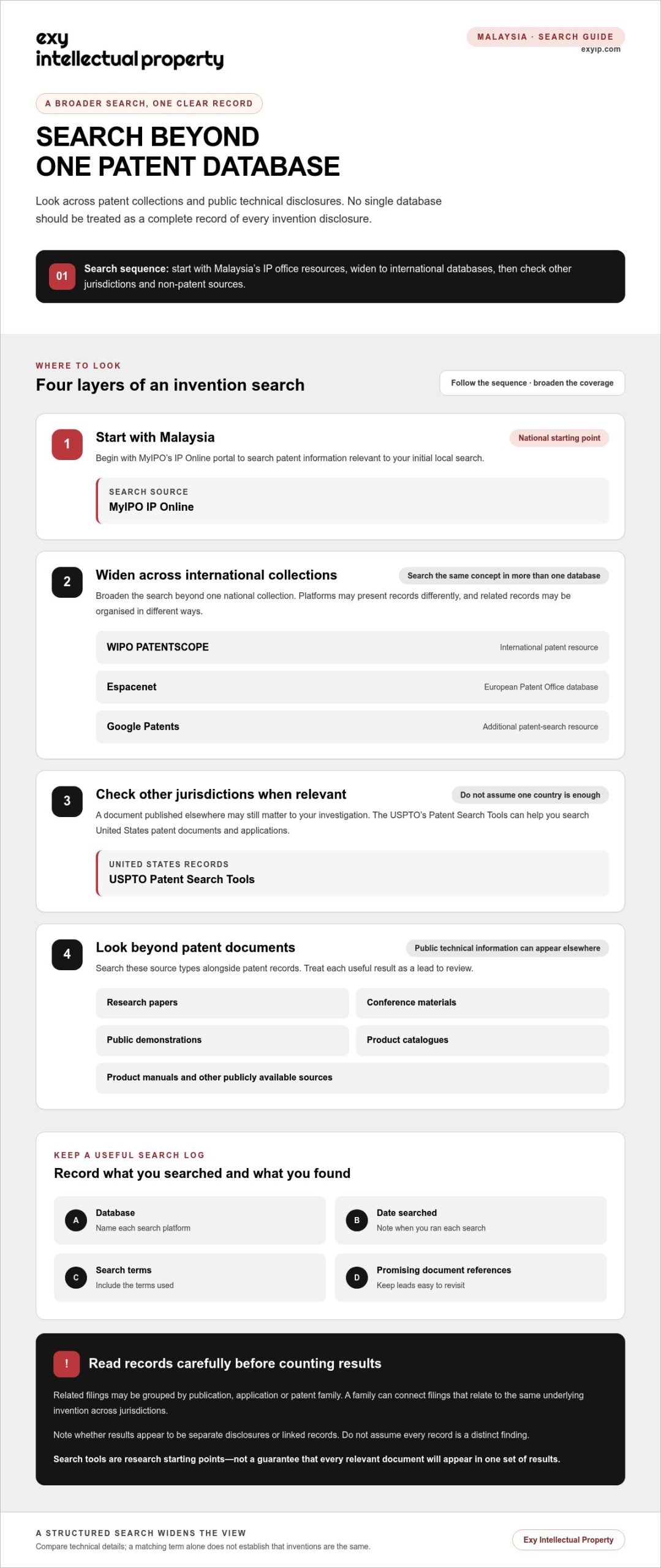
A useful preliminary search goes beyond an exact product name. Search alternative terms, older documents and disclosures outside patent records. In Malaysia, you can begin with MyIPO’s IP Online portal, then broaden your search using WIPO PATENTSCOPE, the European Patent Office’s Espacenet and Google Patents.
This guide explains how to structure those searches, compare results with your invention and keep a clear record of what you find. You’ll also learn why a similar result isn’t always decisive, and when a professional novelty search can help interpret technical similarities and inform your patent strategy. Exy Intellectual Property provides patent novelty searches to support your next steps, though a search cannot guarantee a particular outcome.
Key Takeaways
- Start by describing the technical problem your invention addresses and how its solution works, then build search terms from those details.
- A practical workflow for how to check if an invention already exists includes refining terms, reviewing results and recording what you find.
- Assess documents against your invention’s technical features, not just matching titles or keywords.
- Record similarities, differences, document type, jurisdiction and status to make results easier to assess.
- Consider professional novelty analysis when terminology is complex or close results are difficult to interpret. It can inform patent strategy but cannot guarantee a grant.
What Does It Mean to Check Whether an Invention Already Exists?
A preliminary invention search is an organised first look for earlier documents or other disclosures that may describe your invention’s technical features. It helps you find material that deserves closer review. It does not decide whether your invention qualifies for patent protection.
A preliminary search locates potentially relevant disclosures; a professional opinion assesses their significance against the invention and the applicable patent criteria. A search result is evidence to examine, not a final answer about your rights or commercial plans.
Existing, similar, and patented are not interchangeable
An idea can be familiar without a particular technical solution having been described. For example, the general aim of reducing water use may be well known, while a specific valve arrangement or control method could be described in a document. Search for how the invention works, not only its broad purpose or product name.
Technical features may still be relevant when a document uses different wording or shows the technology in a different product form. A mechanism described for industrial equipment, for instance, could warrant review if your concept uses a similar mechanism in a household device. That does not automatically mean the inventions are the same. The details and how they relate need careful comparison.
Prior art is a common term for information made available before a relevant date that may be considered when assessing an invention. Patent documents are one possible source. A published patent application is not the same as a granted patent: publication makes the document available to read, while grant is a separate status. Neither the word “patent” in a search result nor a document’s publication alone establishes that it is currently enforceable. Status, jurisdiction and the document’s contents all matter.
A product does not need to appear in shops for its technology to have been disclosed. It may be described in a patent document, a technical paper, a product manual or another public source. A product’s absence from the market is not proof that no earlier disclosure exists.
What a preliminary search can and cannot tell you
Search results help you identify documents that may warrant closer review and spot features that appear relevant. But results depend on the terms used, the databases searched and how documents are interpreted. A search for a product name alone may miss technical descriptions that use different terminology, while a broad search may return documents that share a word but not the underlying mechanism.
Finding no exact match is not proof of novelty, and it does not guarantee patent protection. The phrase how to check if an invention already exists describes a useful first step, not a shortcut to a definitive decision. Record promising results and compare their technical details before drawing conclusions.
An initial novelty inquiry is not the same as legal advice on patentability or freedom to operate. Patentability concerns whether an invention may qualify for protection. Freedom to operate concerns whether a planned product or activity could infringe rights that apply in a particular jurisdiction. A preliminary search can help shape questions for further analysis, but it does not settle either issue.
Where to Search for Existing Inventions and Patent Documents
No single database should be treated as a complete record of every invention disclosure. Patent collections differ in their coverage and the records they make available, and relevant information may also sit outside patent systems. For a comprehensive invention search, start with national IP office databases, then widen the search to international resources such as Espacenet, Google Patents and WIPO PATENTSCOPE.
These tools are research starting points, not a guarantee that every relevant document will appear in one set of results. The United States Patent and Trademark Office’s USPTO Patent Search Tools can help you search US patent documents and applications. A document published elsewhere may still matter to your investigation, so don’t limit your review to a single jurisdiction.
Search patent databases across jurisdictions
Run searches for the same technical concept in more than one database. Each platform may present records differently, and related documents can be organised by publication, application or patent family. A family can connect filings that relate to the same underlying invention across jurisdictions. Note whether results appear to be separate disclosures or linked records before counting them as distinct findings.
Keep a simple search log with each database, the date searched, the terms used and promising document references. This makes your work easier to revisit and helps you identify gaps when refining the search.
Look beyond patent documents
Earlier technical information may appear in research papers, conference materials, public demonstrations, product catalogues, manuals or other publicly available sources. Search these alongside patent records. Try synonyms, alternate technical names and phrases describing the problem the invention solves, since a disclosure may use different language from your working name.
For example, if you are investigating a device that controls water flow, search not only its product name but also terms for its components, operating method and intended function. Treat each source as a lead to review, rather than assuming a search result proves that the technology is identical or protected.
For each useful lead, capture the source, title, publication or application details where available, relevant passage and why it caught your attention. Avoid assuming that a search tool covers every country, document type or form of disclosure. Search interfaces and records can change, so documenting when and where you searched gives later reviewers a clearer picture of the work completed.
Combining database searches with non-patent sources gives you a more informed starting point than relying on one tool alone. If technical documents are difficult to compare, Exy Intellectual Property’s patent novelty search support can help assess technical similarities and inform your next steps.
How to Judge Whether a Search Result Is Relevant
A search result deserves attention when its technical teaching may relate to how your invention works. A shared title or keyword is only a lead. A document about a “water sensor,” for example, may describe a different sensing method and have little technical overlap with your concept. Conversely, a document with an unfamiliar title may describe a mechanism worth examining.
A keyword match points to a document; a technically relevant disclosure may describe features or relationships that matter to your invention. Use that distinction to guide your review, rather than treating every result as a match or dismissing a document based on its title.
Compare the technical teaching, not just the wording
Break your invention into searchable parts: its components, what each part does, the materials involved and how the parts interact. Compare those features with the document’s description and drawings. Make plain-language notes about what appears to match, what differs and what you cannot yet determine. If a feature is unclear, flag it for closer review instead of ruling the document out.
For instance, two devices may both regulate water flow but use different valve structures or control methods. The shared function is a reason to inspect the document, not a conclusion that the technical solutions are the same.
Comparison point: Record what to check and what to note.
Matching features: List components, functions, materials or relationships that appear in both.
Different features: Note what your invention includes that the document does not appear to describe.
Document type: Identify whether you are reviewing a patent application, a granted patent or another kind of publication.
Jurisdiction: Record the country or countries connected with the document.
Status: Note the status shown in the database and when you viewed it.
Read document details with care
Titles and abstracts help you decide what to open, but they are not a substitute for reading the technical description and claims. The description may explain how an example works; the claims set out the subject matter for which protection is sought or has been granted. Read the relevant passages in context, and avoid assuming a single shared feature establishes the scope or effect of a patent.
Capture the publication reference, applicant or owner, relevant dates and any available status information. Related documents may belong to the same patent family, with records connected across jurisdictions. Keep the individual document details alongside any family information, so you can tell which record you actually reviewed.
A database status is a useful reference point, not a complete legal assessment of scope or enforceability. It may not answer whether a document is relevant to your invention, what rights apply in a particular jurisdiction or whether a planned product can be commercialized. If the technical comparison remains uncertain, record the question rather than treating a preliminary assessment as a final decision.
For how to check if an invention already exists, a disciplined comparison helps separate superficial similarities from disclosures that merit expert attention. Your notes also give a patent novelty search professional a clearer starting point for examining technical relationships and informing your next steps.
How to Check if an Invention Already Exists: A Search Workflow
A repeatable search is easier to manage when you begin with the technology, not a product name. This workflow takes you from a clear description to a set of recorded documents for closer review. Treat each result as a lead to assess, not a final decision about patentability.
Build and refine a search strategy
Before opening a database, write down the problem your invention addresses and how its technical solution works. List distinctive components, their functions, how they connect, and any alternative names. This gives you more useful search options than relying on a working name, which may not appear in earlier documents.
- Define the invention. Describe the technical problem and the mechanism or process that addresses it. Note what each part does and how the parts work together.
- Identify search terms. Create a short list of component names, functions, materials, synonyms and broader descriptions of the problem. If a device uses a “folding support,” for example, consider related terms such as “hinged brace” or “collapsible frame” where they accurately describe the feature.
- Search across relevant sources. Try combinations of the terms in patent databases and other sources identified for your search. Search both specific phrases and broader technical concepts, since documents may describe a feature without using your chosen wording.
- Refine the queries. If results are too broad, add a distinctive component or function. If they are too narrow, remove a term or replace it with a synonym. You can also use an International Patent Classification (IPC) term as another discovery route when you can identify a relevant classification. Treat it as a way to find more material, not as a substitute for keyword searches.
- Review promising results. Open documents that appear to describe related technology. Compare their technical details with your notes, and flag unclear points rather than deciding from a title or abstract alone.
- Document the search. Record the queries, databases and dates, along with relevant documents and your observations. This creates a clear trail for later review.
Keep useful records of what you find
For each potentially relevant document, save its identifier, title, publication details, applicant or owner where shown, and the source database. Note which features appear similar, which seem different, and which passages or drawings prompted your interest. Keep related family documents identifiable as separate records, even when they are connected.
Use neutral language in your notes. “Describes a similar locking function” is more useful than “blocks my patent,” which makes a conclusion the search alone cannot support. Mark unresolved questions, such as whether a feature has the same technical role or how a document’s claims relate to its description. A record of what you searched and found is also a practical starting point for expert review.
If you want technical similarities assessed as part of a professional novelty search, request a patent novelty search from Exy Intellectual Property.
When to Move from DIY to Professional Novelty Analysis
A preliminary search can help you identify documents worth investigating. Specialist review may be useful when you’re unsure how to compare those documents with your invention or what their details mean. Your notes and findings can give an expert a clear starting point.
Signs that an initial search needs closer review
Consider a closer review if you find several documents describing similar technical features but can’t tell whether they teach the same solution or only share a broad function. Specialist attention may also help when terminology is unfamiliar, classifications are difficult to interpret, related patent family documents span jurisdictions, or displayed status information leaves questions. These are signs to investigate, not proof that your invention cannot be protected.
Interpretation can be demanding because a technical description, its claims and its drawings may each present different details. A specialist can assess how those parts relate to your invention’s features, helping distinguish a superficial resemblance from a document that merits closer analysis. This can be particularly useful when small differences in component arrangement or operation may matter.
Keep your search record. Include the databases and queries you used, the date of each search, relevant document identifiers, and your notes on similarities and differences. Add questions you couldn’t resolve, such as whether two terms describe the same component or whether a document’s claims cover the feature you are assessing. This organised record helps focus the review on the uncertainties that matter.
Turn search findings into an informed IP strategy
A professional novelty search takes the inquiry further by examining potentially relevant disclosures in relation to the technical details of your invention. Its findings can inform decisions about next steps, including whether patent drafting or filing should be considered. It is a deeper analysis, not a guarantee that a patent will be granted or that a particular filing strategy will succeed.
Exy Intellectual Property provides patent novelty searches, patent drafting and patent filing support. These are connected but distinct parts of the process: search findings can inform drafting, while filing support relates to pursuing an application. The purpose of reviewing results is to make better-informed decisions, not to treat a search as a promise of protection.
If close results or technical questions are difficult to assess, discuss your invention and search findings with Exy Intellectual Property. A professional review can help clarify the issues and inform your next steps, without assuming a particular outcome.
Turn Your Search into a Confident Next Step
Knowing how to check if an invention already exists is a practical starting point, but your next decision should reflect what the search can and cannot establish. Treat unresolved questions as prompts for further analysis, not as reasons to abandon a promising idea or assume protection is assured. A considered next step can help you decide how to develop and protect the invention with a clearer view of the information available.
Exy Intellectual Property provides IP advisory services in Malaysia and globally, supporting informed decisions about intellectual property as your plans take shape. Where a search needs technical interpretation, a specialist review can help you understand the issues and consider suitable options without promising a particular patent outcome.
Discuss your invention and search findings with Exy Intellectual Property to explore a practical path forward. Share the search record and the technical questions you want reviewed to make the discussion focused and useful.
Frequently Asked Questions
Can a Google search prove that my invention is new?
No. A Google search can surface publicly accessible pages, product listings, technical articles and other useful leads, but it can’t establish that no relevant disclosure exists. Search engines may not index every source, and technical documents may use terms you haven’t tried. Use web results to find leads, then assess relevant material in patent records and other sources before drawing conclusions about novelty.
Can an invention exist even if it has never been patented?
Yes. A technical solution may have been described in a research paper, product manual, catalogue or public demonstration without a patent being granted. For example, a device could be shown at an industry event or explained in a published study. Such material may be relevant to an invention search, so look beyond patent databases and note where and when you find each disclosure.
Are unpublished patent applications visible in patent searches?
Usually, no. An application that has not been made public generally won’t appear in public patent search results, so a database search cannot reveal every application that may exist. Published records can also take time to appear across different search tools. Treat a clear search result as a snapshot of accessible information, not confirmation that no earlier application exists.
Should I tell people about my invention before checking for existing patents?
Be cautious about public disclosure before getting advice on your protection options. A presentation, online post or product demonstration may create questions about how the disclosure affects a later application. Malaysia has a grace period for certain public disclosures, but it shouldn’t be treated as a blanket safeguard for every situation. Keep technical details confidential while you assess next steps, especially before public promotion.
Does finding a similar patent mean I cannot protect my invention?
No, not automatically. A document may share a component or broad purpose without describing the same technical solution. The distinction can depend on the details of the invention and the document’s claims, so compare the features rather than relying on its title or abstract. If a result appears close, Exy Intellectual Property can assess its relevance before you decide whether to change direction or pursue protection.
Can I search for existing inventions in Malaysia using international databases?
Yes. For a search connected to Malaysia, you can combine MyIPO’s public search portal with international resources such as WIPO PATENTSCOPE, Espacenet and Google Patents. These can help locate documents published in other countries that may be relevant to your technical review. Search results and record details can differ between platforms, so note the source and verify important document information before relying on it.